×
Request Free Sample ×

Kindly complete the form below to receive a free sample of this Report

* Please use a valid business email

Leading companies partner with us for data-driven Insights

clients tt-cursor
Hero Background

Global Heavy Construction Equipment Market

ID: MRFR/PCM/0210-CR
132 Pages
Pradeep Nandi
March 2024

Heavy Construction Equipment Market Research Report Information by Type (Earthmoving Equipment, Material Handling, Heavy Vehicle, Crushers, Others), by Application (Excavation & Demolition, Material Handling, Heavy Lifting, Recycling & Waste Management, Tunneling), by End Use(Metal, Mineral, Coal, Aggregate, Infrastructure, Real Estate, Oil & Gas, Mining, Forestry & Agriculture and Others),–Market Forecast Till 2035

Share:
Download PDF ×

We do not share your information with anyone. However, we may send you emails based on your report interest from time to time. You may contact us at any time to opt-out.

Global Heavy Construction Equipment Market Infographic
Purchase Options

Global Heavy Construction Equipment Market Summary

As per MRFR analysis, The Global Heavy Construction Equipment Size was estimated at 206708.4 USD Million in 2024. The heavy construction equipment industry is projected to grow from 216465.54 USD Million in 2025 to 343316.86 USD Million by 2035, exhibiting a compound annual growth rate (CAGR) of 4.72 during the forecast period 2025 - 2035.

Key Market Trends & Highlights

The Global Heavy Construction Equipment is poised for substantial growth driven by technological advancements and sustainability initiatives.

  • North America remains the largest market for heavy construction equipment, reflecting robust infrastructure development.
  • Asia-Pacific is recognized as the fastest-growing region, propelled by rapid urbanization and economic expansion.
  • Excavation equipment, particularly excavators, dominates the market, while loaders are emerging as the fastest-growing segment.
  • Infrastructure development initiatives and technological innovations are key drivers fueling market growth.

Market Size & Forecast

2024 Market Size 206708.4 (USD Million)
2035 Market Size 343316.86 (USD Million)
CAGR (2025 - 2035) 4.72%

Major Players

Caterpillar (US), Komatsu (JP), Hitachi Construction Machinery (JP), Volvo Construction Equipment (SE), Liebherr (DE), Doosan Infracore (KR), JCB (GB), CASE Construction Equipment (US), Terex Corporation (US)

Global Heavy Construction Equipment Market Trends

The Global Heavy Construction Equipment is currently experiencing a dynamic evolution, driven by various factors that shape its landscape. The increasing demand for infrastructure development, particularly in emerging economies, appears to be a primary catalyst for growth. Governments are investing heavily in transportation networks, urban development, and energy projects, which necessitates the use of advanced machinery. Furthermore, the integration of technology into heavy equipment, such as automation and telematics, seems to enhance operational efficiency and safety, thereby attracting more investments into this sector. As sustainability becomes a focal point, manufacturers are likely to innovate towards eco-friendly solutions, which may redefine market dynamics in the coming years. In addition, the competitive landscape of The Global Heavy Construction Equipment is marked by a blend of established players and new entrants. This competition fosters innovation and drives down costs, benefiting end-users. The trend towards rental services is also gaining traction, as companies seek flexibility and reduced capital expenditure. Overall, the market appears poised for continued growth, with technological advancements and changing consumer preferences shaping its trajectory. Stakeholders must remain vigilant to adapt to these shifts and leverage emerging opportunities for success.

Technological Advancements

The integration of cutting-edge technologies into heavy construction equipment is transforming operational capabilities. Innovations such as automation, artificial intelligence, and telematics are enhancing efficiency and safety on job sites. These advancements not only streamline processes but also reduce operational costs, making them attractive to contractors and construction firms.

Sustainability Initiatives

There is a growing emphasis on sustainability within The Global Heavy Construction Equipment. Manufacturers are increasingly focusing on developing eco-friendly machinery that minimizes environmental impact. This trend is driven by regulatory pressures and a societal shift towards greener practices, prompting companies to adopt sustainable solutions in their operations.

Shift Towards Rental Services

The rental model for heavy construction equipment is gaining popularity among contractors and construction firms. This shift allows companies to access the latest machinery without the burden of ownership costs. The flexibility offered by rental services is appealing, particularly in a market characterized by fluctuating demand and project-based work.

Global Heavy Construction Equipment Market Drivers

Urbanization Trends

Rapid urbanization is a significant driver of the Global Heavy Construction Equipment Market Industry. As populations migrate to urban areas, the demand for residential, commercial, and infrastructure projects escalates. This trend is particularly evident in developing regions, where cities are expanding rapidly to accommodate growing populations. The need for heavy construction equipment, such as concrete mixers and loaders, is likely to increase as urban development projects proliferate. By 2035, the market is expected to reach 342.2 USD Billion, underscoring the impact of urbanization on equipment demand.

Market Growth Projections

The Global Heavy Construction Equipment Market Industry is projected to experience substantial growth over the next decade. With a market value of 206.7 USD Billion in 2024, the industry is expected to expand to 342.2 USD Billion by 2035. This growth trajectory, characterized by a CAGR of 4.69% from 2025 to 2035, reflects the increasing demand for heavy construction equipment driven by infrastructure development, urbanization, and technological advancements. Charts illustrating this growth can provide a visual representation of the market's potential, highlighting key trends and projections.

Technological Advancements

Technological advancements are playing a pivotal role in shaping the Global Heavy Construction Equipment Market Industry. Innovations such as automation, telematics, and electric machinery are enhancing operational efficiency and reducing environmental impact. For example, manufacturers are increasingly integrating IoT technology into their equipment, allowing for real-time monitoring and predictive maintenance. This shift not only improves productivity but also aligns with global sustainability goals. As a result, the market is poised for growth, with a projected CAGR of 4.69% from 2025 to 2035, reflecting the industry's adaptation to these technological changes.

Infrastructure Development Initiatives

The Global Heavy Construction Equipment Market Industry is currently experiencing a surge due to extensive infrastructure development initiatives across various countries. Governments are investing heavily in transportation, energy, and urban development projects, which require advanced heavy construction equipment. For instance, the United States has allocated significant funding for infrastructure improvements, which is expected to drive demand for excavators, bulldozers, and cranes. This trend is reflected in the market's projected value of 206.7 USD Billion in 2024, indicating a robust growth trajectory fueled by these initiatives.

Increased Investment in Renewable Energy

The Global Heavy Construction Equipment Market Industry is witnessing a shift towards increased investment in renewable energy projects. Governments and private sectors are allocating substantial resources to develop wind, solar, and hydroelectric power facilities. This trend necessitates the use of specialized heavy construction equipment for the installation and maintenance of renewable energy infrastructure. As the world moves towards sustainable energy solutions, the demand for heavy machinery tailored for these projects is expected to rise. This shift could significantly impact market dynamics, contributing to the overall growth of the industry.

Regulatory Compliance and Safety Standards

The Global Heavy Construction Equipment Market Industry is influenced by stringent regulatory compliance and safety standards imposed by governments worldwide. These regulations necessitate the use of advanced equipment that meets safety and environmental criteria. For instance, the European Union has established regulations that require construction machinery to adhere to specific emissions standards. Consequently, manufacturers are compelled to innovate and produce cleaner, safer equipment. This focus on compliance not only drives demand for new machinery but also enhances the overall market value, contributing to the industry's growth.

Market Segment Insights

By Application: Excavation (Largest) vs. Material Handling (Fastest-Growing)

The application segment of The Global Heavy Construction Equipment is a dynamic landscape marked by a distribution among several critical areas. Excavation holds the largest market share, largely due to its essential role in foundational work across various construction projects. Other applications such as material handling, demolition, road construction, and mining also contribute significantly but with varying shares. Material handling is emerging as the fastest-growing segment, driven by increasing demand for efficiency and productivity in construction processes. As infrastructure projects expand globally, the need for advanced material handling equipment is surging. Additionally, demolition and road construction are witnessing steady growth, fueled by urban development and infrastructure upgrades. Mining remains a steady player in the market, driven by the need for extraction in resource-rich regions.

Excavation (Dominant) vs. Demolition (Emerging)

Excavation is a dominant force in The Global Heavy Construction Equipment, characterized by the extensive use of excavators, backhoes, and related machinery. This segment thrives on large-scale construction and civil engineering projects, making it essential for foundational tasks. With advancements in technology, excavators are becoming more efficient, with features that enhance precision and reduce operational costs. On the other hand, demolition is an emerging segment, gaining traction due to urban renewal projects and the need to clear outdated infrastructure. Modern demolition equipment, including high-reach excavators and hydraulic shears, are designed for safety and efficiency, positioning this segment for rapid growth as cities evolve and modernization efforts increase.

By Equipment Type: Excavators (Largest) vs. Loaders (Fastest-Growing)

The Global Heavy Construction Equipment showcases a competitive landscape across various equipment types, with excavators currently holding the largest market share. This segment's prominence stems from their versatile applications in construction, mining, and demolition activities. Following closely are bulldozers and cranes, which enjoy significant demand due to their specialized functions in earthmoving and lifting operations, respectively. Dump trucks also contribute to the market, particularly in logistics and material handling functions. In recent years, the growth trends within this sector have been influenced by several factors, including infrastructure development initiatives globally and an increasing focus on automation in construction processes. Loaders, in particular, have been identified as the fastest-growing segment, driven by the rising demand for efficient material handling. The overall push towards eco-friendly equipment is steering innovations in all categories, compelling manufacturers to adapt and evolve their product offerings.

Excavators (Dominant) vs. Loaders (Emerging)

Excavators have long been a dominant force in The Global Heavy Construction Equipment, recognized for their multi-functionality and efficiency in various operations, including digging, demolition, and lifting. The versatility of excavators allows them to be used in diverse construction projects, ranging from small residential jobs to large-scale infrastructure developments. On the other hand, loaders, while emerging in their growth trajectory, are witnessing increased adoption due to their essential role in material handling and earthmoving, particularly in urban construction settings. Their efficiency in loading and transporting materials makes them vital for contemporary construction sites. As technology advances, both segments are expected to witness enhancements, with excavators integrating more intelligent features and loaders becoming more powerful and compact.

By Power Source: Internal Combustion Engine (Largest) vs. Electric (Fastest-Growing)

The Global Heavy Construction Equipment is significantly dominated by the Internal Combustion Engine (ICE), which holds the largest share among the various power sources. ICE is widely recognized for its robustness and reliability, making it the go-to choice in heavy-duty applications. In contrast, the Electric power source is establishing itself rapidly, driven by innovations in battery technology and a stronger emphasis on environmental sustainability. This shift reflects the industry's adaptation to changing regulations and consumer preferences for greener alternatives.

Power Sources: Internal Combustion Engine (Dominant) vs. Electric (Emerging)

The Internal Combustion Engine (ICE) remains the dominant power source in The Global Heavy Construction Equipment, credited with high performance and operational efficiency. Typical applications include cranes, bulldozers, and excavators where high torque is crucial. However, the Electric power source is considered an emerging player, appealing to environmentally conscious operators wanting to minimize their carbon footprint. With advancements in battery storage and electric motors, the electric segment is experiencing robust growth, particularly in urban construction projects where noise and emissions regulations are stringent. Both segments showcase distinct advantages, with ICE focusing on power and durability, while Electric emphasizes sustainability and lower operational costs.

By End Use: Infrastructure Development (Largest) vs. Residential Construction (Fastest-Growing)

In The Global Heavy Construction Equipment, the end-use segment has varied distribution with Infrastructure Development leading as the largest sector. It comprises a significant share of the market due to ongoing government projects and urbanization trends. Following closely, Residential Construction shows considerable demand, fueled by rising housing needs and urban expansion in developing economies. Commercial Construction and Industrial Construction also contribute to the market but with relatively smaller shares. Lastly, Mining Operations holds a vital position but is heavily influenced by commodity prices and regulatory factors.

Infrastructure Development (Dominant) vs. Residential Construction (Emerging)

Infrastructure Development stands as the dominant end use in The Global Heavy Construction Equipment, driven by increased public spending on essential services such as transportation, utilities, and communal facilities. This segment is characterized by high capital investments, robust project pipelines, and long-term contracts, making it a steady revenue source for equipment manufacturers. On the other hand, Residential Construction is the emerging segment, fueled by growing urban populations and a surge in affordable housing initiatives. Although it currently lags behind in market share, its rapid growth trajectory indicates a shift in demand dynamics, spurred by private sector investments and a focus on sustainable building practices.

Get more detailed insights about Global Heavy Construction Equipment Market

Regional Insights

North America : Established Market Leader

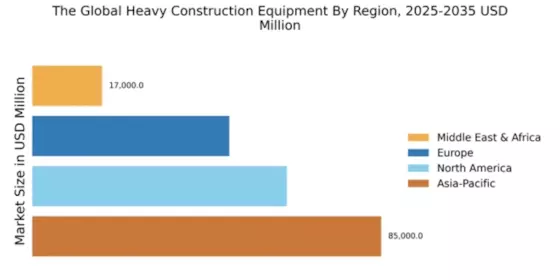
North America is witnessing robust growth in the heavy construction equipment market, driven by increased infrastructure spending and a booming construction sector. The market size reached $62,000.0 million in 2025, reflecting a significant demand for advanced machinery. Regulatory support for sustainable construction practices is also a catalyst, encouraging investments in eco-friendly equipment and technologies. The United States dominates this region, accounting for the majority of the market share. Key players such as Caterpillar, CASE Construction Equipment, and Terex Corporation are leading the charge, focusing on innovation and efficiency. The competitive landscape is characterized by a mix of established firms and emerging players, all vying for a share in this lucrative market.

Europe : Innovative Construction Hub

Europe's heavy construction equipment market is evolving, with a focus on sustainability and innovation. The market size is estimated at $48,000.0 million in 2025, driven by stringent regulations promoting eco-friendly construction practices. Countries are investing heavily in infrastructure projects, which is expected to boost demand for advanced machinery and technologies in the coming years. Germany, France, and the UK are leading the market, with companies like Liebherr and Volvo Construction Equipment at the forefront. The competitive landscape is marked by a strong emphasis on R&D, with firms striving to develop energy-efficient and low-emission equipment. This focus on sustainability is reshaping the market dynamics, making it a key player in the global arena.

Asia-Pacific : Emerging Powerhouse

Asia-Pacific is the largest market for heavy construction equipment, with a market size of $80,000.0 million in 2025. The region's growth is fueled by rapid urbanization, infrastructure development, and government initiatives aimed at enhancing connectivity. Countries like China and India are leading the charge, with significant investments in construction projects that drive demand for heavy machinery. China is the dominant player in this market, accounting for a substantial share. Key manufacturers such as Komatsu and Hitachi Construction Machinery are expanding their operations to meet the growing demand. The competitive landscape is characterized by a mix of local and international players, all striving to capture the burgeoning market opportunities in this dynamic region.

Middle East and Africa : Resource-Rich Frontier

The Middle East and Africa region is witnessing a gradual increase in the heavy construction equipment market, with a size of $6,808.4 million in 2025. The growth is primarily driven by ongoing infrastructure projects and urban development initiatives across various countries. Governments are investing in transportation and housing, which is expected to boost demand for heavy machinery in the coming years. Countries like the UAE and South Africa are leading the market, with significant contributions from local and international players. The competitive landscape is evolving, with companies focusing on providing tailored solutions to meet the unique demands of the region. As infrastructure development continues, the market is poised for steady growth, attracting investments from key players in the industry.

Key Players and Competitive Insights

The Global Heavy Construction Equipment is currently characterized by a dynamic competitive landscape, driven by technological advancements, increasing infrastructure investments, and a growing emphasis on sustainability. Major players such as Caterpillar (US), Komatsu (JP), and Volvo Construction Equipment (SE) are strategically positioning themselves through innovation and digital transformation. Caterpillar (US) focuses on integrating advanced technologies into its equipment, enhancing operational efficiency and reducing environmental impact. Meanwhile, Komatsu (JP) emphasizes partnerships and collaborations to expand its product offerings and market reach, while Volvo Construction Equipment (SE) is investing heavily in electric and hybrid machinery, aligning with global sustainability goals. Collectively, these strategies are reshaping the competitive environment, fostering a shift towards more sustainable and technologically advanced solutions.

In terms of business tactics, companies are increasingly localizing manufacturing to reduce costs and improve supply chain efficiency. This approach not only enhances responsiveness to regional market demands but also mitigates risks associated with global supply chain disruptions. The market structure appears moderately fragmented, with several key players exerting significant influence. The collective actions of these companies contribute to a competitive atmosphere where innovation and operational excellence are paramount.

In November 2025, Caterpillar (US) announced a strategic partnership with a leading technology firm to develop AI-driven predictive maintenance solutions for its heavy machinery. This initiative is expected to enhance equipment reliability and reduce downtime, thereby providing customers with a competitive edge in project execution. The integration of AI into their offerings signifies Caterpillar's commitment to leveraging technology for improved operational efficiency.

In October 2025, Komatsu (JP) unveiled a new line of electric excavators aimed at reducing carbon emissions in urban construction projects. This launch not only reflects the company's dedication to sustainability but also positions it favorably in a market increasingly focused on eco-friendly solutions. The introduction of electric machinery is likely to attract environmentally conscious clients and enhance Komatsu's market share.

In September 2025, Volvo Construction Equipment (SE) expanded its production capabilities in Europe by investing €50 million in a new facility dedicated to electric construction equipment. This strategic move underscores Volvo's commitment to leading the transition towards sustainable construction practices. By enhancing its production capacity, Volvo is poised to meet the growing demand for electric machinery, further solidifying its competitive position.

As of December 2025, the competitive trends in The Global Heavy Construction Equipment are increasingly defined by digitalization, sustainability, and the integration of AI technologies. Strategic alliances are becoming more prevalent, enabling companies to pool resources and expertise to drive innovation. The competitive differentiation is likely to evolve from traditional price-based competition to a focus on technological advancements, sustainability, and supply chain reliability. This shift indicates a future where companies that prioritize innovation and environmental responsibility will likely lead the market.

Key Companies in the Global Heavy Construction Equipment Market market include

Industry Developments

November 2023- Komatsu Ltd. announced the introduction of their new electric dump HD1500-8 EQ truck. A highly effective and reliable machine, this pioneering tipper is designed to minimize carbon emissions and operational costs. Compared to conventional diesel-powered dump trucks, the HD1500-8 EQ promises a great deal of fuel economy and environmental considerations due to its electric drive system as well as regenerative braking technology.

March 2023- Volvo AB has entered into a strategic partnership with Nvidia Corporation for the development of AI-driven autonomous construction equipment. This cooperation seeks to incorporate Nvidia’s AI technology into Volvo’s heavy machinery, thereby making it operate on an autonomous basis thus boosting efficiency and safety in construction sites. Through this partnership, Volvo demonstrates its dedication to innovation and technological progress within the sector of construction equipment; thus positioning itself as a thought leader in terms of self-driving solutions for building purposes.

March 2023 – Teleo, an organization that develops autonomous technologies for heavy construction equipment, signed agreements with John Aarts Group, Teichert, and Tomahawk Construction today, respectively, for remote-operated wheel loaders, bulldozers, and dump trucks.

March 2023 – Manitex International Inc., a globally recognized provider of truck cranes, specialized industrial equipment as well as infrastructure & construction markets rental solutions, announced the official launch of the ECSY-Electric Crane System together with opening day at CONEXPO-Las Vegas.

Future Outlook

Global Heavy Construction Equipment Market Future Outlook

The Global Heavy Construction Equipment is projected to grow at a 4.72% CAGR from 2024 to 2035, driven by urbanization, infrastructure investments, and technological advancements.

New opportunities lie in:

  • Integration of IoT for predictive maintenance solutions.
  • Development of electric and hybrid construction machinery.
  • Expansion into emerging markets with tailored equipment solutions.

By 2035, the market is expected to exhibit robust growth, driven by innovation and strategic investments.

Market Segmentation

Global Heavy Construction Equipment Market End Use Outlook

  • Residential Construction
  • Commercial Construction
  • Infrastructure Development
  • Industrial Construction
  • Mining Operations

Global Heavy Construction Equipment Market Application Outlook

  • Excavation
  • Material Handling
  • Demolition
  • Road Construction
  • Mining

Global Heavy Construction Equipment Market Power Source Outlook

  • Internal Combustion Engine
  • Electric
  • Hybrid
  • Hydraulic
  • Pneumatic

Global Heavy Construction Equipment Market Equipment Type Outlook

  • Excavators
  • Bulldozers
  • Cranes
  • Loaders
  • Dump Trucks

Report Scope

MARKET SIZE 2024206708.4(USD Million)
MARKET SIZE 2025216465.54(USD Million)
MARKET SIZE 2035343316.86(USD Million)
COMPOUND ANNUAL GROWTH RATE (CAGR)4.72% (2024 - 2035)
REPORT COVERAGERevenue Forecast, Competitive Landscape, Growth Factors, and Trends
BASE YEAR2024
Market Forecast Period2025 - 2035
Historical Data2019 - 2024
Market Forecast UnitsUSD Million
Key Companies ProfiledCaterpillar (US), Komatsu (JP), Hitachi Construction Machinery (JP), Volvo Construction Equipment (SE), Liebherr (DE), Doosan Infracore (KR), JCB (GB), CASE Construction Equipment (US), Terex Corporation (US)
Segments CoveredApplication, Equipment Type, Power Source, End Use
Key Market OpportunitiesIntegration of advanced automation and artificial intelligence in heavy construction equipment operations.
Key Market DynamicsTechnological advancements drive efficiency and sustainability in heavy construction equipment, reshaping competitive dynamics and consumer preferences.
Countries CoveredNorth America, Europe, APAC, South America, MEA

Market Highlights

Author
Pradeep Nandi
Senior Research Analyst

I have a bachelor's degree in mechanical engineering and an MBA. I have more than two years of expertise in the retail, food, and beverage, chemical, and material industries, and hence have developed a sound cross-domain expertise. A firm believer in lifelong learning and sharing of knowledge. Having a proclivity for hatching ideas and trying to absorb as much information as possible in a short amount of time. Introducing corporates to the data and insight, which enables them to move from probability to possibility, has been my key areas of interest. 

Leave a Comment

FAQs

How much is the Heavy Construction Equipment Market?

The Heavy Construction Equipment Market size is expected to be valued at USD 343316.86 million in 2035.

What is the growth rate of the Heavy Construction Equipment Market?

Heavy Construction Equipment Market is projected to grow at a CAGR of 4.72% during the forecast period, 2025-2035

Which region held the largest market share in the Heavy Construction Equipment Market?

Asia- Pacific had the largest share of the global market.

Who are the key players in the Heavy Construction Equipment Market?

The key players in the market include Volvo Group, Sany Heavy Industry Co., Ltd., Liebherr AG, JCB, CNH Industrial N.V, Caterpillar Inc, Xuzhou Construction Machinery Group Co., Ltd., and Terex Corporation.

Which Type dominates the Heavy Construction Equipment Market?

The earthmoving equipment category dominated the market in 2024.

Which Application type had the largest market share in the Heavy Construction Equipment Market?

The excavation & demolition had the largest revenue share of the global market.

Download Free Sample

Kindly complete the form below to receive a free sample of this Report

Compare Licence

×
Features License Type
Single User Multiuser License Enterprise User
Price $4,950 $5,950 $7,250
Maximum User Access Limit 1 User Upto 10 Users Unrestricted Access Throughout the Organization
Free Customization
Direct Access to Analyst
Deliverable Format
Platform Access
Discount on Next Purchase 10% 15% 15%
Printable Versions