Download Free Sample
Kindly complete the form below to receive a free sample of this Report
GNSS Device Market Size, Share and Research Report By Technology (Satellite Navigation, Differential GNSS, Real-Time Kinematic), By Application (Automotive, Aerospace, Marine, Telecommunication), By End Use (Commercial Use, Personal Use, Industrial Use), By Device Type (Handheld GNSS Receivers, OEM GNSS Modules, Smartphone GNSS) and By Regional (North America, Europe, South America, Asia Pacific, Middle East and Africa) - Industry Forecast Till 2035
As per Market Research Future analysis, the GNSS Device Market Size was estimated at 58.22 USD Billion in 2024. The GNSS Device industry is projected to grow from 61.46 USD Billion in 2025 to 105.49 USD Billion by 2035, exhibiting a compound annual growth rate (CAGR) of 5.55% during the forecast period 2025 - 2035
The GNSS Device Market is poised for substantial growth driven by technological advancements and increasing applications across various sectors.
| 2024 Market Size | 58.22 (USD Billion) |
| 2035 Market Size | 105.49 (USD Billion) |
| CAGR (2025 - 2035) | 5.55% |
The GNSS Device Market is currently experiencing a dynamic evolution, driven by advancements in technology and increasing demand across various sectors. The proliferation of smart devices and the integration of GNSS capabilities into everyday applications are reshaping the landscape. As industries such as automotive, agriculture, and telecommunications adopt these technologies, the market appears poised for substantial growth. Furthermore, the emphasis on precision and reliability in navigation systems is fostering innovation, leading to the development of more sophisticated GNSS devices. This trend is likely to enhance user experience and expand the range of applications, from personal navigation to complex industrial solutions. In addition, the growing awareness of the importance of location-based services is influencing consumer behavior. Users are increasingly seeking devices that offer enhanced accuracy and real-time data. This shift is prompting manufacturers to invest in research and development, aiming to create products that meet the evolving needs of consumers. As the GNSS Device Market continues to mature, it may witness the emergence of new players and technologies, further diversifying the competitive landscape. Overall, the market's trajectory suggests a promising future, characterized by innovation and increased adoption across multiple sectors.
The convergence of GNSS technology with the Internet of Things (IoT) is becoming increasingly prevalent. This integration allows for enhanced data collection and analysis, enabling smarter decision-making across various applications. As more devices become interconnected, the demand for precise location data is likely to rise, driving innovation in GNSS solutions.
There is a growing emphasis on the development of autonomous systems, particularly in the automotive sector. GNSS devices play a crucial role in enabling self-driving technology by providing accurate positioning information. This trend suggests a shift towards more advanced navigation systems that can support complex algorithms and real-time decision-making.
As concerns regarding data privacy and security continue to escalate, the GNSS Device Market is witnessing a trend towards incorporating advanced security features. Manufacturers are increasingly focusing on developing devices that offer secure data transmission and protection against potential threats, thereby enhancing user trust and confidence in GNSS technologies.
Technological advancements are playing a crucial role in shaping the GNSS Device Market. Innovations such as multi-frequency GNSS receivers and improved signal processing techniques are enhancing the accuracy and reliability of positioning systems. The introduction of new satellite constellations, including Galileo and BeiDou, is also contributing to the diversification of GNSS services. These advancements are expected to drive the market forward, as users demand higher precision and better performance from GNSS devices. The ongoing research and development efforts in this field suggest that the GNSS Device Market will continue to evolve, offering more sophisticated solutions to meet the needs of various applications, from surveying to autonomous vehicles.
The GNSS Device Market is experiencing a notable surge in demand due to the increasing adoption of precision agriculture techniques. Farmers are increasingly utilizing GNSS technology to enhance crop yields and optimize resource usage. According to recent data, the precision agriculture segment is projected to grow at a compound annual growth rate of approximately 12% over the next five years. This growth is driven by the need for accurate field mapping, soil analysis, and crop monitoring, which GNSS devices facilitate. As agricultural practices evolve, the integration of GNSS technology becomes essential for farmers aiming to improve efficiency and sustainability. Consequently, the GNSS Device Market is likely to witness substantial growth as more agricultural stakeholders recognize the benefits of these advanced technologies.
The GNSS Device Market is significantly influenced by the expansion of the transportation and logistics sectors. With the increasing complexity of supply chains and the demand for real-time tracking, GNSS devices are becoming indispensable. The market for logistics and transportation is expected to grow at a rate of around 10% annually, driven by the need for efficient fleet management and route optimization. GNSS technology enables companies to monitor vehicle locations, manage deliveries, and reduce operational costs. As urbanization continues to rise, the reliance on GNSS devices for navigation and tracking in transportation is likely to increase, further propelling the growth of the GNSS Device Market.
The GNSS Device Market is benefiting from the increasing adoption of smart city initiatives across various regions. As urban areas strive to enhance infrastructure and improve public services, GNSS technology is becoming integral to urban planning and management. Smart transportation systems, waste management, and energy distribution are just a few areas where GNSS devices are utilized to optimize operations. The market for smart city solutions is projected to grow significantly, with GNSS technology playing a pivotal role in enabling real-time data collection and analysis. This trend indicates that the GNSS Device Market will likely see a rise in demand as cities invest in technology to improve efficiency and sustainability.
The GNSS Device Market is witnessing a growing interest in personal navigation devices, driven by the increasing reliance on mobile applications for navigation and location-based services. As smartphones and wearables become ubiquitous, the demand for accurate positioning solutions is on the rise. The personal navigation segment is expected to grow at a robust pace, fueled by advancements in GNSS technology and the proliferation of location-based services. Users are increasingly seeking devices that offer enhanced features such as real-time traffic updates and personalized routing. This trend suggests that the GNSS Device Market will continue to expand as consumers prioritize convenience and accuracy in their navigation experiences.
The GNSS Device Market is experiencing a diverse distribution among technology segments. Satellite Navigation continues to dominate the market, with the largest share, thanks to its widespread implementation in consumer electronics, automotive, and various industrial applications. In contrast, Real-Time Kinematic (RTK) is witnessing accelerated growth, driven by advancements in accuracy and performance crucial for applications in surveying, agriculture, and autonomous systems. The Differential GNSS segment occupies a middle ground, contributing significantly but not at the same growth rate as RTK. The growth trends in the GNSS Device Market highlight a shift towards enhanced positional accuracy and reliability. With the rise of autonomous vehicles and precision agriculture, technologies such as RTK are quickly gaining traction. Moreover, government investments in infrastructure and initiatives aimed at improving navigational systems further amplify demand across all segments. The focus on integrating GNSS solutions into IoT devices also signals a transition towards smarter technological ecosystems, positioning the market for future innovations and growth.
Technology: Satellite Navigation (Dominant) vs. Differential GNSS (Emerging)
Satellite Navigation represents the cornerstone of GNSS technology, serving a wide array of application areas from everyday navigation to complex industrial logistics. Its dominance comes from well-established systems and infrastructure that have made it a ubiquitous technology globally. Meanwhile, Differential GNSS is seen as an emerging player, offering enhanced accuracy and reliability over standard GNSS services. This segment caters to specialized sectors like aviation, marine, and critical land surveying applications where precision is paramount. As requirements for accuracy escalate in these sectors, Differential GNSS is poised to capture a larger share, showcasing the potential for substantial growth and innovation in its applications.
The GNSS Device Market is diverse, with significant applications across automotive, aerospace, marine, and telecommunication sectors. The automotive segment holds the largest market share, driven by the increasing demand for smart navigation and advanced driver-assistance systems (ADAS). In contrast, the aerospace sector, while smaller currently, is rapidly gaining traction as GNSS technology enhances tracking and safety in aviation, making it a key focus for future growth.
Automotive: Dominant vs. Aerospace: Emerging
The automotive sector remains the dominant force in the GNSS Device Market, characterized by its widespread adoption in vehicles for navigation and safety features. As consumer preferences shift towards connected vehicles, this segment is adapting with innovations like real-time traffic updates and automated driving functionalities. Conversely, the aerospace segment is emerging as a significant player, driven by advancements in satellite communications and navigation. This growth is propelled by a surge in demand for more precise navigation systems and enhanced operational efficiency in air transport, positioning aerospace as a vital growth area in the GNSS landscape.
The GNSS device market is segmented into commercial, personal, and industrial uses, with commercial use dominating the overall market share. This segment primarily includes applications such as fleet management, logistics, and agriculture, which leverage GNSS technology for operational efficiency. Personal use follows closely, featuring devices like smartphones and wearables, which are increasingly popular due to their GPS capabilities. As technology advances, more consumers are integrating GNSS into their daily lives, thereby narrowing the gap between commercial and personal usage in terms of market size. Growth trends in the GNSS device segment are being propelled by the evolution of technology and increased consumer demand. The commercial segment continues to thrive, driven by sectors such as transportation and agriculture, where precision and tracking capabilities are essential. Conversely, the personal use segment is experiencing rapid growth as advancements in mobile technology and location-based services enhance user engagement. This dynamic landscape suggests a vibrant future for both segments, with increasing integration in various applications supporting their expansion.
Commercial Use: Fleet Management (Dominant) vs. Personal Use: Smartphones (Emerging)
Fleet management serves as a dominant force in the commercial segment of the GNSS device market, as organizations across various industries recognize the potential of real-time tracking and optimized routing for improving operational efficiency. Features such as vehicle tracking, routing software, and telemetry solutions provide significant advantages in cost savings and productivity. On the other hand, personal use of GNSS devices through smartphones is emerging rapidly, fueled by the widespread adoption of location-based applications and services. With features including navigation, fitness tracking, and social connectivity, smartphones are becoming integral to everyday life. This segment's growth is facilitated by innovations in app development and a growing consumer appetite for enhanced navigation and location services.
The GNSS Device Market exhibits a diverse range of device types, with Handheld GNSS Receivers taking the lead in market share. These devices dominate due to their portability and high accuracy, catering to outdoor enthusiasts, surveyors, and professionals requiring precise location tracking. In contrast, OEM GNSS Modules are quickly gaining traction, driven by the increasing integration of GNSS technology into various applications, particularly in automotive and IoT devices. This shift is indicative of the growing demand for compact, high-performing solutions that can be embedded in larger systems. The growth trends within this segment are largely influenced by advancements in technology, such as improved satellite connectivity and enhanced signal processing capabilities. Handheld GNSS Receivers maintain a strong user base due to their established presence and reliability. Meanwhile, OEM GNSS Modules benefit from the rise of smart devices and autonomous vehicles, making them an attractive option for manufacturers. Together, these segments reflect the evolving landscape of location-based services and the continuous push for innovation in the GNSS market.
Handheld GNSS Receivers (Dominant) vs. OEM GNSS Modules (Emerging)
Handheld GNSS Receivers are recognized for their robustness and versatility, making them ideal for applications ranging from outdoor navigation to precision surveying. Their ability to provide real-time, highly accurate positioning data has solidified their position as the dominant choice among end-users. Meanwhile, OEM GNSS Modules are emerging as a significant player, thanks to their compact form factor and adaptability for various uses, especially in consumer electronics and automotive systems. These modules enable manufacturers to seamlessly integrate GNSS capabilities into their products, tapping into the growing demand for location-based services. As technology advances, both segments are poised for growth, with handheld devices focusing on user experience while OEM modules prioritize integration and scalability.
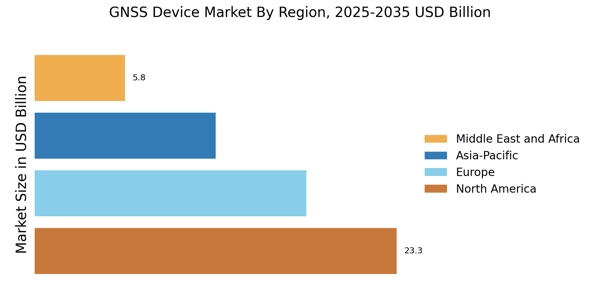
North America is the largest market for GNSS devices, holding approximately 40% of the global share. The region's growth is driven by advancements in technology, increasing demand for precision agriculture, and the integration of GNSS in various sectors such as transportation and logistics. Regulatory support from agencies like the FCC further catalyzes market expansion, ensuring robust infrastructure and standards for GNSS applications. The United States leads the market, with key players like Garmin, Trimble, and Rockwell Collins driving innovation and competition. Canada also plays a significant role, particularly in sectors like mining and agriculture. The competitive landscape is characterized by a mix of established companies and emerging startups, all vying for a share in this rapidly evolving market.
Europe is the second-largest market for GNSS devices, accounting for around 30% of the global market share. The region's growth is fueled by increasing investments in smart transportation systems, autonomous vehicles, and the European Union's commitment to enhancing satellite navigation services. Regulatory frameworks, such as the European GNSS Agency's initiatives, are pivotal in promoting the adoption of GNSS technologies across various sectors. Leading countries in this region include Germany, France, and the UK, where companies like Thales and Hexagon are prominent players. The competitive landscape is marked by a strong emphasis on innovation and collaboration among industry stakeholders. The presence of various research institutions and government initiatives further strengthens the market, ensuring a steady flow of advancements in GNSS technology.
Asia-Pacific is witnessing rapid growth in the GNSS device market, holding approximately 20% of the global share. The region's expansion is driven by increasing urbanization, rising demand for location-based services, and government initiatives to improve infrastructure. Countries like China and India are at the forefront, with significant investments in smart city projects and transportation systems that leverage GNSS technology. China is the largest market in the region, with companies like Topcon and u-blox leading the charge. India is also emerging as a key player, focusing on enhancing its satellite navigation capabilities. The competitive landscape is characterized by a mix of local and international players, all striving to capture the growing demand for GNSS solutions in various applications, including agriculture, transportation, and telecommunications.
The Middle East and Africa region is gradually emerging in the GNSS device market, holding about 10% of the global share. The growth is driven by increasing investments in infrastructure, urban development, and the adoption of advanced technologies in sectors like oil and gas, agriculture, and transportation. Government initiatives aimed at enhancing navigation and positioning services are also contributing to market expansion. Leading countries include the UAE and South Africa, where companies are increasingly adopting GNSS solutions for various applications. The competitive landscape is evolving, with both local and international players entering the market to meet the growing demand. The region's unique challenges and opportunities present a fertile ground for innovation and growth in GNSS technologies.
The GNSS Device Market has witnessed significant growth and transformation in recent years, driven by the increasing demand for accurate location-based services across various industries, including automotive, aerospace, agriculture, and telecommunications. The market is characterized by intense competition among key players who are continually enhancing their technological capabilities, expanding their product portfolios, and exploring new applications to generate revenue. As GNSS technology evolves, companies in this space are focusing on collaboration, strategic partnerships, and acquisitions to bolster their market positions.
The competitive landscape is marked by rapid innovation cycles, evolving consumer expectations, and regulatory changes that create both challenges and opportunities for market participants.Qualcomm has established a robust presence in the GNSS Device Market, leveraging its strengths in semiconductor technology and wireless communications. The company is known for its advanced GNSS chipsets that offer high accuracy and reliability in location tracking, which are pivotal in various applications such as navigation, fleet management, and smart cities. Qualcomm's significant investment in research and development enables it to stay ahead of the curve, providing innovative solutions that cater to market demands.
Its extensive ecosystem, which includes partnerships with device manufacturers and software developers, further amplifies its competitive advantage, allowing Qualcomm to deliver integrated GNSS solutions that enhance user experiences across diverse devices and platforms.Rockwell Collins holds a vital position in the GNSS Device Market, particularly within the aerospace and defense sectors. The company is recognized for its advanced navigation solutions that incorporate GNSS technology, ensuring precise and dependable location information essential for aviation safety and operational efficiency. Rockwell Collins emphasizes the development of cutting-edge navigation systems that address the stringent requirements of the industry.
The company’s legacy in avionics and integrated communication solutions positions it as a trusted partner for organizations seeking reliable GNSS applications. Its continued focus on innovation and integration of GNSS capabilities into existing products enhances its market share while meeting the evolving needs of customers in high-stakes environments.




Recent developments in the GNSS Device Market have highlighted significant advancements and collaborations. Qualcomm has been pushing innovations in GNSS technology, enhancing accuracy for various applications. Rockwell Collins continues to develop hybrid positioning solutions that integrate GNSS with other navigational aids. Trimble and Garmin are expanding their market reach through strategic partnerships in the agricultural and automotive sectors. Magellan is focusing on consumer navigation products, emphasizing ease of use and functionality. Nokia has been bolstering its GNSS offerings as part of its broader technological ecosystem.
Notably, there have been mergers involving brands like Ublox and Hexagon, strengthening their joint capabilities in the GNSS space. Growing demand for high-precision applications, particularly in autonomous vehicles and IoT devices, is driving market valuation, with companies like TomTom reporting increased investment towards research and development. Skyhook continues to enhance its location-based services to suit evolving market needs. These developments indicate that collaborations and technological advancements are becoming crucial for businesses within the GNSS landscape, with the market experiencing growth fueled by the demand for improved location accuracy across various sectors.
The GNSS Device Market is projected to grow at a 5.55% CAGR from 2025 to 2035, driven by advancements in technology, increased demand for precision navigation, and expanding applications across various sectors.
New opportunities lie in:
By 2035, the GNSS Device Market is expected to achieve substantial growth and innovation.
| MARKET SIZE 2024 | 58.22(USD Billion) |
| MARKET SIZE 2025 | 61.46(USD Billion) |
| MARKET SIZE 2035 | 105.49(USD Billion) |
| COMPOUND ANNUAL GROWTH RATE (CAGR) | 5.55% (2025 - 2035) |
| REPORT COVERAGE | Revenue Forecast, Competitive Landscape, Growth Factors, and Trends |
| BASE YEAR | 2024 |
| Market Forecast Period | 2025 - 2035 |
| Historical Data | 2019 - 2024 |
| Market Forecast Units | USD Billion |
| Key Companies Profiled | Garmin (US), Trimble (US), Hexagon (SE), Topcon (JP), NovAtel (CA), u-blox (CH), Rockwell Collins (US), Thales (FR), Satellogic (AR) |
| Segments Covered | Technology, Application, End Use, Device Type, Regional |
| Key Market Opportunities | Integration of advanced artificial intelligence in GNSS devices enhances accuracy and user experience. |
| Key Market Dynamics | Technological advancements and regulatory changes drive innovation and competition in the GNSS Device Market. |
| Countries Covered | North America, Europe, APAC, South America, MEA |
The GNSS Device Market was valued at 58.22 USD Billion in 2024.
The market is projected to reach 105.49 USD Billion by 2035.
The expected CAGR for the GNSS Device Market during 2025 - 2035 is 5.55%.
Key technology segments include Satellite Navigation, Differential GNSS, and Real-Time Kinematic, with valuations of 42.0, 32.0, and 31.49 USD Billion respectively by 2035.
The primary applications include Automotive, Aerospace, Marine, and Telecommunication, with projected valuations of 40.0, 25.0, 20.0, and 20.49 USD Billion respectively by 2035.
The end-use segment shows growth in Commercial Use, Personal Use, and Industrial Use, with projected valuations of 36.0, 25.0, and 44.49 USD Billion respectively by 2035.
Available device types include Handheld GNSS Receivers, OEM GNSS Modules, and Smartphone GNSS, with projected valuations of 27.0, 40.0, and 38.49 USD Billion respectively by 2035.
Key players include Garmin, Trimble, Hexagon, Topcon, NovAtel, u-blox, Rockwell Collins, Thales, and Satellogic.
Trends influencing growth include advancements in technology, increasing demand in automotive applications, and the rise of smartphone GNSS capabilities.
While specific regional data is not provided, the overall growth trends suggest that regions with strong automotive and aerospace sectors may experience higher demand.


Kindly complete the form below to receive a free sample of this Report

“This is really good guys. Excellent work on a tight deadline. I will continue to use you going forward and recommend you to others. Nice job”


“Thanks. It’s been a pleasure working with you, please use me as reference with any other Intel employees.”


“Thanks for sending the report it gives us a good global view of the Betaïne market.”


“Thank you, this will be very helpful for OQS.”


“We found the report very insightful! we found your research firm very helpful. I'm sending this email to secure our future business.”


“I am very pleased with how market segments have been defined in a relevant way for my purposes (such as "Portable Freezers & refrigerators" and "last-mile"). In general the report is well structured. Thanks very much for your efforts.”


“I have been reading the first document or the study, ,the Global HVAC and FP market report 2021 till 2026. Must say, good info! I have not gone in depth at all parts, but got a good indication of the data inside!”


“We got the report in time, we really thank you for your support in this process. I also thank to all of your team as they did a great job.”


“The Automotive 48V ECU Components Procurement Intelligence Study” was a complex project, but the Market Research Future (MRFR) team handled it with quality, agility, and customer-centricity. They delivered all requested data on time and within the agreed scope. The team, including Shubhendra Anand and Rahul Gotadki, was always readily available to clarify questions and swiftly implement necessary adjustments, driving the project to a successful conclusion within a very demanding timeframe.
I would also like to specifically commend Akshay Agarwal for his responsiveness and support at every stage—from our initial inquiry on May 6th through to final delivery on June 18th. His dedication made the entire process seamless.”



