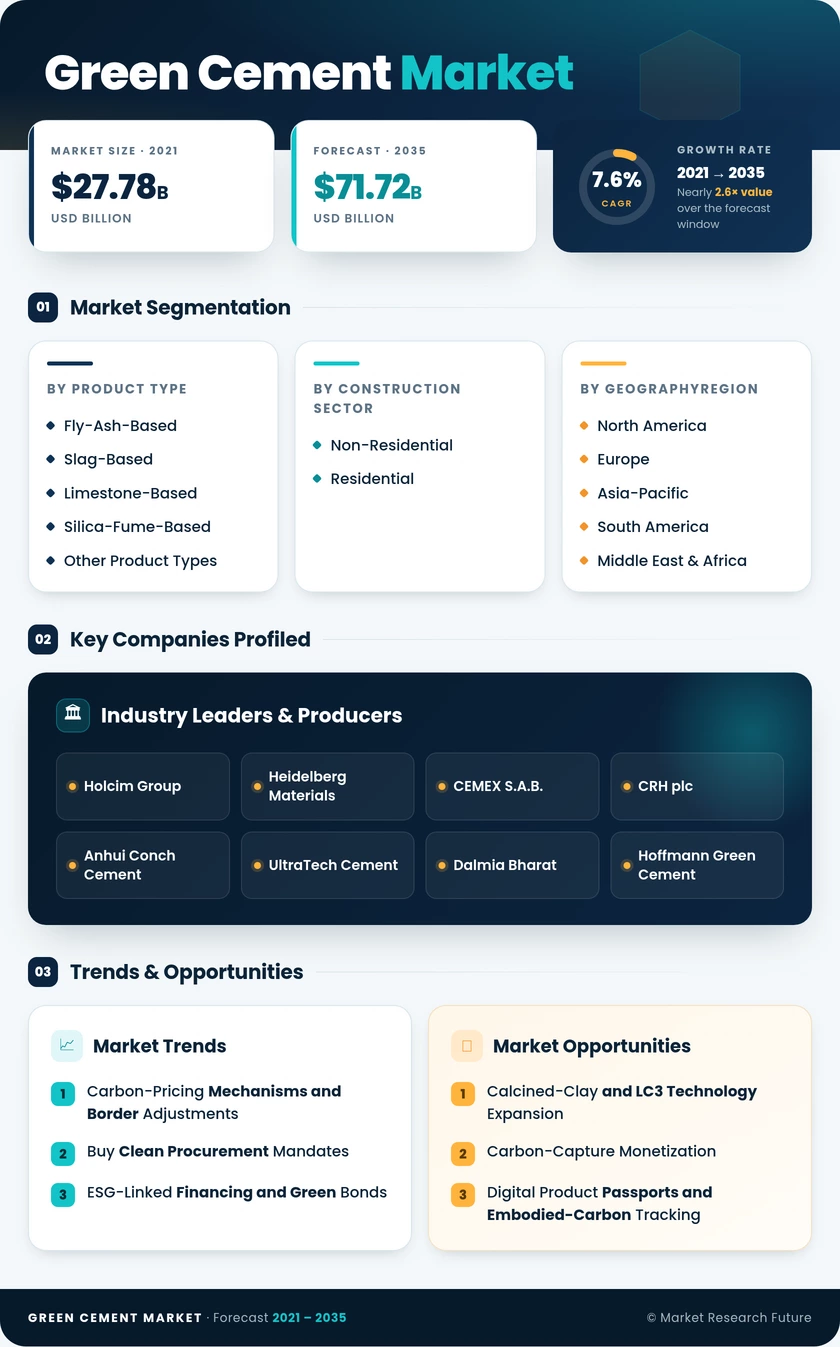
Green Cement Market

ID: MRFR/CnM/2131-HCR
111 Pages
Chitranshi Jaiswal
Last Updated: June 22, 2026
Green Cement Market Research Report Information By Product Type (Fly Ash based, Slag based, Geopolymer, Others), By Application (Residential, Non-Residential), And By Region (North America, Europe, Asia-Pacific, And Rest Of The World) – Market Forecast Till 2035.
Download PDF ×

We do not share your information with anyone. However, we may send you emails based on your report interest from time to time. You may contact us at any time to opt-out.

  1. 1 Market Overview |
    1. 1.1 Study Assumptions & Market Definition |
    2. 1.2 Scope of the Study |
    3. 1.3 Research Methodology
  2. 2 Market Summary & Key Takeaways
  3. 3 Market Dynamics |
    1. 3.1 Market Drivers Analysis | |
      1. 3.1.1 Carbon-Pricing and CBAM Expansion | |
      2. 3.1.2 Buy Clean Procurement Mandates | |
      3. 3.1.3 ESG-Linked Project Financing | |
      4. 3.1.4 Infrastructure Stimulus Packages | |
      5. 3.1.5 Clinker-Substitution Technology Advances | |
      6. 3.1.6 Green-Building Certification Growth | |
      7. 3.1.7 Carbon-Capture, Utilization & Storage Scale-Up |
    2. 3.2 Market Restraints Analysis | |
      1. 3.2.1 Higher Unit Cost of Green Formulations | |
      2. 3.2.2 Feedstock Supply Variability (Fly Ash, Slag) | |
      3. 3.2.3 Performance-Standard Conservatism | |
      4. 3.2.4 Fragmented Certification and Labeling | |
      5. 3.2.5 Limited Awareness Among Small Contractors |
    3. 3.3 Market Opportunity Analysis | |
      1. 3.3.1 Calcined-Clay and LC3 Technology Expansion | |
      2. 3.3.2 Carbon-Capture Monetization | |
      3. 3.3.3 Digital Product Passports and Embodied-Carbon Tracking | |
      4. 3.3.4 Emerging-Market Urbanization | |
      5. 3.3.5 Green-Cement-as-a-Service Business Models |
    4. 3.4 Industry Value Chain Analysis |
    5. 3.5 Porter's Five Forces Analysis
  4. 4 Global Green Cement Market Size & Forecast (2021–2035) |
    1. 4.1 Historical Market Size (2021–2025) |
    2. 4.2 Current & Forecast Market Size (2026–2035) |
    3. 4.3 Market Size by Revenue (USD Billion) |
    4. 4.4 Year-over-Year Growth Analysis
  5. 5 Segmentation Analysis |
    1. 5.1 By Product Type | |
      1. 5.1.1 Fly-Ash-Based | |
      2. 5.1.2 Slag-Based | |
      3. 5.1.3 Limestone-Based | |
      4. 5.1.4 Silica-Fume-Based | |
      5. 5.1.5 Other Product Types |
    2. 5.2 By Construction Sector | |
      1. 5.2.1 Non-Residential | |
      2. 5.2.2 Residential
  6. 6 Regional Analysis |
    1. 6.1 North America | |
      1. 6.1.1 United States | |
      2. 6.1.2 Canada | |
      3. 6.1.3 Mexico |
    2. 6.2 Europe | |
      1. 6.2.1 Germany | |
      2. 6.2.2 United Kingdom | |
      3. 6.2.3 France | |
      4. 6.2.4 Italy | |
      5. 6.2.5 Spain | |
      6. 6.2.6 Nordic Countries | |
      7. 6.2.7 Russia | |
      8. 6.2.8 Rest of Europe |
    3. 6.3 Asia-Pacific | |
      1. 6.3.1 China | |
      2. 6.3.2 India | |
      3. 6.3.3 Japan | |
      4. 6.3.4 South Korea | |
      5. 6.3.5 ASEAN | |
      6. 6.3.6 Rest of Asia-Pacific |
    4. 6.4 South America | |
      1. 6.4.1 Brazil | |
      2. 6.4.2 Argentina | |
      3. 6.4.3 Rest of South America |
    5. 6.5 Middle East & Africa | |
      1. 6.5.1 Saudi Arabia | |
      2. 6.5.2 UAE | |
      3. 6.5.3 South Africa | |
      4. 6.5.4 Egypt | |
      5. 6.5.5 Rest of MEA
  7. 7 Competitive Landscape |
    1. 7.1 Market Share Analysis (2025) |
    2. 7.2 Competitive Benchmarking Matrix |
    3. 7.3 Company Profiles | |
      1. 7.3.1 Holcim Group | |
      2. 7.3.2 Heidelberg Materials | |
      3. 7.3.3 CEMEX S.A.B. | |
      4. 7.3.4 CRH plc | |
      5. 7.3.5 Anhui Conch Cement | |
      6. 7.3.6 UltraTech Cement | |
      7. 7.3.7 Dalmia Bharat | |
      8. 7.3.8 Hoffmann Green Cement Technologies | |
      9. 7.3.9 Ecocem | |
      10. 7.3.10 Solidia Technologies
  8. 8 Future Outlook & Strategic Recommendations (2026–2035) |
    1. 8.1 AI-Optimized Mix Design and Quality Control |
    2. 8.2 Electrification and Hydrogen-Fired Kilns |
    3. 8.3 Circular-Economy Integration |
    4. 8.4 ESG Reporting Mandates and Scope 3 Transparency
  9. 9 Recent Developments & News
  10. 10 Frequently Asked Questions (FAQs)
  11. 11 Report Scope & Methodology |
    1. 11.1 Study Period & Base Year |
    2. 11.2 Data Sources & Citations |
    3. 11.3 Abbreviations
  12. 12 LIST OF TABLES
  13. 13 LIST OF FIGURES

Segmentation Quick Reference

DimensionSub-SegmentsDominant SegmentFastest Growing Segment
Product TypeFly-Ash-Based, Slag-Based, Limestone-Based, Silica-Fume-Based, Other Product TypesFly-Ash-Based (46.8% share, 2025)Slag-Based (8.3% CAGR)
Construction SectorNon-Residential, ResidentialNon-Residential (62.3% share, 2025)Residential (7.1% CAGR)
RegionNorth America, Europe, Asia-Pacific, South America, Middle East & AfricaNorth America (34.0% share, 2025)Asia-Pacific (8.6% CAGR)


Market Segmentation Overview

By Product Type

Sub-SegmentKey Trend
Fly-Ash-BasedLargest revenue contributor; thermal-plant by-product supply anchors cost-effective blending
Slag-BasedFastest expansion driven by infrastructure pours requiring sulfate resistance
Limestone-BasedGrowing adoption in fly-ash-constrained regions; lower calcination energy requirements
Silica-Fume-BasedPremium positioning for high-performance and ultra-high-strength concrete applications
Other Product TypesEncompasses geopolymer, LC3, and proprietary clinker-free binder technologies


Fly-ash-based formulations dominate because of established standards, cost efficiency, and abundant feedstock near coal-fired generation assets. Slag-based cement gains share as infrastructure-intensive projects value its durability characteristics, and the Green Cement Market diversifies its raw-material base.

By Construction Sector

Sub-SegmentKey Trend
Non-ResidentialLed by government Buy Clean mandates and commercial LEED/BREEAM certification requirements
ResidentialAccelerating through green-home programs and evolving national building energy codes


Non-residential works generate the majority of demand because institutional and infrastructure buyers operate under stringent embodied-carbon procurement rules. Residential growth accelerates as certification programs widen and homebuyers increasingly factor sustainability ratings into purchase decisions.