×
Request Free Sample ×

Kindly complete the form below to receive a free sample of this Report

* Please use a valid business email

Leading companies partner with us for data-driven Insights

clients tt-cursor
Hero Background

Green Solvent Market

ID: MRFR/CnM/9748-HCR
111 Pages
Priya Nagrale
October 2025

Green Solvent Market Research Report By Solvent Type (Bio-based Solvents, Water-based Solvents, Halogenated Solvents, Aromatic Solvents, Terpenes and Other Natural Solvents), By Application (Paints and Coatings, Adhesives and Sealants, Cleaning and Degreasing, Electronics and Semiconductor Manufacturing, Pharmaceuticals and Cosmetics), By Purity (Industrial Grade, High Purity, Research Grade), By End-Use Industry (Automotive, Construction, Electronics, Healthcare, Aerospace) and By Regional (North America, Europe, South America, Asia Pacific... read more

Share:
Download PDF ×

We do not share your information with anyone. However, we may send you emails based on your report interest from time to time. You may contact us at any time to opt-out.

Green Solvent Market Infographic
Purchase Options

Green Solvent Market Summary

As per MRFR analysis, the Green Solvent Market Size was estimated at 9.58 USD Billion in 2024. The Green Solvent industry is projected to grow from 10.07 USD Billion in 2025 to 16.6 USD Billion by 2035, exhibiting a compound annual growth rate (CAGR) of 5.12 during the forecast period 2025 - 2035.

Key Market Trends & Highlights

The Green Solvent Market is poised for substantial growth driven by environmental consciousness and regulatory support.

  • The demand for bio-based solvents is rising, particularly in North America, as industries seek sustainable alternatives.
  • Regulatory frameworks are increasingly favoring eco-friendly solutions, propelling market expansion in the Asia-Pacific region.
  • Technological advancements in solvent production are enhancing efficiency and reducing environmental impact across various sectors.
  • Rising environmental awareness and stringent regulations are key drivers fueling growth in the paints and pharmaceuticals segments.

Market Size & Forecast

2024 Market Size 9.58 (USD Billion)
2035 Market Size 16.6 (USD Billion)
CAGR (2025 - 2035) 5.12%

Major Players

BASF SE (DE), Dow Inc. (US), LyondellBasell Industries N.V. (US), Solvay S.A. (BE), Eastman Chemical Company (US), AkzoNobel N.V. (NL), Huntsman Corporation (US), Clariant AG (CH), Mitsubishi Chemical Corporation (JP)

Green Solvent Market Trends

The Green Solvent Market is currently experiencing a notable transformation, driven by increasing environmental awareness and regulatory pressures. Stakeholders across various industries are progressively shifting towards sustainable practices, which has led to a heightened demand for eco-friendly solvents. These solvents, derived from renewable resources, are perceived as safer alternatives to traditional solvents, which often contain harmful volatile organic compounds. As a result, manufacturers are investing in research and development to innovate and expand their product offerings, aligning with the growing consumer preference for greener solutions. Moreover, the Green Solvent Market is witnessing a diversification of applications, spanning sectors such as paints and coatings, adhesives, and cleaning products. This broadening scope indicates a potential for growth, as industries seek to comply with stringent environmental regulations while enhancing their product portfolios. The trend towards sustainability is not merely a fleeting phase; it appears to be a fundamental shift in how businesses operate. Consequently, the Green Solvent Market is poised for continued expansion, as companies recognize the long-term benefits of adopting environmentally friendly practices and products.

Rising Demand for Bio-based Solvents

There is an increasing inclination towards bio-based solvents, which are derived from natural sources. This trend reflects a broader commitment to sustainability, as industries seek to minimize their carbon footprint and reduce reliance on fossil fuels.

Regulatory Support for Eco-friendly Solutions

Governments worldwide are implementing stricter regulations aimed at reducing the use of harmful chemicals. This regulatory landscape is fostering a favorable environment for the adoption of green solvents, as companies strive to comply with new standards.

Technological Advancements in Solvent Production

Innovations in production technologies are enhancing the efficiency and effectiveness of green solvents. These advancements not only improve the performance of eco-friendly solvents but also contribute to cost reductions, making them more accessible to various industries.

Green Solvent Market Drivers

Market Growth Projections

The Global Green Solvent Market Industry is on a growth trajectory, with projections indicating a market size of 9.58 USD Billion in 2024 and an anticipated increase to 16.6 USD Billion by 2035. This growth reflects a compound annual growth rate (CAGR) of 5.12% from 2025 to 2035, driven by various factors including regulatory support, technological advancements, and changing consumer preferences. The increasing adoption of green solvents across multiple industries, such as automotive and pharmaceuticals, further supports this positive outlook. As sustainability becomes a core focus for businesses, the green solvent market is likely to flourish.

Growing Environmental Regulations

The Global Green Solvent Market Industry is experiencing a surge in demand due to increasing environmental regulations aimed at reducing volatile organic compounds (VOCs) and harmful emissions. Governments worldwide are implementing stringent policies to promote the use of eco-friendly solvents, which has led to a shift in manufacturing practices. For instance, the European Union's REACH regulation encourages the adoption of green solvents in various applications, including paints and coatings. This regulatory landscape is expected to drive the market's growth, with the industry projected to reach 9.58 USD Billion in 2024, reflecting a strong commitment to sustainability.

Rising Demand from End-User Industries

The Global Green Solvent Market Industry is significantly influenced by the rising demand from end-user industries such as paints, coatings, and adhesives. These sectors are increasingly adopting green solvents to align with sustainability goals and consumer preferences for environmentally friendly products. For example, the paint industry is shifting towards bio-based solvents, which are perceived as safer alternatives. This trend is expected to contribute to the market's expansion, with projections indicating a growth to 16.6 USD Billion by 2035. The increasing awareness of the environmental impact of traditional solvents further supports this transition.

Consumer Preference for Sustainable Products

The Global Green Solvent Market Industry is witnessing a shift in consumer preferences towards sustainable products. As environmental awareness increases, consumers are actively seeking products that minimize ecological impact. This trend is particularly evident in the cosmetics and personal care sectors, where brands are reformulating products to include green solvents. The growing demand for transparency in ingredient sourcing further drives this change. Companies that adopt green solvents are likely to enhance their brand image and attract environmentally conscious consumers. This shift is expected to bolster market growth, contributing to the industry's projected expansion in the coming years.

Technological Advancements in Solvent Production

Technological advancements in the production of green solvents are playing a crucial role in the Global Green Solvent Market Industry. Innovations in extraction and synthesis methods are enhancing the efficiency and cost-effectiveness of bio-based solvents. For instance, the development of new catalytic processes allows for the production of solvents from renewable resources, reducing reliance on petroleum-based products. These advancements not only improve the quality of green solvents but also expand their application range. As a result, the market is poised for growth, with a projected CAGR of 5.12% from 2025 to 2035, indicating a robust future for sustainable solvent solutions.
Market Segment Insights

By Application: Paints (Largest) vs. Cleaning Agents (Fastest-Growing)

The Green Solvent Market exhibits a diverse range of applications, with the largest share held by the paints segment, which capitalizes on the rising demand for eco-friendly coatings. Following closely are adhesives and coatings, which are significant contributors to market dynamics. Cleaning agents and personal care products, while smaller in comparison, play crucial roles in furthering the adoption of green practices across various industries. This distribution underscores the varying degrees of market maturity and preferences within the application segment.

Paints: Dominant vs. Cleaning Agents: Emerging

In the Green Solvent Market, paints represent the dominant application, reflecting a strong preference for eco-friendly options that meet stringent regulatory requirements. These solvents are preferred for their low VOC emissions, making them ideal for environmentally conscious consumers. In contrast, cleaning agents are emerging rapidly due to increased awareness about health and hygiene. They are being developed with formulations that prioritize sustainability while still maintaining effectiveness. As consumer preferences shift towards more sustainable and non-toxic products, both segments are poised to benefit, though paints remain firmly established as the leading application.

By End Use Industry: Pharmaceuticals (Largest) vs. Automotive (Fastest-Growing)

The Green Solvent Market shows a distinct distribution of market share across various end-use industries. Pharmaceuticals emerges as the largest segment, leveraging the segment's focus on sustainability and regulatory standards to boost its market presence. Meanwhile, sectors such as Automotive are gaining traction, driven by increased demand for eco-friendly solutions that align with evolving consumer preferences and regulatory requirements. Growth trends within the Green Solvent Market are shaped by rising environmental awareness and stringent regulations on volatile organic compounds (VOCs). The Automotive industry is expected to grow rapidly as manufacturers seek sustainable alternatives to traditional solvents, promoting innovation in formulations. Meanwhile, Pharmaceuticals continue to solidify their dominance as they adopt green practices across R&D and production processes, contributing to steady growth in the segment.

Pharmaceuticals: Dominant vs. Automotive: Emerging

The Pharmaceuticals segment of the Green Solvent Market is characterized by its adherence to strict regulatory standards and a commitment to sustainability. This segment is pivotal as it demonstrates the importance of selecting solvents with lower environmental impact, ensuring product efficacy while meeting safety regulations. In contrast, the Automotive segment is positioned as an emerging player, reflecting a growing shift towards sustainable manufacturing practices. As automotive industries increasingly innovate to meet eco-friendly demands, green solvents are becoming essential in formulations, coatings, and cleaning products, highlighting the dynamic evolution in consumer preferences and regulatory pressures that prioritize sustainability in production.

By Type: Bio-based Solvents (Largest) vs. Water-based Solvents (Fastest-Growing)

In the Green Solvent Market, the bio-based solvents segment holds a significant share, driven by the increasing demand for sustainable and environmentally friendly products. These solvents are derived from renewable resources, making them more appealing to consumers and industries striving for lower carbon footprints. Meanwhile, water-based solvents emerge as a fast-growing segment, appealing to diverse applications, especially in coatings and adhesives, due to their low toxicity and favorable regulatory environment. This growth indicates a shifting preference towards safer products that minimize environmental impact. Growth trends in the Green Solvent Market are largely influenced by legislative regulations aimed at reducing volatile organic compounds (VOCs) and fostering the adoption of greener alternatives. Factors like rising awareness of environmental sustainability and advancements in manufacturing processes further bolster the market for green solvents. The momentum gained by emerging segments like water-based solvents signals a transformative shift in consumer preferences toward greener products, pushing manufacturers to innovate and adapt to these changing demands.

Bio-based Solvents: Dominant vs. Water-based Solvents: Emerging

Bio-based solvents are currently the dominant force in the Green Solvent Market, characterized by their renewable origins and lower environmental impacts compared to traditional solvents. Industries are increasingly opting for these solvents due to stringent regulations against harmful chemicals and the growing consumer demand for sustainable products. On the other hand, water-based solvents are emerging rapidly, noted for their non-toxic and eco-friendly nature. Their applicability spans various sectors, making them a versatile choice for many formulations. Companies investing in research and development of water-based alternatives are capitalizing on the trend for safer products, ensuring a robust growth trajectory as environmental concerns become paramount across industries.

By Functionality: Solubilizing Agents (Largest) vs. Cleaning Agents (Fastest-Growing)

Within the Green Solvent Market, solubilizing agents hold the largest market share, primarily due to their widespread application in various industries such as paints, coatings, and inks. On the other hand, cleaning agents represent the fastest-growing segment, driven by increasing demand for eco-friendly cleaning solutions across the commercial and residential sectors. This shift toward sustainable products is reshaping consumer preferences and influencing market dynamics. As industries increasingly prioritize environmental sustainability, the growth of cleaning agents is further propelled by regulatory measures and a heightened consumer awareness of chemical impacts on health. The development of innovative cleaning formulations, which leverage natural ingredients, is also contributing to the robust growth of this segment. In contrast, solubilizing agents, while dominant, face challenges from evolving regulations and competition from alternative technologies that drive innovation within the market.

Solubilizing Agents (Dominant) vs. Extracting Agents (Emerging)

Solubilizing agents are characterized by their ability to enhance the dissolution of solid substances in liquid mediums, making them essential in formulations across various sectors, including pharmaceuticals and agriculture. This segment's dominance is supported by a well-established market presence and continued investment in research and development to improve solvent efficacy. Conversely, extracting agents are emerging players in the green solvent sphere, gaining traction due to their efficiency in selectively isolating specific compounds without the use of harmful chemicals. They are particularly favored in food processing and natural product extraction, presenting significant growth potential as ethical and sustainable sourcing practices gain momentum.

By Formulation Type: Aqueous Formulations (Largest) vs. Non-Aqueous Formulations (Fastest-Growing)

In the Green Solvent Market, 'Aqueous Formulations' hold the largest market share, owing to their extensive use in various applications such as cleaning and coatings. Their environmentally friendly nature and ease of use position them as the preferred choice among consumers seeking sustainable solutions. 'Non-Aqueous Formulations', while smaller in market share, are gaining traction due to their effectiveness in specific industrial applications and the growing demand for high-performance solvents.

Aqueous Formulations (Dominant) vs. Non-Aqueous Formulations (Emerging)

Aqueous Formulations are characterized by their water-based composition, making them less toxic and more eco-friendly than their non-aqueous counterparts. They are widely used in sectors such as paints, adhesives, and cleaning products. On the other hand, Non-Aqueous Formulations are becoming increasingly popular, especially in industries requiring powerful solvents that can dissolve a broader range of substances. These formulations are often preferred for applications like oil paints and industrial cleaners. As regulations tighten and sustainability becomes a priority, both segments are adapting to meet market demands, with aqueous formulations benefiting from a dominant position, while non-aqueous formulations are considered emerging players.

Get more detailed insights about Green Solvent Market

Regional Insights

North America : Sustainable Innovation Leader

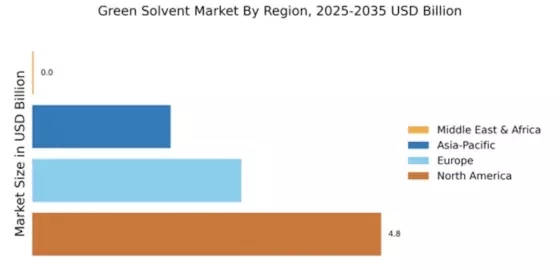
North America is witnessing significant growth in the green solvent market, driven by increasing environmental regulations and a shift towards sustainable practices. The market size reached $2.87 billion in 2025, reflecting a growing demand for eco-friendly alternatives in various industries. Regulatory catalysts, such as the EPA's initiatives to reduce VOC emissions, are further propelling this trend, making green solvents a preferred choice for manufacturers. The United States leads the North American market, with key players like Dow Inc. and Eastman Chemical Company dominating the landscape. The competitive environment is characterized by innovation and strategic partnerships aimed at enhancing product offerings. As companies invest in R&D, the presence of major firms ensures a robust supply chain, catering to diverse applications in paints, coatings, and cleaning products.

Europe : Market Share Leader

Europe holds the largest market share in the green solvent sector, valued at $4.79 billion in 2025. The region's growth is fueled by stringent environmental regulations and a strong commitment to sustainability. The European Union's Green Deal and REACH regulations are pivotal in promoting the adoption of green solvents, encouraging industries to transition from traditional solvents to more sustainable options, thereby reducing environmental impact. Germany, France, and the UK are the leading countries in this market, with major players like BASF SE and AkzoNobel N.V. driving innovation. The competitive landscape is marked by a focus on developing bio-based solvents and enhancing product performance. As the demand for eco-friendly solutions rises, European companies are well-positioned to capitalize on this trend, ensuring a sustainable future for the industry.

Asia-Pacific : Emerging Market Potential

The Asia-Pacific region is emerging as a significant player in the green solvent market, with a market size of $1.76 billion in 2025. The growth is driven by increasing industrialization, urbanization, and a rising awareness of environmental issues. Countries like China and India are implementing stricter regulations on solvent emissions, which is boosting the demand for green solvents as industries seek compliant alternatives to traditional solvents. China is the largest market in the region, with a growing number of local manufacturers entering the green solvent space. Key players such as Mitsubishi Chemical Corporation are focusing on innovation and sustainability to capture market share. The competitive landscape is evolving, with both multinational corporations and local firms striving to meet the increasing demand for eco-friendly products across various applications, including automotive and construction.

Middle East and Africa : Untapped Market Opportunities

The Middle East and Africa region represents a nascent market for green solvents, with a size of $0.16 billion in 2025. The slow growth can be attributed to limited awareness and adoption of sustainable practices in many industries. However, there is a growing recognition of the need for environmentally friendly solutions, driven by global trends and local regulatory pressures. As industries begin to shift towards sustainability, the demand for green solvents is expected to gradually increase. Countries like South Africa and the UAE are beginning to explore the potential of green solvents, with local companies starting to invest in sustainable alternatives. The competitive landscape is still developing, with few key players present. As awareness grows and regulations tighten, the market is likely to see increased participation from both local and international firms, paving the way for future growth in this region.

Key Players and Competitive Insights

The Green Solvent Market is currently characterized by a dynamic competitive landscape, driven by increasing environmental regulations and a growing demand for sustainable products. Key players such as BASF SE (Germany), Dow Inc. (US), and Solvay S.A. (Belgium) are strategically positioning themselves through innovation and partnerships. BASF SE (Germany) has focused on developing bio-based solvents, which aligns with the rising consumer preference for eco-friendly solutions. Meanwhile, Dow Inc. (US) emphasizes digital transformation and supply chain optimization to enhance operational efficiency and reduce environmental impact. Solvay S.A. (Belgium) is actively pursuing mergers and acquisitions to expand its portfolio of green solvents, thereby strengthening its market presence and competitive edge.

The market structure appears moderately fragmented, with several players vying for market share. Key business tactics include localizing manufacturing to reduce transportation emissions and optimizing supply chains for sustainability. The collective influence of these major companies shapes the competitive environment, as they strive to meet the increasing demand for green solvents while adhering to stringent regulations.

In October 2025, Dow Inc. (US) announced a partnership with a leading technology firm to develop AI-driven solutions for optimizing solvent production processes. This strategic move is likely to enhance Dow's operational efficiency and reduce costs, positioning the company favorably in a market that increasingly values technological integration. The collaboration may also facilitate the development of innovative products that cater to evolving consumer preferences.

In November 2025, BASF SE (Germany) launched a new line of bio-based solvents derived from renewable resources. This initiative not only underscores BASF's commitment to sustainability but also responds to the growing demand for environmentally friendly alternatives in various industries. The introduction of these products could potentially capture a significant market share, as businesses seek to comply with environmental regulations and enhance their sustainability profiles.

In December 2025, Solvay S.A. (Belgium) completed the acquisition of a smaller competitor specializing in green solvents. This acquisition is expected to bolster Solvay's product offerings and expand its market reach. By integrating the acquired company's technologies and expertise, Solvay may enhance its competitive positioning and drive innovation in the green solvent sector.

As of December 2025, current trends in the Green Solvent Market indicate a shift towards digitalization, sustainability, and AI integration. Strategic alliances are increasingly shaping the competitive landscape, as companies recognize the value of collaboration in driving innovation. The focus appears to be shifting from price-based competition to differentiation through technology, sustainability, and supply chain reliability. This evolution suggests that companies that prioritize innovation and sustainable practices are likely to thrive in the future.

Key Companies in the Green Solvent Market market include

Industry Developments

  • Q2 2024: Cargill opens new bioindustrial facility in Eddyville, Iowa to expand green solvents production Cargill announced the opening of a new bioindustrial facility in Eddyville, Iowa, dedicated to the production of bio-based solvents, aiming to meet growing demand for sustainable alternatives in the chemical industry.
  • Q1 2024: Stepan Company launches new line of bio-based solvents for industrial applications Stepan Company introduced a new portfolio of bio-based solvents designed for use in coatings, adhesives, and cleaning products, expanding its offerings in the green solvents market.
  • Q2 2024: BASF and Avantium sign partnership to develop next-generation green solvents BASF and Avantium announced a strategic partnership to jointly develop and commercialize new green solvents derived from renewable feedstocks, targeting applications in paints and coatings.
  • Q3 2024: Solvay inaugurates new R&D center focused on green solvent innovation in Lyon, France Solvay opened a new research and development center in Lyon, France, dedicated to advancing green solvent technologies and accelerating the commercialization of sustainable chemical solutions.
  • Q2 2024: LanzaTech secures $50 million Series C funding to scale green solvent production LanzaTech raised $50 million in Series C funding to expand its proprietary gas fermentation technology for producing green solvents from industrial emissions.
  • Q1 2025: Evonik launches new green solvent for pharmaceutical synthesis Evonik introduced a new green solvent specifically designed for pharmaceutical synthesis, offering improved safety and environmental performance compared to traditional solvents.
  • Q2 2025: Clariant announces partnership with Neste to supply bio-based feedstocks for green solvents Clariant and Neste entered into a partnership to secure sustainable, bio-based feedstocks for the production of green solvents, supporting Clariant’s commitment to circular chemistry.
  • Q1 2024: Dow unveils new eco-friendly solvent platform for paints and coatings Dow launched a new platform of eco-friendly solvents aimed at reducing volatile organic compound (VOC) emissions in paints and coatings, reinforcing its sustainability strategy.
  • Q3 2024: INEOS completes acquisition of bio-based solvent producer Ecovio INEOS announced the acquisition of Ecovio, a leading producer of bio-based solvents, to strengthen its position in the sustainable chemicals market.
  • Q2 2025: AkzoNobel opens new green solvent manufacturing plant in the Netherlands AkzoNobel inaugurated a new manufacturing facility in the Netherlands dedicated to the production of green solvents for use in paints, coatings, and cleaning products.
  • Q1 2025: DSM appoints new Head of Green Solvents Business Unit DSM announced the appointment of a new executive to lead its Green Solvents Business Unit, reflecting the company’s focus on expanding its sustainable product portfolio.
  • Q2 2024: Shell and Braskem sign agreement to co-develop renewable solvents Shell and Braskem entered into a collaboration agreement to jointly develop and commercialize renewable solvents for industrial and consumer applications.

Future Outlook

Green Solvent Market Future Outlook

The Green Solvent Market is projected to grow at a 5.12% CAGR from 2024 to 2035, driven by increasing environmental regulations, demand for sustainable products, and technological advancements.

New opportunities lie in:

  • Development of bio-based solvent formulations for industrial applications.
  • Expansion into emerging markets with tailored green solvent solutions.

  • Investment in R&D for innovative solvent recycling technologies.

By 2035, the Green Solvent Market is expected to achieve substantial growth, reflecting a robust commitment to sustainability.

Market Segmentation

Green Solvent Market Type Outlook

  • Bio-based Solvents
  • Synthetic Solvents
  • Water-based Solvents
  • Supercritical Fluids
  • Ionic Liquids

Green Solvent Market Application Outlook

  • Paints
  • Adhesives
  • Coatings
  • Cleaning Agents
  • Personal Care Products

Green Solvent Market Functionality Outlook

  • Solubilizing Agents
  • Cleaning Agents
  • Degreasing Agents
  • Extracting Agents
  • Emulsifiers

Green Solvent Market End Use Industry Outlook

  • Automotive
  • Construction
  • Electronics
  • Pharmaceuticals
  • Food and Beverage

Green Solvent Market Formulation Type Outlook

  • Aqueous Formulations
  • Non-Aqueous Formulations
  • Emulsions
  • Suspensions
  • Solutions

Report Scope

MARKET SIZE 20249.58(USD Billion)
MARKET SIZE 202510.07(USD Billion)
MARKET SIZE 203516.6(USD Billion)
COMPOUND ANNUAL GROWTH RATE (CAGR)5.12% (2024 - 2035)
REPORT COVERAGERevenue Forecast, Competitive Landscape, Growth Factors, and Trends
BASE YEAR2024
Market Forecast Period2025 - 2035
Historical Data2019 - 2024
Market Forecast UnitsUSD Billion
Key Companies ProfiledBASF SE (DE), Dow Inc. (US), LyondellBasell Industries N.V. (US), Solvay S.A. (BE), Eastman Chemical Company (US), AkzoNobel N.V. (NL), Huntsman Corporation (US), Clariant AG (CH), Mitsubishi Chemical Corporation (JP)
Segments CoveredApplication, End Use Industry, Type, Functionality, Formulation Type
Key Market OpportunitiesGrowing demand for sustainable products drives innovation in the Green Solvent Market.
Key Market DynamicsRising regulatory pressures and consumer demand drive innovation and adoption of sustainable green solvents across various industries.
Countries CoveredNorth America, Europe, APAC, South America, MEA

Leave a Comment

FAQs

What is the market size of the Green Solvent Market?

Green Solvent Market is expected to grow with a CAGR of 5.12% in the period 2025-2035

Which region is expected to hold the largest market share in the Green Solvent Market?

Asia-Pacific is expected to hold the largest market share in the Green Solvent Market, owing to the increasing demand for green solvents in various industries such as pharmaceuticals, electronics, and automotive.

What are the key drivers of the Green Solvent Market?

The key drivers of the Green Solvent Market include the growing demand for sustainable and environmentally friendly products, stringent government regulations on VOC emissions, and increasing adoption of green solvents in various industries.

What are the major applications of Green Solvents?

Green solvents are used in a wide range of applications, including paints and coatings, cleaning agents, adhesives, and pharmaceuticals. They are also used in the extraction of natural products and in the synthesis of various chemicals.

Who are the key competitors in the Green Solvent Market?

Some of the key competitors in the Green Solvent Market include BASF, Dow, Eastman Chemical, Evonik, and INEOS.

What is the expected growth rate of the Green Solvent Market?

Green Solvent Market is projected to grow at a CAGR of 5.12% during the forecast period, 2025-2035

What are the challenges faced by the Green Solvent Market?

The Green Solvent Market faces challenges such as the high cost of green solvents compared to traditional solvents, the limited availability of green solvents, and the lack of awareness about the benefits of green solvents.

What are the opportunities in the Green Solvent Market?

The Green Solvent Market presents opportunities such as the increasing demand for sustainable products, the growing adoption of green solvents in various industries, and supportive government regulations.

What are the key trends in the Green Solvent Market?

Key trends in the Green Solvent Market include the development of new green solvents, the increasing use of bio-based green solvents, and the growing adoption of green solvents in emerging markets.

What is the outlook for the Green Solvent Market?

The outlook of the Green Solvent Market is positive, driven by the increasing demand for sustainable products, the growing adoption of green solvents in various industries, and supportive government regulations.

Download Free Sample

Kindly complete the form below to receive a free sample of this Report

Compare Licence

×
Features License Type
Single User Multiuser License Enterprise User
Price $4,950 $5,950 $7,250
Maximum User Access Limit 1 User Upto 10 Users Unrestricted Access Throughout the Organization
Free Customization
Direct Access to Analyst
Deliverable Format
Platform Access
Discount on Next Purchase 10% 15% 15%
Printable Versions