×
Request Free Sample ×

Kindly complete the form below to receive a free sample of this Report

* Please use a valid business email

Leading companies partner with us for data-driven Insights

clients tt-cursor
Hero Background

Solvent Market

ID: MRFR/CnM/7009-HCR
185 Pages
Priya Nagrale
February 2026

Solvent Market Research Report Information By Type (Alcohols, Ketones, Esters, Aromatic, Aliphatic and Other), By Source (Petrochemical-Based and Bio-based Solvents), By Application (Paints And Coatings, Adhesives, Pharmaceuticals, Cosmetics and Personal care and Other) and By Region - Forecast to 2035.

Share:
Download PDF ×

We do not share your information with anyone. However, we may send you emails based on your report interest from time to time. You may contact us at any time to opt-out.

Solvent Market Infographic
Purchase Options

Solvent Market Summary

As per MRFR analysis, the Solvent Market Size was estimated at 16.78 USD Billion in 2024. The Solvent industry is projected to grow from 19.49 USD Billion in 2025 to 87.13 USD Billion by 2035, exhibiting a compound annual growth rate (CAGR) of 16.16% during the forecast period 2025 - 2035.

Key Market Trends & Highlights

The solvent market is currently experiencing a transformative shift towards sustainability and innovation.

  • The market is witnessing a notable shift towards eco-friendly solvents, driven by increasing environmental regulations.
  • Technological advancements in solvent production are enhancing efficiency and reducing costs across various applications.
  • North America remains the largest market for solvents, while the Asia-Pacific region is recognized as the fastest-growing market.
  • The rising demand for paints and coatings, along with the growth in adhesives and sealants, serves as a key driver for market expansion.

Market Size & Forecast

2024 Market Size 16.78 (USD Billion)
2035 Market Size 87.13 (USD Billion)
CAGR (2025 - 2035) 16.16%

Major Players

BASF (DE), Dow (US), ExxonMobil (US), SABIC (SA), LyondellBasell (US), Eastman Chemical (US), Solvay (BE), Mitsubishi Chemical (JP), Huntsman Corporation (US)

Our Impact
Enabled $4.3B Revenue Impact for Fortune 500 and Leading Multinationals
Partnering with 2000+ Global Organizations Each Year
30K+ Citations by Top-Tier Firms in the Industry

Solvent Market Trends

The Solvent Market is currently experiencing a dynamic evolution, driven by various factors including environmental regulations, technological advancements, and shifting consumer preferences. As industries increasingly prioritize sustainability, there is a noticeable shift towards eco-friendly solvents. This transition appears to be influenced by stringent regulations aimed at reducing volatile organic compounds (VOCs) and promoting safer alternatives. Consequently, manufacturers are investing in research and development to create innovative products that align with these environmental standards. Furthermore, the rise of green chemistry is fostering the development of bio-based solvents, which are derived from renewable resources and are perceived as more sustainable options. In addition to environmental considerations, the Solvent Market is also shaped by the growing demand from end-user industries such as paints and coatings, pharmaceuticals, and adhesives. These sectors are increasingly seeking high-performance solvents that enhance product efficacy while minimizing environmental impact. The ongoing globalization of trade is further contributing to market expansion, as companies seek to tap into emerging markets with rising industrial activities. Overall, the Solvent Market appears poised for continued growth, with a focus on sustainability and innovation driving its trajectory.


Shift Towards Eco-Friendly Solvents


The Solvent Market is witnessing a pronounced shift towards eco-friendly solvents, driven by increasing environmental regulations and consumer demand for sustainable products. This trend suggests that manufacturers are prioritizing the development of solvents with lower environmental impact, which may include bio-based and renewable options.


Technological Advancements in Solvent Production


Technological innovations are playing a crucial role in the Solvent Market, enabling the creation of more efficient and effective solvents. These advancements may lead to improved production processes, resulting in higher quality products that meet the evolving needs of various industries.


Rising Demand from End-User Industries


The Solvent Market is experiencing heightened demand from key end-user sectors such as paints, coatings, and pharmaceuticals. This trend indicates that as these industries grow, they are increasingly relying on solvents that enhance performance while adhering to stricter environmental standards.

Solvent Market Drivers

Market Growth Projections

The Global Solvent Market Industry is projected to experience substantial growth over the coming years. With a market value of 28.2 USD Billion in 2024, it is anticipated to reach 68.2 USD Billion by 2035. This growth trajectory suggests a compound annual growth rate of 8.35% from 2025 to 2035. Such projections indicate a robust demand across various sectors, including automotive, pharmaceuticals, and paints and coatings. The increasing focus on sustainability and innovation within the industry further supports this positive outlook, suggesting that the Global Solvent Market Industry is well-positioned for future expansion.

Rising Demand in Automotive Sector

The Global Solvent Market Industry is experiencing a notable surge in demand from the automotive sector. As manufacturers increasingly prioritize the use of solvents for paint thinners, adhesives, and coatings, the market is projected to reach 28.2 USD Billion in 2024. This growth is driven by the automotive industry's shift towards more environmentally friendly products, which often require high-quality solvents for effective application. The increasing production of electric vehicles, which necessitate advanced coatings and adhesives, further propels this trend. Consequently, the automotive sector plays a pivotal role in shaping the future landscape of the Global Solvent Market Industry.

Increasing Environmental Regulations

The Global Solvent Market Industry is also shaped by increasing environmental regulations aimed at reducing volatile organic compounds (VOCs) emissions. Governments worldwide are implementing stricter guidelines to promote the use of low-VOC and eco-friendly solvents. This regulatory landscape is pushing manufacturers to innovate and develop greener alternatives, which could reshape the market dynamics. While this transition may present challenges, it also opens avenues for growth in the segment of sustainable solvents. As a result, the Global Solvent Market Industry may witness a shift towards more environmentally compliant products, aligning with global sustainability goals.

Growth in Paints and Coatings Industry

The Global Solvent Market Industry is poised for growth due to the expanding paints and coatings sector. Solvents are integral to the formulation of various paints, varnishes, and coatings, which are widely used in construction, automotive, and industrial applications. As urbanization accelerates and infrastructure development projects proliferate, the demand for high-quality coatings is expected to rise. This trend is likely to contribute to the market's compound annual growth rate of 8.35% from 2025 to 2035. The paints and coatings industry, therefore, represents a critical driver for the Global Solvent Market Industry, influencing both production and consumption patterns.

Expansion of Pharmaceutical Applications

The Global Solvent Market Industry is significantly influenced by the expansion of pharmaceutical applications. Solvents are essential in drug formulation, extraction processes, and as reaction media in pharmaceutical manufacturing. The increasing focus on developing new drugs and therapies, particularly in the wake of rising health concerns, is expected to bolster the market. With the pharmaceutical sector projected to grow substantially, the demand for solvents is likely to follow suit. This trend suggests that the Global Solvent Market Industry could see a marked increase in value, potentially aligning with the overall market growth forecast of 68.2 USD Billion by 2035.

Technological Advancements in Solvent Production

Technological advancements in solvent production are a key driver of the Global Solvent Market Industry. Innovations in extraction and purification processes enhance the efficiency and quality of solvents, making them more suitable for various applications. The adoption of advanced manufacturing techniques, such as green chemistry principles, is likely to improve production efficiency while minimizing environmental impact. These advancements not only cater to the growing demand for high-performance solvents but also align with the industry's shift towards sustainability. As a result, the Global Solvent Market Industry is expected to benefit from these technological developments, fostering growth and competitiveness.
Market Segment Insights

By Application: Paints and Coatings (Largest) vs. Adhesives (Fastest-Growing)

In the solvent market, the 'Application' segment is dominated by the Paints and Coatings category, which holds the largest share. This segment benefits from the increasing demand for decorative and protective coatings in the construction and automotive industries. Following closely are Adhesives, which are gaining traction due to their integral use in construction, automotive, and electronics, highlighting a significant shift towards more eco-friendly and efficient bonding solutions.

Paints and Coatings (Dominant) vs. Adhesives (Emerging)

Paints and Coatings continue to dominate the solvent market due to their essential role in applications across various industries, particularly in construction and automotive. This segment emphasizes quality and performance, indicated by the consistent preference for high-solid and low-VOC formulations. In comparison, Adhesives represent the emerging force within the market, driven by technological advancements and a growing trend towards sustainable products. As industries seek stronger and more environmentally friendly bonding solutions, adhesives are expanding rapidly, introducing innovative solvent-based formulations that cater to diverse applications.

By End Use Industry: Automotive (Largest) vs. Electronics (Fastest-Growing)

In the Solvent Market, the automotive industry holds the largest share, driven by the increasing demand for coatings and adhesives in vehicle manufacturing and maintenance. Concurrently, the electronics sector is emerging as a significant player, leveraging solvents for cleaning and degreasing applications in electronic components, contributing to its expansion in market share. As environmental regulations tighten, the need for compliant solvent solutions in these sectors is becoming more crucial, shaping their market dynamics.

Automotive: Adhesives (Dominant) vs. Electronics: Cleaning Agents (Emerging)

The automotive sector, characterized by the dominance of adhesives , plays a critical role in vehicle assembly, ensuring structural integrity and aesthetic appeal. As automakers focus on lightweight materials to enhance fuel efficiency, the adoption of high-performance adhesives is expected to rise. On the other hand, the electronics industry's use of cleaning agents is gaining momentum, attributed to the growing demand for precision cleaning of intricate components. This segment benefits from advances in solvent formulation that prioritize sustainability and efficacy, marking its established and emerging positions within the solvent market.

By Chemical Composition: Hydrocarbon Solvents (Largest) vs. Alcohols (Fastest-Growing)

In the Solvent Market, hydrocarbon solvents currently dominate the landscape, comprising a significant share due to their extensive applications in paints, coatings, and industrial cleaning. However, alcohols are the fastest-growing segment, increasingly favored for their eco-friendly properties and versatility across various industries, including pharmaceuticals and personal care. Together, these segments highlight a clear bifurcation in consumer preferences, with traditional hydrocarbons still holding strong while alternatives rise in prominence.

Hydrocarbon Solvents (Dominant) vs. Alcohols (Emerging)

Hydrocarbon Solvents are characterized by their versatility and efficiency, making them the preferred choice for many industrial applications. They are utilized in paints, varnishes, and cleaning products due to their exceptional solvency and evaporation rates. In contrast, Alcohols represent an emerging trend in the solvent market, driven by their eco-friendliness and lower toxicity. They are increasingly adopted in various end-use sectors due to their ability to act as both solvents and functional ingredients, indicating a shift towards sustainable practices within the industry.

By Physical State: Liquid (Largest) vs. Solid (Fastest-Growing)

In the Solvent Market, the distribution of segments by physical state reveals that liquid solvents hold the dominant share, characterized by their extensive use in a variety of applications including paints, coatings, and pharmaceuticals. Solid solvents, while currently smaller in market share, are rapidly gaining traction due to advancements in formulation technologies that enhance their usefulness in specialized industrial processes. Gas solvents, although less common, serve niche applications, providing unique benefits in specific activities such as extraction and purification processes.

Liquid (Dominant) vs. Solid (Emerging)

Liquid solvents are the backbone of the Solvent Market, favored for their versatility and wide-ranging applications. They are integral to various industries due to their ability to dissolve a broad spectrum of compounds and their advantages in handling and application. Solid solvents are emerging with characteristics that enable them to be used in innovative applications where liquid options have limitations. Their growth is fueled by increasing demand for more sustainable and efficient solvents in sectors like pharmaceuticals and materials science. As formulations advance, solid solvents are likely to gain more market share, indicating a shift towards their adoption.

By Regulatory Compliance: Volatile Organic Compounds (Largest) vs. Green Solvents (Fastest-Growing)

In the Solvent Market, the distribution of regulatory compliance segment values is primarily dominated by Volatile Organic Compounds (VOCs), which hold the largest market share due to widespread applications in various industries, including paints, coatings, and adhesives. Non-VOC solvents, while less common, also play a crucial role for businesses looking to comply with stringent environmental regulations, and Green Solvents are emerging rapidly as companies shift towards more sustainable practices. As the Solvent Market  moves towards stricter environmental standards, the growth of Green Solvents is noteworthy, making them the fastest-growing segment. Companies are increasingly investing in innovative technologies that reduce VOC emissions and utilize bio-based materials, driving the adoption of Green Solvents. The rising consumer demand for environmentally friendly products is further propelling this growth, as regulations around the use of VOCs tighten, stimulating market transformation towards non-toxic alternatives.

Solvents: VOCs (Dominant) vs. Green Solvents (Emerging)

Volatile Organic Compounds (VOCs) are the dominant player in the solvent market, known for their effectiveness and versatility in various applications such as coatings, adhesives, and industrial cleaning. However, due to their environmental impact, they face increasing regulatory scrutiny, prompting businesses to seek alternatives. In contrast, Green Solvents are emerging as a preferred choice for manufacturers aiming to align with sustainability goals and reduce their carbon footprint. Green Solvents, derived from renewable resources, offer similar or improved performance without compromising safety or regulatory compliance. As industries strive for greener solutions, the shift towards Green Solvents is gaining momentum, positioning them as a vital segment that will reshape the market landscape.

Get more detailed insights about Solvent Market

Regional Insights

North America : Established Market with Growth Potential

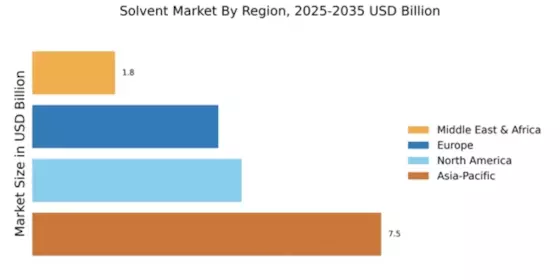
The North American Solvent Market, valued at $4.5 billion, is driven by robust demand from the automotive, construction, and coatings industries. Regulatory support for environmentally friendly solvents is also a significant catalyst for growth. The region's focus on sustainability and innovation is expected to enhance market dynamics, with a projected growth rate of 3-4% annually through 2025. Leading countries like the US and Canada dominate the market, with key players such as Dow Inc. and ExxonMobil Chemical Company driving competition. The presence of established manufacturers and a strong distribution network further solidify North America's position in The Solvent. The competitive landscape is characterized by strategic partnerships and technological advancements aimed at meeting evolving consumer demands.

Europe : Innovation and Sustainability Focus

Europe's Solvent Market, valued at $4.0 billion, is characterized by a strong emphasis on sustainability and innovation. Regulatory frameworks, such as REACH, promote the use of safer solvents, driving demand for eco-friendly alternatives. The market is expected to grow steadily, supported by increasing applications in the automotive and pharmaceutical sectors. Germany, France, and the UK are leading countries in this region, with major players like BASF SE and LyondellBasell Industries N.V. enhancing competitive dynamics. The presence of advanced manufacturing facilities and a focus on R&D contribute to the region's market strength. As companies adapt to regulatory changes, the competitive landscape is evolving, fostering innovation and collaboration among industry stakeholders.

Asia-Pacific : Emerging Powerhouse in Solvents

The Asia-Pacific Solvent Market, valued at $7.5 billion, is the largest globally, driven by rapid industrialization and urbanization. Key growth drivers include increasing demand from the automotive, electronics, and construction sectors. The region's favorable regulatory environment and investments in infrastructure are expected to propel market growth, with an annual growth rate of 5-6% projected through 2025. China, Japan, and India are the leading countries in this market, with significant contributions from key players like Mitsubishi Chemical Corporation and Eastman Chemical Company. The competitive landscape is marked by a mix of local and international companies, fostering innovation and competitive pricing. As the region continues to expand, the solvent market is poised for substantial growth, supported by increasing consumer demand and technological advancements.

Middle East and Africa : Resource-Rich Frontier for Solvents

The Middle East and Africa Solvent Market, valued at $1.78 billion, is emerging as a significant player in the global landscape. The region's growth is driven by increasing industrial activities and a rising demand for solvents in the oil and gas, paints, and coatings sectors. Regulatory initiatives aimed at promoting local manufacturing are also contributing to market expansion. Countries like Saudi Arabia and South Africa are at the forefront of this growth, with key players such as SABIC and Shell Chemicals establishing a strong presence. The competitive landscape is evolving, with investments in infrastructure and technology enhancing production capabilities. As the region seeks to diversify its economy, the solvent market is expected to benefit from increased investments and strategic partnerships.

Solvent Market Regional Image

Key Players and Competitive Insights

The Solvent Market is characterized by a dynamic competitive landscape, driven by increasing demand across various end-use industries such as paints and coatings, pharmaceuticals, and adhesives. Key players are actively pursuing strategies that emphasize innovation, sustainability, and regional expansion to enhance their market positions. For instance, BASF (DE) has focused on developing bio-based solvents, which aligns with the growing trend towards environmentally friendly products. Similarly, Dow (US) has been investing in digital transformation initiatives to optimize its operations and improve customer engagement, thereby reinforcing its competitive edge. The market structure appears moderately fragmented, with several players vying for market share. Companies are increasingly localizing manufacturing to reduce lead times and enhance supply chain efficiency. This tactic not only mitigates risks associated with The Solvent demands. The collective influence of major players, including ExxonMobil (US) and SABIC (SA), suggests a competitive environment where collaboration and strategic partnerships are becoming essential for sustained growth. In November 2025, ExxonMobil (US) announced a significant investment in a new facility aimed at producing high-performance solvents tailored for the automotive sector. This strategic move is likely to enhance ExxonMobil's product offerings and strengthen its position in a rapidly evolving market. The investment underscores the company's commitment to innovation and its responsiveness to the specific needs of key industries. In October 2025, SABIC (SA) launched a new line of sustainable solvents derived from renewable resources. This initiative not only reflects the company's dedication to sustainability but also positions it favorably in a market increasingly driven by environmental considerations. The introduction of these products may attract a broader customer base seeking eco-friendly alternatives, thereby enhancing SABIC's competitive stance. In September 2025, LyondellBasell (US) entered into a strategic partnership with a leading technology firm to develop advanced solvent recycling technologies. This collaboration is indicative of a broader trend towards circular economy practices within the industry. By focusing on recycling, LyondellBasell aims to reduce waste and improve resource efficiency, which could lead to cost savings and a stronger market position. As of December 2025, the Solvent Market is witnessing trends that emphasize digitalization, sustainability, and the integration of AI technologies. Strategic alliances are increasingly shaping the competitive landscape, enabling companies to leverage shared resources and expertise. The shift from price-based competition to a focus on innovation and technology is evident, as firms prioritize supply chain reliability and product differentiation. Looking ahead, competitive differentiation is likely to evolve further, with companies that embrace these trends poised to lead the market.

Key Companies in the Solvent Market include

Industry Developments

February 2023, LyondellBasell and KIRKBI invest in APK to develop recycling technology: LyondellBasell (NYSE: LYB), a leader in the chemical industry and KIRKBI A/S, the family-owned holding and investment company of the LEGO brand, announces they have signed an agreement to make an investment in APK, which specializes in a unique solvent-based recycling technology for low density polyethylene (LDPE).

April 2022- Solvay : announces the production of a new generation solvent at its Melle site: Solvay announces the production of the new generation solvent Rhodiasolv®IRIS, with excellent eco-friendly properties. Previously manufactured in China, this solvent will now be produced from 2023 onwards at Solvay's Melle site(France). Rhodiasolv®IRIS is efficient, non-flammable, readily biodegradable, low volatile and non-CMR (carcinogenic, mutagenic and reprotoxic). It is used in many applications such as formulation of phytosanitary products, paint stripping, graffiti and resin clean-up, industrial cleaning and agrochemistry

June 2021, Neste and LyondellBasell today announced a long-term commercial agreement under which LyondellBasell will source Neste RE™, a feedstock from Neste that has been produced from 100% renewable feedstock from bio-based sources, such as waste and residue oils and fats. This feedstock will be processed through the cracker at LyondellBasell’s Wesseling, Germany, plant into polymers and sold under the CirculenRenew brand name.

Future Outlook

Solvent Market Future Outlook

The Solvent Market is projected to grow at a 16.16% CAGR from 2025 to 2035, driven by increasing demand in pharmaceuticals, paints, and coatings. The future outlook for Solvents Market is positive, driven by high demand in pharmaceutical synthesis and the construction-led paints sector. The transition toward bio-based, low-VOC alternatives remains the critical growth catalyst.

New opportunities lie in:

  • Development of bio-based solvents for eco-friendly applications. Expansion into emerging markets with tailored solvent solutions. Investment in advanced recycling technologies for solvent recovery.

By 2035, the Solvent Market is expected to achieve substantial growth, reflecting evolving industry needs and sustainability trends.

Market Segmentation

Solvent Market Application Outlook

  • Paints and Coatings

  • Adhesives

  • Cleaning Agents

  • Pharmaceuticals

  • Cosmetics

Solvent Market Physical State Outlook

  • Liquid

  • Solid

  • Gas

Solvent Market End Use Industry Outlook

  • Automotive

  • Construction

  • Electronics

  • Food and Beverage

  • Textiles

Solvent Market Chemical Composition Outlook

  • Hydrocarbon Solvents

  • Alcohols

  • Esters

  • Ketones

  • Aromatic Solvents

Solvent Market Regulatory Compliance Outlook

  • Volatile Organic Compounds

  • Non-VOC Solvents

  • Green Solvents

Report Scope

MARKET SIZE 2024 16.78(USD Billion)
MARKET SIZE 2025 19.49(USD Billion)
MARKET SIZE 2035 87.13(USD Billion)
COMPOUND ANNUAL GROWTH RATE (CAGR) 16.16% (2025 - 2035)
REPORT COVERAGE Revenue Forecast, Competitive Landscape, Growth Factors, and Trends
BASE YEAR 2024
Market Forecast Period 2025 - 2035
Historical Data 2019 - 2024
Market Forecast Units USD Billion
Key Companies Profiled BASF (DE), Dow (US), ExxonMobil (US), SABIC (SA), LyondellBasell (US), Eastman Chemical (US), Solvay (BE), Mitsubishi Chemical (JP), Huntsman Corporation (US)
Segments Covered Application, End Use Industry, Chemical Composition, Physical State, Regulatory Compliance
Key Market Opportunities Growing demand for eco-friendly solvents driven by regulatory changes and consumer preferences.
Key Market Dynamics Rising demand for eco-friendly solvents drives innovation and regulatory shifts in the solvent market.
Countries Covered North America, Europe, APAC, South America, MEA

Market Highlights

Author
Priya Nagrale
Senior Research Analyst

With an experience of over five years in market research industry (Chemicals & Materials domain), I gather and analyze market data from diverse sources to produce results, which are then presented back to a client. Also, provide recommendations based on the findings. As a Senior Research Analyst, I perform quality checks (QC) for market estimations, QC for reports, and handle queries and work extensively on client customizations. Also, handle the responsibilities of client proposals, report planning, report finalization, and execution

Leave a Comment

FAQs

How much is the Solvent Market?

The solvent market size was USD 25.6 Billion in 2022

What is the growth rate of the Solvent Market?

The solvents market registered a CAGR of 6.4% during the forecast period.

Which region held the largest market share in the Solvent Market?

Asia-Pacific largest market share in the Solvent Market

Who are the key players in the Solvent Market?

BASF SE (Germany), Solvay SA (Belgium), Eastman Chemical Company (US), Exxon Mobil Corporation (US), Royal Dutch Shell Plc (Netherlands), Sasol Solvents (South Africa), Ashland Inc. (US), Chevron Phillips Chemical Company LLC (US), Kuraray Co., Ltd. (Japan), LyondellBasell Industries Holdings B.V. (Netherlands), The Dow Chemical Company (US), TotalEnergies SE (France), INEOS AG (US) and Huntsman International LLC (US)

Which Type led the Solvent Market?

Acohols

Which Source had the largest market share in the Solvent Market?

Petrochemical-Based

Which Application had the largest market share in the Solvent Market?

Paints And Coatings

Research Approach


Secondary Research

The secondary research process involved comprehensive analysis of chemical industry regulatory databases, peer-reviewed materials science journals, petrochemical industry publications, and authoritative chemical safety organizations. Key sources included the US Environmental Protection Agency (EPA), European Chemicals Agency (ECHA), Occupational Safety and Health Administration (OSHA), American Chemistry Council (ACC), European Chemical Industry Council (Cefic), International Council of Chemical Associations (ICCA), National Institute for Occupational Safety and Health (NIOSH), PubChem (National Library of Medicine), US Geological Survey (USGS) Mineral Commodity Summaries, Eurostat Chemical Industry Statistics, International Energy Agency (IEA) Petrochemicals Tracker, and national environmental ministry reports from key manufacturing markets. These sources were used to collect production capacity statistics, regulatory compliance data (particularly VOC emission standards), chemical safety assessments, trade flow analysis, and market landscape evaluation for petrochemical-based solvents, bio-based alternatives, alcohols, ketones, esters, and specialty solvent categories.


Primary Research

As part of the initial research process, stakeholders from both the supply and demand sides were interviewed to get both qualitative and quantitative information. CEOs, VPs of Manufacturing Operations, heads of regulatory compliance, and marketing directors from solvent manufacturers, petrochemical conglomerates, and chemical distributors were some of the supply-side sources. On the demand side, there were procurement directors from paints and coatings companies, R&D heads from drug formulations companies, supply chain managers from adhesives companies, and sustainability officers from makeup and personal care brands. Primary study confirmed market segmentation for alcohols and bio-based products, confirmed green chemistry pipeline timelines, and gathered information on how businesses adopt new technologies, how they price goods in bulk, and how much it costs to follow the rules.

Primary Respondent Breakdown:

By Designation: C-level Primaries (32%), Director Level (30%), Others (38%)

By Region: North America (32%), Europe (30%), Asia-Pacific (32%), Rest of World (6%)


Market Size Estimation

Global market valuation was derived through production volume mapping and capacity utilization analysis. The methodology included:

Identification of 50+ key manufacturers and refiners across North America, Europe, Asia-Pacific, Middle East & Africa, and South America

Product mapping across alcohols (methanol, ethanol, isopropanol), ketones (acetone, MEK), esters, aromatic solvents (toluene, xylene), aliphatic hydrocarbons, and emerging bio-based solvent categories

Analysis of reported and modeled annual revenues specific to solvent portfolios, including commodity and specialty grades

Coverage of manufacturers representing 75-80% of global market capacity in 2024

Extrapolation using bottom-up (production volume × average selling price by region and application) and top-down (manufacturer revenue validation against trade data) approaches to derive segment-specific valuations for paints & coatings, pharmaceutical, and adhesives applications

Download Free Sample

Kindly complete the form below to receive a free sample of this Report

Compare Licence

×
Features License Type
Single User Multiuser License Enterprise User
Price $4,950 $5,950 $7,250
Maximum User Access Limit 1 User Upto 10 Users Unrestricted Access Throughout the Organization
Free Customization
Direct Access to Analyst
Deliverable Format
Platform Access
Discount on Next Purchase 10% 15% 15%
Printable Versions