Download Free Sample
Kindly complete the form below to receive a free sample of this Report
Greenhouse and Vertical Farming System Maintenance Market Size, Share and Trends Analysis Research Report Information By End-User (Commercial Growers, Research Institutions, Educational Institutions, Government Agencies, Private Farms), By Technology (Hydroponics, Aeroponics, Aquaponics, Soil-Based Systems, Integrated Pest Management), By Application (Crop Production, Plant Propagation, Research and Development, Food Production, Horticulture), By System Type (Greenhouse Systems, Vertical Farming Systems, Container Farming Systems, Rooftop Farming Systems, Hybrid Systems), By Maintenance Type (Preventive Maintenance, Corrective Maintenance, Predictive Maintenance, Routine Maintenance, Emergency Maintenance), And By Region (North America, Europe, Asia-Pacific, And Rest Of The World) – Market Forecast Till 2035.
As per MRFR analysis, the Greenhouse & Vertical Farming System Maintenance Market was estimated at 4.2 USD Billion in 2024. The Greenhouse & Vertical Farming System Maintenance industry is projected to grow from 4.48 USD Billion in 2025 to 8.5 USD Billion by 2035, exhibiting a compound annual growth rate (CAGR) of 6.62% during the forecast period 2025 - 2035.
The Greenhouse and Vertical Farming System Maintenance Market is poised for substantial growth driven by technological advancements and sustainability initiatives.
| 2024 Market Size | 4.2 (USD Billion) |
| 2035 Market Size | 8.5 (USD Billion) |
| CAGR (2025 - 2035) | 6.62% |
AeroFarms (US), Plenty (US), Vertical Harvest (US), Green Spirit Farms (US), Urban Crop Solutions (BE), Gotham Greens (US), BrightFarms (US), Infarm (DE), Sky Greens (SG)
Our Impact
Enabled $4.3B Revenue Impact for Fortune 500 and Leading Multinationals
Partnering with 2000+ Global Organizations Each Year
30K+ Citations by Top-Tier Firms in the Industry
The Greenhouse & Vertical Farming System Maintenance Market is currently experiencing a notable evolution, driven by the increasing demand for sustainable agricultural practices. As urbanization accelerates, the necessity for efficient food production systems becomes more pronounced. This market appears to be influenced by technological advancements that enhance operational efficiency and reduce resource consumption. Moreover, the growing awareness of environmental issues seems to propel investments in innovative farming solutions, which may lead to a more resilient agricultural framework. In addition, the integration of smart technologies into greenhouse and vertical farming systems indicates a shift towards precision agriculture. This trend suggests that stakeholders are increasingly prioritizing data-driven decision-making to optimize crop yields and minimize waste. As the market continues to mature, it is likely that maintenance services will evolve to encompass a broader range of solutions, including automation and remote monitoring. The future of the Greenhouse & Vertical Farming System Maintenance Market appears promising, with potential for significant growth as it adapts to the changing landscape of global food production.
The incorporation of advanced technologies into greenhouse and vertical farming systems is reshaping maintenance practices. Automation, IoT devices, and data analytics are becoming integral, allowing for real-time monitoring and management of environmental conditions. This trend suggests that maintenance services will increasingly focus on integrating these technologies to enhance efficiency and reduce operational costs.
There is a growing emphasis on sustainable practices within the Greenhouse & Vertical Farming System Maintenance Market. Stakeholders are prioritizing eco-friendly solutions that minimize resource usage and reduce environmental impact. This trend indicates a shift towards maintenance strategies that align with broader sustainability goals, potentially influencing product development and service offerings.
The rise of urban agriculture is significantly impacting the Greenhouse & Vertical Farming System Maintenance Market. As cities seek to enhance food security and reduce transportation emissions, the demand for local food production systems is increasing. This trend suggests that maintenance services will need to adapt to the unique challenges and requirements of urban environments, fostering innovation in service delivery.
The Greenhouse & Vertical Farming System Maintenance Market is experiencing a surge in technological advancements that enhance operational efficiency. Automation and smart technologies, such as IoT sensors and AI-driven analytics, are increasingly integrated into maintenance practices. These innovations allow for real-time monitoring of environmental conditions, leading to optimized resource usage and reduced operational costs. According to recent data, the adoption of automated systems in greenhouse maintenance has led to a 20% reduction in labor costs. As these technologies evolve, they are likely to further streamline maintenance processes, making them more efficient and less labor-intensive. This trend not only improves productivity but also attracts new investments into the Greenhouse & Vertical Farming System Maintenance Market, as stakeholders seek to capitalize on the benefits of advanced technologies.
The Greenhouse & Vertical Farming System Maintenance Market is significantly influenced by the rising demand for locally sourced produce. Consumers are increasingly prioritizing fresh, organic, and locally grown food, which has led to a proliferation of greenhouse and vertical farming operations. This trend is supported by data indicating that the market for locally sourced food has grown by approximately 25% over the past few years. As more urban areas embrace vertical farming to meet this demand, the need for effective maintenance solutions becomes paramount. Proper maintenance ensures that these systems operate at peak efficiency, thereby maximizing yield and quality. Consequently, the Greenhouse & Vertical Farming System Maintenance Market is poised for growth as operators seek reliable maintenance services to support their production goals.
Government support and incentives play a crucial role in shaping the Greenhouse & Vertical Farming System Maintenance Market. Various governments are recognizing the importance of sustainable agriculture and are implementing policies that promote the establishment and maintenance of greenhouse and vertical farming systems. Financial incentives, such as grants and tax breaks, are being offered to encourage investment in these technologies. For instance, recent initiatives have allocated millions in funding to support urban agriculture projects, which directly impacts the maintenance sector. This support not only fosters innovation but also enhances the overall viability of the Greenhouse & Vertical Farming System Maintenance Market, as more operators are likely to invest in maintenance solutions that ensure compliance with regulatory standards.
Urbanization and space constraints are significant factors influencing the Greenhouse & Vertical Farming System Maintenance Market. As urban populations continue to grow, the demand for efficient food production systems within limited spaces becomes increasingly critical. Vertical farming, in particular, offers a solution by utilizing vertical space to maximize yield in urban environments. This trend is supported by data indicating that urban areas are projected to house over 68% of the global population by 2050. Consequently, the need for effective maintenance of these systems is paramount to ensure their productivity and sustainability. Operators are likely to invest in maintenance solutions that optimize space utilization and enhance operational efficiency. The Greenhouse & Vertical Farming System Maintenance Market is thus expected to thrive as urban agriculture becomes a vital component of food security strategies.
The Greenhouse & Vertical Farming System Maintenance Market is increasingly driven by environmental sustainability initiatives. As concerns about climate change and resource depletion grow, there is a heightened focus on sustainable farming practices. Greenhouse and vertical farming systems are often viewed as solutions to reduce the carbon footprint associated with traditional agriculture. Data suggests that these systems can use up to 90% less water than conventional farming methods. As a result, maintenance practices that emphasize sustainability are becoming more prevalent. This shift not only aligns with consumer preferences for eco-friendly products but also encourages investment in maintenance technologies that support sustainable operations. The Greenhouse & Vertical Farming System Maintenance Market is thus likely to expand as operators seek to adopt practices that minimize environmental impact.
The Greenhouse & Vertical Farming System Maintenance Market is characterized by distinct applications that showcase varying levels of market share. Crop Production currently stands as the largest segment, driven by the increasing demand for sustainable food sources and optimized farming techniques. Horticulture follows closely, gaining traction as urban farming becomes more popular, appealing to both commercial growers and home gardening enthusiasts. Other notable applications like Plant Propagation, Research and Development, and Food Production play crucial roles but occupy smaller portions of the overall market.
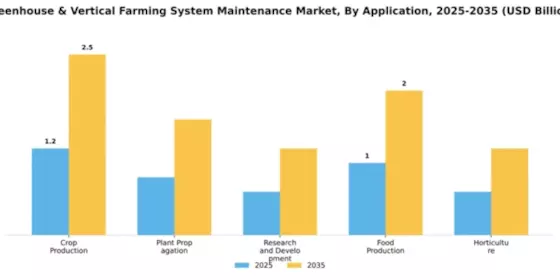
Crop Production (Dominant) vs. Horticulture (Emerging)
Crop Production is dominant in the Greenhouse & Vertical Farming System Maintenance Market, primarily due to its critical role in addressing global food security. This segment thrives on advancements in agricultural technology and practices that enhance productivity and resource efficiency. In contrast, Horticulture, labeled as emerging, capitalizes on the growing trend of urbanization and consumer interest in local, high-quality produce. This segment attracts investments in innovative farming solutions aimed at maximizing yield and minimizing space. As consumers seek fresher produce and environmentally friendly options, both segments are set to evolve significantly in response to market demands.
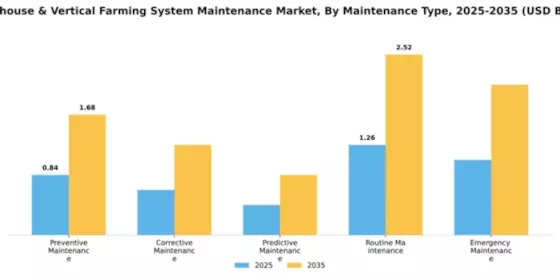
In the Greenhouse & Vertical Farming System Maintenance Market, preventive maintenance has emerged as the largest segment, driven by its proactive approach to reducing downtime and extending equipment lifespan. Corrective maintenance follows, focusing on repairs after failures. Predictive maintenance is gaining traction as farmers and operators prioritize data-driven strategies to forecast equipment issues. Routine maintenance remains essential but is overshadowed by the growth of predictive approaches in advanced systems. The growth in predictive maintenance is propelled by advancements in IoT and machine learning technologies, allowing for real-time monitoring and predictive analytics. Additionally, the increasing emphasis on sustainability in agriculture is driving the need for efficient management practices. As greenhouse and vertical farming systems evolve, a shifting focus toward predictive and preventive strategies is expected to reshape the maintenance landscape significantly.
Preventive Maintenance (Dominant) vs. Emergency Maintenance (Emerging)
Preventive maintenance stands out as a dominant force in the Greenhouse & Vertical Farming System Maintenance Market, emphasizing scheduled upkeep to prevent equipment failures. It contributes significantly to ensuring operational efficiency and reducing unexpected downtimes, making it an essential strategy for farm operators. In contrast, emergency maintenance, while less frequent, has emerged as an emerging segment, often necessitated by unforeseen equipment breakdowns. This type of maintenance can disrupt operations and incur higher costs, urging farm managers to adopt preventive measures. The characteristics of emergency maintenance include its reactive nature and the potential for significant downtime, contrasting with the proactive strategies of preventive maintenance, which are increasingly essential in optimizing the performance of greenhouse systems and vertical farming environments.
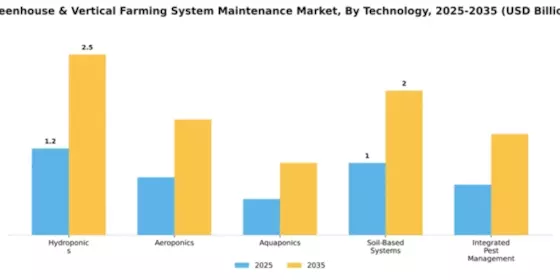
In the Greenhouse & Vertical Farming System Maintenance Market, hydroponics holds the largest market share due to its efficiency in resource use and high yield potential. This technology allows for precise control over nutrient delivery, leading to excellent crop performance. Following closely, aeroponics is gaining traction and represents the fastest-growing segment, driven by its ability to reduce water usage and promote rapid plant growth without soil. Overall, both segments illustrate the market's trend towards optimizing resource management and maximizing agricultural outputs. The growth of hydroponics is supported by increasing demands for fresh produce and sustainable farming practices, resulting in significant investments in this area. Aeroponics, on the other hand, is focusing on innovations that enhance its appeal, particularly in urban farming setups where space and resource efficiency are crucial. As sustainability takes the forefront in agriculture, both hydroponics and aeroponics are set to redefine traditional farming with technology-driven advancements.
Technology: Hydroponics (Dominant) vs. Aeroponics (Emerging)
Hydroponics is the dominant technology in the Greenhouse & Vertical Farming System Maintenance Market due to its proven effectiveness in cultivating high-quality crops in a controlled environment, thereby reducing dependency on arable land. This method utilizes nutrient-rich water solutions, allowing for optimized growth rates and efficient use of space. In contrast, aeroponics, while still considered an emerging technology, is making significant strides in market presence. It employs a misting technique to deliver nutrients to plant roots, which not only enhances growth speed but also minimizes water usage compared to traditional methods. Both technologies reflect a shift towards more sustainable and efficient agricultural practices, catering to the increasing demand for fresh produce in urban areas.
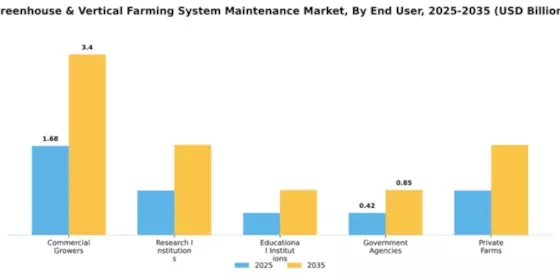
The Greenhouse & Vertical Farming System Maintenance Market is significantly shaped by its end users, with commercial growers taking the largest share. This segment encompasses a broad spectrum of agricultural businesses that prioritize high-yield and sustainable farming practices. In contrast, research institutions are emerging rapidly, driven by technological advancements and a heightened focus on innovative agricultural methods. This dynamic underscores the growing recognition of vertical farming's potential to address food security challenges. As the demand for sustainable food sources escalates, commercial growers are increasingly investing in advanced maintenance systems to enhance yield efficiency, reduce resource consumption, and minimize environmental impact. Research institutions are gaining momentum due to their role in developing new technologies and methodologies for cultivation. This synergy between commercial growers and research facilities is believed to significantly propel overall market growth, as collaborative efforts can yield practical applications that benefit both sectors.
Commercial Growers: Dominant vs. Research Institutions: Emerging
Commercial growers hold a dominant position within the Greenhouse & Vertical Farming System Maintenance Market due to their extensive operations aimed at maximizing productivity and efficiency. These growers are characterized by their ability to invest in advanced maintenance technologies, ensuring continuous cultivation cycles and minimizing downtime. As they often require constant upgrades to stay competitive, they drive innovations in maintenance systems. On the other hand, research institutions, though still emerging, are rapidly gaining traction as key influencers in this market. They contribute valuable insights into best practices and novel techniques that enhance cultivation methods. Their focus on sustainable practices and integration of cutting-edge technology positions them as vital players, anticipating future trends that commercial growers can leverage to improve agricultural outcomes.
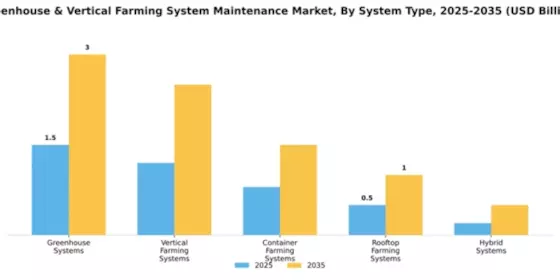
In the Greenhouse & Vertical Farming System Maintenance Market, the landscape is significantly shaped by the dominance of greenhouse systems, which hold the largest market share due to their established presence and extensive range of applications. These systems benefit from favorable climatic conditions and proven agricultural practices, leading to sustained demand. Meanwhile, vertical farming systems are emerging as the fastest-growing segment, driven by urbanization, technological advancements, and the need for sustainable food production in limited spaces, thereby reshaping conventional agriculture paradigms.
Greenhouse Systems (Dominant) vs. Vertical Farming Systems (Emerging)
Greenhouse systems hold a dominant position in the Greenhouse & Vertical Farming System Maintenance Market, characterized by their flexible design and ability to optimize growing conditions through controlled environments. They cater to a wide variety of crops, allowing for year-round production and reduced reliance on weather conditions. Conversely, vertical farming systems are rapidly gaining traction as an emerging option, appealing to urban developers and environmentally conscious consumers. These systems maximize space utilization and minimize resource use, which responds directly to the challenges of urban food deserts and sustainability initiatives. While greenhouse systems leverage traditional methods, vertical systems introduce innovative technologies such as hydroponics and aeroponics, making them competitive alternatives.
Get more detailed insights about Greenhouse & Vertical Farming System Maintenance Market Request Free Sample
North America leads the Greenhouse & Vertical Farming System Maintenance Market, holding a significant market share of 2.1 billion. The region's growth is driven by increasing urbanization, technological advancements, and a rising demand for locally sourced produce. Regulatory support for sustainable agriculture practices further catalyzes market expansion, with initiatives aimed at reducing carbon footprints and enhancing food security. The competitive landscape is robust, featuring key players like AeroFarms, Plenty, and Gotham Greens. The U.S. is at the forefront, leveraging advanced technologies and innovative farming techniques. Canada is also emerging as a significant player, focusing on vertical farming solutions. The presence of these companies fosters a dynamic environment, encouraging investment and research in sustainable farming practices.
Europe's Greenhouse & Vertical Farming System Maintenance Market is valued at 1.3 billion, driven by a strong emphasis on sustainability and local food production. The region benefits from supportive regulations aimed at reducing environmental impact and promoting urban agriculture. Initiatives like the European Green Deal are pivotal in fostering innovation and investment in sustainable farming technologies, enhancing food security across member states. Leading countries include Germany, the Netherlands, and France, where companies like Urban Crop Solutions and Infarm are making significant strides. The competitive landscape is characterized by a mix of established firms and startups, all focused on innovative solutions to meet the growing demand for fresh produce. The region's commitment to sustainability positions it as a leader in the global market.
The Asia-Pacific region, with a market size of 0.9 billion, is witnessing rapid growth in the Greenhouse & Vertical Farming System Maintenance Market. Urbanization and food security concerns are driving demand for innovative farming solutions. Governments are increasingly supporting vertical farming initiatives through favorable policies and funding, aiming to enhance agricultural productivity and sustainability in densely populated areas. Countries like Singapore and Japan are leading the charge, with companies such as Sky Greens pioneering vertical farming technologies. The competitive landscape is evolving, with both local startups and international players vying for market share. The region's unique challenges, such as limited arable land, further emphasize the need for efficient farming solutions, making it a hotbed for innovation in the sector.
The Middle East & Africa region, with a market size of 0.1 billion, is at the nascent stage of the Greenhouse & Vertical Farming System Maintenance Market. The region's growth is driven by water scarcity and the need for food security, prompting governments to explore innovative agricultural solutions. Regulatory frameworks are gradually evolving to support sustainable farming practices, aiming to enhance local food production and reduce dependency on imports. Countries like the UAE and South Africa are emerging as key players, with investments in vertical farming technologies gaining traction. The competitive landscape is still developing, with a mix of local and international firms entering the market. The region's unique challenges present opportunities for innovative solutions, making it a potential growth area for the industry.
The Greenhouse & Vertical Farming System Maintenance Market is characterized by a dynamic competitive landscape, driven by increasing urbanization, the demand for sustainable food production, and technological advancements. Key players such as AeroFarms (US), Plenty (US), and Infarm (DE) are strategically positioned to leverage these trends. AeroFarms (US) focuses on innovation in aeroponic technology, enhancing crop yields while minimizing resource use. Meanwhile, Plenty (US) emphasizes partnerships with local grocery chains to expand its market reach, thereby integrating its operations into urban supply chains. Infarm (DE) adopts a unique approach by deploying modular farming units in urban areas, which allows for localized production and reduced transportation costs. Collectively, these strategies contribute to a competitive environment that is increasingly focused on sustainability and efficiency.In terms of business tactics, companies are localizing manufacturing and optimizing supply chains to enhance operational efficiency. The market appears moderately fragmented, with several players vying for market share. However, the influence of key players is substantial, as they set benchmarks for innovation and operational excellence. This competitive structure encourages smaller firms to adopt similar strategies, thereby elevating overall market standards.In November AeroFarms (US) announced a partnership with a leading technology firm to integrate AI-driven analytics into its farming systems. This strategic move is likely to enhance operational efficiency and crop management, allowing for real-time adjustments based on environmental conditions. The integration of AI could potentially revolutionize how data is utilized in vertical farming, setting a new standard for precision agriculture.In October Plenty (US) expanded its operations by opening a new facility in a major metropolitan area, significantly increasing its production capacity. This expansion is strategically important as it positions Plenty to meet the growing demand for fresh produce in urban centers, while also reducing delivery times and costs. Such moves indicate a clear focus on scaling operations to capture market share in densely populated regions.In September Infarm (DE) launched a new vertical farming unit designed specifically for restaurants and grocery stores, enhancing its product offering. This initiative reflects a strategic pivot towards catering to the food service industry, which is increasingly seeking sustainable sourcing options. By targeting this segment, Infarm is likely to strengthen its market presence and diversify its revenue streams.As of December current competitive trends in the Greenhouse & Vertical Farming System Maintenance Market include a pronounced shift towards digitalization, sustainability, and AI integration. Strategic alliances are becoming increasingly vital, as companies collaborate to enhance technological capabilities and market reach. The competitive differentiation is expected to evolve, moving away from price-based competition towards innovation, technology, and supply chain reliability. This shift suggests that companies that prioritize these aspects will likely emerge as leaders in the market.


The Greenhouse & Vertical Farming System Maintenance Market is projected to grow at a 6.62% CAGR from 2025 to 2035, driven by technological advancements and increasing urbanization.
New opportunities lie in:
By 2035, the market is expected to be robust, driven by innovation and sustainable practices.
| MARKET SIZE 2024 | 4.2(USD Billion) |
| MARKET SIZE 2025 | 4.48(USD Billion) |
| MARKET SIZE 2035 | 8.5(USD Billion) |
| COMPOUND ANNUAL GROWTH RATE (CAGR) | 6.62% (2025 - 2035) |
| REPORT COVERAGE | Revenue Forecast, Competitive Landscape, Growth Factors, and Trends |
| BASE YEAR | 2024 |
| Market Forecast Period | 2025 - 2035 |
| Historical Data | 2019 - 2024 |
| Market Forecast Units | USD Billion |
| Key Companies Profiled | AeroFarms (US), Plenty (US), Vertical Harvest (US), Green Spirit Farms (US), Urban Crop Solutions (BE), Gotham Greens (US), BrightFarms (US), Infarm (DE), Sky Greens (SG) |
| Segments Covered | Application, Maintenance Type, Technology, End User, System Type |
| Key Market Opportunities | Integration of automation and IoT technologies enhances efficiency in Greenhouse & Vertical Farming System Maintenance Market. |
| Key Market Dynamics | Rising demand for sustainable agriculture drives innovation in greenhouse and vertical farming system maintenance solutions. |
| Countries Covered | North America, Europe, APAC, South America, MEA |
The market is projected to reach a valuation of 8.5 USD Billion by 2035.
In 2024, the market valuation stood at 4.2 USD Billion.
The expected CAGR for the market during the forecast period is 6.62%.
Key players include AeroFarms, Plenty, Vertical Harvest, and Gotham Greens, among others.
Main applications include Crop Production, Food Production, and Horticulture, with valuations projected to reach 2.5, 2.0, and 1.2 USD Billion respectively by 2035.
By 2035, Routine Maintenance is expected to reach 2.52 USD Billion, while Preventive Maintenance may reach 1.68 USD Billion.
Technologies such as Hydroponics and Aeroponics are projected to grow, with Hydroponics reaching 2.5 USD Billion by 2035.
Commercial Growers are expected to see a market valuation of 3.4 USD Billion by 2035.
Greenhouse Systems are projected to reach 3.0 USD Billion, while Vertical Farming Systems may reach 2.5 USD Billion by 2035.
Research Institutions are expected to contribute a market valuation of 1.7 USD Billion by 2035.



Kindly complete the form below to receive a free sample of this Report

“This is really good guys. Excellent work on a tight deadline. I will continue to use you going forward and recommend you to others. Nice job”


“Thanks. It’s been a pleasure working with you, please use me as reference with any other Intel employees.”


“Thanks for sending the report it gives us a good global view of the Betaïne market.”


“Thank you, this will be very helpful for OQS.”


“We found the report very insightful! we found your research firm very helpful. I'm sending this email to secure our future business.”


“I am very pleased with how market segments have been defined in a relevant way for my purposes (such as "Portable Freezers & refrigerators" and "last-mile"). In general the report is well structured. Thanks very much for your efforts.”


“I have been reading the first document or the study, ,the Global HVAC and FP market report 2021 till 2026. Must say, good info! I have not gone in depth at all parts, but got a good indication of the data inside!”


“We got the report in time, we really thank you for your support in this process. I also thank to all of your team as they did a great job.”


“The Automotive 48V ECU Components Procurement Intelligence Study” was a complex project, but the Market Research Future (MRFR) team handled it with quality, agility, and customer-centricity. They delivered all requested data on time and within the agreed scope. The team, including Shubhendra Anand and Rahul Gotadki, was always readily available to clarify questions and swiftly implement necessary adjustments, driving the project to a successful conclusion within a very demanding timeframe.
I would also like to specifically commend Akshay Agarwal for his responsiveness and support at every stage—from our initial inquiry on May 6th through to final delivery on June 18th. His dedication made the entire process seamless.”



