Hardware Encryption Market (2025 - 2035)

Hardware Encryption Market Size, Share and Research Report By Technology (Advanced Encryption Standard, Elliptic Curve Cryptography, RSA Encryption, Quantum Encryption), By Application (Data Storage Devices, Network Security, Cloud Computing, Mobile Devices), By End Use (Government, Banking and Financial Services, Healthcare, Telecommunications), By Deployment Type (On-Premises, Cloud-Based, Hybrid) and By Regional (North America, Europe, South America, Asia Pacific, Middle East and Africa) – Industry Forecast Till 2035
ID: MRFR/SEM/3429-HCR
200 Pages
Nirmit Biswas, Aarti Dhapte
Last Updated: July 15, 2026
Hardware Encryption Market
Market Size
Forecast Period2025-2035
CAGR (2025-2035)4.70%
2025 Market SizeUSD 355.85 Million
2035 Market SizeUSD 561.63 Million
Key Players
Samsung Electronics
Western Digital
Seagate Technology
Micron Technology
Kingston Technology
Intel Corporation
Opportunities
  • Post-Quantum Hardware Upgrade Wave
  • Automotive Security Module Proliferation
  • Emerging-Market Regulatory Tailwinds

Hardware Encryption Market Summary

The Hardware Encryption Market reached USD 355.85 Million in 2025 and is projected to expand from USD 371.47 Million in 2026 to USD 561.63 Million by 2035, reflecting a 4.70% CAGR across the forecast window. Federal mandates — including NIST's post-quantum cryptography standardization finalized in August 2024 and the European Union's Cyber Resilience Act — are creating an irreversible procurement cycle that favors dedicated encryption silicon over software-only alternatives [1][2]. Enterprise risk budgets have swelled in parallel: global cybersecurity spending surpassed USD 215 billion in 2024, and a growing slice now targets hardware-anchored data protection [3].

A generational technological transition is occurring in the hardware encryption market. System-on-chip solutions, which incorporate secure enclaves with storage circuitry, are replacing outdated full-disk encryption controllers based on single-purpose ASICs. In order to replace outdated HDD encryption modules in enterprise data centers, major SSD manufacturers have committed more than USD 1.8 billion to NAND-integrated encryption research and development between 2023 and 2026 [4][5].

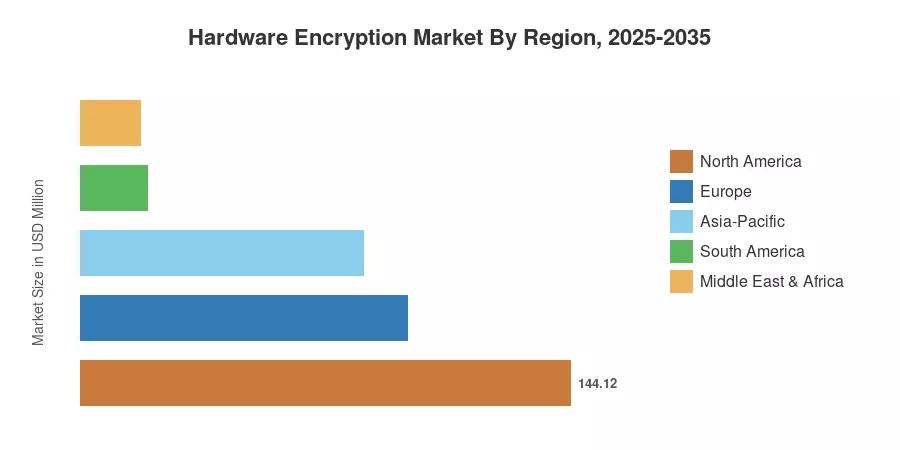
Due to CMMC 2.0 compliance deadlines and defense purchases, North America had about 40.5% of the hardware encryption market in 2025. Asia-Pacific has the fastest growth, with a 23.4% CAGR, thanks to India's enactment of the Digital Personal Data Protection Act and China's enforcement of the Cryptography Law. Europe had the second-largest proportion, at about 27.0%, thanks to the passage of the NIS2 Directive among its member states. Quantum-readiness criteria will change competitive standing in every location over the course of the next ten years.

Key Report Takeaways

• By Product

  • Solid State Drives (SSD) captured 46.7% of Hardware Encryption Market revenue in 2025, reinforcing their dominance across enterprise and consumer storage segments.
  • Hard Disk Drives (HDD) posted a 2.8% CAGR through the forecast period as data archival workloads sustain residual demand.

• By Algorithm Standard

  • Advanced Encryption Standard (AES) accounted for 66.0% of the Hardware Encryption Market in 2025, reflecting deep ecosystem integration.
  • Post-quantum algorithm implementations are expanding at a 37.5% CAGR as federal migration timelines tighten.

• By Architecture

  • Application-Specific Integrated Circuits (ASICs) held 61.0% share of the Hardware Encryption Market, favored for throughput consistency in high-volume manufacturing.

• By End-Use Industry

  • Consumer electronics represented 34.5% of the Hardware Encryption Market revenue in 2025.
  • The automotive vertical is advancing at a 28.2% CAGR, fueled by encrypted V2X communication mandates.

• By Region

  • North America led with 40.5% of the Hardware Encryption Market revenue in 2025.
  • Asia-Pacific is the fastest-growing region at a 23.4% CAGR.

Market Size and Forecast (2021–2035)

Market Research Future's sizing methodology triangulates semiconductor industry shipment data, OEM encryption-attach rates reported through channel audits, and downstream demand modeling calibrated against enterprise IT capital expenditure surveys.
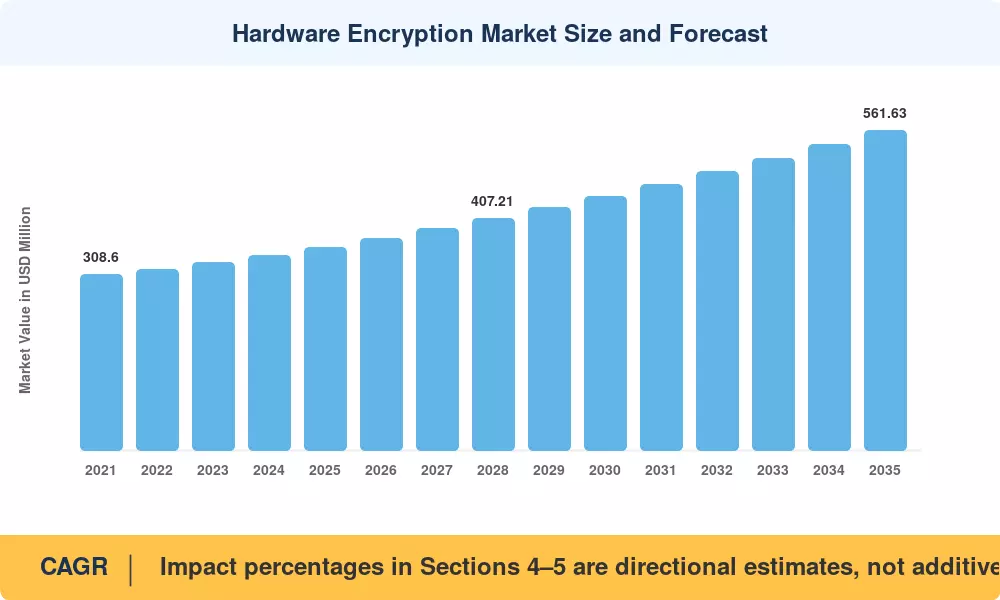
Hardware Encryption Market Size and Forecast
Our Impact
Enabled $4.3B Revenue Impact for Fortune 500 and Leading Multinationals
Partnering with 2000+ Global Organizations Each Year
30K+ Citations by Top-Tier Firms in the Industry

Driver Impact Analysis

Driver ~% Impact on CAGR Geographic Relevance Impact Timeline
Zero-trust security mandates +0.9% Global Short-term (≤2 yr)
Data center SSD refresh cycles +0.7% North America, Asia-Pacific Short-term (≤2 yr)
Post-quantum cryptography migration +0.6% Global Long-term (≥4 yr)
Automotive encrypted ECU architectures +0.5% Europe, Asia-Pacific Medium-term (2–4 yr)
Edge AI inferencing security requirements +0.4% Asia-Pacific Medium-term (2–4 yr)
Regulatory compliance expansion (GDPR, CCPA, DPDP) +0.3% North America, Europe, Asia-Pacific Short-term (≤2 yr)
Cloud infrastructure encryption mandates +0.3% Global Medium-term (2–4 yr)

Zero-Trust Security Mandates

Executive Order 14028 requires U.S. federal agencies to implement zero-trust architectures to bolster cybersecurity, with Office of Management and Budget (OMB) memoranda mandating robust encryption for all endpoints handling sensitive information. Furthermore, the Department of Defense’s CMMC 2.0 framework now requires FIPS 140-3 validated cryptographic modules for the approximately 215,000 companies within the Defense Industrial Base that manage controlled unclassified information.

Data Center SSD Refresh Cycles

The global hyperscale data center market, currently hosting over 1,000 facilities, is expanding rapidly to support artificial intelligence and cloud workloads. As operators increase server density—with average rack power density rising significantly in recent years—the integration of on-die AES-XTS encryption engines in NVMe SSDs has become standard. This hardware-level security is now a fundamental requirement for modern infrastructure refresh cycles.

Post-Quantum Cryptography Migration

NIST has finalized post-quantum algorithm standards—including ML-KEM and ML-DSA—to defend against future quantum computing threats. Guided by the National Security Agency’s CNSA 2.0 suite, all National Security Systems must transition to these quantum-resistant standards by 2030, with full implementation expected by 2035. This necessitates a massive upgrade to hardware security modules that can support lattice-based cryptographic functions.


Automotive Encrypted ECU Architectures

UN Regulation No. 155 mandates that all new vehicle type approvals in signatory markets implement rigorous cybersecurity management systems. As vehicles become increasingly software-defined, this regulation forces the adoption of hardware security modules across internal electronic control units. With the regulation applying to diverse categories of vehicles, manufacturers are integrating hardware-based encryption to secure V2X, OTA, and in-vehicle communication channels.

Restraints Impact Analysis

Impact estimates below follow the same directional methodology described in Section 4 and are not directly subtractive from the headline CAGR.

Restraint ~% Impact on CAGR Geographic Relevance Impact Timeline
Premium pricing for software encryption –0.5% Global Short-term (≤2 yr)
Supply chain constraints for advanced crypto-IP cores –0.4% Global Medium-term (2–4 yr)
Export control regulations on encryption technology –0.3% North America, Europe Long-term (≥4 yr)
Software-defined encryption competition –0.3% North America, Europe Short-term (≤2 yr)
Legacy system integration complexity –0.2% Global Medium-term (2–4 yr)


Premium Pricing Over Software Encryption

Hardware-based encryption modules often command a 40–60% cost premium compared to software-only implementations, creating significant friction in price-sensitive sectors. For small-to-medium enterprises, this capital expenditure often forces extended procurement cycles. While software encryption serves as a baseline for compliance, the performance degradation and key management complexities associated with it eventually incentivize larger organizations to transition toward hardware-integrated solutions.

Supply Chain Constraints for Crypto-IP Cores

The semiconductor industry is currently navigating a period of high-margin, low-volume demand, leading to severe supply-side constraints for specialized components. Foundries are prioritizing high-demand AI and logic accelerators, which have extended lead times for specialized secure-element wafers. This scarcity creates bottleneck risks, occasionally forcing manufacturers to delay product launches as they compete for limited available packaging capacity.

Export Control Regulations

The Wassenaar Arrangement and supplemental national frameworks, such as the U.S. Export Administration Regulations (EAR), govern the international transfer of dual-use encryption technologies. These regimes restrict exports to numerous jurisdictions to address national security risks. Consequently, vendors face substantial compliance costs and must navigate complex licensing procedures, which effectively limit their addressable geographic market and complicate global supply chain operations.

Hardware Encryption Market Opportunities

Post-Quantum Hardware Upgrade Wave

NIST finalized its first three post-quantum cryptographic standards in August 2024, initiating a critical compliance transition. The NSA’s CNSA 2.0 directive mandates that all National Security Systems transition to these quantum-resistant algorithms, with infrastructure-level migration required by 2035. This necessitates a multi-year replacement cycle for all FIPS-validated modules, driving significant demand for hardware capable of lattice-based cryptographic operations.


Automotive Security Module Proliferation

UNECE Regulation No. 155 establishes mandatory cybersecurity management systems for vehicles, now applicable across 54 signatory countries. As connectivity features like V2X and over-the-air updates become standard, the integration of dedicated hardware security modules (HSMs) is essential for compliance. This regulatory enforcement across global markets creates a long-term demand multiplier for hardened, tamper-resistant encryption components in new vehicle platforms.


Emerging-Market Regulatory Tailwinds

National data protection laws, such as India’s Digital Personal Data Protection Act (2023) and Brazil’s LGPD, have established rigorous security obligations for organizations processing personal data. These regulations require data fiduciaries to implement reasonable security safeguards, including encryption. As enforcement escalates in these economies, entities are increasingly adopting hardware-based encryption to ensure compliance and mitigate the risk of severe financial penalties.


Edge AI Encryption-as-a-Service

The rapid deployment of edge inference accelerators in smart cities and industrial IoT necessitates integrated encryption to protect sensitive model weights and inference data. Subscription-based encryption provisioning allows OEMs to maintain security over the hardware lifecycle, transforming initial capital expenditure into recurring revenue. This shift supports secure, low-latency processing, which is increasingly critical for protecting decentralized artificial intelligence infrastructure.

Hardware Encryption Market Future Outlook

Post-Quantum Transition and Algorithm Agility

The decade ahead will be defined by the migration from classical to quantum-resistant encryption primitives embedded in hardware. NIST projects that 80% of federal cryptographic modules will require replacement or firmware upgrades by 2033 [1]. Vendors that design algorithm-agile architectures — controllers capable of switching between ML-KEM and classical AES-XTS without silicon respins — will command pricing premiums and extended government contract cycles within the Hardware Encryption Market.

Convergence of AI Inference and Hardware Security

Edge AI accelerators shipping after 2028 will increasingly bundle on-die encryption engines to protect proprietary model weights and inference pipelines. estimates that 65% of enterprise AI inference workloads will run at the edge by 2030, each node requiring hardware-level data protection [9]. This convergence expands the Hardware Encryption Market beyond traditional storage into a horizontal infrastructure layer spanning compute, networking, and sensor subsystems.

Automotive and IoT Encryption at Scale

The global connected-car fleet is forecast to exceed 500 million units by 2032, with each platform embedding multiple HSM chipsets [8]. Industrial IoT deployments in manufacturing, energy, and logistics will add billions of encrypted endpoints. The Hardware Encryption Market will shift from a storage-centric value proposition to a pervasive security fabric woven across mobility, industrial automation, and smart-infrastructure domains.

Sustainability and Supply-Chain Resilience

Semiconductor manufacturers face growing ESG scrutiny on the energy intensity of cryptographic processing. Next-generation encryption ASICs fabricated on 3nm and 2nm process nodes deliver 40–60% power reduction per encryption operation compared with 7nm predecessors [13]. Concurrently, diversification of foundry capacity into the United States (CHIPS Act), Europe (EU Chips Act), and India (Semicon India Programme) will reduce single-source risk for the Hardware Encryption Market supply chain through the 2030s [22].

Hardware Encryption Market Segmentation

By Product

Segment Key Metric Primary Demand Driver
Solid State Drives (SSD) 46.7% share (2025) Enterprise data center refresh
Hard Disk Drives (HDD) 2.8% CAGR Archival and surveillance storage
USB Drives & Portable Storage USD 28.47 Million (2025) Government mobile workforce
Others (Inline Encryptors, HSMs) 4.1% CAGR Network-layer encryption


The Hardware Encryption Market remains heavily tilted toward SSD-embedded encryption, driven by the irreversible enterprise transition from spinning media to flash. NVMe SSDs with on-die AES-XTS 256-bit engines have become the default specification for hyperscale cloud providers; Amazon Web Services, Microsoft Azure, and Google Cloud all mandate hardware encryption on customer-facing storage tiers [4]. HDD-based encryption retains a role in cold-storage and video-surveillance deployments where cost-per-terabyte sensitivity outweighs throughput requirements.

By Algorithm Standard

Segment Key Metric Primary Demand Driver
Advanced Encryption Standard (AES) 66.0% share (2025) Universal ecosystem support
Rivest-Shamir-Adleman (RSA) USD 32.14 Million (2025) Legacy PKI infrastructure
Post-Quantum Algorithms 37.5% CAGR NIST PQC standardization
Others (Camellia, ChaCha20) 2.3% CAGR Regional and open-source adoption


AES dominance in the Hardware Encryption Market reflects two decades of ecosystem entrenchment: every major storage controller vendor, every FIPS 140-3 validation lab, and every operating-system kernel supports AES-XTS natively. Post-quantum algorithms represent the highest-growth frontier, though hardware implementations remain in early qualification stages. Lattice-based schemes like ML-KEM demand 3–5× more gate area than AES-256 in current silicon, creating a temporary cost barrier that will narrow as process-node advances mature [1][2].

By Architecture

Segment Key Metric Primary Demand Driver
Application-Specific IC (ASIC) 61.0% share (2025) High-volume SSD integration
Field-Programmable Gate Array (FPGA) USD 37.82 Million (2025) Prototyping and low-volume defense
System-on-Chip with Secure Element 23.8% CAGR IoT and automotive platforms
Others (Discrete Security Processors) 3.2% CAGR Legacy enterprise refresh


ASICs dominate the Hardware Encryption Market because their fixed-function design delivers the lowest per-unit encryption cost at production volumes exceeding 10 million units. SoC platforms integrating secure enclaves alongside application processors are the fastest-growing architecture, particularly in automotive and IoT contexts, where board space and power budgets prohibit discrete encryption chips.

By End-Use Industry

Segment Key Metric Primary Demand Driver
Consumer Electronics 34.5% share (2025) Smartphone and laptop SSD encryption
Automotive 28.2% CAGR UNECE R155 compliance
BFSI USD 53.79 Million (2025) Regulatory data-at-rest mandates
Government & Defense 4.9% CAGR CMMC and zero-trust procurement
Healthcare USD 24.92 Million (2025) HIPAA and patient data protection
Others (Telecom, Industrial) 4.3% CAGR 5G and IIoT expansion


Consumer electronics anchor the largest share of the Hardware Encryption Market because virtually every smartphone, laptop, and tablet shipped today contains an SSD or eMMC module with embedded AES encryption. The automotive vertical's rapid CAGR reflects a structural shift: before 2024, fewer than 15% of new vehicles included dedicated HSMs, whereas post-UNECE R155 enforcement, that figure will approach 100% in regulated markets by 2028 [8].


Regional Market Share Analysis

Region Key Metric Primary Investment Themes
North America 40.5% share (2025) Defense compliance, cloud infrastructure
Europe 27.0% share (2025) NIS2 Directive, automotive cybersecurity
Asia-Pacific 23.4% CAGR (2026–2035) Data localization, SSD manufacturing
South America USD 19.57 Million (2025) LGPD enforcement, banking modernization
Middle East & Africa USD 17.79 Million (2025) Smart-city programs, defense procurement
Total USD 355.85 Million (2025)

The Hardware Encryption Market exhibits pronounced geographic concentration, with the top two regions accounting for roughly two-thirds of global revenue. Policy environments, data-sovereignty regulations, and semiconductor supply-chain proximity drive significant regional variation in the Hardware Encryption Market trajectory.


North America

Country Key Metric Key Driver
United States 78.2% of regional share CMMC 2.0 and federal zero-trust mandates
Canada 4.6% CAGR Critical infrastructure protection standards
Mexico USD 5.18 Million (2025) Nearshoring-driven data center growth


U.S. federal procurement alone generates over USD 90 million in annual Hardware Encryption Market demand, anchored by DoD and intelligence-community endpoint requirements. Canada's Centre for Cyber Security published updated encryption guidance in 2024 mandating FIPS 140-3 modules for all federal workstations, while Mexico's growing data center corridor along the Querétaro–Monterrey axis is attracting hyperscale tenants that specify hardware-encrypted storage as a baseline [7][17].

Europe

Country Key Metric Key Driver
Germany 24.3% of regional share Automotive OEM encryption requirements
United Kingdom 4.9% CAGR Financial-sector encryption standards
France USD 14.86 Million (2025) Defense procurement modernization
Italy 3.7% CAGR Smart manufacturing encryption
Spain USD 5.42 Million (2025) Public-sector digitization
Nordic Countries 5.1% CAGR Data sovereignty regulations
Russia USD 4.95 Million (2025) Domestic encryption chip development
Rest of Europe 4.3% CAGR NIS2 compliance expansion


Germany's position reflects the density of automotive Tier-1 suppliers integrating HSM chipsets into ECU platforms ahead of UNECE R155 enforcement. The UK's Financial Conduct Authority updated its operational resilience framework in 2024 to require hardware-rooted encryption for all customer data at rest, affecting more than 1,500 regulated firms [10][18].

Asia-Pacific

Country Key Metric Key Driver
China 38.5% of regional share Cryptography Law compliance
India 28.6% CAGR DPDP Act rollout, digital payments
Japan USD 11.24 Million (2025) Enterprise SSD adoption
South Korea 5.3% CAGR Semiconductor ecosystem integration
ASEAN USD 6.17 Million (2025) Financial-sector modernization
Rest of Asia-Pacific 4.8% CAGR Telecom infrastructure upgrades


China's Cryptography Law mandates domestically developed encryption hardware for critical information infrastructure, channeling procurement toward state-approved vendors and creating a parallel Hardware Encryption Market ecosystem. India's Unified Payments Interface processed over 14 billion transactions monthly by late 2024, and the Reserve Bank of India's 2025 circular on payment data encryption at rest is accelerating HSM deployments across the banking sector [19][20].

South America

Country Key Metric Key Driver
Brazil 62.4% of regional share LGPD enforcement, fintech growth
Argentina 4.1% CAGR Banking-sector digitization
Rest of South America USD 3.72 Million (2025) Government IT modernization


Brazil's national data protection authority issued 47 enforcement actions in 2024 under LGPD, with penalties increasingly tied to encryption-at-rest deficiencies. This regulatory pressure is converting the Hardware Encryption Market from a niche defense procurement category into a mainstream enterprise compliance line item across Latin America's largest economy [10].

Middle East & Africa

Country Key Metric Key Driver
Saudi Arabia 31.8% of regional share Vision 2030 smart-city encryption mandates
UAE 5.7% CAGR Financial-center data protection
South Africa USD 2.85 Million (2025) POPIA compliance
Egypt 4.4% CAGR Government digitization programs
Rest of MEA USD 4.13 Million (2025) Defense modernization


Saudi Arabia's NEOM and Riyadh smart-city projects specify hardware-encrypted storage for all surveillance, IoT, and citizen-services data, creating a concentrated procurement pipeline. The UAE's Data Protection Law (2021) and its 2024 amendments extended encryption-at-rest obligations to free-zone entities, expanding the Hardware Encryption Market addressable base by an estimated 3,500 regulated enterprises [21].


Hardware Encryption Market By Region, 2025-2035

Competitive Benchmarking

The Hardware Encryption Market exhibits medium concentration, with the top five vendors accounting for an estimated 42–48% of global revenue. The Herfindahl-Hirschman Index sits in the 900–1,100 range, indicating a moderately competitive landscape where scale advantages in SSD manufacturing coexist with specialized niche players serving defense and enterprise HSM segments.

Company Est. Revenue Share Range Key Offerings Strategic Positioning
Samsung Electronics ~9–12% Self-encrypting SSDs, UFS modules Vertically integrated NAND and controller design
Western Digital ~8–11% SanDisk SEDs, enterprise HDD encryption Broad product portfolio across consumer and enterprise
Seagate Technology ~7–10% Exos SED HDDs, Lyve encrypted storage Data center and surveillance focus
Micron Technology ~5–8% Encrypted NAND SSDs, automotive storage Automotive and industrial-grade encryption
Kingston Technology ~4–7% IronKey encrypted USB, enterprise SEDs Secure portable storage leadership
Intel Corporation ~4–7% Optane encrypted storage, SGX enclaves Platform-level security integration
Thales Group ~3–6% Luna HSMs, CipherTrust encryption Enterprise key management and HSM
Kioxia Holdings ~3–5% XD-series encrypted SSDs Flash-forward NAND encryption technology
IBM Corporation ~3–5% Guardium, z-series crypto modules Mainframe and hybrid-cloud encryption
NetApp ~2–4% NVMe encrypted storage arrays Enterprise storage infrastructure


Recent News & Developments

  • SEALSQ and L5 Cartronics—(July 14, 2026)—Formed a strategic partnership to develop secure, cost-effective multi-package IoT connectivity modules integrating hardware-based cryptographic security for high-volume deployments.
  • SEALSQ and GlobalFoundries—(July 2026)—Announced a memorandum of understanding to co-develop post-quantum cryptography (PQC) security IP, secure chiplet architectures, and cryogenic CMOS ecosystems for quantum computing.
  • BTQ Technologies and ICTK—(July 2026)—Finalized the design for a next-generation hybrid security processor, integrating post-quantum cryptography with physical hardware-rooted identity for edge computing devices.

Hardware Encryption Market Report Scope

Parameter Detail
Market Scope Global Hardware Encryption Market across products, algorithm standards, architectures, end-use industries, and five geographic regions
Study Period 2021–2035
CAGR (2026–2035) 4.70%
Base Year Market Size USD 355.85 Million (2025)
Forecast Endpoint USD 561.63 Million (2035)
Fastest Growing Segment Post-Quantum Algorithms (37.5% CAGR)
Companies Profiled Samsung, Western Digital, Seagate, Micron, Kingston, Intel, Thales, Kioxia, IBM, NetApp
Valuation Currency USD Million
CAGR Driver Disclaimer Impact percentages in Sections 4–5 are directional estimates, not additive to headline CAGR.


FAQs

How does hardware encryption differ from software encryption in terms of total cost of ownership?
Hardware encryption eliminates CPU overhead and licensing fees, reducing five-year TCO by 18–25% in deployments exceeding 1,000 endpoints [12]. Performance penalties disappear because dedicated silicon handles cryptographic operations.
Can existing enterprise storage be retrofitted with hardware encryption?
Retrofitting requires replacing the storage controller or drive, not just firmware. Most organizations treat encryption upgrades as part of scheduled storage refresh cycles every 3–5 years [4].
What certification should procurement teams prioritize when selecting encrypted storage?
FIPS 140-3 Level 2 or higher remains the benchmark for government and regulated-industry deployments [1]. Common Criteria EAL4+ provides an additional assurance layer for defense applications.
How will post-quantum standards affect existing hardware encryption investments?
Current AES-256 hardware remains quantum-safe for symmetric operations. Asymmetric key-exchange modules will require silicon upgrades or firmware patches aligned with NIST's ML-KEM timeline [2].
What latency impact does hardware encryption introduce in NVMe SSD workloads?
Modern on-die AES-XTS engines add sub-microsecond latency, typically under 0.3 µs per 4 KB block [4]. This overhead is imperceptible in enterprise and consumer workloads.
Are there open-source alternatives to proprietary hardware encryption controllers?
RISC-V-based secure enclaves with open-source cryptographic cores are emerging but lack FIPS certification [15]. Proprietary controllers dominate regulated deployments where validated compliance is mandatory.
How do export controls affect multinational hardware encryption procurement?
Wassenaar Arrangement Category 5 Part 2 restricts encryption hardware transfers to designated countries [14]. Multinational buyers must obtain licenses or source regionally compliant variants.    
Author
Author
Author Profile
Nirmit Biswas LinkedIn
Senior Research Analyst
With 5+ years of expertise in Market Intelligence and Strategic Research, Nirmit Biswas specializes in ICT, Semiconductors, and BFSI. Backed by an MBA in Financial Services and a Computer Science foundation, Nirmit blends technical depth with business acumen. He has successfully led 100+ projects for global enterprises and startups, including Amazon, Cisco, L&T and Huawei, delivering market estimations, competitive benchmarking, and GTM strategies. His focus lies in transforming complex data into clear, actionable insights that drive growth, innovation, and investment decisions. Recognized for bridging engineering innovation with executive strategy, Nirmit helps businesses navigate dynamic markets with confidence.
Co-Author
Co-Author Profile
Aarti Dhapte LinkedIn
AVP - Research
A consulting professional focused on helping businesses navigate complex markets through structured research and strategic insights. I partner with clients to solve high-impact business problems across market entry strategy, competitive intelligence, and opportunity assessment. Over the course of my experience, I have led and contributed to 100+ market research and consulting engagements, delivering insights across multiple industries and geographies, and supporting strategic decisions linked to $500M+ market opportunities. My core expertise lies in building robust market sizing, forecasting, and commercial models (top-down and bottom-up), alongside deep-dive competitive and industry analysis. I have played a key role in shaping go-to-market strategies, investment cases, and growth roadmaps, enabling clients to make confident, data-backed decisions in dynamic markets.

Research Approach


Secondary Research

The secondary research process involved comprehensive analysis of cybersecurity regulatory frameworks, technical standards documentation, peer-reviewed journals, and authoritative government databases. Key sources included the National Institute of Standards and Technology (NIST) Computer Security Resource Center, National Security Agency (NSA) Commercial Solutions for Classified (CSfC) Program, Cybersecurity and Infrastructure Security Agency (CISA) advisories and guidelines, Federal Information Processing Standards (FIPS) 140-3 validation database, European Union Agency for Cybersecurity (ENISA) threat landscape reports, International Organization for Standardization (ISO/IEC 27001, ISO/IEC 19790) certification bodies, PCI Security Standards Council, Cloud Security Alliance (CSA), Internet Engineering Task Force (IETF) cryptographic standards, ACM Digital Library and IEEE Xplore for cryptographic research, Common Criteria certification portal (Common Criteria Portal), National Cyber Security Centre (NCSC-UK), Bundesamt für Sicherheit in der Informationstechnik (BSI-Germany), ANSSI (France), and CERT/CC vulnerability databases. These sources were utilized to collect encryption adoption metrics, FIPS 140-2/140-3 validation data, threat intelligence statistics, regulatory compliance requirements, and technology landscape analysis for Advanced Encryption Standard (AES), Elliptic Curve Cryptography (ECC), RSA encryption, and emerging quantum encryption technologies.

Additional specialized sources included Storage Networking Industry Association (SNIA), Trusted Computing Group (TCG) specifications, Global Platform for secure element standards, FIDO Alliance authentication standards, and semiconductor industry reports from SEMI and SIA (Semiconductor Industry Association).


Primary Research

Qualitative and quantitative insights were obtained by interviewing supply-side and demand-side stakeholders during the primary research process. The supply-side sources consisted of CEOs, CTOs, VPs of Hardware Engineering, product security architects, and regulatory compliance leaders from hardware encryption chipset manufacturers, secure storage device OEMs, and cryptographic module vendors. CISOs, IT security directors, cloud infrastructure architects, data protection officers from banking and financial services, government agencies, healthcare systems, telecommunications providers, and procurement leads from enterprise IT departments constituted demand-side sources.

Primary research validated market segmentation across encryption technologies (AES, ECC, RSA, Quantum), application verticals (data storage, network security, cloud computing, mobile devices), deployment models (on-premises, cloud-based, hybrid), and confirmed product development roadmaps, quantum-safe transition timelines, and enterprise adoption patterns for hardware security modules (HSMs), self-encrypting drives (SEDs), and trusted platform modules (TPMs).

Primary Respondent Breakdown:

By Designation: C-level Primaries (42%), Director Level (31%), Others (27%)

By Region: North America (32%), Europe (30%), Asia-Pacific (33%), Rest of World (5%)


Market Size Estimation

Global market valuation was derived through revenue mapping and deployment volume analysis. The methodology included:

Identification of 50+ key manufacturers across North America, Europe, Asia-Pacific, and Latin America specializing in cryptographic processors, secure storage controllers, HSMs, and encryption-enabled storage devices

Product mapping across AES hardware accelerators, ECC cryptographic modules, RSA security processors, quantum-resistant cryptographic hardware, self-encrypting drives, and network encryption appliances

Analysis of reported and modeled annual revenues specific to hardware encryption product portfolios, including chipset-level, module-level, and system-level solutions

Coverage of manufacturers representing 72-78% of global market share in 2024, including validated FIPS 140-3 certified product vendors

Extrapolation using bottom-up (deployment volume × ASP by vertical and region) and top-down (manufacturer revenue validation) approaches to derive segment-specific valuations across government, BFSI, healthcare, telecommunications, and cloud service provider end-use segments

Download Free Sample

Kindly complete the form below to receive a free sample of this Report

Download PDF ×

We do not share your information with anyone. However, we may send you emails based on your report interest from time to time. You may contact us at any time to opt-out.