×
Request Free Sample ×

Kindly complete the form below to receive a free sample of this Report

* Please use a valid business email

Leading companies partner with us for data-driven Insights

clients tt-cursor
Hero Background

Harmonic Filter Market

ID: MRFR/SEM/8700-HCR
100 Pages
Aarti Dhapte
October 2025

Harmonic Filter Market Research Report By Type (Active Harmonic Filters, Passive Harmonic Filters, Hybrid Harmonic Filters), By Application (Industrial, Commercial, Residential, Utility), By End Use (Manufacturing, Power Generation, Telecommunications, Data Centers), By Power Rating (Low Power, Medium Power, High Power) and By Regional (North America, Europe, South America, Asia Pacific, Middle East and Africa) - Forecast to 2035

Share:
Download PDF ×

We do not share your information with anyone. However, we may send you emails based on your report interest from time to time. You may contact us at any time to opt-out.

Harmonic Filter Market Infographic
Purchase Options

Harmonic Filter Market Summary

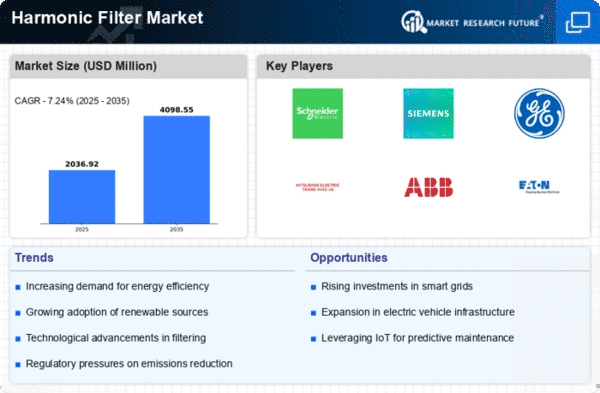
As per MRFR analysis, the Harmonic Filter Market Size was estimated at 1899.4 USD Million in 2024. The Harmonic Filter industry is projected to grow from 2036.95 in 2025 to 4098.55 by 2035, exhibiting a compound annual growth rate (CAGR) of 7.24 during the forecast period 2025 - 2035.

Key Market Trends & Highlights

The Harmonic Filter Market is poised for substantial growth driven by technological advancements and increasing regulatory compliance.

  • North America remains the largest market for harmonic filters, driven by stringent regulatory standards and a focus on power quality improvement.
  • The Asia-Pacific region is emerging as the fastest-growing market, fueled by rapid industrialization and a rising demand for harmonic mitigation solutions.
  • The power quality improvement segment dominates the market, while the telecommunications segment is witnessing the fastest growth due to increasing reliance on digital infrastructure.
  • Key market drivers include the increasing demand for renewable energy and the expansion of industrial automation, which are shaping the future of harmonic filter applications.

Market Size & Forecast

2024 Market Size 1899.4 (USD Million)
2035 Market Size 4098.55 (USD Million)
CAGR (2025 - 2035) 7.24%

Major Players

Schneider Electric (FR), Siemens (DE), General Electric (US), Mitsubishi Electric (JP), ABB (CH), Eaton (US), Toshiba (JP), Rockwell Automation (US), Crompton Greaves (IN)

Harmonic Filter Market Trends

The Harmonic Filter Market is currently experiencing a notable transformation, driven by the increasing demand for energy efficiency and the growing awareness of power quality issues. As industries and commercial sectors strive to optimize their operations, the adoption of harmonic filters has become more prevalent. These devices play a crucial role in mitigating harmonic distortion, which can lead to equipment malfunction and increased energy costs. The market appears to be expanding as more organizations recognize the benefits of integrating harmonic filters into their electrical systems. Furthermore, advancements in technology are likely to enhance the performance and efficiency of these filters, making them more appealing to a broader range of applications. In addition to technological advancements, regulatory frameworks are evolving to promote the use of harmonic filters. Governments and regulatory bodies are increasingly implementing standards aimed at reducing harmonic emissions, which further propels the demand for these solutions. The Harmonic Filter Market seems poised for growth as stakeholders across various sectors, including manufacturing, renewable energy, and data centers, seek to comply with these regulations while improving their operational efficiency. As the market continues to mature, it may witness the emergence of innovative products and solutions that cater to specific industry needs, thereby enhancing overall power quality and reliability.

Technological Advancements

The Harmonic Filter Market is witnessing a surge in technological innovations, which are enhancing the efficiency and effectiveness of harmonic filtering solutions. New designs and materials are being developed, allowing for better performance and integration into existing systems. This trend indicates a shift towards more sophisticated filtering technologies that can address complex power quality issues.

Regulatory Compliance

Increasingly stringent regulations regarding power quality and harmonic emissions are shaping the Harmonic Filter Market. Organizations are compelled to adopt harmonic filters to meet compliance standards, which drives market growth. This trend suggests that regulatory frameworks will continue to influence purchasing decisions and product development.

Growing Awareness of Power Quality

There is a rising awareness among industries about the importance of power quality and its impact on operational efficiency. As businesses recognize the detrimental effects of harmonic distortion, the demand for harmonic filters is likely to increase. This trend highlights a shift in focus towards proactive measures for maintaining power quality.

Harmonic Filter Market Drivers

Rising Industrial Automation

The Global Harmonic Filter Market Industry is experiencing growth due to the rising trend of industrial automation. As industries increasingly adopt automated processes, the demand for reliable power quality becomes paramount. Harmonic filters are essential in ensuring that automated systems operate efficiently without disruptions caused by harmonic distortion. The proliferation of smart manufacturing technologies further amplifies this need, as these systems require stable power supplies for optimal performance. The market is poised for growth as industries recognize the importance of harmonic filters in maintaining operational efficiency and reliability in automated environments.

Growth of Renewable Energy Sources

The Global Harmonic Filter Market Industry is significantly impacted by the increasing integration of renewable energy sources into the power grid. As solar and wind energy systems proliferate, they introduce unique harmonic challenges that necessitate the use of harmonic filters. These filters help in maintaining grid stability and ensuring the efficient operation of renewable energy systems. The transition towards a greener energy landscape is likely to drive the market's expansion, as industries seek solutions to manage the harmonics generated by these sources. This trend aligns with global efforts to enhance energy sustainability and is anticipated to contribute to the market's growth trajectory.

Regulatory Compliance and Standards

The Global Harmonic Filter Market Industry is influenced by stringent regulatory frameworks aimed at maintaining power quality standards. Governments worldwide are implementing regulations that mandate compliance with harmonic distortion limits, compelling industries to adopt harmonic filters. For example, the IEEE 519 standard outlines guidelines for harmonic control in electrical systems. As industries face penalties for non-compliance, the adoption of harmonic filters becomes essential. This regulatory push is expected to propel the market towards a valuation of 4.1 USD Billion by 2035, reflecting a compound annual growth rate of 7.28% from 2025 to 2035. Compliance not only mitigates penalties but also enhances operational reliability.

Increasing Demand for Energy Efficiency

The Global Harmonic Filter Market Industry experiences a notable surge in demand for energy-efficient solutions. As industries strive to reduce operational costs and enhance sustainability, harmonic filters play a crucial role in mitigating power quality issues. For instance, the implementation of these filters can lead to energy savings of up to 30% in certain applications. This trend is expected to contribute significantly to the market's growth, with projections indicating a market value of 1.89 USD Billion in 2024. The increasing focus on energy efficiency aligns with global initiatives aimed at reducing carbon footprints, further driving the adoption of harmonic filters.

Technological Advancements in Filter Design

The Global Harmonic Filter Market Industry benefits from continuous technological advancements in filter design and manufacturing. Innovations such as active harmonic filters and hybrid solutions are emerging, offering enhanced performance and adaptability to various industrial applications. These advancements enable better harmonic mitigation and improved energy efficiency, appealing to a broader range of industries. As manufacturers invest in research and development, the market is likely to witness an influx of advanced products that cater to specific needs. This evolution in technology not only enhances the effectiveness of harmonic filters but also positions them as essential components in modern electrical systems.


Market Segment Insights

By Application: Power Quality Improvement (Largest) vs. Harmonic Mitigation (Fastest-Growing)

In the Harmonic Filter Market, the application segment is diversified with Power Quality Improvement leading with a significant market share, followed closely by Harmonic Mitigation. Voltage Regulation and Load Balancing, while essential, occupy smaller portions of the market. Power Quality Improvement is crucial for ensuring that electrical systems operate efficiently, and it captures the largest share due to the increasing demand for reliable and uninterrupted power. Meanwhile, Harmonic Mitigation is quickly gaining traction as industries aim to reduce distortion in electrical systems, highlighting an upward trend in its market share.

Power Quality Improvement (Dominant) vs. Harmonic Mitigation (Emerging)

Power Quality Improvement remains the dominant application in the Harmonic Filter Market, characterized by its vital role in maintaining the stability and reliability of electrical performance. Companies focusing on this application are enhancing their technologies to address the growing concerns about equipment failure and energy losses due to poor power quality. On the other hand, Harmonic Mitigation is considered an emerging segment, driven by the increasing complexity of modern electrical systems and the rising need to reduce harmonic distortion. This segment is poised for rapid growth as more industries adopt practices to optimize their energy efficiency and comply with regulatory standards.

By End Use Industry: Manufacturing (Largest) vs. Telecommunications (Fastest-Growing)

The harmonic filter market is characterized by a diverse range of end-use industries. Among them, the manufacturing sector holds the largest share due to its extensive reliance on various machinery and electrical equipment susceptible to harmonic distortions. The manufacturing industry's hardware-intensive operations drive steady demand for harmonic filters to maintain system reliability and efficiency. In contrast, telecommunications is emerging as the fastest-growing segment. The rapid advancements in digital technology and increasing data traffic bolster the need for efficient electrical systems that can minimize harmonic disturbances, thus fostering significant growth in the adoption of harmonic filters within this sector.

Manufacturing: Dominant vs. Telecommunications: Emerging

Manufacturing represents the dominant end-use industry in the harmonic filter market due to its critical reliance on high-performance equipment. This sector encompasses a wide array of applications, from assembly lines to heavy machinery, where the integrity of electrical systems is paramount. Harmonic filters play a vital role in improving power quality and operational efficiency, enabling manufacturers to mitigate energy losses and extend equipment life. On the other hand, telecommunications serves as an emerging segment, driven by the surge in mobile communications and internet connectivity. The need for reliable power systems capable of managing harmonics becomes increasingly important as telecom networks expand, positioning this sector for robust growth as it adopts advanced harmonic filtering solutions.

By Type: Active Harmonic Filter (Largest) vs. Passive Harmonic Filter (Fastest-Growing)

The harmonic filter market is segmented into passive, active, and hybrid filters, with active harmonic filters holding the largest market share due to their advanced technology and effectiveness in mitigating harmonic distortions. Passive filters also maintain a significant position, catering to cost-sensitive projects where efficiency is less critical. Hybrid harmonic filters combine the best characteristics of both, creating a niche but valuable segment in the market.

Active Harmonic Filter (Dominant) vs. Passive Harmonic Filter (Emerging)

Active harmonic filters are leading the market with sophisticated electronic controls that adapt dynamically to varying load conditions, thereby providing superior performance in harmonic mitigation. They are ideal for applications requiring constant power quality, making them prevalent in industries such as telecommunications and manufacturing. Meanwhile, passive harmonic filters, though traditionally a cost-effective solution, are gaining traction as manufacturers innovate to enhance their reliability and efficiency. As businesses seek to balance cost and performance, passive filters present an emerging alternative, especially for small to medium-sized enterprises.

By Component: Inductor (Largest) vs. Capacitor (Fastest-Growing)

In the Harmonic Filter Market, the composition of components is essential for understanding market dynamics. Inductors hold the largest market share due to their critical role in filtering out noise and enhancing power quality. Capacitors, while currently in a smaller market position, are growing rapidly as more industries recognize their necessity in energy efficiency and power factor correction. The balance of market share among these components reflects their respective applications in various industrial sectors, highlighting the significance of tailored harmonic filtering solutions.

Inductor (Dominant) vs. Capacitor (Emerging)

Inductors are integral to the harmonic filter market due to their ability to control voltage levels and improve energy efficiency. They are predominantly used in applications requiring high reliability and excellent performance under varying load conditions, making them the dominant choice among component types. In contrast, capacitors are emerging as a vital component, driven by the push for improved energy savings and compliance with regulatory standards. Their role in enhancing overall system performance positions them as a rapidly growing segment, particularly in renewable energy applications and grid stabilization efforts.

By Installation Type: Indoor Installation (Largest) vs. Outdoor Installation (Fastest-Growing)

In the Harmonic Filter Market, the installation type segment is predominantly led by Indoor Installation, which captures the largest market share. This segment benefits from its widespread use in various applications, including commercial and industrial settings. Conversely, Outdoor Installation is emerging rapidly, driven by increasing demand for renewable energy sources and the need for robust filtering solutions in harsher environments. The Modular Installation segment, while significant, currently accounts for a smaller share compared to its indoor and outdoor counterparts.

Indoor Installation (Dominant) vs. Outdoor Installation (Emerging)

Indoor Installation remains the dominant installation type in the harmonic filter market due to its versatility and adaptability to various indoor environments. It is favored for its efficiency in noise reduction and harmonic distortion mitigation across numerous sectors, including manufacturing and data centers. On the other hand, Outdoor Installation is recognized as an emerging segment, gaining traction due to the expansion of renewable energy projects and the need for outdoor power equipment. This installation type is engineered to withstand environmental challenges, making it ideal for substations and outdoor facilities.

Get more detailed insights about Harmonic Filter Market

Regional Insights

North America : Market Leader in Harmonic Filters

North America is poised to maintain its leadership in the harmonic filter market, holding a significant share of 950.0 million in 2025. The region's growth is driven by increasing industrial automation, stringent regulations on power quality, and a rising demand for energy-efficient solutions. The adoption of advanced technologies and the push for renewable energy sources further catalyze market expansion. Regulatory frameworks promoting energy efficiency are also pivotal in shaping market dynamics. The competitive landscape in North America is robust, featuring key players such as General Electric, Schneider Electric, and Eaton. These companies are leveraging innovative technologies to enhance product offerings and meet the growing demand for harmonic filters. The presence of established manufacturing facilities and a strong distribution network further solidify the region's market position. As industries increasingly focus on sustainability, the harmonic filter market is expected to witness sustained growth in the coming years.

Europe : Emerging Market with Strong Regulations

Europe is emerging as a significant player in the harmonic filter market, with a market size of 600.0 million in 2025. The region's growth is primarily driven by stringent regulations aimed at improving power quality and reducing energy losses. The European Union's commitment to sustainability and energy efficiency is fostering demand for harmonic filters across various sectors, including manufacturing and renewable energy. The increasing integration of renewable energy sources into the grid is also a key growth driver. Leading countries in Europe, such as Germany, France, and the UK, are at the forefront of this market. Major players like Siemens and ABB are actively investing in R&D to develop advanced harmonic filter solutions. The competitive landscape is characterized by a mix of established companies and innovative startups, all striving to capture market share. The regulatory environment is supportive, encouraging investments in energy-efficient technologies and solutions.

Asia-Pacific : Rapid Growth in Emerging Economies

The Asia-Pacific region is witnessing rapid growth in the harmonic filter market, projected to reach 250.0 million in 2025. This growth is fueled by increasing industrialization, urbanization, and a rising focus on energy efficiency. Countries like China and India are investing heavily in infrastructure development, which is driving the demand for harmonic filters. Additionally, government initiatives aimed at promoting renewable energy sources are further propelling market growth in the region. China and India are the leading countries in this market, with numerous local and international players vying for market share. Companies such as Mitsubishi Electric and Toshiba are expanding their presence in the region, focusing on innovative solutions tailored to local needs. The competitive landscape is evolving, with both established firms and new entrants contributing to market dynamics. As the region continues to develop, the harmonic filter market is expected to flourish, driven by technological advancements and regulatory support.

Middle East and Africa : Emerging Market with Growth Potential

The Middle East and Africa region is gradually emerging in the harmonic filter market, with a projected size of 99.4 million in 2025. The growth is primarily driven by increasing industrial activities and a rising focus on energy efficiency. Governments in the region are beginning to implement regulations aimed at improving power quality and reducing energy losses, which is expected to boost demand for harmonic filters. The growing adoption of renewable energy sources is also contributing to market expansion. Countries like South Africa and the UAE are leading the way in this market, with several key players, including Crompton Greaves, establishing a presence. The competitive landscape is characterized by a mix of local and international companies, all striving to capture market share. As the region continues to develop its industrial base, the harmonic filter market is anticipated to grow, supported by regulatory initiatives and increasing awareness of energy efficiency.

Key Players and Competitive Insights

The Harmonic Filter Market is currently characterized by a dynamic competitive landscape, driven by increasing demand for energy efficiency and the need to mitigate power quality issues in various industrial applications. Key players such as Schneider Electric (FR), Siemens (DE), and ABB (CH) are strategically positioned to leverage their technological expertise and extensive product portfolios. Schneider Electric (FR) focuses on innovation and digital transformation, aiming to enhance energy management solutions. Siemens (DE) emphasizes regional expansion and partnerships to strengthen its market presence, while ABB (CH) is committed to sustainability and integrating advanced technologies into its offerings. Collectively, these strategies contribute to a competitive environment that is increasingly focused on technological advancement and customer-centric solutions.

In terms of business tactics, companies are localizing manufacturing and optimizing supply chains to enhance operational efficiency and reduce costs. The market appears moderately fragmented, with several key players exerting considerable influence. This structure allows for a diverse range of products and solutions, catering to various customer needs while fostering competition among established and emerging players.

In November 2025, Schneider Electric (FR) announced a partnership with a leading renewable energy firm to develop integrated harmonic filtering solutions aimed at optimizing energy consumption in solar power installations. This strategic move underscores Schneider's commitment to sustainability and positions the company to capitalize on the growing renewable energy sector, potentially enhancing its market share.

In October 2025, Siemens (DE) launched a new line of smart harmonic filters designed to integrate seamlessly with existing industrial automation systems. This innovation not only reflects Siemens' focus on digitalization but also addresses the increasing demand for smart solutions that enhance operational efficiency. The introduction of these products may strengthen Siemens' competitive edge in the market.

In September 2025, ABB (CH) expanded its manufacturing capabilities in Asia by investing in a new facility dedicated to producing advanced harmonic filters. This expansion is likely to improve ABB's supply chain reliability and responsiveness to regional demand, thereby enhancing its competitive positioning in the global market.

As of December 2025, current trends in the Harmonic Filter Market are heavily influenced by digitalization, sustainability, and the integration of artificial intelligence (AI) into product offerings. Strategic alliances are increasingly shaping the competitive landscape, enabling companies to pool resources and expertise to drive innovation. The shift from price-based competition to a focus on technological differentiation and supply chain reliability is evident, suggesting that future competitive dynamics will hinge on the ability to innovate and deliver sustainable solutions.

Key Companies in the Harmonic Filter Market market include

Industry Developments

The Global Harmonic Filter Market has been witnessing significant developments recently, driven by advancements in technology and increasing demand for energy efficiency. Companies like Mitsubishi Electric and Schneider Electric are at the forefront of innovation, launching advanced harmonic filtering solutions to enhance power quality across various industries. Meanwhile, Eaton and General Electric have focused on expanding their product lines to cater to the evolving needs of their customers. In terms of mergers and acquisitions, Parker Hannifin has successfully acquired several smaller players to enhance its market presence and technological capabilities.

Delta Electronics continues to strengthen its position through strategic partnerships, while Siemens is focusing on integrating digital solutions to improve harmonic filter performance. Recent market valuation growth for companies in this sector has shown a positive trend, indicating a robust interest in harmonic filtering solutions due to regulatory compliance and sustainability goals. The impact of this growth is evidenced by increased R&D investment and an emphasis on developing innovative solutions among key players like Crompton Greaves and Toshiba, ultimately contributing to an evolving landscape in the harmonic filter market.

Future Outlook

Harmonic Filter Market Future Outlook

The Harmonic Filter Market is projected to grow at a 7.24% CAGR from 2024 to 2035, driven by increasing demand for energy efficiency and regulatory compliance.

New opportunities lie in:

  • Development of advanced passive and active harmonic filters for industrial applications.
  • Integration of IoT technology for real-time monitoring and predictive maintenance.
  • Expansion into emerging markets with tailored solutions for local energy challenges.

By 2035, the Harmonic Filter Market is expected to achieve robust growth, reflecting evolving energy demands.

Market Segmentation

Harmonic Filter Market Type Outlook

  • Passive Harmonic Filter
  • Active Harmonic Filter
  • Hybrid Harmonic Filter

Harmonic Filter Market Component Outlook

  • Inductor
  • Capacitor
  • Resistor
  • Transformer

Harmonic Filter Market Application Outlook

  • Power Quality Improvement
  • Harmonic Mitigation
  • Voltage Regulation
  • Load Balancing

Harmonic Filter Market End Use Industry Outlook

  • Manufacturing
  • Energy and Utilities
  • Telecommunications
  • Transportation

Harmonic Filter Market Installation Type Outlook

  • Indoor Installation
  • Outdoor Installation
  • Modular Installation

Report Scope

MARKET SIZE 20241899.4(USD Million)
MARKET SIZE 20252036.95(USD Million)
MARKET SIZE 20354098.55(USD Million)
COMPOUND ANNUAL GROWTH RATE (CAGR)7.24% (2024 - 2035)
REPORT COVERAGERevenue Forecast, Competitive Landscape, Growth Factors, and Trends
BASE YEAR2024
Market Forecast Period2025 - 2035
Historical Data2019 - 2024
Market Forecast UnitsUSD Million
Key Companies ProfiledSchneider Electric (FR), Siemens (DE), General Electric (US), Mitsubishi Electric (JP), ABB (CH), Eaton (US), Toshiba (JP), Rockwell Automation (US), Crompton Greaves (IN)
Segments CoveredApplication, End Use Industry, Type, Component, Installation Type
Key Market OpportunitiesGrowing demand for energy efficiency drives innovation in the Harmonic Filter Market.
Key Market DynamicsRising demand for energy efficiency drives innovation and competition in the harmonic filter market.
Countries CoveredNorth America, Europe, APAC, South America, MEA

Leave a Comment

FAQs

What is the expected value of the Global Harmonic Filter Market in 2024?

The Global Harmonic Filter Market is expected to be valued at 1.89 USD Billion in 2024.

What will be the market size of the Global Harmonic Filter Market by 2035?

The market size of the Global Harmonic Filter Market is projected to reach 3.82 USD Billion by 2035.

What is the expected CAGR for the Global Harmonic Filter Market from 2025 to 2035?

The expected compound annual growth rate for the Global Harmonic Filter Market from 2025 to 2035 is 7.2%.

Which region is projected to dominate the Global Harmonic Filter Market by 2032?

North America is projected to dominate the Global Harmonic Filter Market with a value of 1.3 USD Billion by 2032.

How much will the Passive Harmonic Filters segment be valued in 2032?

The Passive Harmonic Filters segment is expected to be valued at 1.05 USD Billion by 2032.

Who are the key players in the Global Harmonic Filter Market?

Major players in the Global Harmonic Filter Market include Parker Hannifin, Hammond Power Solutions, Mitsubishi Electric, and Eaton among others.

What is the projected market value of Active Harmonic Filters by 2032?

The projected market value of Active Harmonic Filters by 2032 is 1.25 USD Billion.

What is the market value of the Global Harmonic Filter Market in the APAC region for 2023?

The market value of the Global Harmonic Filter Market in the APAC region is expected to be 0.4 USD Billion in 2023.

What opportunities exist for growth in the Global Harmonic Filter Market?

Growth opportunities in the Global Harmonic Filter Market include increasing demand for energy efficiency and advancements in technology.

What challenges does the Global Harmonic Filter Market face?

The Global Harmonic Filter Market faces challenges such as regulatory compliance and high installation costs.

Download Free Sample

Kindly complete the form below to receive a free sample of this Report

Compare Licence

×
Features License Type
Single User Multiuser License Enterprise User
Price $4,950 $5,950 $7,250
Maximum User Access Limit 1 User Upto 10 Users Unrestricted Access Throughout the Organization
Free Customization
Direct Access to Analyst
Deliverable Format
Platform Access
Discount on Next Purchase 10% 15% 15%
Printable Versions