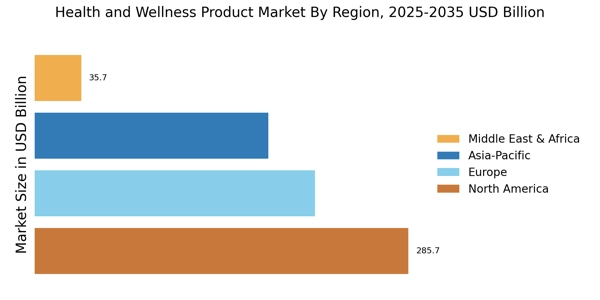
According to Market Research Future analysis, the Health and Wellness Product Market Size was valued at USD 714.18 Billion in 2024 & the market is projected to grow from USD 783.4 Billion in 2025 to USD 1975.77 Billion by 2035, registering a CAGR of 9.69% during the forecast period 2025–2035. North America led the market with over 40% share, generating around USD 285.67 billion in revenue. Rising global health awareness and preventive healthcare adoption are major growth drivers for the health and wellness product market, as consumers increasingly prioritize nutrition, immunity, and lifestyle improvement, boosting demand for supplements, functional foods, and holistic wellness solutions worldwide.
According to WHO, noncommunicable diseases account for 74% of global deaths, while IHME reports rising lifestyle-related risk factors; CDC highlights over 60% adults using dietary supplements, collectively reinforcing strong preventive health adoption driving sustained demand for wellness products globally.
Key Market Trends & Highlights
The Health and Wellness Product Market is experiencing a dynamic shift towards natural and personalized solutions driven by technological advancements.
- North America holds over 40% share in 2024, supported by high chronic disease prevalence and strong preventive healthcare spending.
- Europe valued at USD 214.25 billion in 2024, accounting for 30% share with strong regulatory and nutrition awareness support.
- Preventive healthcare adoption rising globally, with NCDs causing 74% of deaths, boosting demand for wellness and nutrition products.
- Online retail dominates with 47% share in 2024, driven by rapid e-commerce adoption and convenience-based consumer behavior.
Market Size & Forecast
| 2024 Market Size | 714.18 (USD Billion) |
| 2035 Market Size | 1975.77 (USD Billion) |
| CAGR (2025 - 2035) | 9.69% |
Major Players
Companies such as Nestle (CH), Unilever (GB), Procter & Gamble (US), Johnson & Johnson (US), Herbalife (US), Amway (US), GNC Holdings (US), Nature's Bounty (US), Kraft Heinz (US), Danone (FR) are some of the major participants in the global market.