Healthcare Logistics Market Summary
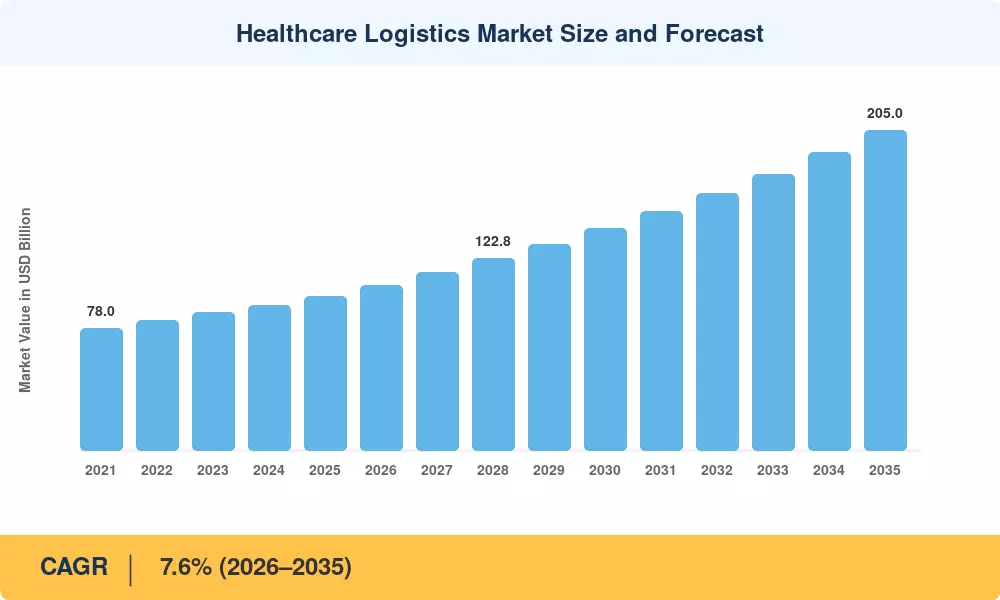
The healthcare logistics market stood at an estimated USD 98.5 billion in 2025 and is projected to reach USD 205.0 billion by 2035, expanding at a compound annual growth rate of 7.6% during the 2026–2035 forecast window. Two catalysts are accelerating spending across the healthcare logistics market: the global push to decentralize clinical trials — a shift that demands precision-grade shipment networks — and the USD 4.1 billion allocation across G7 nations for pandemic-preparedness supply infrastructure under WHO's revised International Health Regulations [1]. These policy commitments are converting what was once a cost center into a boardroom-level investment priority.
Digitalization is rewriting the operational playbook. Legacy paper-based track-and-trace systems are yielding to IoT-enabled sensors, blockchain-verified chain-of-custody platforms, and AI-driven demand-forecasting engines. The European Commission's Falsified Medicines Directive serialization mandate, fully enforced since 2024, pushed over 80% of EU-based distributors to adopt end-to-end digital verification within two years [2]. That regulatory pressure created a template now being replicated across Southeast Asia and South America.
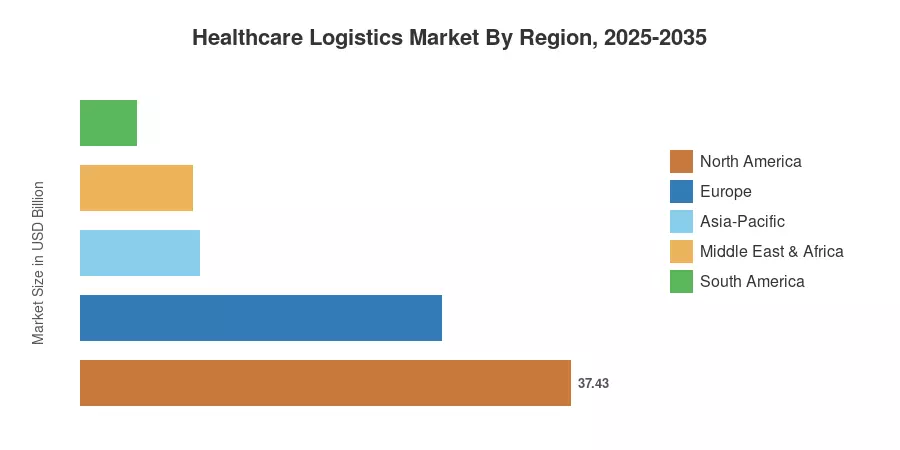
North America commands approximately 38% of the healthcare logistics market, anchored by the United States' dense specialty-pharmacy network and FDA Drug Supply Chain Security Act requirements [3]. Asia-Pacific is the fastest-growing region at a projected 9.2% CAGR, fueled by India's pharmaceutical export boom and China's hospital modernization wave. Europe holds the second-largest share at roughly 28%, driven by the EU Good Distribution Practice (GDP) framework. As biologics, cell and gene therapies, and personalized medicines expand their share of the therapeutic pipeline, the healthcare logistics market is poised for structural, not cyclical, growth through 2035.
Key Report Takeaways
• By Service Type
- Transportation services account for the largest revenue share of the healthcare logistics market, capturing roughly 42% of global spend in 2025 — reflecting the complexity of multi-modal pharmaceutical shipment routes.
- Warehousing and storage services are expanding at a CAGR of 8.3% as temperature-sensitive biologics demand purpose-built facilities with validated cold rooms.
- Value-added services (packaging, labeling, regulatory documentation) generated approximately USD 12.4 billion in 2025, driven by serialization compliance mandates worldwide.
• By Application
- Pharmaceutical products represent the dominant application in the healthcare logistics market, accounting for over 55% share, led by specialty drugs and biosimilars.
- Clinical trial logistics is the fastest-growing application segment at a 9.8% CAGR, propelled by decentralized and hybrid trial designs.
• By Region
- North America leads the healthcare logistics market with ~38% share, underpinned by stringent regulatory traceability standards.
- Asia-Pacific registers the highest regional CAGR of 9.2%, with India and China driving pharmaceutical manufacturing relocation and export growth.
- Europe contributes ~28% of global revenue, supported by EU GDP compliance frameworks and cross-border pharmaceutical distribution harmonization.
Healthcare Logistics Market Size and Forecast (2021–2035)
Market Research Future's sizing model combines bottom-up revenue aggregation from publicly listed logistics operators with top-down validation against pharmaceutical production output, trade flow data from UN Comtrade, and regulatory filing volumes. Historical figures (2021–2024) are derived from audited annual reports and customs-cleared pharmaceutical shipment values. Forecast values (2026–2035) apply a regression-adjusted CAGR anchored to biologic pipeline expansion rates, regulatory mandate timelines, and GDP-per-capita healthcare spending elasticity.