Author

Rahul Gotadki

Healthcare Payer Service Market Research Report By Service Type (Claims Management, Billing and Payment Processing, Member Management, Fraud Detection and Prevention), By End User (Health Insurance Companies, Government Healthcare Programs, Managed Care Organizations, Third-Party Administrators), By Deployment Mode (On-Premises, Cloud-Based, Hybrid), By Functionality (Administrative Services, Technology Support Services, Consulting Services) and By Regional (North America, Europe, South America, Asia Pacific, Middle East and Africa) - Growth & Industry Forecast 2025 To 2035
As per Market Research Future analysis, the Healthcare Payer Service Market was estimated at 79.44 USD Billion in 2024. The Healthcare Payer Service industry is projected to grow from 86.44 USD Billion in 2025 to 201.14 USD Billion by 2035, exhibiting a compound annual growth rate (CAGR) of 8.81% during the forecast period 2025 - 2035
The Healthcare Payer Service Market is experiencing a transformative shift towards digitalization and value-based care models.
| 2024 Market Size | 79.44 (USD Billion) |
| 2035 Market Size | 201.14 (USD Billion) |
| CAGR (2025 - 2035) | 8.81% |
UnitedHealth Group (US), Anthem (US), Aetna (US), Cigna (US), Humana (US), Centene Corporation (US), Molina Healthcare (US), Kaiser Permanente (US), Blue Cross Blue Shield (US)
Our Impact
Enabled $4.3B Revenue Impact for Fortune 500 and Leading Multinationals
Partnering with 2000+ Global Organizations Each Year
30K+ Citations by Top-Tier Firms in the Industry
The Healthcare Payer Service Market is currently experiencing a transformative phase, driven by advancements in technology and evolving consumer expectations. As healthcare systems worldwide adapt to new paradigms, payers are increasingly focusing on enhancing service delivery through digital solutions. This shift not only streamlines operations but also improves patient engagement, thereby fostering a more patient-centric approach. Moreover, regulatory changes and the push for value-based care are compelling payers to innovate their service offerings, ensuring they meet the diverse needs of their clientele. In addition, the integration of artificial intelligence and data analytics is reshaping the landscape of the Healthcare Payer Service Market. These technologies enable payers to gain insights into patient behavior and health trends, allowing for more personalized services. As competition intensifies, organizations are likely to invest in these technologies to maintain a competitive edge. Overall, the market appears poised for growth, with a focus on efficiency, transparency, and improved health outcomes for patients.
The ongoing digital transformation within the Healthcare Payer Service Market is reshaping how services are delivered. Payers are adopting digital tools to enhance operational efficiency and improve customer interactions. This trend reflects a broader movement towards technology-driven solutions that prioritize user experience.
There is a growing emphasis on value-based care within the Healthcare Payer Service Market. Payers are increasingly aligning their services with outcomes rather than volume, which encourages a focus on quality and patient satisfaction. This shift is likely to influence service models and reimbursement strategies.
The integration of advanced analytics is becoming a critical component of the Healthcare Payer Service Market. By leveraging data analytics, payers can better understand patient needs and optimize service delivery. This trend suggests a move towards more informed decision-making and personalized care.
The increasing demand for telehealth services is a pivotal driver in the Healthcare Payer Service Market. As patients seek more accessible healthcare options, telehealth has emerged as a viable solution. According to recent data, telehealth utilization has surged, with estimates indicating that over 30% of patients now prefer virtual consultations. This shift necessitates that healthcare payers adapt their service offerings to accommodate telehealth reimbursement models. Consequently, payers are investing in technology and infrastructure to support these services, which may lead to enhanced patient satisfaction and improved health outcomes. The integration of telehealth into payer services not only streamlines operations but also aligns with the broader trend of digital transformation in healthcare, thereby reshaping the payer landscape.
The transition towards value-based care models is reshaping the Healthcare Payer Service Market. This paradigm shift emphasizes patient outcomes over service volume, compelling payers to rethink their reimbursement strategies. Data suggests that value-based care initiatives can lead to a reduction in healthcare costs by up to 20% while improving patient satisfaction. As a result, payers are increasingly investing in care coordination and management programs that align with these models. This shift not only enhances the quality of care but also fosters a more sustainable healthcare system. Payers that successfully implement value-based care strategies are likely to experience improved financial performance and patient loyalty.
Technological advancements are a driving force in the Healthcare Payer Service Market. Innovations such as artificial intelligence, machine learning, and blockchain are transforming how payers operate. For instance, AI-driven analytics can enhance claims processing efficiency, potentially reducing administrative costs by up to 30%. Furthermore, blockchain technology offers secure and transparent data sharing, which is crucial for maintaining patient privacy and trust. As these technologies continue to evolve, payers are likely to adopt them to streamline operations and improve service delivery. The integration of advanced technologies not only enhances operational efficiency but also positions payers to better meet the demands of an increasingly tech-savvy patient population.
The growing focus on consumer-centric services is reshaping the Healthcare Payer Service Market. As patients become more informed and engaged in their healthcare decisions, payers are compelled to enhance their service offerings. This trend is reflected in the increasing demand for personalized healthcare solutions, which can improve patient satisfaction and retention. Data indicates that payers that prioritize consumer engagement strategies may see a 15% increase in member retention rates. Additionally, the rise of health apps and online portals allows patients to access information and manage their healthcare more effectively. By adopting a consumer-centric approach, payers can foster stronger relationships with their members, ultimately leading to improved health outcomes and financial performance.
Regulatory changes and compliance requirements significantly influence the Healthcare Payer Service Market. As governments worldwide implement new healthcare policies, payers must navigate complex regulatory landscapes. For instance, recent legislation has mandated increased transparency in pricing and coverage, compelling payers to enhance their reporting and compliance mechanisms. This shift may lead to increased operational costs but also presents opportunities for innovation in service delivery. Payers that proactively adapt to these changes are likely to gain a competitive edge. Moreover, compliance with evolving regulations can enhance trust and credibility among consumers, which is essential in a market where patient choice is increasingly paramount.
In the Healthcare Payer Service Market, the segment of Claims Management holds the largest market share due to its critical role in processing healthcare claims efficiently and accurately. It not only ensures timely reimbursement for healthcare providers but also enhances patient satisfaction, leading to its dominant position in this segment. In contrast, Fraud Detection and Prevention, though smaller in share, is emerging rapidly as healthcare payers increasingly recognize the need to combat fraud, waste, and abuse in the healthcare system, driving investments in advanced technologies such as AI and machine learning. The growth trends in the Healthcare Payer Service Market indicate a shift towards digital transformation and automation. Claims Management continues to thrive owing to ongoing innovations aiming to streamline processing times and reduce errors. On the other hand, the Fraud Detection and Prevention segment is experiencing the fastest growth due to heightened regulatory scrutiny and increased fraudulent activities, prompting payers to implement robust detection and prevention frameworks that leverage data analytics and advanced algorithms.
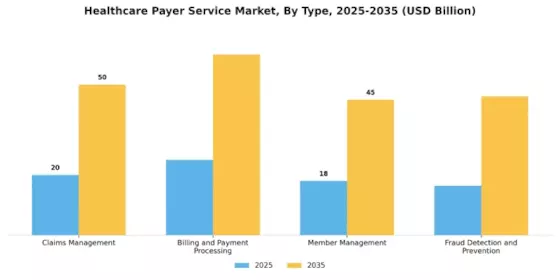
Claims Management (Dominant) vs. Fraud Detection and Prevention (Emerging)
Claims Management, being the dominant force in the Healthcare Payer Service Market, focuses on effectively managing the entire lifecycle of claims processing, ensuring that all claims are submitted, processed, and settled in a timely manner. Its established protocols, along with robust software solutions, have made it an integral part of operations for payers, enabling them to maximize reimbursement while minimizing operational costs. Conversely, Fraud Detection and Prevention is an emerging segment that leverages cutting-edge technology to identify and mitigate fraudulent claims. It is gaining traction as healthcare organizations face increasing financial pressures and legal obligations, pushing them to invest significantly in prevention strategies. By using sophisticated algorithms and real-time data analysis, this segment is arming payers with the tools necessary to safeguard against fraud effectively.
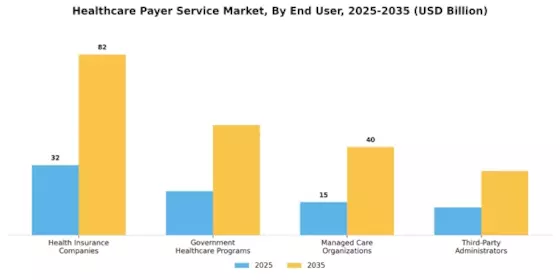
In the Healthcare Payer Service Market, Health Insurance Companies hold the largest market share, driven by a vast customer base and extensive offerings. These companies provide a range of services from premium collection to claims management, ensuring a robust presence in the market. Meanwhile, Government Healthcare Programs, although smaller in share, are rapidly expanding as they adapt to increasing healthcare needs and funding support, making up a significant part of the market landscape.
Health Insurance Companies (Dominant) vs. Government Healthcare Programs (Emerging)
Health Insurance Companies represent the dominant segment in the Healthcare Payer Service Market. They operate on a large scale, acquired through traditional and digital avenues, providing comprehensive health insurance solutions. Their infrastructure is solidified by advanced technology and customer service infrastructures that cater to diverse population needs. On the other hand, Government Healthcare Programs are emerging as an important segment, fueled by demographic shifts and policy reforms. They are focused on providing healthcare access to underprivileged populations and effectively managing public health costs, thus gaining traction in the market.
The Healthcare Payer Service Market exhibits a diverse deployment mode landscape, with Cloud-Based solutions capturing the largest market share. This segment's growth can be attributed to their flexibility, scalability, and cost-effectiveness, making them extremely appealing to healthcare payers. Conversely, Hybrid deployment modes are gaining traction, as they offer a balanced approach combining both on-premises and cloud capabilities, catering to organizations looking for customized solutions.
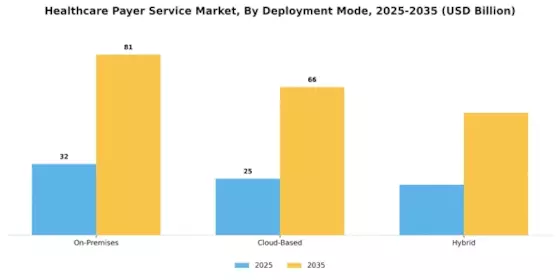
Hybrid (Dominant) vs. On-Premises (Emerging)
The hybrid deployment model stands out as a dominant force in the Healthcare Payer Service Market, merging the benefits of on-premises infrastructure and cloud services to provide an adaptable solution for healthcare payers. Organizations adopting hybrid models appreciate the flexibility to manage sensitive data internally while leveraging the power of cloud computing for less critical functions. On-premises systems, while considered emerging, are still significant for institutions prioritizing data security and regulatory compliance, often favored by larger payers with established IT frameworks. Both models represent crucial approaches as healthcare payers respond to evolving operational demands and patient needs.
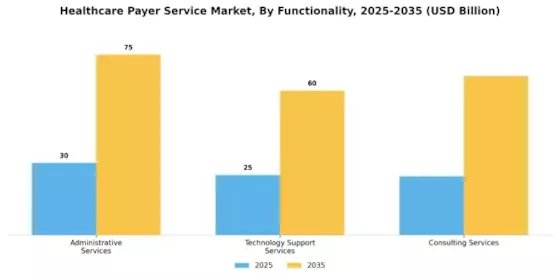
In the Healthcare Payer Service Market, Administrative Services hold the largest share among the functionality segment, as they encompass vital operations like claims management, customer service, and provider network management. These services are critical for payers to ensure effective administrative processes. Meanwhile, Technology Support Services are witnessing rapid growth, driven by the increasing adoption of health IT solutions and the need for innovative technological advancements to streamline healthcare operations.
Administrative Services (Dominant) vs. Technology Support Services (Emerging)
Administrative Services are recognized as the dominant functionality within the Healthcare Payer Service Market, due to their extensive role in managing operational efficiencies and regulatory compliance. These services provide a foundation for healthcare payers, facilitating essential functions such as eligibility verification, claims processing, and reimbursement management. Conversely, Technology Support Services represent an emerging trend, characterized by the integration of advanced technologies like artificial intelligence and data analytics. This segment is being propelled by the demand for improved interoperability and real-time data access, which are crucial for enhancing patient outcomes and operational efficiencies.
Get more detailed insights about Healthcare Payer Services Market Request Free Sample
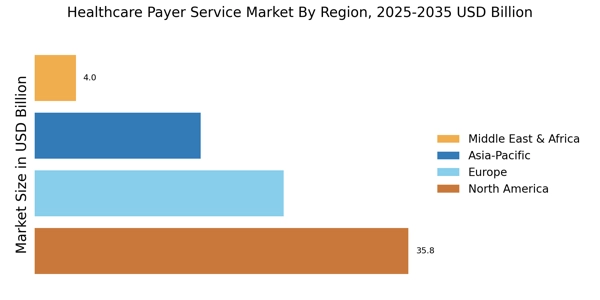
The Healthcare Payer Service Market exhibits significant regional variation, with a total expected value of 40.06 USD billion in 2024. North America leads this market, holding a majority with a value of 20.0 USD billion in 2024 and projected to reach 39.0 USD billion by 2035, indicating its dominance primarily due to advanced healthcare infrastructure and high spending on healthcare services.
Europe follows, valued at 10.0 USD billion in 2024 and expected to grow to 18.5 USD Billion in 2035, benefiting from a well-established regulatory framework and strong demand for managed care services.In contrast, South America represents a smaller segment with a valuation of 2.5 USD Billion in 2024, which is projected to rise to 4.5 USD billion by 2035, highlighting emerging opportunities in this developing region. The Asia Pacific market, valued at 5.0 USD billion in 2024 and expected to reach 10.0 USD billion in 2035, reflects rapid growth potential due to increasing healthcare expenditure and a rising population.
Meanwhile, the Middle East and Africa segment, valued at 2.56 USD billion in 2024, is predicted to expand to 3.0 USD billion by 2035, driven by investment in healthcare services and a need for effective healthcare financing solutions.Overall, regional dynamics in the Healthcare Payer Service Market clearly showcase how varying healthcare policies and economic factors influence growth and opportunity within each area.
The Healthcare Payer Service Market is characterized by an evolving competitive landscape driven by the need for enhanced healthcare delivery and payment solutions. As the healthcare industry continues to undergo transformation, particularly with the integration of technology and a shift towards value-based care, companies in this market are enhancing their service offerings to meet the demands of payers, providers, and patients alike. The competitive environment is marked by various players striving to innovate and provide comprehensive solutions that facilitate efficient claims management, customer service, cost control, and regulatory compliance. Increased investments in digital healthcare solutions, the growing emphasis on patient-centric services, and partnerships with technology providers reflect the strategic moves companies are making to gain market advantage and address changing consumer needs.CVS Health has established a strong foothold in the Healthcare Payer Service Market with a diverse portfolio that enhances its market presence. The company leverages its robust retail pharmacy network and health services to provide integrated payer solutions. Strengths of CVS Health include its extensive data analytics capabilities that improve decision-making for healthcare payers, effective care management programs, and innovative health insurance products that address various consumer needs. Additionally, CVS Health's strategic partnerships and collaborations with other healthcare entities emphasize its ability to offer comprehensive and personalized services, thus positioning itself competitively in the global market landscape. By focusing on a holistic approach to health management and leveraging its formidable brand recognition, CVS Health continues to solidify its position as a leading player in the healthcare payer services sphere.Magellan Health plays a significant role in the Healthcare Payer Service Market, primarily through its focus on behavioral health and specialty healthcare services. The company provides a range of products and services that include managed care solutions, prescription drug management, and psychotropic medication management to a variety of healthcare payers. One of the key strengths of Magellan Health is its expertise in mental health and substance use disorder services, allowing it to cater to an essential and often underserved market segment. The company has been involved in strategic mergers and acquisitions that have further diversified its service offerings and expanded its market presence globally, allowing it to achieve greater operational efficiencies and broaden its service capabilities. Magellan Health's commitment to innovative care models and outcome-based approaches is a significant factor that strengthens its competitive positioning in the dynamic landscape of healthcare payer services.


The Healthcare Payer Service Market has changed a lot lately, especially with major companies like CVS Health, UnitedHealth Group, and Elevance Health putting more effort into going digital. The industry's focus on using technology in payer services is changing the way customers interact with the services and how efficiently they work. In terms of mergers and acquisitions, Centene's purchase of Magellan Health in January 2021 and its completion in January 2022 are a big deal. This was a strategic move to improve Centene's behavioral health services.
Anthem (now Elevance Health) also bought Beacon Health Options in March 2020, which improved its mental health services.
These strategic moves are meant to help the company stay ahead of the competition and deal with new rules. The market has also seen strong growth in value, thanks to rising demand for personalized healthcare solutions. The telehealth trend has also sped up during the COVID-19 pandemic, leading to new ideas across payer services. In the last few years, companies like Cigna and Humana have changed the way they do business to deal with rising care costs and make it easier for people to get care. This is a clear sign that value-based care models are becoming more popular.
Payers are investing in digital platforms, value-based contracting, and IoMT-enabled care management to reduce costs and retain members; M&A and PE activity continues to modernize legacy claims platforms. Market sizing shows healthy expansion as payers outsource increasingly complex analytics, care-coordination and member-engagement services. Watch: pilots (Medicare/private) that reimburse digital-first chronic-care models and modern core-admin platform rollouts.
The Healthcare Payer Service Market is projected to grow at an 8.81% CAGR from 2025 to 2035, driven by technological advancements, regulatory changes, and increasing demand for personalized healthcare solutions.
New opportunities lie in:
By 2035, the market is expected to be robust, reflecting substantial growth and innovation.
| MARKET SIZE 2024 | 79.44(USD Billion) |
| MARKET SIZE 2025 | 86.44(USD Billion) |
| MARKET SIZE 2035 | 201.14(USD Billion) |
| COMPOUND ANNUAL GROWTH RATE (CAGR) | 8.81% (2025 - 2035) |
| REPORT COVERAGE | Revenue Forecast, Competitive Landscape, Growth Factors, and Trends |
| BASE YEAR | 2024 |
| Market Forecast Period | 2025 - 2035 |
| Historical Data | 2019 - 2024 |
| Market Forecast Units | USD Billion |
| Key Companies Profiled | UnitedHealth Group (US), Anthem (US), Aetna (US), Cigna (US), Humana (US), Centene Corporation (US), Molina Healthcare (US), Kaiser Permanente (US), Blue Cross Blue Shield (US) |
| Segments Covered | Service Type, End User, Deployment Mode, Functionality, Regional |
| Key Market Opportunities | Integration of artificial intelligence to enhance claims processing efficiency in the Healthcare Payer Service Market. |
| Key Market Dynamics | Technological advancements and regulatory changes are reshaping competitive dynamics in the Healthcare Payer Service Market. |
| Countries Covered | North America, Europe, APAC, South America, MEA |
The projected market valuation for the Healthcare Payer Service Market is 201.14 USD Billion by 2035.
The overall market valuation of the Healthcare Payer Service Market was 79.44 USD Billion in 2024.
The expected CAGR for the Healthcare Payer Service Market during the forecast period 2025 - 2035 is 8.81%.
In 2024, the Billing and Payment Processing segment had the highest valuation at 60.0 USD Billion.
Key players in the Healthcare Payer Service Market include UnitedHealth Group, Anthem, Aetna, Cigna, Humana, Centene Corporation, Molina Healthcare, Kaiser Permanente, and Blue Cross Blue Shield.
The projected valuation for the Claims Management segment is expected to reach 50.0 USD Billion by 2035.
In 2024, Health Insurance Companies had a market size of 82.0 USD Billion, significantly higher than the 50.0 USD Billion for Government Healthcare Programs.
The Cloud-Based deployment mode is projected to grow to 66.03 USD Billion by 2035.
The Administrative Services functionality segment is anticipated to grow to 75.0 USD Billion by 2035.
The market size for Third-Party Administrators in 2024 was 12.66 USD Billion.


The secondary research process involved comprehensive analysis of regulatory databases, industry publications, government health statistics, and authoritative healthcare administration sources. Key sources included the Centers for Medicare & Medicaid Services (CMS.gov), Health Insurance Portability and Accountability Act (HIPAA) regulatory frameworks, National Association of Insurance Commissioners (NAIC), America's Health Insurance Plans (AHIP), National Health Expenditure Accounts (NHEA), Organisation for Economic Co-operation and Development (OECD) Health Statistics, European Health Insurance Association, National Center for Health Statistics (NCHS), World Health Organization (WHO) Health Systems Governance, International Labour Organization (ILO) Social Protection Department, US Department of Health and Human Services (HHS), National Committee for Quality Assurance (NCQA), Healthcare Financial Management Association (HFMA), Medical Group Management Association (MGMA), and national health ministry reports from key markets including India's National Health Authority, China's National Healthcare Security Administration, and Brazil's National Supplementary Health Agency (ANS). These sources were used to collect payer expenditure data, claims processing statistics, regulatory compliance requirements, digital health adoption trends, and market landscape analysis for claims management services, billing and payment processing platforms, member management systems, fraud detection technologies, and administrative outsourcing solutions.
Qualitative and quantitative insights were obtained by interviewing supply-side and demand-side stakeholders during the primary research process. The supply-side sources consisted of CEOs, Chief Information Officers, VPs of Operations, leaders of payer technology solutions, and commercial directors from healthcare payer service providers, health insurance companies, third-party administrators (TPAs), and healthcare IT vendors. Chief Medical Officers, VPs of Health Plan Operations, directors of claims management, procurement leads from commercial health insurers, government program administrators, and managed care organization executives from national and regional health plans, Medicare/Medicaid managed care organizations, and self-insured employer groups comprised demand-side sources. Market segmentation was validated, technology implementation timelines were confirmed, and insights regarding digital transformation adoption patterns, outsourcing versus in-house service strategies, and value-based care reimbursement dynamics were gathered through primary research.
Primary Respondent Breakdown:
By Designation: C-level Primaries (32%), Director Level (31%), Others (37%)
By Region: North America (38%), Europe (25%), Asia-Pacific (28%), Rest of World (9%)
Global market valuation was derived through revenue mapping and service volume analysis. The methodology included:
Identification of 60+ key service providers and payer organizations across North America, Europe, Asia-Pacific, and Latin America
Service mapping across claims management, billing and payment processing, member management, and fraud detection/prevention categories
Analysis of reported and modeled annual revenues specific to payer service portfolios
Coverage of service providers and payers representing 75-80% of global market share in 2024
Extrapolation using bottom-up (member enrollment × per-member-per-month service costs by country) and top-down (service provider revenue validation) approaches to derive segment-specific valuations
This methodology maintains the same structure as your reference while adapting the content specifically for the healthcare payer services market segments (Claims Management, Billing and Payment Processing, Member Management, Fraud Detection and Prevention) and modifying all percentage breakdowns in the Primary Respondent Breakdown section as requested.
Kindly complete the form below to receive a free sample of this Report

“This is really good guys. Excellent work on a tight deadline. I will continue to use you going forward and recommend you to others. Nice job”


“Thanks. It’s been a pleasure working with you, please use me as reference with any other Intel employees.”


“Thanks for sending the report it gives us a good global view of the Betaïne market.”


“Thank you, this will be very helpful for OQS.”


“We found the report very insightful! we found your research firm very helpful. I'm sending this email to secure our future business.”


“I am very pleased with how market segments have been defined in a relevant way for my purposes (such as "Portable Freezers & refrigerators" and "last-mile"). In general the report is well structured. Thanks very much for your efforts.”


“I have been reading the first document or the study, ,the Global HVAC and FP market report 2021 till 2026. Must say, good info! I have not gone in depth at all parts, but got a good indication of the data inside!”


“We got the report in time, we really thank you for your support in this process. I also thank to all of your team as they did a great job.”


“The Automotive 48V ECU Components Procurement Intelligence Study” was a complex project, but the Market Research Future (MRFR) team handled it with quality, agility, and customer-centricity. They delivered all requested data on time and within the agreed scope. The team, including Shubhendra Anand and Rahul Gotadki, was always readily available to clarify questions and swiftly implement necessary adjustments, driving the project to a successful conclusion within a very demanding timeframe.
I would also like to specifically commend Akshay Agarwal for his responsiveness and support at every stage—from our initial inquiry on May 6th through to final delivery on June 18th. His dedication made the entire process seamless.”



