Download Free Sample
Kindly complete the form below to receive a free sample of this Report
Japan Healthcare Payer Services Market Research Report By Service Type (Claims Management, Billing and Payment Processing, Member Management, Fraud Detection and Prevention), By End User (Health Insurance Companies, Government Healthcare Programs, Managed Care Organizations, Third-Party Administrators), By Deployment Mode (On-Premises, Cloud-Based, Hybrid) and By Functionality (Administrative Services, Technology Support Services, Consulting Services) -Forecast to 2035
As per Market Research Future analysis, the Japan healthcare payer-services market size was estimated at 2383.32 USD Million in 2024. The Japan healthcare payer-services market is projected to grow from 2585.43 USD Million in 2025 to 5834.2 USD Million by 2035, exhibiting a compound annual growth rate (CAGR) of 8.4% during the forecast period 2025 - 2035
The Japan The healthcare payer-services market is experiencing a transformative shift. This shift is driven by technological advancements and demographic changes.
| 2024 Market Size | 2383.32 (USD Million) |
| 2035 Market Size | 5834.2 (USD Million) |
| CAGR (2025 - 2035) | 8.48% |
UnitedHealth Group (US), Anthem (US), Aetna (US), Cigna (US), Humana (US), Centene (US), Molina Healthcare (US), Kaiser Permanente (US), WellCare Health Plans (US)
Our Impact
Enabled $4.3B Revenue Impact for Fortune 500 and Leading Multinationals
Partnering with 2000+ Global Organizations Each Year
30K+ Citations by Top-Tier Firms in the Industry
The healthcare payer-services market in Japan is currently experiencing a transformative phase, driven by advancements in technology and evolving consumer expectations. The integration of digital health solutions is reshaping how services are delivered, with a notable shift towards telemedicine and remote patient monitoring. This trend appears to enhance accessibility and efficiency, potentially leading to improved patient outcomes. Furthermore, the regulatory environment is adapting to these changes, suggesting a more supportive framework for innovation in healthcare delivery. In addition, the aging population in Japan is influencing the dynamics of the healthcare payer-services market. As the demographic landscape shifts, there is an increasing demand for tailored services that cater to the unique needs of older adults. This demographic trend may prompt payers to develop more comprehensive coverage options, focusing on preventive care and chronic disease management. Overall, the interplay between technology, regulatory changes, and demographic shifts is likely to shape the future of the healthcare payer-services market in Japan, fostering a more patient-centric approach to healthcare delivery.
The healthcare payer-services market is undergoing a significant digital transformation. This shift includes the adoption of telehealth services and mobile health applications, which enhance patient engagement and streamline administrative processes. As technology continues to evolve, payers are likely to invest in innovative solutions that improve service delivery and operational efficiency.
The demographic changes in Japan, particularly the aging population, are reshaping the healthcare payer-services market. With a growing number of elderly individuals, there is an increasing need for specialized services that address chronic conditions and long-term care. Payers may need to adapt their offerings to meet the demands of this demographic, focusing on preventive care and personalized health management.
The regulatory landscape surrounding the healthcare payer-services market is evolving to accommodate new technologies and practices. Policymakers are likely to implement reforms that support innovation while ensuring patient safety and data security. This adaptation may create opportunities for payers to enhance their service offerings and improve overall healthcare delivery.
The healthcare payer-services market is undergoing a paradigm shift towards preventive care, which is becoming increasingly prioritized in Japan. This focus is largely driven by the recognition that preventive measures can significantly reduce long-term healthcare costs. Payers are now incentivizing preventive services, such as regular health screenings and wellness programs, to mitigate the financial burden of chronic diseases. It is estimated that for every ¥1 invested in preventive care, there is a potential return of ¥3 in reduced healthcare costs. This strategic shift not only enhances patient health outcomes but also positions payers to better manage their financial risks. As a result, the emphasis on preventive care is likely to continue shaping the landscape of the healthcare payer-services market.
The healthcare payer-services market is currently navigating an environment of increased regulatory scrutiny in Japan. Regulatory bodies are implementing stricter compliance measures to ensure transparency and accountability among payers. This trend is evident in the recent updates to the Health Insurance Act, which mandates more rigorous reporting and auditing processes. As a result, payer organizations are investing in compliance technologies and training programs to meet these new requirements. This heightened focus on regulation not only aims to protect consumers but also fosters a more competitive landscape among payers. Consequently, the healthcare payer-services market is likely to see a surge in demand for compliance-related services and solutions, as organizations strive to adhere to evolving regulations.
Japan's healthcare payer-services market is significantly influenced by the rising healthcare expenditure, which has been steadily increasing over the years. As of 2025, healthcare spending in Japan is estimated to reach approximately ¥42 trillion, reflecting a growth rate of around 4% annually. This increase is driven by factors such as the need for advanced medical technologies, higher costs of pharmaceuticals, and the demand for improved healthcare services. Consequently, healthcare payers are compelled to adapt their strategies to manage these rising costs effectively. This trend indicates a growing opportunity for payer-services providers to innovate and offer cost-effective solutions that align with the evolving needs of healthcare consumers, thereby fostering growth in the healthcare payer-services market.
The healthcare payer-services market is increasingly shifting towards value-based care models, which emphasize patient outcomes over volume of services provided. In Japan, this transition is being driven by both payers and providers who recognize the need for sustainable healthcare solutions. Value-based care models encourage collaboration among stakeholders, leading to improved care coordination and reduced costs. It is projected that by 2026, value-based care initiatives could account for up to 40% of total healthcare spending in Japan. This shift not only aligns with the goals of enhancing patient satisfaction but also positions payers to better manage their financial risks. As such, the healthcare payer-services market is likely to evolve in response to this growing trend, fostering innovation and new service offerings.
The healthcare payer-services market is experiencing a notable transformation due to rapid technological advancements. Innovations such as artificial intelligence (AI), machine learning, and big data analytics are enhancing operational efficiencies and improving patient outcomes. In Japan, the integration of these technologies is projected to increase the efficiency of claims processing by up to 30%. Furthermore, the adoption of telemedicine and digital health solutions is reshaping service delivery, allowing payers to offer more personalized care. This shift not only enhances patient engagement but also reduces administrative costs, thereby driving growth in the healthcare payer-services market. As technology continues to evolve, it is likely that payer organizations will increasingly invest in these solutions to remain competitive and meet the demands of a tech-savvy population.
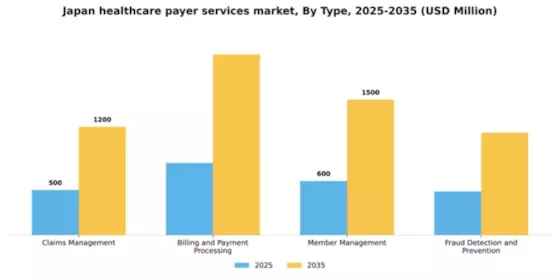
In the Japan healthcare payer-services market, the segment values exhibit distinct market share distributions. Claims Management is the largest segment, holding a significant position due to its critical role in processing healthcare claims efficiently, ensuring timely reimbursements and streamlining administrative functions. On the other hand, Fraud Detection and Prevention, while smaller in absolute size, is gaining traction rapidly as stakeholders recognize the increasing threat of fraudulent activities, necessitating advanced technologies and robust systems to safeguard resources. Growth trends in the segment indicate a shifting focus toward enhancing operational efficiencies and adopting innovative technologies. The demand for Billing and Payment Processing services is also on the rise as healthcare organizations seek to simplify financial transactions and improve patient experiences. Furthermore, the escalating concerns around fraud are driving investments in Fraud Detection and Prevention solutions, which are becoming essential for maintaining integrity within healthcare payer operations.
Claims Management (Dominant) vs. Fraud Detection and Prevention (Emerging)
Claims Management serves as the dominant player within the Japan healthcare payer-services market, characterized by its established frameworks and processes that facilitate efficient claims processing. This segment benefits from a large customer base, including healthcare providers and payers, who rely heavily on effective claims management to ensure financial stability and operational effectiveness. In contrast, Fraud Detection and Prevention, while emerging, is poised for rapid growth driven by heightened awareness and regulation around fraudulent claims. This segment employs advanced analytics and machine learning technologies to uncover potential fraud, protect assets, and enhance overall trust in healthcare payer services. As threats evolve, the agility and innovation within Fraud Detection and Prevention will be pivotal for their market ascent.
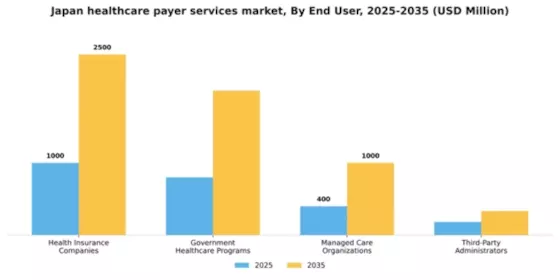
In the Japan healthcare payer-services market, Health Insurance Companies hold the largest share, reflecting their crucial role in providing coverage and managing care. Meanwhile, Government Healthcare Programs, while representing a smaller segment, are rapidly expanding, driven by policies aimed at enhancing public health access and affordability. Growth trends indicate that Health Insurance Companies are focusing on technology integration and customer-centric services, which enhances their market position. Conversely, Government Healthcare Programs are seeing accelerated growth due to demographic changes, increased healthcare demands, and government initiatives aimed at universal health coverage, highlighting their emerging presence in the market.
Health Insurance Companies: Dominant vs. Government Healthcare Programs: Emerging
Health Insurance Companies dominate the market by offering comprehensive coverage and innovative solutions that cater to varying healthcare needs. They have established robust networks with healthcare providers, ensuring a seamless experience for policyholders. On the other hand, Government Healthcare Programs are becoming increasingly significant, especially as aging populations necessitate expanded healthcare services. These programs are characterized by their focus on equitable access and preventative care initiatives. As they evolve, they are likely to leverage their emerging status to address gaps in health coverage and collaborate more closely with Health Insurance Companies, fostering a more integrated healthcare system.
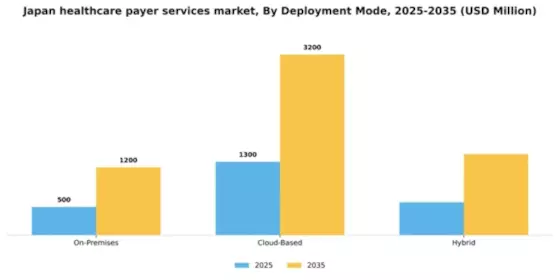
In the Japan healthcare payer-services market, the distribution of deployment modes reveals that Cloud-Based solutions hold the largest share, bringing significant advantages in terms of flexibility and cost-effectiveness. In contrast, On-Premises deployment is gaining momentum, reflecting a growing adherence to regulatory compliance and data security standards prevalent in the market. Hybrid solutions, while present, are still emerging and cater to organizations seeking a balanced approach. The growth trends for these segments indicate a clear shift toward Cloud-Based solutions due to their scalability and the increasing adoption of telehealth services. On-Premises solutions, although perceived as traditionally slower in growth, are becoming favored by large institutions focused on control over their data environments. Thus, while Cloud-Based remains dominant, On-Premises is capturing the interest of a niche market amid evolving regulations and patient needs.
Cloud-Based (Dominant) vs. On-Premises (Emerging)
Cloud-Based deployment in the Japan healthcare payer-services market is characterized by its ability to provide scalable solutions that adapt to the needs of healthcare organizations. It simplifies integration with various healthcare technologies and enhances collaboration among stakeholders. This segment benefits from reduced operational costs and improved data accessibility, making it highly attractive. On the other hand, On-Premises deployment is emerging as a strong contender, particularly among larger payers that prioritize heightened control over data management and compliance with stringent regulations. This segment is evolving with advancements in security features that increasingly appeal to organizations wary of data breaches. As such, the market sees both segments coexist, catering to varied operational needs.
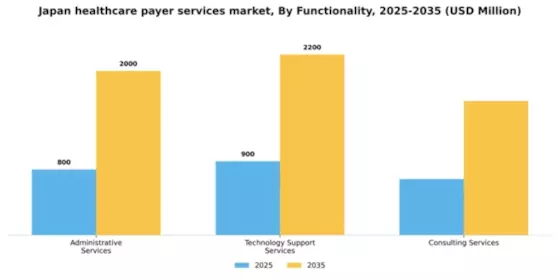
In the Japan healthcare payer-services market, Administrative Services holds the largest market share, as these services are vital for managing claims processing, member eligibility, and compliance issues within the healthcare system. Following this, Technology Support Services have been steadily gaining traction, driven by the increasing digitalization of healthcare processes and the growing need for efficient IT infrastructures that support administrative functions. Growth trends in this segment indicate a marked shift towards integrating advanced technology solutions, which facilitate better data management and streamline operations. Factors such as heightened efficiency, regulatory compliance, and support for telemedicine have bolstered the demand for both Administrative and Technology Support Services. Consulting Services are also witnessing a steady rise, emphasizing strategic partnerships and advisory roles to enhance operational effectiveness.
Administrative Services (Dominant) vs. Consulting Services (Emerging)
Administrative Services dominate the landscape of the Japan healthcare payer-services market by ensuring the seamless execution of essential functions such as billing, claims management, and patient services. Their established frameworks and proficiency in navigating regulatory requirements rank them as a preferred choice among healthcare payers. On the other hand, Consulting Services are emerging as a vital resource, offering insights and strategies to optimize performance, reduce costs, and enhance patient engagement. These services are increasingly valuable as healthcare organizations seek to adapt to rapidly changing regulations and the necessity for innovative solutions to maintain competitiveness. The combination of solid administrative foundations and consultative expertise is shaping a responsive and adaptive service environment in the market.
Get more detailed insights about Japan Healthcare Payer Services Market Request Free Sample
The healthcare payer-services market in Japan is characterized by a dynamic competitive landscape, driven by factors such as technological advancements, regulatory changes, and an increasing demand for personalized healthcare solutions. Major players in this market, including UnitedHealth Group (US), Anthem (US), and Cigna (US), are strategically positioning themselves through innovation and partnerships. These companies are focusing on enhancing their digital capabilities and expanding their service offerings, which collectively shapes a competitive environment that is increasingly reliant on technology and customer-centric solutions.Key business tactics employed by these companies include optimizing supply chains and localizing services to better meet the needs of the Japanese market. The competitive structure of the market appears moderately fragmented, with several key players exerting influence while also facing competition from emerging local firms. This fragmentation allows for a diverse range of services and innovations, fostering a competitive atmosphere that encourages continuous improvement and adaptation.
In October UnitedHealth Group (US) announced a partnership with a leading Japanese technology firm to develop AI-driven healthcare solutions aimed at improving patient outcomes. This strategic move is likely to enhance UnitedHealth's service delivery and operational efficiency, positioning the company as a leader in the integration of technology within the healthcare payer-services sector. The collaboration underscores the importance of leveraging local expertise to navigate the complexities of the Japanese healthcare landscape.
In September Anthem (US) expanded its telehealth services in Japan, responding to the growing demand for remote healthcare solutions. This expansion is significant as it aligns with global trends towards digital health, allowing Anthem to capture a larger market share while providing accessible healthcare options to patients. The initiative reflects a broader shift within the industry towards integrating technology into traditional healthcare models, which may redefine patient engagement strategies.
In August Cigna (US) launched a new wellness program tailored specifically for the Japanese market, focusing on preventive care and chronic disease management. This initiative is strategically important as it not only addresses the unique health challenges faced by the Japanese population but also positions Cigna as a proactive player in the healthcare payer-services market. By emphasizing preventive care, Cigna may enhance its brand reputation and foster long-term customer loyalty.
As of November current trends in the healthcare payer-services market include a strong emphasis on digitalization, sustainability, and the integration of AI technologies. Strategic alliances are increasingly shaping the competitive landscape, enabling companies to pool resources and expertise to innovate more effectively. Looking ahead, competitive differentiation is likely to evolve from traditional price-based competition towards a focus on innovation, technological advancements, and reliable supply chains. This shift suggests that companies that prioritize these areas may gain a competitive edge in an ever-evolving market.
Recent developments in the Japan Healthcare Payer Services Market have been significant, reflecting the industry's dynamic nature. Companies such as Fukoku Mutual Life Insurance Company and Mitsui Sumitomo Insurance Company have been adapting to regulatory changes aimed at enhancing healthcare access and cost control. In September 2023, Japan Post Insurance announced plans to expand its health insurance offerings to cater to the aging population, which is rapidly increasing due to a declining birthrate and longer life expectancy. Aflac Incorporated has recently focused on digital transformation to streamline claims processing, promoting efficiency in service delivery.
In October 2023, it was reported that Tokyo Marine Holdings entered into a strategic partnership with Hitachi HealthCare to develop advanced health-monitoring technologies. The market has also seen increased competition, with companies like Nippon Life Insurance Company and Daiichi Life Holdings adjusting their pricing strategies to attract younger policyholders. Major mergers and acquisitions have defined the landscape; for example, in April 2023, SOMPO Holdings acquired a minor share in MS&AD Insurance Group to enhance its service portfolio. Overall, the evolving regulatory framework, demographic shifts, and competitive landscape continue to reshape the Japan Healthcare Payer Services Market significantly.
The Healthcare Payer Services Market in Japan is projected to grow at an 8.48% CAGR from 2025 to 2035, driven by technological advancements and increasing demand for efficient healthcare solutions.
New opportunities lie in:
By 2035, the market is expected to achieve substantial growth and innovation.
| MARKET SIZE 2024 | 2383.32(USD Million) |
| MARKET SIZE 2025 | 2585.43(USD Million) |
| MARKET SIZE 2035 | 5834.2(USD Million) |
| COMPOUND ANNUAL GROWTH RATE (CAGR) | 8.48% (2025 - 2035) |
| REPORT COVERAGE | Revenue Forecast, Competitive Landscape, Growth Factors, and Trends |
| BASE YEAR | 2024 |
| Market Forecast Period | 2025 - 2035 |
| Historical Data | 2019 - 2024 |
| Market Forecast Units | USD Million |
| Key Companies Profiled | UnitedHealth Group (US), Anthem (US), Aetna (US), Cigna (US), Humana (US), Centene (US), Molina Healthcare (US), Kaiser Permanente (US), WellCare Health Plans (US) |
| Segments Covered | Type, End User, Deployment Mode, Functionality |
| Key Market Opportunities | Integration of advanced analytics and artificial intelligence in healthcare payer-services market enhances operational efficiency and patient outcomes. |
| Key Market Dynamics | Rising regulatory scrutiny and technological advancements reshape competitive dynamics in Japan's healthcare payer-services market. |
| Countries Covered | Japan |
The projected market valuation for the Japan healthcare payer-services market in 2035 is $5834.2 Million.
The overall market valuation in 2024 was $2383.32 Million.
The expected CAGR for the Japan healthcare payer-services market during the forecast period 2025 - 2035 is 8.48%.
In 2024, the claims management segment had a valuation of $500 Million.
The projected valuations for billing and payment processing by 2035 are expected to reach $2000 Million.
The cloud-based deployment mode is anticipated to dominate the market by 2035, with projected valuations of $3200 Million.
The valuation range for health insurance companies in 2024 was between $1000 Million and $2500 Million.
By 2035, spending on technology support services is expected to reach $2200 Million.
The valuation for fraud detection and prevention in 2024 was $483.32 Million.
Key players in the Japan healthcare payer-services market include UnitedHealth Group, Anthem, Aetna, Cigna, Humana, Centene, Molina Healthcare, Kaiser Permanente, and WellCare Health Plans.


Kindly complete the form below to receive a free sample of this Report

“This is really good guys. Excellent work on a tight deadline. I will continue to use you going forward and recommend you to others. Nice job”


“Thanks. It’s been a pleasure working with you, please use me as reference with any other Intel employees.”


“Thanks for sending the report it gives us a good global view of the Betaïne market.”


“Thank you, this will be very helpful for OQS.”


“We found the report very insightful! we found your research firm very helpful. I'm sending this email to secure our future business.”


“I am very pleased with how market segments have been defined in a relevant way for my purposes (such as "Portable Freezers & refrigerators" and "last-mile"). In general the report is well structured. Thanks very much for your efforts.”


“I have been reading the first document or the study, ,the Global HVAC and FP market report 2021 till 2026. Must say, good info! I have not gone in depth at all parts, but got a good indication of the data inside!”


“We got the report in time, we really thank you for your support in this process. I also thank to all of your team as they did a great job.”


“The Automotive 48V ECU Components Procurement Intelligence Study” was a complex project, but the Market Research Future (MRFR) team handled it with quality, agility, and customer-centricity. They delivered all requested data on time and within the agreed scope. The team, including Shubhendra Anand and Rahul Gotadki, was always readily available to clarify questions and swiftly implement necessary adjustments, driving the project to a successful conclusion within a very demanding timeframe.
I would also like to specifically commend Akshay Agarwal for his responsiveness and support at every stage—from our initial inquiry on May 6th through to final delivery on June 18th. His dedication made the entire process seamless.”



