Download Free Sample
Kindly complete the form below to receive a free sample of this Report
Healthcare Professional Education Services Market Research Report By Content Focus (Clinical Skills, Patient Safety, Healthcare Management, Research Methodology, Ethics in Healthcare), By Education Type (Continuing Medical Education, Postgraduate Education, Certification Programs, Online Learning, Workshops), By Delivery Method (In-Person Training, Online Courses, Hybrid Learning, Simulation-Based Training, Self-Paced Learning), By Target Audience (Physicians, Nurses, Pharmacists, Allied Health Professionals, Medical Students), By Regulatory Compliance (Accredited Programs, Non-Accredited Programs, Mandatory Training, Voluntary Training, Specialized Training) And By Region (North America, Europe, Asia-Pacific, And Rest Of The World) – Market Forecast Till 2035.
As per MRFR analysis, the Healthcare Professional Education Services Market was estimated at 40.5 USD Billion in 2024. The Healthcare Professional Education Services industry is projected to grow from 41.97 USD Billion in 2025 to 60.0 USD Billion by 2035, exhibiting a compound annual growth rate (CAGR) of 3.64% during the forecast period 2025 - 2035.
The Healthcare Professional Education Services Market is experiencing a transformative shift driven by technological advancements and evolving educational needs.
| 2024 Market Size | 40.5 (USD Billion) |
| 2035 Market Size | 60.0 (USD Billion) |
| CAGR (2025 - 2035) | 3.64% |
Medscape (US), UpToDate (US), DynaMed (US), American Medical Association (US), Elsevier (NL), Wolters Kluwer (NL), Harvard Medical School (US), Johns Hopkins University (US), Mayo Clinic (US)
Our Impact
Enabled $4.3B Revenue Impact for Fortune 500 and Leading Multinationals
Partnering with 2000+ Global Organizations Each Year
30K+ Citations by Top-Tier Firms in the Industry
The Healthcare Professional Education Services Market is currently experiencing a transformative phase, driven by the increasing demand for advanced training and continuous professional development among healthcare practitioners. This market encompasses a wide array of educational offerings, including online courses, workshops, and certification programs tailored to enhance the skills and knowledge of healthcare professionals. As the landscape of healthcare evolves, the emphasis on lifelong learning becomes more pronounced, suggesting that educational institutions and service providers must adapt their offerings to meet the changing needs of the workforce. Furthermore, the integration of technology into educational frameworks appears to be reshaping how training is delivered, with virtual simulations and interactive platforms gaining traction. In addition to technological advancements, the Healthcare Professional Education Services Market is influenced by regulatory changes and the growing importance of evidence-based practice. Healthcare organizations are increasingly prioritizing education that aligns with current standards and best practices, which may lead to a shift in the types of programs offered. Moreover, the collaboration between educational institutions and healthcare providers seems to be strengthening, fostering a more integrated approach to training that benefits both parties. As the market continues to evolve, it is likely that new trends will emerge, further shaping the future of healthcare education and professional development.
The incorporation of advanced technologies into educational programs is becoming more prevalent. Online learning platforms, virtual reality simulations, and mobile applications are enhancing the learning experience for healthcare professionals. This trend indicates a shift towards more flexible and accessible training options, allowing practitioners to engage with content at their own pace.
There is a growing emphasis on interdisciplinary education within the Healthcare Professional Education Services Market. Programs that encourage collaboration among various healthcare disciplines are gaining popularity. This approach fosters a more comprehensive understanding of patient care and promotes teamwork, which is essential in modern healthcare settings.
As the healthcare landscape evolves, the importance of regulatory compliance and accreditation in educational programs is becoming increasingly critical. Institutions are focusing on ensuring that their offerings meet the necessary standards set by governing bodies. This trend suggests a heightened awareness of the need for quality assurance in healthcare education.
The Healthcare Professional Education Services Market is increasingly focusing on patient-centered care as a core component of healthcare education. This paradigm shift emphasizes the importance of understanding patient needs, preferences, and values in the delivery of care. Educational programs are being redesigned to incorporate training on communication skills, empathy, and cultural competence. Recent data indicates that healthcare organizations prioritizing patient-centered approaches report higher patient satisfaction and better health outcomes. Consequently, educational institutions are adapting their curricula to ensure that future healthcare professionals are equipped with the necessary skills to provide holistic care. This growing emphasis on patient-centered education is likely to drive demand within the Healthcare Professional Education Services Market, as stakeholders recognize the value of training that aligns with contemporary healthcare practices.
The Healthcare Professional Education Services Market is increasingly emphasizing interdisciplinary collaboration in educational programs. This approach recognizes that effective healthcare delivery often requires teamwork among various professionals, including doctors, nurses, pharmacists, and allied health workers. Educational institutions are responding by designing curricula that promote collaborative learning and interprofessional education. Recent studies suggest that interdisciplinary training can lead to improved communication and teamwork skills, ultimately enhancing patient care. As healthcare systems strive for integrated care models, the demand for such educational frameworks is expected to rise. This trend not only prepares healthcare professionals for real-world challenges but also aligns with the broader goals of improving healthcare outcomes, thereby contributing to the growth of the Healthcare Professional Education Services Market.
The Healthcare Professional Education Services Market is significantly influenced by regulatory changes and compliance requirements. Governments and professional bodies are increasingly mandating specific educational standards and accreditation for healthcare professionals. This regulatory landscape necessitates that educational institutions adapt their curricula to meet these evolving standards. For instance, recent regulations have emphasized the importance of evidence-based practice and patient safety in training programs. As a result, educational providers are investing in curriculum development and faculty training to ensure compliance. This focus on regulatory adherence not only enhances the quality of education but also fosters trust among stakeholders, including patients and healthcare organizations. The ongoing evolution of regulations is likely to drive further growth in the Healthcare Professional Education Services Market.
The Healthcare Professional Education Services Market is experiencing a notable shift due to technological advancements. The integration of digital platforms, such as e-learning and virtual simulations, has transformed traditional educational methodologies. This shift allows for more flexible learning environments, catering to the diverse needs of healthcare professionals. According to recent data, the e-learning segment is projected to grow at a compound annual growth rate of 10% over the next five years. This trend indicates a strong preference for online education, which is likely to enhance accessibility and engagement among healthcare professionals. Furthermore, the use of artificial intelligence and machine learning in educational tools is expected to personalize learning experiences, thereby improving knowledge retention and application in clinical settings.
The Healthcare Professional Education Services Market is witnessing an increased demand for continuous professional development (CPD) among healthcare practitioners. As the healthcare landscape evolves, professionals are required to stay abreast of the latest advancements in medical knowledge and practices. This demand is reflected in the growing number of CPD programs offered, which are designed to enhance skills and competencies. Recent statistics indicate that approximately 70% of healthcare professionals engage in some form of CPD annually. This trend underscores the importance of lifelong learning in maintaining high standards of care and improving patient outcomes. Consequently, educational institutions are expanding their offerings to include specialized training and certification programs, thereby contributing to the growth of the Healthcare Professional Education Services Market.
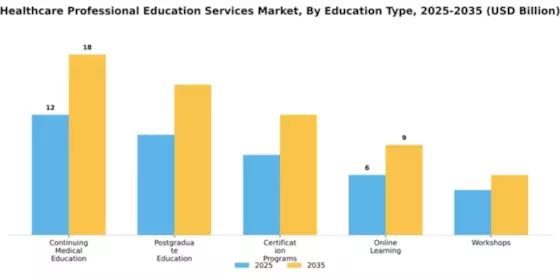
The Healthcare Professional Education Services Market is primarily driven by Continuing Medical Education (CME), which holds the largest market share due to its critical role in maintaining healthcare professionals' qualifications. The demand for CME has increased as healthcare regulations evolve and professionals seek to remain compliant with licensure requirements. Other key segments include Postgraduate Education, Certification Programs, and Workshops, each contributing significantly to market diversity.
Continuing Medical Education (Dominant) vs. Certification Programs (Emerging)
Continuing Medical Education (CME) is a vital aspect of professional development, providing healthcare professionals with the knowledge and skills necessary to enhance their practice and stay updated with medical advancements. As regulations and licensing requirements become more stringent, CME proves to be the dominant education type in the market. On the other hand, Certification Programs are emerging as essential components for healthcare professionals looking to specialize further and demonstrate their competencies in specific areas. These programs not only enhance career prospects but also cater to the increasing demand for qualified professionals in niche healthcare fields.
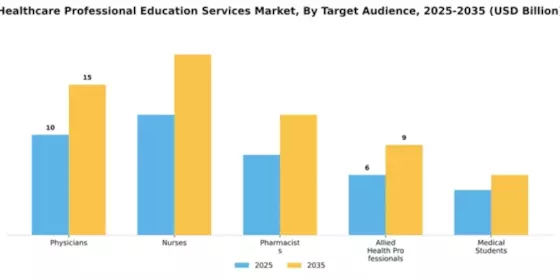
In the Healthcare Professional Education Services Market, the target audience is primarily composed of Physicians, Nurses, Pharmacists, Allied Health Professionals, and Medical Students, each contributing uniquely to the market dynamics. Physicians hold the largest share of the market, as continuous education is imperative for their practice and compliance with evolving medical standards. Nurses, while making up a smaller segment in terms of representation, are experiencing rapid growth due to the increasing emphasis on patient care quality and specialized training requirements in healthcare settings. Growth trends indicate that the demand for education is shifting towards Nurses, driven by factors such as healthcare reforms, rising patient expectations, and an increased focus on specialized nursing roles. This trend reflects a broader shift towards a more diversified healthcare workforce, with Allied Health Professionals, Pharmacists, and Medical Students also seeing enhanced educational offerings aimed at meeting these challenges. As the sector evolves, educational service providers are poised to adapt to these emerging demands, ensuring relevance and effectiveness in their training programs.
Education: Physicians (Dominant) vs. Nurses (Emerging)
Physicians remain the dominant audience within the Healthcare Professional Education Services Market, as ongoing education is critical to maintaining their licensure and staying abreast of the latest medical advancements. They often require specialized training sessions, workshops, and conferences tailored to their specialties, which drive substantial demand in this segment. Conversely, Nurses represent an emerging force in this market, with a growing need for continued education driven by new healthcare regulations and the complexity of patient care. The focus on nursing has intensified as the healthcare landscape shifts towards holistic and patient-centered care. This evolution has led to innovative educational programs aimed at equipping Nurses with advanced skills and knowledge, positioning their segment for sustained growth in tandem with the increasing importance of their role in healthcare systems.
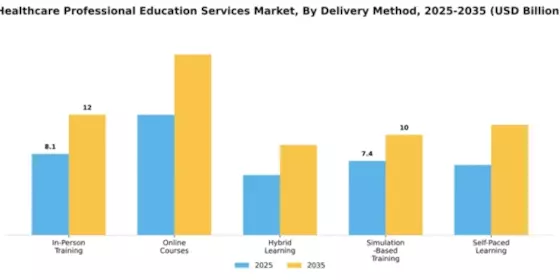
In the Healthcare Professional Education Services Market, the delivery method segment exhibits a diverse range of offerings. In-Person Training dominates the space, characterized by its effective hands-on approach, fostering direct interaction between instructors and participants. Online Courses, on the other hand, are rapidly gaining traction, appealing to healthcare professionals who appreciate the flexibility and convenience of learning at their own pace. As a result, Online Courses are increasing in market share, revolutionizing traditional educational methods. The growth trends in this segment are driven primarily by technological advancements and the increasing demand for accessible training solutions. Hybrid Learning and Simulation-Based Training are also emerging as significant contributors, offering innovations that blend traditional and modern teaching methods. The COVID-19 pandemic accelerated the shift towards online and hybrid models, highlighting the necessity for adaptable training solutions in healthcare, which continue to shape the future landscape of professional education.
Delivery Methods: In-Person Training (Dominant) vs. Simulation-Based Training (Emerging)
In-Person Training remains a dominant approach in the Healthcare Professional Education Services Market, providing an experiential learning environment that fosters collaboration and real-time feedback. This method is invaluable for practical skills, where direct interaction with instructors and peers enhances understanding and application. On the contrary, Simulation-Based Training is emerging as a vital complement, leveraging technology to create realistic scenarios for learners. This method allows healthcare professionals to practice skills safely and repeatedly, significantly improving competency and confidence. As healthcare systems strive for continuous improvement in education, the balance between traditional methods and innovative simulations is becoming increasingly important, driving demand for versatile training solutions that cater to various learning preferences.
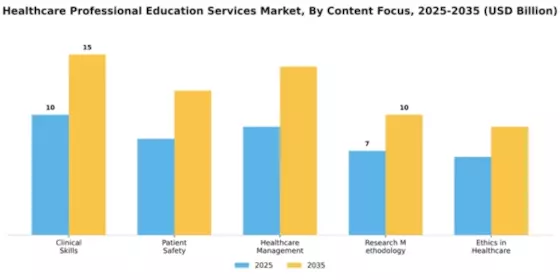
The Healthcare Professional Education Services Market displays a diverse range of focus areas, with Clinical Skills leading the way as the largest segment due to its essential role in training healthcare providers. Patient Safety follows closely, witnessing significant attention and investment as healthcare organizations prioritize this aspect to enhance patient outcomes. The remaining segments, including Healthcare Management, Research Methodology, and Ethics in Healthcare, also play crucial roles but do not command the same market share as the top two. Each segment contributes uniquely to the overall educational framework essential in healthcare settings, catering to different aspects of professional training and competency development. Growth trends in the Healthcare Professional Education Services Market reveal a robust demand for education centered on Clinical Skills and Patient Safety. As healthcare systems evolve and patient needs become more complex, the emphasis on developing comprehensive clinical capabilities is growing. Furthermore, the focus on Patient Safety has garnered substantial traction as regulatory bodies and healthcare institutions adopt stricter standards for quality care, thus driving education initiatives to mitigate risks and improve performance. This dynamic landscape indicates a shift toward integrating these focus areas into standardized training curricula, facilitating a more competent healthcare workforce.
Clinical Skills (Dominant) vs. Patient Safety (Emerging)
Clinical Skills represent the dominant content focus within the Healthcare Professional Education Services Market, underpinning the core competencies needed for effective patient care. This segment emphasizes the practical application of medical knowledge, honing healthcare providers' skills through hands-on training, simulations, and continuing education programs. Its significant demand stems from the necessity for healthcare professionals to be agile and proficient in real-world scenarios. In contrast, Patient Safety, categorized as an emerging focus area, reflects a growing recognition of its importance in healthcare delivery. As organizations strive to minimize errors and enhance care quality, education surrounding safe practices, risk management, and error prevention is rapidly developing. This trend indicates a shift where both segments will likely see increasing interdependence in curricula, promoting a holistic approach to healthcare education.
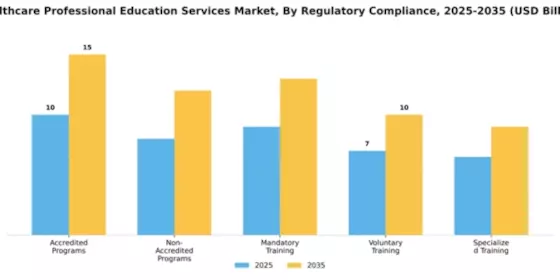
In the Healthcare Professional Education Services Market, the Regulatory Compliance segment displays a varied distribution among its sub-segments. Accredited Programs currently hold the largest share in this sector, reflecting the industry's emphasis on recognized qualifications and adherence to regulatory standards. Non-Accredited Programs and Specialty Training follow, catering to specific knowledge areas and flexibility in training. Mandatory Training is gaining traction due to regulatory requirements, increasingly driving the growth of professional education initiatives.
Accredited Programs (Dominant) vs. Mandatory Training (Emerging)
Accredited Programs stand as the dominant player in the Regulatory Compliance segment, focusing on providing recognized certifications that enhance the credibility of healthcare professionals. These programs are designed to meet rigorous standards, ensuring that participants gain relevant and up-to-date knowledge essential for their practice. On the other hand, Mandatory Training is emerging rapidly as a critical component of compliance, driven by regulatory requirements for healthcare professionals. This training not only ensures legal adherence but also fosters a culture of ongoing learning and patient safety. As regulations tighten, the demand for both Accredited and Mandatory Trainings is expected to rise, creating new opportunities for educational providers.
Get more detailed insights about Healthcare Professional Education Services Market Request Free Sample
North America holds the largest share of the Healthcare Professional Education Services Market, valued at $20.25 billion in 2024. The region's growth is driven by increasing demand for continuous medical education, technological advancements, and supportive regulatory frameworks. The presence of leading institutions and organizations fosters innovation and enhances the quality of education, making it a hub for healthcare professionals seeking advanced training and resources. The competitive landscape in North America is characterized by key players such as Medscape, UpToDate, and the American Medical Association. These organizations provide a wide range of educational resources, including online courses and clinical guidelines. The U.S. remains the dominant country in this sector, with significant investments in healthcare education and a focus on improving patient outcomes through enhanced professional training.
Europe's Healthcare Professional Education Services Market is valued at $10.5 billion, reflecting a growing emphasis on professional development and regulatory compliance. The region benefits from a diverse healthcare system and increasing collaboration among educational institutions and healthcare providers. Regulatory bodies are promoting continuous education to ensure healthcare professionals meet evolving standards and practices, driving demand for innovative training solutions. Leading countries in Europe, such as Germany, the UK, and France, are at the forefront of this market. The presence of established organizations like Elsevier and Wolters Kluwer enhances the competitive landscape. These players offer comprehensive educational resources, including digital platforms and specialized training programs, catering to the diverse needs of healthcare professionals across the continent.
The Asia-Pacific region's Healthcare Professional Education Services Market is valued at $7.5 billion, driven by increasing healthcare investments and a rising demand for skilled professionals. Countries in this region are focusing on enhancing healthcare education to address workforce shortages and improve service delivery. Government initiatives and partnerships with educational institutions are fostering growth, making this region a key player in the global market. Leading countries such as China, India, and Japan are witnessing significant advancements in healthcare education. The competitive landscape includes both local and international players, with a growing emphasis on digital learning platforms. This shift is enabling healthcare professionals to access quality education and training, thereby enhancing their skills and competencies in a rapidly evolving healthcare environment.
The Middle East and Africa's Healthcare Professional Education Services Market is valued at $2.25 billion, reflecting significant growth potential. The region is experiencing an increase in healthcare investments and a focus on improving educational standards. Governments are implementing policies to enhance healthcare training, which is crucial for addressing the skills gap and improving healthcare delivery across various countries. Countries like South Africa, UAE, and Saudi Arabia are leading the way in healthcare education initiatives. The competitive landscape is evolving, with both local and international organizations entering the market. Key players are focusing on developing tailored educational programs to meet the specific needs of healthcare professionals in the region, thereby driving growth and innovation.
The Healthcare Professional Education Services Market is characterized by a dynamic competitive landscape, driven by the increasing demand for continuous professional development among healthcare practitioners. Key players are focusing on innovation, digital transformation, and strategic partnerships to enhance their offerings and maintain a competitive edge. Companies such as Medscape (US), UpToDate (US), and Elsevier (NL) are at the forefront, leveraging technology to deliver tailored educational content and resources that meet the evolving needs of healthcare professionals. Their strategies collectively contribute to a market that appears moderately fragmented, with a mix of established entities and emerging players vying for market share.In terms of business tactics, companies are increasingly localizing their educational content to cater to regional healthcare regulations and practices. This localization, coupled with supply chain optimization, allows for more effective delivery of educational services. The competitive structure of the market suggests a blend of concentrated and fragmented elements, where major players exert considerable influence while also facing competition from niche providers that specialize in specific areas of healthcare education.In November Medscape (US) launched a new mobile application designed to provide on-the-go access to the latest medical research and educational resources. This strategic move is significant as it aligns with the growing trend of mobile learning, enabling healthcare professionals to stay updated with minimal disruption to their practice. The app's user-friendly interface and personalized content recommendations are likely to enhance user engagement and retention, positioning Medscape as a leader in mobile healthcare education.In October Elsevier (NL) announced a partnership with several leading medical schools to integrate their educational resources into the curriculum. This collaboration is pivotal as it not only expands Elsevier's reach but also reinforces its commitment to enhancing medical education through evidence-based resources. By embedding their content within academic programs, Elsevier is likely to foster a new generation of healthcare professionals who are well-versed in the latest medical knowledge and practices.In September the American Medical Association (US) introduced a new certification program aimed at enhancing the skills of healthcare professionals in telemedicine. This initiative reflects the growing importance of telehealth services and the need for practitioners to adapt to new technologies. By offering specialized training, the AMA is positioning itself as a key player in the evolving landscape of healthcare education, potentially increasing its influence and relevance in the market.As of December the competitive trends in the Healthcare Professional Education Services Market are increasingly defined by digitalization, sustainability, and the integration of artificial intelligence (AI) into educational platforms. Strategic alliances among key players are shaping the landscape, fostering innovation and enhancing service delivery. The shift from price-based competition to a focus on technological advancement and supply chain reliability is evident, suggesting that future competitive differentiation will hinge on the ability to innovate and adapt to the changing needs of healthcare professionals.






The Healthcare Professional Education Services Market is projected to grow at a 3.64% CAGR from 2025 to 2035, driven by technological advancements, increasing demand for continuous education, and regulatory changes.
New opportunities lie in:
By 2035, the market is expected to be robust, reflecting sustained growth and innovation.
| MARKET SIZE 2024 | 40.5(USD Billion) |
| MARKET SIZE 2025 | 41.97(USD Billion) |
| MARKET SIZE 2035 | 60.0(USD Billion) |
| COMPOUND ANNUAL GROWTH RATE (CAGR) | 3.64% (2025 - 2035) |
| REPORT COVERAGE | Revenue Forecast, Competitive Landscape, Growth Factors, and Trends |
| BASE YEAR | 2024 |
| Market Forecast Period | 2025 - 2035 |
| Historical Data | 2019 - 2024 |
| Market Forecast Units | USD Billion |
| Key Companies Profiled | Medscape (US), UpToDate (US), DynaMed (US), American Medical Association (US), Elsevier (NL), Wolters Kluwer (NL), Harvard Medical School (US), Johns Hopkins University (US), Mayo Clinic (US) |
| Segments Covered | Education Type, Target Audience, Delivery Method, Content Focus, Regulatory Compliance |
| Key Market Opportunities | Integration of digital platforms enhances accessibility and engagement in the Healthcare Professional Education Services Market. |
| Key Market Dynamics | Rising demand for online learning platforms is reshaping Healthcare Professional Education Services delivery and accessibility. |
| Countries Covered | North America, Europe, APAC, South America, MEA |
The market valuation was 40.5 USD Billion in 2024.
The projected valuation for 2035 is 60.0 USD Billion.
The expected CAGR is 3.64% during the forecast period.
Key players include Medscape, UpToDate, DynaMed, and the American Medical Association.
The primary segments include Continuing Medical Education, Postgraduate Education, and Certification Programs.
Continuing Medical Education generated approximately 12.0 USD Billion in 2024.
Online Learning is projected to generate between 6.0 and 9.0 USD Billion.
Nurses represent the highest revenue segment, generating between 12.0 and 18.0 USD Billion.
Simulation-Based Training generated between 7.4 and 10.0 USD Billion in 2024.
Content focusing on Healthcare Management is projected to generate between 9.0 and 14.0 USD Billion.


Kindly complete the form below to receive a free sample of this Report

“This is really good guys. Excellent work on a tight deadline. I will continue to use you going forward and recommend you to others. Nice job”


“Thanks. It’s been a pleasure working with you, please use me as reference with any other Intel employees.”


“Thanks for sending the report it gives us a good global view of the Betaïne market.”


“Thank you, this will be very helpful for OQS.”


“We found the report very insightful! we found your research firm very helpful. I'm sending this email to secure our future business.”


“I am very pleased with how market segments have been defined in a relevant way for my purposes (such as "Portable Freezers & refrigerators" and "last-mile"). In general the report is well structured. Thanks very much for your efforts.”


“I have been reading the first document or the study, ,the Global HVAC and FP market report 2021 till 2026. Must say, good info! I have not gone in depth at all parts, but got a good indication of the data inside!”


“We got the report in time, we really thank you for your support in this process. I also thank to all of your team as they did a great job.”


“The Automotive 48V ECU Components Procurement Intelligence Study” was a complex project, but the Market Research Future (MRFR) team handled it with quality, agility, and customer-centricity. They delivered all requested data on time and within the agreed scope. The team, including Shubhendra Anand and Rahul Gotadki, was always readily available to clarify questions and swiftly implement necessary adjustments, driving the project to a successful conclusion within a very demanding timeframe.
I would also like to specifically commend Akshay Agarwal for his responsiveness and support at every stage—from our initial inquiry on May 6th through to final delivery on June 18th. His dedication made the entire process seamless.”



