IoT Professional Services Market Summary
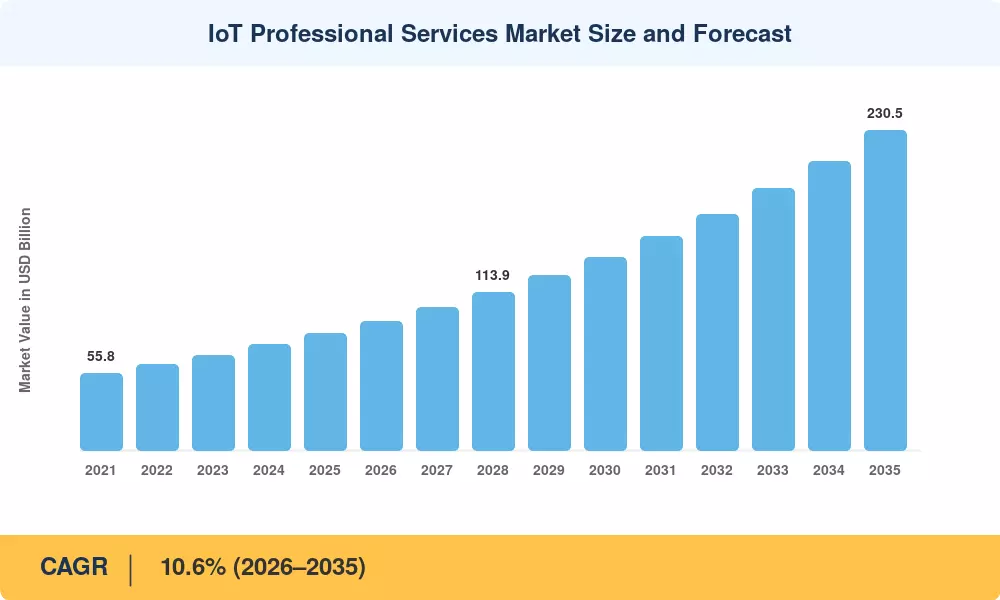
The IoT Professional Services Market reached an estimated USD 84.2 billion in 2025 and is projected to grow from USD 93.1 billion in 2026 to USD 230.5 billion by 2035, registering a CAGR of 10.6% over the forecast period (2026–2035). Two catalysts have reshaped enterprise spending patterns: first, widespread government mandates around critical-infrastructure digitization—such as the U.S. Bipartisan Infrastructure Law's USD 65 billion broadband allocation [1] and the EU's Digital Decade Policy Programme targeting 75% cloud/AI/big-data uptake by 2030 [2]; and second, the accelerating rollout of private 5G networks that require specialized integration expertise beyond what most internal IT teams can deliver. Together, these forces are converting what was once discretionary consulting spend into a recurring budget line for enterprises scaling connected operations.
The IoT Professional Services Market is at the crossroads of an architectural transition. Legacy SCADA and siloed telemetry platforms, many of which were deployed in the 2000s, are being replaced by cloud-native, AI-augmented IoT architectures that require end-to-end professional support from design to lifecycle management. estimates that companies that implement IoT at a large scale spend approximately 60–70% of the overall cost of projects on services, not hardware or software licenses [3], indicating the fundamental significance of this sector. The EU Cyber Resilience Act and NIST’s IoT cybersecurity recommendations, among other regulatory requirements, add to the pressure on enterprises to hire expert consultancies to ensure compliance-ready deployments.
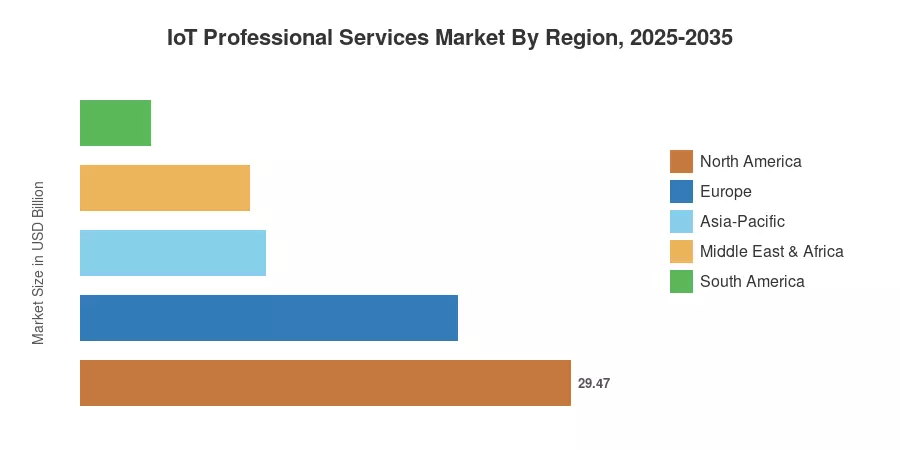
North America accounts for over 35% of the global IoT Professional Services Market revenue, driven by large business IT expenditures and early adoption by hyperscalers. Asia-Pacific is the fastest expanding market with a predicted CAGR of 13.2%, powered by smart city plans in China, India and Southeast Asia. Europe is the second largest market (~27%), driven by Industry 4.0 mandates in Germany, France and the Nordics. Demand for professional services will only rise through 2035 as edge computing architectures develop and generative AI transforms analytics pipelines.
Key Report Takeaways
• By Service Type
- System integration & deployment services represent the largest service category in the IoT Professional Services Market, capturing approximately 34% of global revenue in 2025.
- Managed services is the fastest-growing category, posting a projected CAGR of 12.4% through 2035 as enterprises shift from project-based to outcome-based engagements.
- Consulting & advisory services generated an estimated USD 18.7 billion in 2025, reflecting strong demand for architecture planning and vendor-neutral roadmapping.
• By End-User Vertical
- Manufacturing leads vertical adoption in the IoT Professional Services Market with a 26% revenue share, driven by predictive-maintenance and digital-twin deployments.
- Healthcare is expanding at a CAGR of 13.8%, the fastest among verticals, as remote patient monitoring and connected-device compliance needs surge.
• By Geography
- North America dominates the IoT Professional Services Market with approximately 35% of global spending.
- Asia-Pacific is expected to reach USD 78.4 billion by 2035, reflecting the highest regional growth trajectory.
- Europe accounts for 27% share, propelled by EU digital sovereignty policies and industrial automation mandates.
Market Size and Forecast (2021–2035)
This forecast model combines bottom-up revenue analysis of prominent professional services providers with top-down macroeconomic factors such as enterprise IT capex patterns, IoT chipset shipping volumes and regional broadband penetration rates. Historical data (2021–2024) is derived from publicly filed annual reports, proprietary vendor surveys, and authenticated third-party sources. Forecast forecasts (2026–2035) are derived from a compound growth technique calibrated to observable contract pipelines and government program budgets.