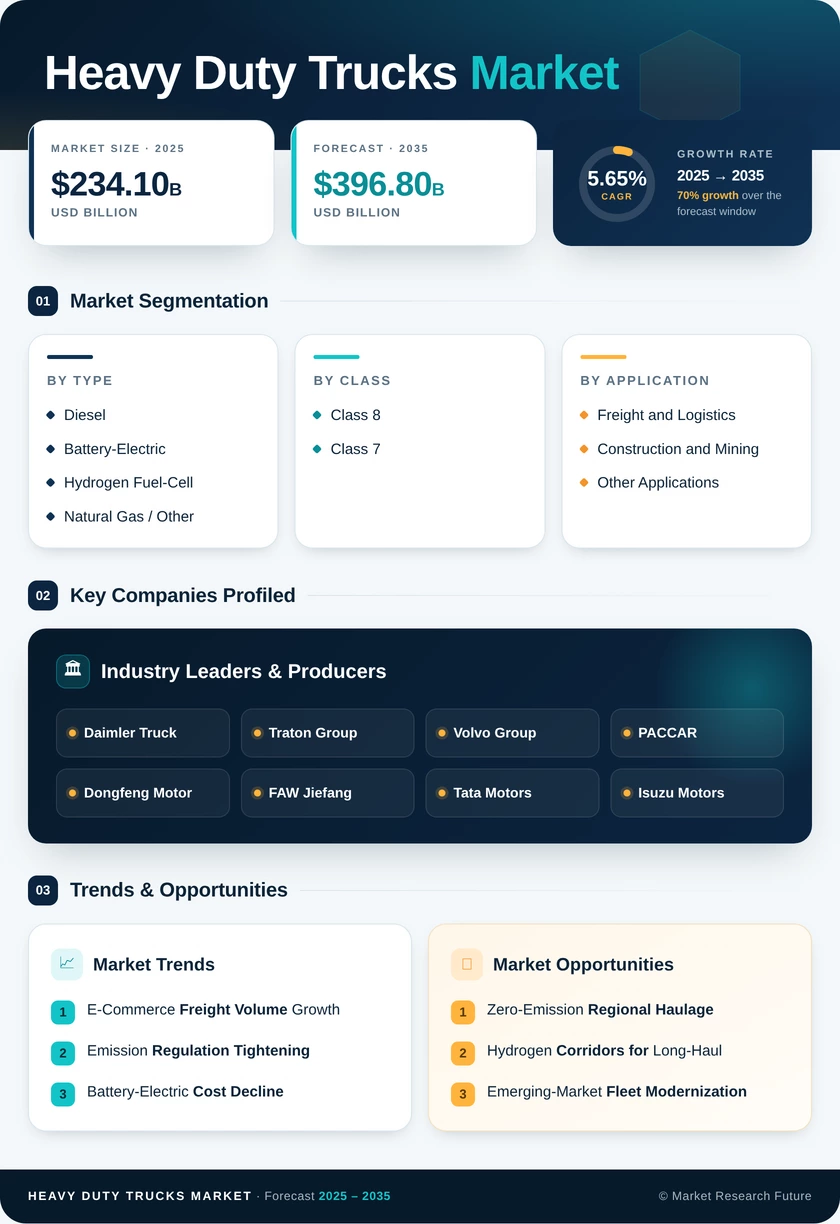
Heavy Duty Truck Market

ID: MRFR/AT/9770-HCR
200 Pages
Triveni Bhoyar
Last Updated: June 05, 2026
Heavy Duty Trucks Market Size, Share & Growth Analysis Report: By Propulsion Type (Diesel, Battery-Electric, Hydrogen Fuel-Cell, Natural Gas / Other), By Class (Class 8, Class 7), By Application (Freight and Logistics, Construction and Mining, Other Applications), By Sales Channel (OEM / First Purchase, Aftermarket / Used) and By Regional (North America, Europe, South America, Asia Pacific, Middle East and Africa) – Industry Growth & Forecast to 2035
Download PDF ×

We do not share your information with anyone. However, we may send you emails based on your report interest from time to time. You may contact us at any time to opt-out.

  1. 1 Market Overview |
    1. 1.1 Study Assumptions & Market Definition |
    2. 1.2 Scope of the Study |
    3. 1.3 Research Methodology
  2. 2 Market Summary & Key Takeaways
  3. 3 Market Dynamics |
    1. 3.1 Market Drivers Analysis | |
      1. 3.1.1 E-Commerce Freight Volume Growth | |
      2. 3.1.2 Emission Regulation Tightening | |
      3. 3.1.3 Battery-Electric Cost Decline | |
      4. 3.1.4 Fleet Renewal and Aging Stock |
    2. 3.2 Market Restraints Analysis | |
      1. 3.2.1 Charging and Refueling Infrastructure Gaps | |
      2. 3.2.2 High Upfront Cost of Zero-Emission Models | |
      3. 3.2.3 Driver Shortage and Labor Constraints |
    3. 3.3 Market Opportunity Analysis | |
      1. 3.3.1 Zero-Emission Regional Haulage | |
      2. 3.3.2 Hydrogen Corridors for Long-Haul | |
      3. 3.3.3 Emerging-Market Fleet Modernization | |
      4. 3.3.4 Connected Fleet Data Monetization | |
      5. 3.3.5 Autonomous Platooning and Driver Augmentation |
    4. 3.4 Industry Value Chain Analysis |
    5. 3.5 Porter's Five Forces Analysis
  4. 4 Global Heavy Duty Trucks Market Size & Forecast (2021–2035) |
    1. 4.1 Historical Market Size (2021–2025) |
    2. 4.2 Current & Forecast Market Size (2026–2035) |
    3. 4.3 Market Size by Revenue (USD Billion) |
    4. 4.4 Year-over-Year Growth Analysis
  5. 5 Segmentation Analysis |
    1. 5.1 By Propulsion Type | |
      1. 5.1.1 Diesel | |
      2. 5.1.2 Battery-Electric | |
      3. 5.1.3 Hydrogen Fuel-Cell | |
      4. 5.1.4 Natural Gas / Other |
    2. 5.2 By Class | |
      1. 5.2.1 Class 7 | |
      2. 5.2.2 Class 8 |
    3. 5.3 By Application | |
      1. 5.3.1 Freight and Logistics | |
      2. 5.3.2 Construction and Mining | |
      3. 5.3.3 Other Applications |
    4. 5.4 By Sales Channel | |
      1. 5.4.1 OEM / First Purchase | |
      2. 5.4.2 Aftermarket / Used
  6. 6 Regional Analysis |
    1. 6.1 North America | |
      1. 6.1.1 United States | |
      2. 6.1.2 Canada | |
      3. 6.1.3 Mexico |
    2. 6.2 Europe | |
      1. 6.2.1 Germany | |
      2. 6.2.2 United Kingdom | |
      3. 6.2.3 France | |
      4. 6.2.4 Italy | |
      5. 6.2.5 Spain | |
      6. 6.2.6 Nordic Countries | |
      7. 6.2.7 Russia | |
      8. 6.2.8 Rest of Europe |
    3. 6.3 Asia-Pacific | |
      1. 6.3.1 China | |
      2. 6.3.2 India | |
      3. 6.3.3 Japan | |
      4. 6.3.4 South Korea | |
      5. 6.3.5 ASEAN | |
      6. 6.3.6 Rest of Asia-Pacific |
    4. 6.4 South America | |
      1. 6.4.1 Brazil | |
      2. 6.4.2 Argentina | |
      3. 6.4.3 Rest of South America |
    5. 6.5 Middle East & Africa | |
      1. 6.5.1 Saudi Arabia | |
      2. 6.5.2 UAE | |
      3. 6.5.3 South Africa | |
      4. 6.5.4 Egypt | |
      5. 6.5.5 Rest of Middle East & Africa
  7. 7 Competitive Landscape |
    1. 7.1 Market Share Analysis (2026) |
    2. 7.2 Competitive Benchmarking Matrix |
    3. 7.3 Company Profiles | |
      1. 7.3.1 Daimler Truck | |
      2. 7.3.2 Traton Group | |
      3. 7.3.3 Volvo Group | |
      4. 7.3.4 PACCAR | |
      5. 7.3.5 Dongfeng Motor | |
      6. 7.3.6 FAW Jiefang | |
      7. 7.3.7 Tata Motors | |
      8. 7.3.8 Isuzu Motors | |
      9. 7.3.9 Nikola Corporation | |
      10. 7.3.10 Hyundai Motor
  8. 8 Future Outlook & Strategic Recommendations (2026–2035) |
    1. 8.1 Near-Term Outlook (2026–2028) |
    2. 8.2 Medium-Term Outlook (2029–2031) |
    3. 8.3 Long-Term Outlook (2032–2035)
  9. 9 Recent Developments & News
  10. 10 Frequently Asked Questions (FAQs)
  11. 11 Report Scope & Methodology |
    1. 11.1 Study Period & Base Year |
    2. 11.2 Data Sources & Citations |
    3. 11.3 Abbreviations
  12. 12 LIST OF TABLES |
  13. TABLE 1 Global Heavy Duty Trucks Market Size & Forecast, by Revenue (USD Billion), 2021–2035 |
  14. TABLE 2 Global Heavy Duty Trucks Market — Year-over-Year Growth Analysis, 2021–2035 |
  15. TABLE 3 Driver Impact Analysis — Global Heavy Duty Trucks Market |
  16. TABLE 4 Restraint Impact Analysis — Global Heavy Duty Trucks Market |
  17. TABLE 5 Global Heavy Duty Trucks Market Size, by Region, 2021–2035 (USD Billion) |
  18. TABLE 6 North America Heavy Duty Trucks Market Size, by Country, 2021–2035 (USD Billion) |
  19. TABLE 7 Europe Heavy Duty Trucks Market Size, by Country, 2021–2035 (USD Billion) |
  20. TABLE 8 Asia-Pacific Heavy Duty Trucks Market Size, by Country, 2021–2035 (USD Billion) |
  21. TABLE 9 South America Heavy Duty Trucks Market Size, by Country, 2021–2035 (USD Billion) |
  22. TABLE 10 Middle East & Africa Heavy Duty Trucks Market Size, by Country, 2021–2035 (USD Billion) |
  23. TABLE 11 Global Heavy Duty Trucks Market Size, by Propulsion Type, 2021–2035 (USD Billion) |
  24. TABLE 12 Global Heavy Duty Trucks Market Size, by Class, 2021–2035 (USD Billion) |
  25. TABLE 13 Global Heavy Duty Trucks Market Size, by Application, 2021–2035 (USD Billion) |
  26. TABLE 14 Global Heavy Duty Trucks Market Size, by Sales Channel, 2021–2035 (USD Billion) |
  27. TABLE 15 Competitive Benchmarking Matrix — Global Heavy Duty Trucks Market, 2026 |
  28. TABLE 16 Company Profiles — Key Players, Global Heavy Duty Trucks Market |
  29. TABLE 17 Recent Developments & Strategic Announcements, 2023–2025 |
  30. TABLE 18 Report Scope & Methodology — Global Heavy Duty Trucks Market |
  31. TABLE 19 Detailed Sources and Citations — Global Heavy Duty Trucks Market
  32. 13 LIST OF FIGURES |
  33. FIGURE 1 Global Heavy Duty Trucks Market — Market Dynamics Overview |
  34. FIGURE 2 Industry Value Chain Analysis — Heavy Duty Trucks Market |
  35. FIGURE 3 Porter's Five Forces Analysis — Heavy Duty Trucks Market |
  36. FIGURE 4 Global Heavy Duty Trucks Market Size Trend, 2021–2035 (USD Billion) |
  37. FIGURE 5 Market Share by Propulsion Type, 2025 vs 2035 |
  38. FIGURE 6 Market Share by Class, 2025 |
  39. FIGURE 7 Market Share by Application, 2025 |
  40. FIGURE 8 Market Share by Sales Channel, 2025 |
  41. FIGURE 9 Regional Market Share, 2025 |
  42. FIGURE 10 Asia-Pacific Country-Level Share, 2025 |
  43. FIGURE 11 Competitive Landscape — Revenue Share Ranges, 2026 |
  44. FIGURE 12 Zero-Emission Adoption Curve, 2026–2035

Segmentation Quick Reference

DimensionSub-SegmentsDominant SegmentFastest Growing Segment
By Propulsion TypeDiesel, Battery-Electric, Hydrogen Fuel-Cell, Natural Gas / OtherDieselBattery-Electric
By ClassClass 7, Class 8Class 8Class 7
By ApplicationFreight and Logistics, Construction and Mining, Other ApplicationsFreight and LogisticsFreight and Logistics
By Sales ChannelOEM / First Purchase, Aftermarket / UsedOEM / First PurchaseOEM / First Purchase


Market Segmentation Overview

By Propulsion Type

Sub-SegmentKey Trend
DieselStill dominant for long-haul; under regulatory pressure
Battery-ElectricFastest growth on regional routes via depot charging
Hydrogen Fuel-CellEmerging for long-haul along refueling corridors
Natural Gas / OtherNiche role in fleet diversification


Propulsion is the defining axis of the Heavy Duty Trucks Market. Diesel retains the volume lead while battery-electric and hydrogen carve out duty-cycle-specific niches, with the transition pace set by infrastructure and total cost of ownership.

By Class

Sub-SegmentKey Trend
Class 7Faster growth in vocational and regional distribution
Class 8Revenue leader anchored by long-haul tractor-trailers


Class structure mirrors duty cycle. Class 8 dominates line-haul economics while Class 7 grows faster as urban and vocational electrification gains momentum.

By Application

Sub-SegmentKey Trend
Freight and LogisticsLargest and fastest-growing, driven by e-commerce
Construction and MiningSteady demand tied to infrastructure spend
Other ApplicationsSpecialized vocational growth


Application demand is led by freight and logistics, where e-commerce tonnage keeps fleets running near capacity, while construction and mining provide a cyclical but reliable base.

By Sales Channel

Sub-SegmentKey Trend
OEM / First PurchaseFastest channel growth on fleet renewal demand
Aftermarket / UsedSignificant for cost-sensitive operators


Sales-channel dynamics favor OEM first-purchase as fleets renew ahead of emission deadlines, while the used market remains essential for operators managing capital constraints.