Helicopter Flight Management System Market
Helicopter Flight Management System Market Summary
As per Market Research Future analysis, the Helicopter Flight Management System Market Size was estimated at 5.1 USD Billion in 2024. The Helicopter Flight Management System industry is projected to grow from 5.357 USD Billion in 2025 to 8.761 USD Billion by 2035, exhibiting a compound annual growth rate (CAGR) of 5.04% during the forecast period 2025 - 2035
Key Market Trends & Highlights
The Helicopter Flight Management System Market is poised for substantial growth driven by technological advancements and increasing safety demands.
- Technological advancements are reshaping the capabilities of helicopter flight management systems, enhancing operational efficiency.
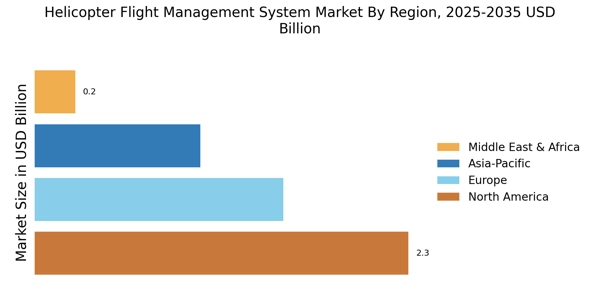
- North America remains the largest market, while the Asia-Pacific region is emerging as the fastest-growing area for helicopter flight management systems.
- The civil aviation segment dominates the market, whereas military aviation is experiencing the most rapid growth.
- Key market drivers include rising military and defense expenditure alongside stringent regulatory compliance and safety standards.
Market Size & Forecast
| 2024 Market Size | 5.1 (USD Billion) |
| 2035 Market Size | 8.761 (USD Billion) |
| CAGR (2025 - 2035) | 5.04% |
Major Players
Honeywell (US), Rockwell Collins (US), Thales (FR), Garmin (US), L3Harris Technologies (US), Airbus (FR), Bell Textron (US), Northrop Grumman (US), Leonardo (IT)
Helicopter Flight Management System Market Trends
The Helicopter Flight Management System Market is currently experiencing a notable evolution, driven by advancements in technology and increasing demand for enhanced operational efficiency. The integration of sophisticated software solutions is transforming traditional flight management practices, allowing for improved navigation, communication, and overall flight safety. As the aviation sector continues to prioritize safety and efficiency, the adoption of these systems is likely to rise, reflecting a shift towards more automated and reliable flight operations. Furthermore, the growing emphasis on reducing operational costs and enhancing pilot situational awareness is propelling the market forward. In addition, the Helicopter Flight Management System Market appears to be influenced by the rising need for compliance with stringent regulatory standards. Manufacturers are focusing on developing systems that not only meet but exceed these requirements, ensuring that operators can maintain high safety standards while optimizing performance. This trend suggests a future where flight management systems are not merely tools but integral components of a comprehensive safety and efficiency strategy within the aviation industry. As the market evolves, stakeholders must remain vigilant to emerging technologies and regulatory changes that could shape the landscape of helicopter operations.
Technological Advancements
The Helicopter Flight Management System Market is witnessing rapid technological advancements, particularly in automation and data analytics. These innovations enhance navigation accuracy and improve decision-making processes for pilots, thereby increasing operational efficiency.
Regulatory Compliance
There is a growing emphasis on regulatory compliance within the Helicopter Flight Management System Market. Manufacturers are developing systems that align with stringent safety standards, ensuring operators can meet legal requirements while optimizing performance.
Increased Demand for Safety Features
The demand for enhanced safety features is rising in the Helicopter Flight Management System Market. Operators are increasingly prioritizing systems that offer advanced safety functionalities, reflecting a broader trend towards risk mitigation in aviation.
Helicopter Flight Management System Market Drivers
Increased Demand for Safety Features
The Helicopter Flight Management System Market is witnessing an increased demand for enhanced safety features. As safety remains a paramount concern in aviation, operators are seeking systems that provide advanced situational awareness and risk management capabilities. Features such as terrain awareness and warning systems (TAWS) and enhanced vision systems (EVS) are becoming essential components of modern flight management systems. Market analysis indicates that the segment focusing on safety features is expected to grow by approximately 10% annually, reflecting the industry's commitment to improving safety standards and reducing accident rates.
Rising Military and Defense Expenditure
The Helicopter Flight Management System Market is benefiting from rising military and defense expenditure across various nations. Governments are increasingly investing in advanced helicopter technologies to enhance their defense capabilities. This trend is particularly evident in countries that are modernizing their military fleets, which often includes upgrading flight management systems. According to recent reports, military spending is projected to increase by 3% annually, which is likely to drive demand for sophisticated helicopter flight management systems that meet the operational requirements of modern warfare.
Technological Advancements in Automation
The Helicopter Flight Management System Market is experiencing a surge in technological advancements, particularly in automation. Innovations such as advanced autopilot systems and integrated flight management solutions are enhancing operational efficiency and safety. The integration of artificial intelligence and machine learning algorithms is enabling real-time data analysis, which assists pilots in making informed decisions. As per recent data, the market for automated flight systems is projected to grow at a compound annual growth rate of 8.5% over the next five years. This trend indicates a strong inclination towards automation, which is likely to drive the demand for sophisticated flight management systems in helicopters.
Regulatory Compliance and Safety Standards
The Helicopter Flight Management System Market is significantly influenced by stringent regulatory compliance and safety standards. Regulatory bodies are continuously updating guidelines to enhance aviation safety, which necessitates the adoption of advanced flight management systems. Compliance with these regulations not only ensures safety but also enhances operational efficiency. For instance, the Federal Aviation Administration (FAA) has mandated the implementation of certain safety features in flight management systems, which has led to an increase in demand for compliant systems. This regulatory environment is expected to propel the market, as manufacturers strive to meet these evolving standards.
Growth in Helicopter Tourism and Emergency Services
The Helicopter Flight Management System Market is also experiencing growth due to the rising popularity of helicopter tourism and emergency services. As tourism operators seek to provide unique aerial experiences, the demand for reliable and efficient flight management systems is increasing. Additionally, emergency medical services (EMS) are increasingly utilizing helicopters for rapid response, necessitating advanced flight management capabilities. The market for helicopter tourism is expected to expand by 7% annually, indicating a robust opportunity for flight management system providers to cater to this burgeoning sector.
Market Segment Insights
By Application: Civil Aviation (Largest) vs. Military Aviation (Fastest-Growing)
In the Helicopter Flight Management System Market, the distribution of market share among various applications reveals that Civil Aviation holds a significant portion, driven by the increasing demand for passenger transport and tourism activities. This sector benefits from a well-established infrastructure and growing fleet sizes, positioning it as the largest segment in this market. Conversely, Military Aviation is witnessing rapid growth, spurred by advancements in defense technologies and rising military expenditures globally, highlighting its importance in the overall market landscape.
Civil Aviation: Dominant vs. Military Aviation: Emerging
Civil Aviation is characterized by robust demand driven by passenger traffic and the need for efficient flight operations, resulting in its dominant market position. The segment benefits from a variety of applications including private charters, tourism, and commercial transport, which are all essential for economic growth. On the other hand, Military Aviation represents an emerging segment, propelled by increased defense spending and modernization of fleet. The integration of advanced flight management systems in military operations enhances operational efficiency and situational awareness, making it a pivotal area of investment for future growth.
By Type: Integrated Systems (Largest) vs. Standalone Systems (Fastest-Growing)
In the Helicopter Flight Management System Market, Integrated Systems currently dominate the market, capturing a significant share due to their enhanced functionality and seamless integration with onboard avionics. Standalone Systems, while smaller in market share, are gaining traction as they provide specialized features that appeal to specific customer needs. The differentiation in usage scenarios between these two types underlines the evolving preferences of operators.
Helicopter Flight Management Systems: Integrated Systems (Dominant) vs. Standalone Systems (Emerging)
Integrated Systems in the Helicopter Flight Management System Market are characterized by their comprehensive approach, allowing for a range of functionalities, including navigation, communication, and control operations. This all-in-one solution not only enhances operational efficiency but also reduces the likelihood of equipment redundancy. On the other hand, Standalone Systems are emerging as a favored choice for operators seeking specific functionalities without the need for complex integration. Their growth is driven by demand for personalized solutions tailored to specialized missions, thus creating a niche market that increasingly attracts investment and innovation.
By System Component: Software (Largest) vs. Support Services (Fastest-Growing)
The System Component segment in the Helicopter Flight Management System Market is primarily dominated by software solutions, which hold a substantial share due to their essential role in improving flight operations and safety. Software enables pilots to manage flight plans, navigation, and systems monitoring effectively, ensuring streamlined operations. While hardware components such as sensors and control systems remain critical, the software segment leads in market share, reflecting the growing dependence on advanced technological solutions in aviation. In contrast, support services are emerging as the fastest-growing segment within System Components. As helicopter operations expand and evolve, maintenance and technical support services are becoming vital to ensure optimal system performance and compliance with regulatory standards. This surge in support services is driven by a need for ongoing training, software updates, and technical assistance, aligning with the increasing complexity of modern helicopter systems.
Software (Dominant) vs. Support Services (Emerging)
The Software segment stands out as the dominant force in the Helicopter Flight Management System Market, characterized by its critical role in operational efficiency and safety enhancements. With advanced algorithms and real-time data processing capabilities, software solutions offer comprehensive functionalities that facilitate navigation, communication, and system management for pilots. This dominance is mirrored in the growing investment in R&D aimed at developing cutting-edge software that integrates seamlessly with hardware components to offer flight teams a cohesive operational toolbox. On the other hand, Support Services are emerging rapidly, reflecting a shift towards ensuring system longevity and reliability. This segment encompasses maintenance, training, and advisory services tailored to adapt to the evolving technological landscape, thereby enhancing user proficiency and operational safety.
By End Use: Commercial (Largest) vs. Government (Fastest-Growing)
In the Helicopter Flight Management System Market, the end use segment is primarily dominated by the commercial sector, which accounts for a significant share. The commercial segment includes various applications, such as air tourism, cargo transportation, and medical evacuations, making it a crucial part of the market. Meanwhile, government use, including military applications and law enforcement, is gradually gaining traction and is expected to grow rapidly, driven by increasing defense budgets and advancements in technology that enhance operational efficiency.
End Use: Commercial (Dominant) vs. Government (Emerging)
The commercial end use segment of the Helicopter Flight Management System Market is characterized by a robust integration of advanced technologies aimed at optimizing flight safety and operational efficiency. This segment predominantly includes private charter services and emergency medical services, utilizing sophisticated management systems to improve logistical capabilities. Conversely, the government segment, while currently at a smaller scale, is emerging due to rising investments in military modernization and the adoption of new technologies in law enforcement. This growth is further propelled by the need for enhanced situational awareness and real-time data utilization, making the government segment a focus area for future development and innovation.
Regional Insights
Key Players and Competitive Insights
Key Companies in the Helicopter Flight Management System Market include
Industry Developments
Recent developments in the Helicopter Flight Management System Market have showcased a strong emphasis on technological advancements and strategic collaborations. Companies like Northrop Grumman and Safran are actively enhancing their product offerings to improve flight safety and operational efficiency.
Boeing and Thales are focusing on integrating advanced avionics to streamline helicopter operations. Additionally, Textron and Leonardo have been exploring partnerships to innovate in rotorcraft design and systems.
The market is experiencing a notable trend in mergers and acquisitions, with companies such as Honeywell and Moog potentially eyeing strategic acquisitions to bolster their technological capabilities.
Reports indicate ongoing negotiations involving Rockwell Collins and Universal Avionics to expand their market presence. As the demand for efficient and safe flight management systems grows, particularly in emergency services and military applications, the valuations of companies like Airbus, Garmin, and Bell Helicopter have seen significant growth, driving further investment in research and development and technological innovations.
This surge is influencing market dynamics, fostering competitive strategies among key players to capture larger market shares and enhance their operational efficiencies in the evolving aerospace sector.
Future Outlook
Helicopter Flight Management System Market Future Outlook
The Helicopter Flight Management System Market is projected to grow at a 5.04% CAGR from 2025 to 2035, driven by technological advancements, increasing demand for safety, and regulatory compliance.
New opportunities lie in:
- Integration of AI-driven predictive maintenance solutions
- Development of modular flight management systems for diverse helicopter models
- Expansion into emerging markets with tailored training programs
By 2035, the market is expected to achieve robust growth, reflecting evolving industry needs and technological innovations.
Market Segmentation
Helicopter Flight Management System Market Type Outlook
- Standalone Systems
- Integrated Systems
Helicopter Flight Management System Market End Use Outlook
- Commercial
- Government
- Private
Helicopter Flight Management System Market Application Outlook
- Civil Aviation
- Military Aviation
- Emergency Medical Services
- Search and Rescue
- Law Enforcement
Helicopter Flight Management System Market System Component Outlook
- Software
- Hardware
- Support Services
Report Scope
| MARKET SIZE 2024 | 5.1(USD Billion) |
| MARKET SIZE 2025 | 5.357(USD Billion) |
| MARKET SIZE 2035 | 8.761(USD Billion) |
| COMPOUND ANNUAL GROWTH RATE (CAGR) | 5.04% (2025 - 2035) |
| REPORT COVERAGE | Revenue Forecast, Competitive Landscape, Growth Factors, and Trends |
| BASE YEAR | 2024 |
| Market Forecast Period | 2025 - 2035 |
| Historical Data | 2019 - 2024 |
| Market Forecast Units | USD Billion |
| Key Companies Profiled | Honeywell (US), Rockwell Collins (US), Thales (FR), Garmin (US), L3Harris Technologies (US), Airbus (FR), Bell Textron (US), Northrop Grumman (US), Leonardo (IT) |
| Segments Covered | Application, Type, System Component, End Use, Regional |
| Key Market Opportunities | Integration of advanced automation and artificial intelligence in the Helicopter Flight Management System Market. |
| Key Market Dynamics | Technological advancements and regulatory changes drive innovation in the Helicopter Flight Management System market. |
| Countries Covered | North America, Europe, APAC, South America, MEA |
FAQs
What is the projected market valuation of the Helicopter Flight Management System Market by 2035?
The projected market valuation for the Helicopter Flight Management System Market by 2035 is approximately 8.761 USD Billion.
What was the market valuation of the Helicopter Flight Management System Market in 2024?
The overall market valuation of the Helicopter Flight Management System Market was 5.1 USD Billion in 2024.
What is the expected CAGR for the Helicopter Flight Management System Market during the forecast period 2025 - 2035?
The expected CAGR for the Helicopter Flight Management System Market during the forecast period 2025 - 2035 is 5.04%.
Which companies are considered key players in the Helicopter Flight Management System Market?
Key players in the Helicopter Flight Management System Market include Honeywell, Rockwell Collins, Thales, Garmin, and L3Harris Technologies.
How does the valuation of Integrated Systems compare to Standalone Systems in 2035?
By 2035, the valuation of Integrated Systems is projected to be 5.36 USD Billion, surpassing the 3.4 USD Billion expected for Standalone Systems.
What is the anticipated growth for the Emergency Medical Services segment by 2035?
The Emergency Medical Services segment is anticipated to grow to 1.2 USD Billion by 2035.
What is the expected valuation for the Government end-use segment by 2035?
The expected valuation for the Government end-use segment of the Helicopter Flight Management System Market is projected to be 3.0 USD Billion by 2035.
What are the projected valuations for hardware components in the Helicopter Flight Management System Market by 2035?
The projected valuation for hardware components in the Helicopter Flight Management System Market is expected to reach 3.42 USD Billion by 2035.
How does the Law Enforcement segment's valuation change from 2024 to 2035?
The Law Enforcement segment's valuation is expected to increase from 1.1 USD Billion in 2024 to 1.6 USD Billion by 2035.
What are the expected market values for the Middle East and Africa region in 2023 and 2032?
Research Approach
Kindly complete the form below to receive a free sample of this Report
Customer Stories
“This is really good guys. Excellent work on a tight deadline. I will continue to use you going forward and recommend you to others. Nice job”
“Thanks. It’s been a pleasure working with you, please use me as reference with any other Intel employees.”
“Thanks for sending the report it gives us a good global view of the Betaïne market.”
“Thank you, this will be very helpful for OQS.”
“We found the report very insightful! we found your research firm very helpful. I'm sending this email to secure our future business.”
“I am very pleased with how market segments have been defined in a relevant way for my purposes (such as "Portable Freezers & refrigerators" and "last-mile"). In general the report is well structured. Thanks very much for your efforts.”
“I have been reading the first document or the study, ,the Global HVAC and FP market report 2021 till 2026. Must say, good info! I have not gone in depth at all parts, but got a good indication of the data inside!”
“We got the report in time, we really thank you for your support in this process. I also thank to all of your team as they did a great job.”