Hemostasis and Tissue Sealing Agents Market Research Report Information by Product (Topical Hemostat, Adhesive & Tissue Sealant), By Material (Chitosan-based Products, Mineral based Products), By Application (Trauma, General Surgery, Minimally Invasive Surgery, Gynecology Others), By End-User (Hospitals, Ambulatory Surgical Centers, Research Institutes), and Region (North America, Europe, Asia-Pacific, and Rest of the World)โForecast till 2035
As per Market Research Future analysis, the Hemostasis and Tissue Sealing Agents Market Size was estimated at 9.04 USD Billion in 2024. The Hemostasis and Tissue Sealing Agents industry is projected to grow from 9.767 USD Billion in 2025 to 21.17 USD Billion by 2035, exhibiting a compound annual growth rate (CAGR) of 8.04% during the forecast period 2025 - 2035
Key Market Trends & Highlights
The Hemostasis and Tissue Sealing Agents Market is experiencing robust growth driven by technological advancements and increasing demand for minimally invasive procedures.
Technological advancements in product development are reshaping the hemostasis and tissue sealing agents market.
North America remains the largest market, while Asia-Pacific is emerging as the fastest-growing region.
Topical hemostats dominate the market, whereas adhesive and tissue sealants are witnessing rapid growth.
Key market drivers include technological innovations and the rising incidence of chronic diseases, fueling demand for these agents.
Market Size & Forecast
2024 Market Size
9.04 (USD Billion)
2035 Market Size
21.17 (USD Billion)
CAGR (2025 - 2035)
8.04%
Major Players
Johnson & Johnson (US), Baxter International (US), Medtronic (US), C.R. Bard (US), Ethicon (US), Stryker (US), B. Braun Melsungen (DE), Terumo Corporation (JP), Hemostasis, Inc. (US)
Our Impact
Enabled $4.3B Revenue Impact for Fortune 500 and Leading Multinationals
Partnering with 2000+ Global Organizations Each Year
30K+ Citations by Top-Tier Firms in the Industry
Hemostasis Tissue Sealing Agents Market Trends
The Hemostasis and Tissue Sealing Agents Market is currently experiencing notable growth, driven by advancements in surgical techniques and an increasing demand for effective wound management solutions. Innovations in product formulations, such as the development of bioactive agents and synthetic materials, are enhancing the efficacy of hemostatic products. Furthermore, the rising prevalence of chronic diseases and the growing number of surgical procedures are contributing to the market's expansion. Healthcare providers are increasingly adopting these agents to improve patient outcomes and reduce complications associated with bleeding during surgeries. In addition, the market landscape is evolving with the introduction of minimally invasive surgical procedures, which require specialized sealing agents to ensure optimal performance. The focus on patient safety and the need for rapid hemostasis are prompting manufacturers to invest in research and development. Regulatory bodies are also playing a crucial role in shaping the market by establishing guidelines that ensure the safety and effectiveness of these products. As the Hemostasis and Tissue Sealing Agents Market continues to evolve, it appears poised for further growth, driven by technological advancements and an increasing emphasis on patient-centered care.
Technological Advancements in Product Development
The Hemostasis and Tissue Sealing Agents Market is witnessing a surge in technological innovations, particularly in the development of advanced materials and formulations. These innovations aim to enhance the effectiveness and safety of hemostatic agents, leading to improved patient outcomes. Manufacturers are focusing on creating products that not only achieve rapid hemostasis but also promote tissue healing, thereby addressing the evolving needs of healthcare providers.
Rising Demand for Minimally Invasive Procedures
There is a growing trend towards minimally invasive surgical techniques, which require specialized hemostatic and sealing agents. These procedures are associated with reduced recovery times and lower complication rates, driving the demand for products that can effectively manage bleeding in such contexts. As surgeons increasingly adopt these techniques, the Hemostasis and Tissue Sealing Agents Market is likely to expand to meet this demand.
Increased Focus on Patient Safety and Regulatory Compliance
The emphasis on patient safety is becoming more pronounced within the Hemostasis and Tissue Sealing Agents Market. Regulatory agencies are implementing stricter guidelines to ensure the safety and efficacy of these products. This focus on compliance is prompting manufacturers to invest in quality assurance and risk management strategies, ultimately leading to the development of safer and more reliable hemostatic agents.
Hemostasis Tissue Sealing Agents Market Drivers
Growing Awareness of Patient Safety
The emphasis on patient safety is becoming increasingly pronounced within the Hemostasis and Tissue Sealing Agents Market. Healthcare institutions are prioritizing the use of products that minimize risks associated with surgical procedures. Regulatory bodies are also enforcing stricter guidelines regarding the use of hemostatic agents, which is likely to drive demand for safer, more effective solutions. The market is responding to this trend by developing products that not only meet regulatory standards but also enhance patient outcomes. As a result, the industry is expected to witness a shift towards innovative hemostatic agents that align with these safety protocols, potentially increasing market share.
Rising Incidence of Chronic Diseases
The increasing incidence of chronic diseases is a critical factor influencing the Hemostasis and Tissue Sealing Agents Market. Conditions such as diabetes, cardiovascular diseases, and obesity often necessitate surgical interventions, thereby driving the demand for effective hemostatic solutions. As the global burden of chronic diseases continues to rise, healthcare systems are compelled to adopt advanced hemostatic agents to manage surgical bleeding effectively. This trend is likely to propel market growth, as healthcare providers prioritize the use of innovative products that enhance surgical outcomes and patient safety. The industry is poised for expansion as it adapts to the evolving healthcare landscape.
Expansion of Healthcare Infrastructure
The expansion of healthcare infrastructure in various regions is a significant driver for the Hemostasis and Tissue Sealing Agents Market. As hospitals and surgical centers increase their capabilities, the demand for advanced hemostatic solutions is likely to rise. Investments in healthcare facilities, particularly in emerging markets, are facilitating access to modern surgical techniques and technologies. This growth is expected to create a favorable environment for the adoption of hemostatic agents, as healthcare providers seek to improve surgical efficiency and patient care. Consequently, the market may experience substantial growth as new facilities are equipped with the latest hemostatic products.
Increasing Surgical Procedures and Trauma Cases
The rising number of surgical procedures and trauma cases is a pivotal driver for the Hemostasis and Tissue Sealing Agents Market. As the population ages and the prevalence of chronic diseases increases, the demand for surgical interventions is expected to rise. According to recent data, the number of surgical procedures performed annually is projected to reach over 300 million by 2025. This surge necessitates effective hemostatic solutions to manage bleeding and ensure patient safety. Consequently, the market for hemostasis and tissue sealing agents is likely to expand, as healthcare providers seek reliable products to enhance surgical outcomes and minimize complications.
Technological Innovations in Hemostasis and Tissue Sealing Agents
The Hemostasis and Tissue Sealing Agents Market is experiencing a surge in technological innovations that enhance product efficacy and safety. Advanced materials, such as bioactive polymers and nanotechnology, are being integrated into hemostatic agents, improving their performance in surgical settings. For instance, the introduction of fibrin sealants has shown to reduce bleeding significantly during surgeries, leading to quicker recovery times. The market is projected to grow at a compound annual growth rate of approximately 6.5% over the next few years, driven by these innovations. Furthermore, the development of smart hemostatic agents that respond to physiological conditions may revolutionize surgical practices, indicating a promising future for the industry.
Market Segment Insights
By Product: Topical Hemostat (Largest) vs. Adhesive & Tissue Sealant (Fastest-Growing)
The Hemostasis and Tissue Sealing Agents Market is characterized by a significant distribution of share between the leading product segments. Topical hemostats dominate the market, appealing to a wide range of surgical applications due to their immediate effectiveness in controlling bleeding. On the other hand, adhesive agents and tissue sealants are rapidly gaining traction, offering innovative solutions for wound closure and tissue bonding, which enhances their attractiveness to healthcare providers.
Topical Hemostat (Dominant) vs. Adhesive & Tissue Sealant (Emerging)
Topical hemostats stand out as the dominant product in the Hemostasis and Tissue Sealing Agents Market, owing to their established applications in various surgical settings. They are particularly favored for their ease of use and quick action in promoting hemostasis during procedures. In contrast, adhesive and tissue sealants are considered an emerging segment with significant growth potential. Their versatility in closing wounds and providing durable tissue connections is driving innovation in this area. Advancements in material technology and an increasing focus on minimally invasive procedures further propels the adoption of adhesive agents, making them an exciting component of the market.
By Material: Chitosan-based Products (Largest) vs. Mineral-based Products (Fastest-Growing)
In the Hemostasis and Tissue Sealing Agents Market, Chitosan-based products currently hold the largest market share among material segments due to their effective hemostatic properties and biocompatibility. The versatility of chitosan, derived from crustacean shells, enables its application across various surgical fields, enhancing its appeal and adoption in the medical community. In contrast, mineral-based products, often comprising calcium-containing compounds, are rapidly gaining traction as they offer unique advantages in certain surgical scenarios, positioning them as a competitive alternative in the market.
Material: Chitosan-based Products (Dominant) vs. Mineral-based Products (Emerging)
Chitosan-based products represent a dominant force in the Hemostasis and Tissue Sealing Agents Market, capitalizing on their natural origin and effectiveness in promoting clotting in surgical procedures. Their ability to form hydrogels in the presence of blood not only enhances their utility but also aligns with the increasing demand for biocompatible and biodegradable materials in healthcare. Conversely, mineral-based products are emerging as innovative solutions, particularly in minimally invasive surgeries. Their properties, such as high tensile strength and rapid absorption, are driving their acceptance. As healthcare providers seek reliable and effective sealing agents, both segments are likely to evolve, with mineral-based products capturing a larger share in the ongoing advancements of surgical technologies.
By End User: Hospitals (Largest) vs. Ambulatory Surgical Centers (Fastest-Growing)
In the Hemostasis and Tissue Sealing Agents Market, the distribution of market share among end users reveals that hospitals occupy the largest segment due to their extensive use of these agents in surgical procedures. They are critical facilities where a variety of surgeries are performed, necessitating a consistent supply of hemostasis and tissue sealing products to ensure patient safety and effective outcomes. Ambulatory Surgical Centers (ASCs) are also significant contributors, catering to outpatient surgeries, and are gaining traction in the market. Growth trends indicate a robust increase in demand for hemostasis and tissue sealing agents driven by improvements in surgical techniques and a growing preference for minimally invasive procedures. ASCs are positioned as the fastest-growing segment, reflecting a shift towards outpatient care, which is more efficient and cost-effective. Research institutes are increasingly involved in developing innovative technologies, further boosting the market growth by introducing advanced sealing and hemostatic solutions.
Hospitals (Dominant) vs. Research Institutes (Emerging)
Hospitals stand out as the dominant end user in the Hemostasis and Tissue Sealing Agents Market, primarily due to their breadth of surgical applications and the requirement for reliable, high-quality sealing solutions. The extensive infrastructure and technological advancements in hospitals guarantee a steady demand for these agents. On the other hand, research institutes represent an emerging segment, focusing on innovative solutions and product development to enhance surgical outcomes. Their contribution is crucial as they pave the way for new technologies and methodologies in hemostasis and tissue sealing, preparing them to play a significant role in future market dynamics.
Get more detailed insights about Hemostasis Tissue Sealing Agents MarketRequest Free Sample
Regional Insights
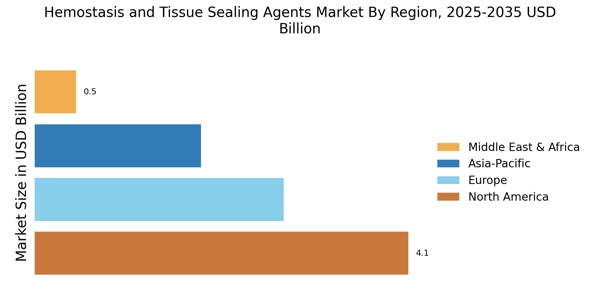
By Region, the study segments the market into North America, Europe, Asia-Pacific, and the Rest of the World. The North American Hemostasis and Tissue Sealing Agents market accounted for the largest market share in 2023. Due to aging population, increasing prevalence of chronic diseases, and the continuous evolution of medical technology. With a focus on enhancing patient outcomes and reducing postoperative complications, the market has become a hub for research and development, resulting in the introduction of innovative products with superior efficacy. In 2019, Ethicon (US) introduced VISTASEAL Fibrin Sealant (Human) to manage bleeding during surgery.
VISTASEAL Fibrin Sealant (Human) contains fibrinogen and thrombin, which are clotting proteins found in human plasma. When applied to the bleeding site, it forms a rapid, adherent, and durable clot. It has been demonstrated to sustain hemostasis (stoppage of bleeding), even in high-risk patients.
Further, the major countries studied are the U.S., Canada, Germany, France, the UK, Italy, Spain, China, Japan, India, Australia, South Korea, and Brazil.
Europe Hemostasis and Tissue Sealing Agents market is expected to account for the second-largest market share due to the favorable health policies and trend towards integrating Hemostasis and tissue sealing agents, including counseling. Further, the German Hemostasis and Tissue Sealing Agents market was attributed to holding the largest market share, and France Hemostasis and Tissue Sealing Agents market is expected to fastest-growing market in the European region.
The Asia-Pacific Hemostasis and Tissue Sealing Agents market is expected to grow at the fastest rate from 2024 to 2032. This is due to rapid economic development, a burgeoning middle class, and increased urbanization. The region's expanding population drives demand for healthcare, technology, and consumer goods. Robust investments in infrastructure, education, and technology fuel industrial growth and innovation. Additionally, favorable government policies and trade agreements enhance business opportunities and foreign investment. The rise of digital economies and advancements in technology, particularly in countries like China, India, and South Korea, further stimulate growth.
The Rest of the World includes the Middle East, Africa, and Latin America. The main factors influencing the growth of Hemostasis and Tissue Sealing Agents in the Middle East and Africa. MEA region has experienced Increasing healthcare expenditure, and the expansion of healthcare infrastructure are driving demand for advanced medical products. The rise in surgical procedures, fueled by a growing population and higher prevalence of chronic diseases, necessitates effective hemostasis solutions.
Key Players and Competitive Insights
The Hemostasis and Tissue Sealing Agents Market is characterized by the presence of many global, regional, players. The market comprises tier-1, tier-2, and local players. The tier-1 and tier-2 players have reached across the globe with diverse Type portfolios. Companies such Johnson & Johnson (US), B Braun Medical Inc (Germany), MIL Laboratories Pvt. Ltd (India), Becton, Dickinson, and Company (US), and Pfizer Inc (US) dominate the Hemostasis and Tissue Sealing Agents Market due to Type differentiation, financial stability, strategic services, and diversified regional presence. The players are focused on investing in extensive research and development as well. Furthermore, they adopt strategic growth initiatives, such as expansion, joint ventures, and partnerships, to strengthen their market position and capture a large customer base. One of the primary business strategies adopted by manufacturers in the global Hemostasis and Tissue Sealing Agents industry to benefit clients and expand the Hemostasis and Tissue Sealing Agents market sector is to manufacture locally to reduce operating costs.
Key Companies in the Hemostasis Tissue Sealing Agents Market include
Industry Developments
November 2023, The Johnson & Johnson MedTech company Ethicon (US) introduced ETHIZIA, an adjuvant hemostat product. ETHIZIATM Hemostatic Sealing Patch is the first and only hemostatic matrix designed to be equally active and effective on both sides. The product is easy to use in open and minimally invasive surgical procedures.
In June 2021, Axio Biosolutions Pvt Ltd (India) received FDA 510(k) clearance for Axiostat Patch, a hemostatic medication that controls moderate to severe bleeding during vascular operations, surgical debridement, and puncture sites
In January 2020, Medtrade Products Limited launched OMNI-STAT 2/3in x 4 3/4 Hemostatic Gauze. OMNI-STAT hemostatic gauze is a non-woven gauze pad laminated on both sides with proprietary chitosan granule technology, designed to quickly control bleeding.
Future Outlook
Hemostasis Tissue Sealing Agents Market Future Outlook
The Hemostasis and Tissue Sealing Agents Market is projected to grow at 8.04% CAGR from 2025 to 2035, driven by technological advancements, increasing surgical procedures, and rising demand for minimally invasive surgeries.
New opportunities lie in:
Development of biodegradable hemostatic agents for enhanced patient safety. Expansion into emerging markets with tailored product offerings. Integration of AI-driven analytics for personalized surgical solutions.

By 2035, the market is expected to achieve substantial growth, reflecting evolving healthcare needs.
Market Segmentation
Hemostasis Tissue Sealing Agents Market Product Outlook
Topical Hemostat
Adhesive & Tissue Sealant
Hemostasis Tissue Sealing Agents Market End User Outlook
Hospitals
Ambulatory Surgical Centers
Research Institutes
Hemostasis Tissue Sealing Agents Market Material Outlook
Chitosan-based Products
Mineral based Products
Report Scope
MARKET SIZE 2024
9.04(USD Billion)
MARKET SIZE 2025
9.767(USD Billion)
MARKET SIZE 2035
21.17(USD Billion)
COMPOUND ANNUAL GROWTH RATE (CAGR)
8.04% (2025 - 2035)
REPORT COVERAGE
Revenue Forecast, Competitive Landscape, Growth Factors, and Trends
BASE YEAR
2024
Market Forecast Period
2025 - 2035
Historical Data
2019 - 2024
Market Forecast Units
USD Billion
Key Companies Profiled
Johnson & Johnson (US), Baxter International (US), Medtronic (US), C.R. Bard (US), Ethicon (US), Stryker (US), B. Braun Melsungen (DE), Terumo Corporation (JP), Hemostasis, Inc. (US)
Segments Covered
Product, Material, Application, End-User
Key Market Opportunities
Advancements in biocompatible materials enhance efficacy in the Hemostasis and Tissue Sealing Agents Market.
Key Market Dynamics
Rising demand for minimally invasive surgeries drives innovation in hemostasis and tissue sealing agents.
What is the projected market valuation for the Hemostasis and Tissue Sealing Agents Market in 2035?
The projected market valuation for the Hemostasis and Tissue Sealing Agents Market in 2035 is 21.17 USD Billion.
What was the market valuation for Hemostasis and Tissue Sealing Agents in 2024?
The market valuation for Hemostasis and Tissue Sealing Agents in 2024 was 9.04 USD Billion.
What is the expected CAGR for the Hemostasis and Tissue Sealing Agents Market from 2025 to 2035?
The expected CAGR for the Hemostasis and Tissue Sealing Agents Market during the forecast period 2025 - 2035 is 8.04%.
Which product segment is projected to have the highest valuation by 2035?
The Adhesive & Tissue Sealant segment is projected to reach a valuation of 12.67 USD Billion by 2035.
What are the key materials used in Hemostasis and Tissue Sealing Agents?
Key materials include Chitosan-based Products and Mineral-based Products, with projected valuations of 8.0 USD Billion and 13.17 USD Billion respectively by 2035.
Which end user segment is expected to grow the most by 2035?
The Hospitals segment is expected to grow the most, reaching a valuation of 8.56 USD Billion by 2035.
Who are the leading companies in the Hemostasis and Tissue Sealing Agents Market?
Leading companies in the market include Johnson & Johnson, Baxter International, Medtronic, and Ethicon.
What was the valuation of the Topical Hemostat segment in 2024?
The valuation of the Topical Hemostat segment in 2024 was 3.62 USD Billion.
How does the market for Hemostasis and Tissue Sealing Agents appear to be evolving?
The market appears to be evolving positively, with a projected increase in valuation from 9.04 USD Billion in 2024 to 21.17 USD Billion in 2035.
What factors might influence the growth of the Hemostasis and Tissue Sealing Agents Market?
Factors influencing growth may include advancements in technology, increasing surgical procedures, and the rising demand for effective hemostatic solutions.

Author
Author
Vikita Thakur
Senior Research Analyst
She holds an experience of about 5+ years in market research and business consulting projects for sectors such as life sciences, medical devices, and healthcare IT. She possesses a robust background in data analysis, market estimation, competitive intelligence, pipeline analysis market trend identification, and consumer behavior insights. Her expertise lies in technical Sales support, client interaction and project management, designing and implementing market research studies, conducting competitive analysis, and synthesizing complex data into actionable recommendations that drive business growth.
read more
Co-Author
Rahul Gotadki
Research Manager
He holds an experience of about 9+ years in Market Research and Business Consulting, working under the spectrum of Life Sciences and Healthcare domains. Rahul conceptualizes and implements a scalable business strategy and provides strategic leadership to the clients. His expertise lies in market estimation, competitive intelligence, pipeline analysis, customer assessment, etc.
The secondary research process involved comprehensive analysis of regulatory databases, peer-reviewed surgical journals, clinical publications, and authoritative healthcare organizations. Key sources included the US Food & Drug Administration (FDA) 510(k) Premarket Notification Database and PMA approvals, European Medicines Agency (EMA) medical device regulations, National Institutes of Health (NIH) Clinical Trials Registry, National Center for Biotechnology Information (NCBI/PubMed) surgical literature, Agency for Healthcare Research and Quality (AHRQ), Centers for Medicare & Medicaid Services (CMS) procedure codes and reimbursement data, World Health Organization (WHO) Global Health Observatory surgery statistics, Organization for Economic Cooperation and Development (OECD) Health Statistics, American College of Surgeons (ACS) trauma and surgical procedure databases, Society of American Gastrointestinal and Endoscopic Surgeons (SAGES) guidelines, European Association for Endoscopic Surgery (EAES) clinical data, national health ministry surgical registries from key markets (CDC National Health Statistics for US, NHS Digital for UK, Bundesamt fรผr Arzneimittel und Medizinprodukte for Germany), and stroke/trauma registry databases. These sources were used to collect surgical procedure volumes, regulatory approval pathways for Class II/III hemostatic devices, clinical safety and efficacy studies, trauma incidence data, OR utilization rates, and competitive landscape analysis for topical hemostats, fibrin sealants, synthetic tissue sealants, chitosan-based agents, and mineral-based hemostatic products.

ย
Primary Research
Qualitative and quantitative insights were obtained by interviewing supply-side and demand-side stakeholders during the primary research process. The supply-side sources consisted of CEOs, VPs of R&D/Medical Affairs, regulatory affairs chiefs, and commercial directors from hemostasis and tissue sealing agent manufacturers, surgical device OEMs, and biomaterial suppliers respectively. Demand-side sources included principal surgeons, trauma directors, surgical nurse managers, OR procurement managers, and materials management directors from academic medical centers, ambulatory surgical centers (ASCs), Level I trauma centers, and tertiary care hospitals. The primary research project confirmed pipeline timelines for next-generation sealants, validated product segmentation across mechanical, active, and flowable hemostats, and collected insights on surgical adoption patterns, price-per-application metrics, contracting strategies with GPOs (Group Purchasing Organizations), and reimbursement dynamics for hemostasis management in inpatient versus outpatient settings.
Primary Respondent Breakdown:
By Designation: C-level Primaries (32%), Director Level (30%), Others (38%)
By Region: North America (38%), Europe (25%), Asia-Pacific (28%), Rest of World (9%)
ย
Market Size Estimation
Global market valuation was derived through revenue mapping and surgical procedure volume analysis. The methodology included:
The identification of over 40 key manufacturers in North America, Europe, Asia-Pacific, and Latin America who specialize in surgical hemostasis and tissue closure technologies
Product mapping across topical hemostats (mechanical, active, flowable), adhesive & tissue sealants (fibrin-based, synthetic, collagen-based), chitosan-based products, mineral-based products (kaolin, clay-based), and other bioactive hemostatic agents
Analysis of reported and modeled annual revenues specific to hemostasis and tissue sealing portfolios, distinguishing between hospital OR sales and ASC/trauma center channels
Coverage of manufacturers representing 72-78% of global market share in 2024
Extrapolation using bottom-up (surgical procedure volume ร hemostasis product utilization rate ร ASP by country/setting) and top-down (manufacturer revenue validation and GPO contract value analysis) approaches to derive segment-specific valuations for trauma, general surgery, minimally invasive surgery (MIS), and gynecology applications
โThis is really good guys. Excellent work on a tight deadline. I will continue to use you going forward and recommend you to others. Nice jobโ
Noah MalgeriCo-Founder
โThanks. Itโs been a pleasure working with you, please use me as reference with any other Intel employees.โ
Joseph AguayoSales Operations & Pricing Manager
โThanks for sending the report it gives us a good global view of the Betaรฏne market.โ
Peter Groot koerkampAccount and Business Manager
โThank you, this will be very helpful for OQS.โ
La Terria DoddProgram Support Specialist
โWe found the report very insightful! we found your research firm very helpful. I'm sending this email to secure our future business.โ
Younghwan ChoiSenior Retail Manager
โI am very pleased with how market segments have been defined in a relevant way for my purposes (such as "Portable Freezers & refrigerators" and "last-mile").
In general the report is well structured. Thanks very much for your efforts.โ
Mark IrwinManagement Consultant
โI have been reading the first document or the study, ,the Global HVAC and FP market report 2021 till 2026. Must say, good info! I have not gone in depth at all parts, but got a good indication of the data inside!โ
Rob KooikerGroup Product Manager HVAC & Fire Protection GMA
โWe got the report in time, we really thank you for your support in this process. I also thank to all of your team as they did a great job.โ
Akif MorogluStrategy & Business Development Director
โThe Automotive 48V ECU Components Procurement Intelligence Studyโ was a complex project, but the Market Research Future (MRFR) team handled it with quality, agility, and customer-centricity. They delivered all requested data on time and within the agreed scope. The team, including Shubhendra Anand and Rahul Gotadki, was always readily available to clarify questions and swiftly implement necessary adjustments, driving the project to a successful conclusion within a very demanding timeframe.
I would also like to specifically commend Akshay Agarwal for his responsiveness and support at every stageโfrom our initial inquiry on May 6th through to final delivery on June 18th. His dedication made the entire process seamless.โ
Guilherme Gomes MartinsProduct Management Director