×
Request Free Sample ×

Kindly complete the form below to receive a free sample of this Report

* Please use a valid business email

Leading companies partner with us for data-driven Insights

clients tt-cursor
Hero Background

Hemp Derivatives Market

ID: MRFR/HC/6952-HCR
90 Pages
Rahul Gotadki
October 2025

Hemp Derivatives Market Research Report Information By Type (Hemp Oil, Hemp-Derived CBD Oil, Hemp Fiber, Others) and By Application (Food & Beverages, Pharmaceuticals, Personal Care, Industrial, Others) - Global Forecast to 2030

Share:
Download PDF ×

We do not share your information with anyone. However, we may send you emails based on your report interest from time to time. You may contact us at any time to opt-out.

Hemp Derivatives Market Infographic
Purchase Options

Hemp Derivatives Market Summary

As per MRFR analysis, the Hemp Derivatives Market Size was estimated at 4776.17 USD Million in 2024. The Hemp Derivatives industry is projected to grow from 5061.58 USD Million in 2025 to 8059.86 USD Million by 2035, exhibiting a compound annual growth rate (CAGR) of 4.83 during the forecast period 2025 - 2035.

Key Market Trends & Highlights

The Hemp Derivatives Market is experiencing robust growth driven by diverse applications and increasing consumer interest.

  • North America remains the largest market for hemp derivatives, driven by rising consumer demand for natural products.
  • The Asia-Pacific region is emerging as the fastest-growing market, reflecting a shift towards acceptance and regulation of hemp derivatives.
  • The Food and Beverage segment continues to dominate the market, while the Cosmetics segment is witnessing rapid growth due to changing consumer preferences.
  • Key market drivers include increasing health awareness and technological advancements in extraction methods, which are propelling the expansion of retail channels.

Market Size & Forecast

2024 Market Size 4776.17 (USD Million)
2035 Market Size 8059.86 (USD Million)
CAGR (2025 - 2035) 4.83%

Major Players

Charlotte's Web (US), Canopy Growth (CA), Aurora Cannabis (CA), Cresco Labs (US), Curaleaf (US), Green Thumb Industries (US), Trulieve (US), HempFusion (US), Medterra (US), Elixinol (AU)

Hemp Derivatives Market Trends

The Hemp Derivatives Market is currently experiencing a notable transformation, driven by increasing consumer awareness regarding the potential benefits of hemp-based products. This shift in perception is fostering a growing demand for various derivatives, including oils, extracts, and fibers. As more individuals seek natural alternatives for health and wellness, the market appears poised for expansion. Additionally, regulatory changes in several regions are likely to facilitate broader access to hemp derivatives, further propelling market growth. Companies are actively innovating to develop new products that cater to diverse consumer preferences, which may enhance their competitive positioning in this evolving landscape. Moreover, the Hemp Derivatives Market is witnessing a surge in applications across multiple sectors, including food and beverage, cosmetics, and pharmaceuticals. This diversification suggests a robust potential for market players to explore untapped opportunities. The increasing integration of hemp derivatives into mainstream products indicates a shift towards sustainability and eco-friendliness, aligning with global trends favoring natural ingredients. As the market continues to mature, stakeholders must remain vigilant to adapt to changing consumer demands and regulatory environments, ensuring they capitalize on the emerging trends that shape the future of the Hemp Derivatives Market.

Rising Consumer Demand for Natural Products

There is a growing inclination among consumers towards natural and organic products, which is significantly influencing the Hemp Derivatives Market. This trend reflects a broader societal shift towards health-conscious choices, prompting manufacturers to innovate and offer hemp-based alternatives that align with these preferences.

Expansion of Regulatory Frameworks

The evolving regulatory landscape surrounding hemp derivatives is likely to play a crucial role in market dynamics. As governments implement clearer guidelines and regulations, this could enhance market stability and encourage investment, thereby fostering growth opportunities for businesses operating in this sector.

Diverse Applications Across Industries

Hemp derivatives are increasingly being utilized in various industries, including food, cosmetics, and pharmaceuticals. This diversification indicates a potential for market expansion, as companies explore innovative uses for hemp-based products, catering to a wider range of consumer needs and preferences.

Hemp Derivatives Market Drivers

Market Growth Projections

The Global Hemp Derivatives Market Industry is projected to maintain a steady market value of 56.8 USD Billion from 2024 through 2030. This stability suggests a mature market phase characterized by a CAGR of  32.3% for the period between 2025 and 2030. The consistent valuation indicates that while growth may not be exponential, the market remains resilient, supported by ongoing consumer interest and regulatory developments. This projection highlights the importance of strategic planning for stakeholders, as they navigate a landscape that is likely to evolve but not necessarily expand dramatically in the coming years.

Rising Demand for Natural Products

The Global Hemp Derivatives Market Industry is witnessing a surge in demand for natural and organic products. Consumers are increasingly favoring hemp-derived goods due to their perceived health benefits and sustainability. This trend is evident in the food and beverage sector, where hemp seeds and oils are gaining traction as nutritious alternatives. The market's value is projected to reach 56.8 USD Billion in 2030, reflecting a growing consumer preference for natural ingredients. This shift towards health-conscious choices suggests a robust future for hemp derivatives, as they align with the global movement towards clean and sustainable living.

Regulatory Support and Legalization

The Global Hemp Derivatives Market Industry benefits from increasing regulatory support and legalization across various regions. Governments are recognizing the economic potential of hemp cultivation and its derivatives, leading to favorable policies. For instance, the 2018 Farm Bill in the United States legalized hemp production, which has significantly boosted the market. This regulatory environment encourages investment and innovation in hemp derivatives, facilitating market growth. As more countries adopt similar measures, the industry is likely to expand, with projections indicating a steady market value of 56.8 USD Billion by 2030, suggesting a stable trajectory for the sector.

Growing Awareness of Health Benefits

The Global Hemp Derivatives Market Industry is experiencing growth driven by increasing awareness of the health benefits associated with hemp products. Consumers are becoming more informed about the nutritional advantages of hemp seeds, oils, and CBD products. This heightened awareness is translating into higher demand for hemp-derived goods in dietary supplements and functional foods. As health-conscious consumers seek natural alternatives, the market is expected to thrive, with projections indicating a steady value of 56.8 USD Billion in 2024. This trend underscores the potential for hemp derivatives to become a staple in health and wellness sectors globally.

Diverse Applications Across Industries

The versatility of hemp derivatives is a key driver for the Global Hemp Derivatives Market Industry. These products find applications in various sectors, including textiles, construction, food, and cosmetics. For example, hemp fibers are utilized in sustainable textiles, while hemp oil is increasingly used in skincare products. This diversity not only broadens the market's appeal but also mitigates risks associated with dependence on a single sector. As industries continue to explore innovative uses for hemp derivatives, the market is poised for growth, potentially maintaining its value at 56.8 USD Billion through 2035, with a projected CAGR of 0.0% from 2025 to 2035.

Increased Investment in Research and Development

Investment in research and development is propelling the Global Hemp Derivatives Market Industry forward. Companies are focusing on enhancing product quality and discovering new applications for hemp derivatives. This commitment to innovation is evident in the development of advanced extraction techniques and formulations that maximize the benefits of hemp. As R&D efforts intensify, the market is likely to see the introduction of novel products that cater to evolving consumer preferences. This trend suggests a dynamic landscape for the industry, as ongoing advancements may contribute to maintaining the market value at 56.8 USD Billion by 2035.
Market Segment Insights

By Application: Food and Beverage (Largest) vs. Cosmetics (Fastest-Growing)

In the Hemp Derivatives Market, the application segment is witnessing notable diversification, with 'Food and Beverage' holding the largest market share. This segment benefits from growing consumer awareness of health benefits associated with hemp extracts, leading to increased incorporation in various edible products. Conversely, the 'Cosmetics' segment, while currently smaller, is emerging rapidly as consumers increasingly seek natural and sustainable beauty products, positioning it as the fastest-growing segment.

Food and Beverage (Dominant) vs. Cosmetics (Emerging)

The 'Food and Beverage' segment is characterized by its widespread acceptance and integration of hemp derivatives, which are valued for their nutritional benefits and versatility. This segment includes a variety of products such as beverages, snacks, and supplements, catering to health-conscious consumers. On the other hand, 'Cosmetics' represents a budding opportunity in the market, driven by a shift towards organic and natural ingredients. As brands innovate with hemp-infused formulations, the demand for skincare and beauty products containing hemp derivatives is rapidly increasing, making it an attractive area for investment and growth.

By Type: Cannabidiol (Largest) vs. Tetrahydrocannabinol (Fastest-Growing)

In the Hemp Derivatives Market, Cannabidiol (CBD) holds the largest share, as it enjoys widespread acceptance and demand due to its numerous therapeutic benefits. Tetrahydrocannabinol (THC), while having a smaller share, is recognized as the fastest-growing segment driven by evolving consumer preferences and regulatory relaxations in several regions. Other segments, such as Hemp Seed Oil, Hemp Fiber, and Hemp Protein, also contribute to market dynamics but are comparatively lower in market share.

Cannabidiol (Dominant) vs. Tetrahydrocannabinol (Emerging)

Cannabidiol is currently the dominant segment in the Hemp Derivatives Market, prized for its non-psychoactive properties and increasing integration into wellness products. Its versatility spans various applications, from health supplements to beauty and personal care items. On the other hand, Tetrahydrocannabinol represents an emerging segment that is gaining traction among recreational users and medicinal consumers alike. THC is often linked with psychoactive effects, yet its expanding acceptance, due to changing regulations, highlights its potential in both therapeutic applications and consumer products.

By End Use: Nutraceuticals (Largest) vs. Personal Care Products (Fastest-Growing)

In the Hemp Derivatives Market, the end-use segment displays a diverse distribution of applications. Nutraceuticals emerge as the largest segment, capturing a significant proportion of market interest due to the increasing consumer focus on health and wellness. Following closely are Personal Care Products, which have gained traction with consumers seeking natural ingredients in skincare and beauty formulations. The remaining segments, including Industrial Products, Animal Feed, and Biofuels, also play critical roles but take up smaller shares comparatively.

Nutraceuticals (Dominant) vs. Personal Care Products (Emerging)

Nutraceuticals stand out as the dominant segment within the Hemp Derivatives Market, driven by growing health awareness and the trend towards natural ingredients. This segment encompasses dietary supplements and health-focused products, appealing to a broad consumer base invested in personal health. In contrast, Personal Care Products are emerging rapidly, tapping into the demand for clean-label beauty and skincare solutions. This segment benefits from the increasing preference for sustainable and organic products among consumers. As innovation continues, both segments demonstrate unique characteristics: Nutraceuticals often emphasize therapeutic benefits, whereas Personal Care Products focus on aesthetic appeal and skin health.

Get more detailed insights about Hemp Derivatives Market

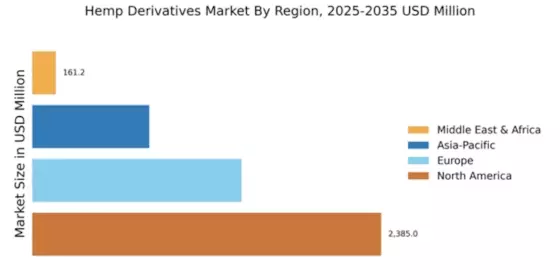
Regional Insights

North America : Market Leader in Hemp Derivatives

North America continues to lead The Hemp Derivatives, holding a significant share of 2385.0M in 2024. The region's growth is driven by increasing consumer awareness of hemp products, favorable regulatory frameworks, and a surge in demand for CBD-based products. The legalization of hemp cultivation in various states has further catalyzed market expansion, making it a hub for innovation and investment in hemp derivatives. The competitive landscape in North America is robust, with key players such as Charlotte's Web, Canopy Growth, and Curaleaf dominating the market. The U.S. and Canada are the leading countries, with a strong presence of established companies and startups alike. The market is characterized by continuous product innovation and strategic partnerships, positioning North America as a pivotal player in the global hemp derivatives sector.

Europe : Emerging Market with Potential

Europe's hemp derivatives market is on the rise, with a market size of 1430.0M in 2024. The growth is fueled by increasing demand for natural and organic products, alongside supportive regulations that promote hemp cultivation and processing. The European Union's commitment to sustainability and green initiatives has also played a crucial role in enhancing market dynamics, making it a promising region for hemp derivatives. Leading countries in this region include Germany, the UK, and France, which are witnessing a surge in hemp product adoption. The competitive landscape features both established companies and new entrants, with a focus on innovation and quality. Key players like Elixinol and other local brands are capitalizing on the growing consumer interest in hemp-based products, positioning Europe as a significant market in the global context.

Asia-Pacific : Emerging Powerhouse in Hemp

The Asia-Pacific region is emerging as a significant player in the hemp derivatives market, with a market size of 800.0M in 2024. The growth is driven by increasing awareness of the health benefits of hemp products and a gradual shift in regulatory frameworks across countries like Australia and New Zealand. The rising demand for CBD and other hemp derivatives is also contributing to market expansion, making it a region to watch in the coming years. Countries such as Australia and New Zealand are leading the charge, with a growing number of companies entering the market. The competitive landscape is characterized by a mix of local and international players, focusing on product innovation and quality. As consumer interest in hemp products continues to rise, the Asia-Pacific region is poised for substantial growth in the hemp derivatives sector.

Middle East and Africa : Untapped Market Potential

The Middle East and Africa region is still in the nascent stages of developing its hemp derivatives market, with a market size of 161.17M in 2024. The growth potential is significant, driven by increasing interest in natural health products and a gradual shift in regulatory attitudes towards hemp cultivation. As awareness of the benefits of hemp products grows, the region is expected to see a rise in demand for various hemp derivatives, paving the way for future market expansion. Countries like South Africa and Israel are at the forefront of this emerging market, with a few local companies beginning to explore hemp cultivation and product development. The competitive landscape is still developing, but there is a growing interest from international players looking to enter this untapped market. As regulations evolve, the Middle East and Africa could become a key player in The Hemp Derivatives.

Key Players and Competitive Insights

The Hemp Derivatives Market is currently characterized by a dynamic competitive landscape, driven by increasing consumer demand for natural products and the expanding legalization of hemp-derived compounds across various jurisdictions. Key players such as Charlotte's Web (US), Canopy Growth (CA), and Curaleaf (US) are strategically positioning themselves through innovation and regional expansion. Charlotte's Web (US) focuses on product diversification, particularly in the wellness sector, while Canopy Growth (CA) emphasizes partnerships to enhance its product offerings. Curaleaf (US) is actively pursuing acquisitions to bolster its market presence, collectively shaping a competitive environment that is both fragmented and rapidly evolving.

In terms of business tactics, companies are increasingly localizing manufacturing to reduce costs and optimize supply chains. The market structure appears moderately fragmented, with several players vying for market share. This fragmentation allows for niche players to thrive, while larger companies leverage economies of scale. The collective influence of these key players is significant, as they drive innovation and set industry standards, thereby influencing consumer preferences and regulatory frameworks.

In November 2025, Charlotte's Web (US) announced a strategic partnership with a leading wellness brand to co-develop a new line of hemp-infused products. This collaboration is expected to enhance Charlotte's Web's market reach and capitalize on the growing trend of holistic health solutions. The strategic importance of this partnership lies in its potential to attract a broader consumer base, particularly those seeking natural alternatives for health and wellness.

In October 2025, Canopy Growth (CA) launched a new line of CBD beverages aimed at the health-conscious consumer segment. This product launch is significant as it reflects Canopy's commitment to innovation and its strategy to penetrate the beverage market, which is rapidly gaining traction. By diversifying its product portfolio, Canopy Growth (CA) positions itself to capture a larger share of the market, appealing to consumers looking for convenient and health-oriented options.

In September 2025, Curaleaf (US) completed the acquisition of a regional hemp processing facility, enhancing its production capabilities. This acquisition is strategically important as it allows Curaleaf to streamline its supply chain and improve product availability. By increasing its operational efficiency, Curaleaf (US) is likely to strengthen its competitive position in the market, particularly in the face of rising demand for hemp derivatives.

As of December 2025, current competitive trends in the Hemp Derivatives Market include a strong emphasis on digitalization, sustainability, and the integration of AI technologies. Strategic alliances are increasingly shaping the landscape, enabling companies to leverage shared resources and expertise. Looking ahead, competitive differentiation is expected to evolve, with a shift from price-based competition to a focus on innovation, technology, and supply chain reliability. This transition may redefine market dynamics, as companies that prioritize these aspects are likely to gain a competitive edge.

Key Companies in the Hemp Derivatives Market market include

Industry Developments

In November 2021, Premier CBD Hub, a leading direct seller of cannabidiol products announced the launch of its new website and premium products. The website premiercbdhub.com is a one-place solution for getting all CBD Hub's products.

Intended Audience

This report will be beneficial for every stakeholder of the hemp derivatives market such as :

  • Hemp derivatives Manufacturers
  • Regulatory Bodies
  • R&D institutes
  • Potential Investors
  • End users


Future Outlook

Hemp Derivatives Market Future Outlook

The Hemp Derivatives Market is projected to grow at a 4.83% CAGR from 2024 to 2035, driven by increasing consumer demand and regulatory advancements.

New opportunities lie in:

  • Development of innovative CBD-infused food and beverage products
  • Expansion into emerging markets with tailored product offerings
  • Investment in sustainable hemp farming practices to enhance supply chain efficiency

By 2035, the market is expected to solidify its position as a key player in the global economy.

Market Segmentation

Hemp Derivatives Market Type Outlook

  • Cannabidiol
  • Tetrahydrocannabinol
  • Hemp Seed Oil
  • Hemp Fiber
  • Hemp Protein

Hemp Derivatives Market End Use Outlook

  • Nutraceuticals
  • Personal Care Products
  • Industrial Products
  • Animal Feed
  • Biofuels

Hemp Derivatives Market Application Outlook

  • Food and Beverage
  • Cosmetics
  • Pharmaceuticals
  • Textiles
  • Construction

Report Scope

MARKET SIZE 20244776.17(USD Million)
MARKET SIZE 20255061.58(USD Million)
MARKET SIZE 20358059.86(USD Million)
COMPOUND ANNUAL GROWTH RATE (CAGR)4.83% (2024 - 2035)
REPORT COVERAGERevenue Forecast, Competitive Landscape, Growth Factors, and Trends
BASE YEAR2024
Market Forecast Period2025 - 2035
Historical Data2019 - 2024
Market Forecast UnitsUSD Million
Key Companies ProfiledCharlotte's Web (US), Canopy Growth (CA), Aurora Cannabis (CA), Cresco Labs (US), Curaleaf (US), Green Thumb Industries (US), Trulieve (US), HempFusion (US), Medterra (US), Elixinol (AU)
Segments CoveredApplication, Type, End Use
Key Market OpportunitiesGrowing consumer demand for sustainable and natural products drives innovation in the Hemp Derivatives Market.
Key Market DynamicsRising consumer demand for natural products drives innovation and competition in the hemp derivatives market.
Countries CoveredNorth America, Europe, APAC, South America, MEA

Market Highlights

Author
Rahul Gotadki
Assistant Manager

He holds an experience of about 7+ years in Market Research and Business Consulting, working under the spectrum of Life Sciences and Healthcare domains. Rahul conceptualizes and implements a scalable business strategy and provides strategic leadership to the clients. His expertise lies in market estimation, competitive intelligence, pipeline analysis, customer assessment, etc. In addition to the above, his other responsibility includes strategic tracking of high growth markets & advising clients on the potential areas of focus they could direct their business initiatives

Leave a Comment

FAQs

At what CAGR is the Hemp Derivatives Market projected to grow during the forecast period?

Hemp Derivatives Market is projected to grow at a 32.3% CAGR between 2024-2030.

Which region is expected to dominate the Hemp Derivatives Market?

Europe is expected to dominate the Hemp Derivatives Market.

What will be the value of the Hemp Derivatives Market during the forecast period?

Hemp Derivatives Market is predicted to touch USD 56.8 billion by 2030.

Which application segment will lead the Hemp Derivatives Market?

Food and Beverages will lead the Hemp Derivatives Market.

Which type segment will dominate the Hemp Derivatives Market?

Hemp-derived CBD oil will dominate the Hemp Derivatives Market.

Download Free Sample

Kindly complete the form below to receive a free sample of this Report

Compare Licence

×
Features License Type
Single User Multiuser License Enterprise User
Price $4,950 $5,950 $7,250
Maximum User Access Limit 1 User Upto 10 Users Unrestricted Access Throughout the Organization
Free Customization
Direct Access to Analyst
Deliverable Format
Platform Access
Discount on Next Purchase 10% 15% 15%
Printable Versions