×
Request Free Sample ×

Kindly complete the form below to receive a free sample of this Report

* Please use a valid business email

Leading companies partner with us for data-driven Insights

clients tt-cursor
Hero Background

High Barrier Packaging Plastics Market

ID: MRFR/CnM/19179-CR
111 Pages
Priya Nagrale
March 2024

High Barrier Packaging Plastics Market Research Report Information By Type (Polyethylene (PE), Polypropylene (PP), Polyethylene Terephthalate (PET), Ethylene Vinyl Alcohol (EVOH), Others), By Product Type (Bags and pouches, Containers, Lids, and Others), By End Use (,Food and beverages, Pharmaceuticals, Chemicals, and Others) and By Region - Global Forecast to 2035

Share:
Download PDF ×

We do not share your information with anyone. However, we may send you emails based on your report interest from time to time. You may contact us at any time to opt-out.

High Barrier Packaging Plastics Market Infographic
Purchase Options

High Barrier Packaging Plastics Market Summary

As per MRFR analysis, the High Barrier Packaging Plastics Market was estimated at 328426.94 USD Million in 2024. The High Barrier Packaging Plastics industry is projected to grow from 343245.64 USD Million in 2025 to 533663.6 USD Million by 2035, exhibiting a compound annual growth rate (CAGR) of 4.51 during the forecast period 2025 - 2035.

Key Market Trends & Highlights

The High Barrier Packaging Plastics Market is experiencing robust growth driven by sustainability and technological advancements.

  • North America remains the largest market for high barrier packaging plastics, driven by increasing demand for food preservation.
  • Asia-Pacific is identified as the fastest-growing region, reflecting a surge in e-commerce and online retail activities.
  • Food packaging continues to dominate the market, while pharmaceutical packaging is emerging as the fastest-growing segment.
  • Key market drivers include the rising demand for food preservation and the increasing focus on sustainability initiatives.

Market Size & Forecast

2024 Market Size 328426.94 (USD Million)
2035 Market Size 533663.6 (USD Million)
CAGR (2025 - 2035) 4.51%

Major Players

Amcor (AU), BASF (DE), Sealed Air (US), Mondi (GB), Berry Global (US), DuPont (US), SABIC (SA), Kraton (US), Clariant (CH), Eastman Chemical (US)

High Barrier Packaging Plastics Market Trends

The High Barrier Packaging Plastics Market is currently experiencing a notable transformation driven by evolving consumer preferences and stringent regulatory frameworks. As sustainability becomes a focal point for manufacturers and consumers alike, there is a growing emphasis on developing eco-friendly materials that do not compromise on performance. This shift is prompting companies to innovate and invest in advanced technologies that enhance the barrier properties of packaging solutions while minimizing environmental impact. Furthermore, the demand for longer shelf life and improved product protection is propelling the adoption of high barrier plastics across various sectors, including food and beverage, pharmaceuticals, and personal care products. In addition to sustainability, the High Barrier Packaging Plastics Market is witnessing a surge in the use of smart packaging technologies. These innovations not only enhance the functionality of packaging but also provide valuable information to consumers regarding product freshness and safety. The integration of digital solutions into packaging is likely to reshape consumer interactions and drive brand loyalty. As the market continues to evolve, stakeholders must remain agile and responsive to emerging trends, ensuring that they meet the diverse needs of consumers while adhering to regulatory standards. Overall, the High Barrier Packaging Plastics Market appears poised for growth, with a focus on sustainability, innovation, and consumer engagement shaping its future trajectory.

Sustainability Initiatives

The High Barrier Packaging Plastics Market is increasingly prioritizing sustainability, with manufacturers exploring biodegradable and recyclable materials. This trend reflects a broader commitment to reducing environmental impact while maintaining product integrity.

Smart Packaging Technologies

The integration of smart technologies into packaging solutions is gaining traction. These innovations enhance user experience by providing real-time information about product quality and freshness, thereby fostering consumer trust.

Regulatory Compliance and Innovation

As regulations surrounding packaging materials become more stringent, companies are compelled to innovate. This trend drives the development of advanced barrier materials that comply with safety standards while offering superior performance.

High Barrier Packaging Plastics Market Drivers

Rising Demand for Food Preservation

The Global High Barrier Packaging Plastics Market Industry experiences a notable increase in demand driven by the need for effective food preservation. High barrier packaging materials significantly extend the shelf life of perishable goods, which is crucial in a world where food waste is a pressing concern. For instance, the market is projected to reach 328.4 USD Billion in 2024, reflecting a growing awareness among consumers and manufacturers about the importance of maintaining food quality. This trend is likely to continue as the industry adapts to evolving consumer preferences for sustainable and long-lasting packaging solutions.

Market Segment Insights

By Application: Food Packaging (Largest) vs. Pharmaceutical Packaging (Fastest-Growing)

The High Barrier Packaging Plastics Market is segmented into various applications, with food packaging dominating the landscape. This sector benefits from the increasing demand for convenient and safe packaging that preserves food quality and extends shelf life. Following food packaging, pharmaceutical packaging also holds a significant position, shaped by the growing global healthcare emphasis and the rise in biologics and personalized medicine. This segment is particularly influenced by stringent regulations that require advanced packaging solutions. In terms of growth trends, pharmaceutical packaging is recognized as the fastest-growing application area. Factors driving this growth include an increase in health-conscious consumers, technological advancements in drug delivery systems, and rising investments in healthcare infrastructure. Food packaging continues to benefit from trends such as organic and ready-to-eat foods, leading to sustained demand for high barrier properties that ensure product integrity and safety in various environments.

Food Packaging (Dominant) vs. Cosmetic Packaging (Emerging)

Food packaging remains the dominant segment in the High Barrier Packaging Plastics Market, driven by consumer demand for durable and user-friendly solutions. This application utilizes innovations such as multilayer films and vacuum-sealed containers that enhance product life and prevent contamination. In contrast, cosmetic packaging is emerging as a significant player, propelled by the industry's shift toward sustainable materials and appealing designs that resonate with environmentally conscious consumers. Both segments prioritize barrier properties; however, cosmetic packaging often emphasizes aesthetic appeal along with functionality, integrating unique materials and designs to meet consumer preferences. As these sectors evolve, competition and innovation will play critical roles in addressing changing market dynamics.

By Material Type: Polyethylene Terephthalate (Largest) vs. Polyamide (Fastest-Growing)

The High Barrier Packaging Plastics Market demonstrates a diverse material type landscape, characterized by distinct segments such as Polyethylene Terephthalate (PET), Polyvinyl Chloride (PVC), Polyethylene (PE), Polypropylene (PP), and Polyamide (PA). Among these, PET holds the largest share due to its superior barrier properties, recyclability, and widespread adoption across various packaging applications, particularly in food and beverage sectors. PVC, while significant, faces competition from eco-friendlier materials, which impacts its market presence. In contrast, Polyamide, although smaller in market share, exhibits the highest growth potential driven by its increasing utilization in high-performance packaging solutions.

Polyethylene Terephthalate (Dominant) vs. Polyamide (Emerging)

Polyethylene Terephthalate (PET) is recognized as the dominant material in the High Barrier Packaging Plastics Market due to its excellent gas and moisture barrier properties, making it ideal for food and pharmaceutical packaging. Its strong recyclability further enhances its sustainability profile, appealing to eco-conscious consumers and regulatory frameworks that favor reduced plastic waste. On the other hand, Polyamide (PA) is emerging rapidly, driven by the demand for lightweight and high-performance packaging. PA's unique properties, such as flexibility and resistance to temperature changes, make it a go-to choice for specialized applications. Its increasing adoption in the food sector is particularly notable, as manufacturers seek materials that provide extended shelf life and freshness.

By End Use Industry: Food and Beverage (Largest) vs. Healthcare (Fastest-Growing)

In the High Barrier Packaging Plastics Market, the Food and Beverage industry holds the largest market share due to the increasing demand for packaged food items and convenience in storage. The segment benefits from consumer preferences for longer shelf life and protection against environmental factors. Following closely is the Healthcare sector, which utilizes high barrier packaging for pharmaceuticals and medical devices, reflecting a growing awareness of product safety and hygiene standards.

Food and Beverage (Dominant) vs. Healthcare (Emerging)

The Food and Beverage segment is a dominant force in the High Barrier Packaging Plastics Market, driven by the need for high-quality packaging solutions that ensure product freshness and safety. This segment is characterized by innovative packaging designs that facilitate convenience, such as resealable pouches and multi-layer films that offer barrier properties. In contrast, the Healthcare sector is emerging as a significant player, with increasing demand for safe and secure packaging for sensitive products. High barrier plastics are crucial for ensuring the integrity of vaccines and medications, thus creating new opportunities for growth in response to regulatory standards and health concerns.

By Barrier Properties: Oxygen Barrier (Largest) vs. Moisture Barrier (Fastest-Growing)

In the High Barrier Packaging Plastics Market, Oxygen Barrier materials hold the largest market share due to their critical role in preserving the quality of perishable goods. This segment is essential for extending the shelf life of food products and pharmaceuticals, making it a preferred choice among manufacturers. On the other hand, the Moisture Barrier segment is experiencing rapid growth, as the demand for goods that are moisture-sensitive continues to rise, including snacks and electronic components, leading to innovative packaging solutions in this area.

Oxygen Barrier (Dominant) vs. Moisture Barrier (Emerging)

Oxygen Barrier materials are recognized for their unique ability to limit oxygen transmission rates, effectively extending the freshness and quality of packaged products. Primarily used in the food and pharmaceutical industries, these barriers are critical for preventing oxidative degradation. Conversely, the Moisture Barrier segment is evolving quickly, driven by increasing consumer awareness regarding product quality and safety. Emerging technologies in moisture barrier films are enhancing durability while reducing thickness, which aligns with the trend of sustainable packaging solutions. As brands seek to differentiate themselves in competitive markets, innovations in moisture barriers will play a significant role in catering to the needs of moisture-sensitive products.

By Form Type: Pouches (Largest) vs. Containers (Fastest-Growing)

The High Barrier Packaging Plastics Market exhibits a diverse distribution among its form types, with pouches leading in market share due to their flexibility, lightweight nature, and superior protective qualities against moisture and oxygen. Films and sheets follow closely, providing essential barriers that cater to various packaging needs, while containers and bottles are also significant but less prominent in comparison to pouches. Each form type plays a crucial role in addressing the specific requirements of food, pharmaceuticals, and other sensitive products that demand high barrier properties. Growth trends within this segment showcase pouches as the dominant form type, aligning with consumer preferences for convenience and sustainable packaging solutions. Meanwhile, containers are emerging as the fastest-growing category, driven by innovations in design and functionality that enhance product preservation. Factors such as increased demand for ready-to-eat meals and the gradual shift towards sustainable materials further boost growth across these form types, underscoring their pivotal roles in the evolving packaging landscape.

Pouches (Dominant) vs. Containers (Emerging)

Pouches stand out in the High Barrier Packaging Plastics Market due to their versatility, offering exceptional barrier properties while accommodating various packaging formats like stand-up pouches and vacuum-sealed options. Their lightweight and resealable features appeal to consumers looking for convenience and freshness, driving their adoption in food and beverage sectors. Containers, while traditionally established, are experiencing an emerging trend as manufacturers innovate to incorporate advanced barrier technologies and eco-friendly materials. This transformation enhances their functionality and attractiveness, particularly in sectors sensitive to product integrity such as pharmaceuticals. The ability to combine aesthetics with practicality positions containers favorably in the competitive landscape, allowing them to respond rapidly to changing consumer expectations.

Get more detailed insights about High Barrier Packaging Plastics Market

Regional Insights

North America : Market Leader in Innovation

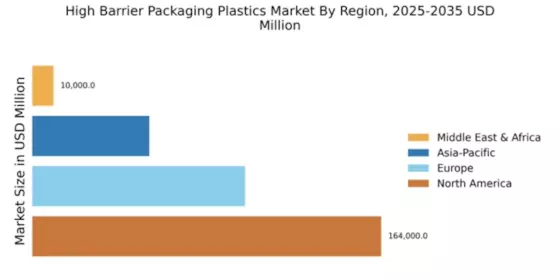
North America is poised to maintain its leadership in the High Barrier Packaging Plastics Market, holding a significant market share of 150,000.0. The region's growth is driven by increasing demand for sustainable packaging solutions and stringent regulations promoting eco-friendly materials. The rise in e-commerce and food delivery services further fuels the need for high-quality packaging that ensures product safety and longevity. The United States and Canada are the leading countries in this sector, with major players like Amcor, Sealed Air, and Berry Global driving innovation. The competitive landscape is characterized by continuous advancements in technology and materials, enabling companies to meet evolving consumer preferences. The presence of established firms and a robust supply chain enhances the region's market position, making it a hub for high barrier packaging solutions.

Europe : Sustainable Packaging Initiatives

Europe is witnessing a significant shift towards sustainable packaging, with a market size of 100,000.0 in the High Barrier Packaging Plastics sector. Regulatory frameworks, such as the EU Plastics Strategy, are catalyzing this transition by promoting the use of recyclable materials and reducing plastic waste. The increasing consumer awareness regarding environmental issues is further driving demand for high barrier packaging that meets sustainability criteria. Leading countries in this region include Germany, France, and the UK, where companies like BASF and Mondi are at the forefront of innovation. The competitive landscape is marked by collaborations and partnerships aimed at developing advanced materials that align with regulatory standards. The presence of key players and a strong focus on R&D are essential for maintaining market growth in Europe.

Asia-Pacific : Emerging Market Potential

Asia-Pacific is emerging as a significant player in the High Barrier Packaging Plastics Market, with a market size of 70,000.0. The region's growth is driven by rapid urbanization, increasing disposable incomes, and a burgeoning e-commerce sector. Additionally, government initiatives aimed at enhancing food safety and reducing waste are propelling the demand for high barrier packaging solutions that ensure product integrity and shelf life. Countries like China, India, and Japan are leading the charge, with key players such as DuPont and SABIC investing heavily in the region. The competitive landscape is evolving, with local manufacturers gaining traction alongside established global firms. This dynamic environment presents ample opportunities for innovation and market expansion in Asia-Pacific, making it a focal point for high barrier packaging advancements.

Middle East and Africa : Untapped Market Opportunities

The Middle East and Africa region is gradually emerging in the High Barrier Packaging Plastics Market, with a market size of 8,000.0. The growth is primarily driven by increasing industrialization and a rising demand for packaged food and beverages. Additionally, government initiatives aimed at improving food safety standards are creating a favorable environment for high barrier packaging solutions that enhance product preservation and safety. Countries like South Africa and the UAE are at the forefront of this market, with local and international players exploring opportunities to expand their footprint. The competitive landscape is characterized by a mix of established companies and new entrants, all vying for market share. As the region continues to develop, the potential for high barrier packaging solutions is expected to grow significantly, attracting investments and innovations.

Key Players and Competitive Insights

The High Barrier Packaging Plastics Market is currently characterized by a dynamic competitive landscape, driven by increasing demand for sustainable packaging solutions and innovations in material science. Key players such as Amcor (AU), BASF (DE), and Sealed Air (US) are strategically positioning themselves through a combination of technological advancements and sustainability initiatives. Amcor (AU) has focused on enhancing its product portfolio with recyclable materials, while BASF (DE) emphasizes the development of bio-based polymers. Sealed Air (US) is leveraging its expertise in protective packaging to cater to the growing e-commerce sector, thereby shaping a competitive environment that prioritizes innovation and environmental responsibility.

In terms of business tactics, companies are increasingly localizing manufacturing to reduce lead times and optimize supply chains. The market structure appears moderately fragmented, with several players vying for market share. However, the collective influence of major companies like Berry Global (US) and DuPont (US) is notable, as they engage in strategic partnerships and acquisitions to enhance their market presence and operational capabilities.

In November 2025, Berry Global (US) announced a partnership with a leading technology firm to develop smart packaging solutions that integrate IoT capabilities. This strategic move is likely to enhance Berry's product offerings, allowing for real-time tracking and improved consumer engagement, which could set a new standard in the packaging industry. The integration of technology into packaging solutions may also provide Berry with a competitive edge in a market increasingly focused on digital transformation.

In October 2025, DuPont (US) unveiled a new line of high-performance barrier films designed for food packaging applications. This launch is significant as it addresses the growing consumer demand for longer shelf life and enhanced product protection. By investing in R&D and focusing on high-performance materials, DuPont is positioning itself as a leader in innovation within the high barrier packaging sector, potentially increasing its market share.

In September 2025, BASF (DE) expanded its production capacity for biodegradable plastics in response to rising environmental concerns. This expansion not only aligns with global sustainability trends but also reinforces BASF's commitment to providing eco-friendly alternatives in the packaging market. Such initiatives may enhance BASF's reputation and appeal to environmentally conscious consumers, thereby influencing purchasing decisions.

As of December 2025, current competitive trends indicate a strong shift towards digitalization, sustainability, and AI integration within the High Barrier Packaging Plastics Market. Strategic alliances are increasingly shaping the landscape, as companies recognize the value of collaboration in driving innovation. The competitive differentiation is likely to evolve from traditional price-based competition to a focus on technological advancements, sustainability, and supply chain reliability, suggesting a transformative period ahead for the industry.

Key Companies in the High Barrier Packaging Plastics Market market include

Industry Developments

In December 2022, the world's leading flexible packaging company, Amcor, stepped up its game and came up with the largest flexible packaging plant in China to meet the increasing demand for flexible packaging solutions within the Asia-Pacific region.

In June 2022, Winpack Ltd, a supplier and manufacturer of high-standard packaging materials, won the International Sustainability and Carbon Certification (ISCC) award for incorporating recycled content into the products.

In March 2022, Cosmo Films Limited enhanced the production base located in Aurangabad, India, with a single line rated capacity of 25000 MT.

In April 2024, UFlex came up with a series of high-barrier packaging films for the first time. These films were fabricated in order to enhance the protection of the product shelf life, and increase sustainability as well. These advanced forms of packaging solutions meet the requirement for high-performance biodegradable materials in the flexible packaging industry.

In January 2022, Klockner Pentaplast made known its intention to increase the post-consumer recycled content (PCR) production capacity in North America and extend its range of sustainable developments for the spheres of pharmaceutical, over-the-counter and food-grade packaging.

In April 2022, Toppan Expandable Sealed Products improved its GL Barrier barrier product line with the addition of a single material PE barrier for liquid product packaging. The company intends to "meet increasing demand" in the European and North American markets. Packaging using vapor deposition with PE material has so far been a limitation and the company asserts its new barrier surpasses the existing designs of that kind.

Future Outlook

High Barrier Packaging Plastics Market Future Outlook

The High Barrier Packaging Plastics Market is projected to grow at a 4.51% CAGR from 2024 to 2035, driven by increasing demand for food safety and sustainability.

New opportunities lie in:

  • Development of biodegradable high barrier films for eco-conscious brands.
  • Investment in advanced recycling technologies for plastic waste management.
  • Expansion into emerging markets with tailored packaging solutions.

By 2035, the market is expected to solidify its position as a leader in sustainable packaging solutions.

Market Segmentation

High Barrier Packaging Plastics Market Form Type Outlook

  • Films
  • Sheets
  • Containers
  • Bottles
  • Pouches

High Barrier Packaging Plastics Market Application Outlook

  • Food Packaging
  • Pharmaceutical Packaging
  • Cosmetic Packaging
  • Industrial Packaging
  • Electronics Packaging

High Barrier Packaging Plastics Market Material Type Outlook

  • Polyethylene Terephthalate
  • Polyvinyl Chloride
  • Polyethylene
  • Polypropylene
  • Polyamide

High Barrier Packaging Plastics Market End Use Industry Outlook

  • Food and Beverage
  • Healthcare
  • Personal Care
  • Electronics
  • Automotive

High Barrier Packaging Plastics Market Barrier Properties Outlook

  • Oxygen Barrier
  • Moisture Barrier
  • Light Barrier
  • Chemical Barrier
  • Flavor Barrier

Report Scope

MARKET SIZE 2024328426.94(USD Million)
MARKET SIZE 2025343245.64(USD Million)
MARKET SIZE 2035533663.6(USD Million)
COMPOUND ANNUAL GROWTH RATE (CAGR)4.51% (2024 - 2035)
REPORT COVERAGERevenue Forecast, Competitive Landscape, Growth Factors, and Trends
BASE YEAR2024
Market Forecast Period2025 - 2035
Historical Data2019 - 2024
Market Forecast UnitsUSD Million
Key Companies ProfiledAmcor (AU), BASF (DE), Sealed Air (US), Mondi (GB), Berry Global (US), DuPont (US), SABIC (SA), Kraton (US), Clariant (CH), Eastman Chemical (US)
Segments CoveredApplication, Material Type, End Use Industry, Barrier Properties, Form Type
Key Market OpportunitiesGrowing demand for sustainable packaging solutions drives innovation in the High Barrier Packaging Plastics Market.
Key Market DynamicsRising demand for sustainable packaging solutions drives innovation in high barrier packaging plastics technology and materials.
Countries CoveredNorth America, Europe, APAC, South America, MEA

Market Highlights

Author
Priya Nagrale
Senior Research Analyst

With an experience of over five years in market research industry (Chemicals & Materials domain), I gather and analyze market data from diverse sources to produce results, which are then presented back to a client. Also, provide recommendations based on the findings. As a Senior Research Analyst, I perform quality checks (QC) for market estimations, QC for reports, and handle queries and work extensively on client customizations. Also, handle the responsibilities of client proposals, report planning, report finalization, and execution

Leave a Comment

FAQs

How much is the High Barrier Packaging Plastics Market?

US$ 3,00,400 Mn

What is the growth rate of the High Barrier Packaging Plastics Market?

4.51%

Which region held the largest market share in the High Barrier Packaging Plastics Market?

Asia-Pacific

Who are the key players in the High Barrier Packaging Plastics Market?

Amcor, MONDI, Sealed Air Corp, Winpak, Huhtamaki Oyj, Jindal Poly Films, Uflex, Cosmo Films, Glenroy Inc., and Dummore Corporation

What Type led the High Barrier Packaging Plastics Market?

Polypropylene

Download Free Sample

Kindly complete the form below to receive a free sample of this Report

Compare Licence

×
Features License Type
Single User Multiuser License Enterprise User
Price $4,950 $5,950 $7,250
Maximum User Access Limit 1 User Upto 10 Users Unrestricted Access Throughout the Organization
Free Customization
Direct Access to Analyst
Deliverable Format
Platform Access
Discount on Next Purchase 10% 15% 15%
Printable Versions