
×
Hero Background
English
Chinese
French
Japanese
Korean
German
Spanish

High Temperature Elastomers Market Trends

ID: MRFR/CnM/3992-HCR
137 Pages
Chitranshi Jaiswal
October 2025

High-Temperature Elastomers Marke Research Information by product type (silicone elastomers, fluorocarbon elastomers, fluorosilicone elastomers, perfluoro elastomers), end-user industry (automobiles, construction, electronics) – Forecast till 2035

Share:
Download PDF ×

We do not share your information with anyone. However, we may send you emails based on your report interest from time to time. You may contact us at any time to opt-out.

High Temperature Elastomers Market Infographic
Purchase Options

Market Trends

Key Emerging Trends in the High Temperature Elastomers Market

The High Temperature Elastomers Market has been undergoing significant trends and shifts recently, reflecting the transient nature of industrial environment. High temperature elastomers which are often referred to as heat-resistant polymers play a vital role in many sectors where there are extreme temperatures involved. They are specifically created to keep their elasticity even under harsh conditions hence indispensable in areas like automobiles, aircrafts, electrical/electronics and industrial manufacturing.

One such trend in the High Temperature Elastomer’s Market is the growing use of silicone elastomer materials. Silicone elastomer have excellent thermal stability characteristics as well as ageing resistance properties besides great electrical insulating ability. These qualities make them perfect for use in components such as gaskets seals used within automotives among other critical applications where there is exposure to extreme temperatures. The reason why there has been rising demand for Silicone high temperature elastomers by players such as automotive industry because a need has risen for them due engine parts or exhaust systems which are durable.

Another notable trend involves increasing focus on R&D endeavors aimed at improving performance of high temperature elastomers. Manufacturers are investing in new formulations and technologies that will enhance heat resistance as well as overall durability of the elastomeric materials. This involves exploring advanced polymer chemistries as well as innovative processing techniques to meet the changing needs of different industries’ end-users. As a result, market is being presented with high performance elastomers that can withstand more adverse temperatures.

Additionally, aerospace industry also contributes to trends in High Temperature Elastomers Market. The aerospace segment is leveraging on use of advanced materials including high temperature elastomers to develop seals, gaskets and O-rings among others due to increased demand for lightweight and fuel efficient aircrafts. These elastomers help improve the effectiveness and safety of aerospace applications by offering dependable sealing solutions in high-temperature environments such as airplane engines.

Diverse factors including technological advancements, industry-specific demands and environmental considerations are driving significant changes in the High Temperature Elastomer’s Market.The increasing use of silicone elastomers, ongoing research and development efforts, the aerospace industry's emphasis on lightweight materials, and the growing importance of sustainability are shaping the market trends in high temperature elastomers. As businesses continue to evolve calling for sturdier materials that are also eco-friendly; hence this implies that there will be continuous growth and innovation within this sector which manufacture high temperature elastomers.


Author
Chitranshi Jaiswal
Research Analyst Level I

In her 3 years of experience in the market research field, she has handled critical cross-domain projects. She has an in-depth knowledge of market estimation & analysis, problem-solving, primary as well as secondary research, and team management.She holds an engineering degree and is an MBA professional from a well-known university, capable of evaluating the market and competitive conditions. An exceptional strategist with excellent communication skills and a passion for delivering cutting-edge & practical insights for the market. Proficient in multi-tasking, and can successfully deal with competing demands, while maintaining complete confidentiality. Generated business through active client and project development, networking, and high-quality responses. Her knowledge and skills have helped in making solid business decisions, securing funding from investors, and avoiding business failures.

Leave a Comment

FAQs

What is the forecast period of High Temperature Elastomers Market research report?

The forecast period for High Temperature Elastomers Market research report is 2025-2035.

Which region will lead the High Temperature Elastomers Market?

High Temperature Elastomers Market is dominated by APAC region.

Who are the key players in the High Temperature Elastomers Market?

The major players are Dow Corning Corporation (U.S.), Wacker Chemie Ag( Germany), Momentive (U.S.), Shin-Etsu Chemical Co., Ltd (Japan), China National Bluestar (Group) Co. Ltd (China), Daikin Industries Ltd (Japan), DuPont (U.S), KCC Corporation (South Korea), Solvay S.A (Belgium), 3M Company (U.S.)

Market Summary

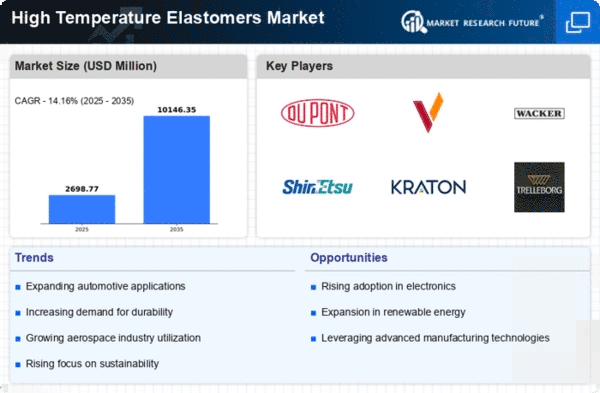
As per MRFR analysis, the High Temperature Elastomers Market was estimated at 2364.02 USD Million in 2024. The High Temperature Elastomers industry is projected to grow from 2698.77 USD Million in 2025 to 10146.35 USD Million by 2035, exhibiting a compound annual growth rate (CAGR) of 14.16 during the forecast period 2025 - 2035.

Key Market Trends & Highlights

The High Temperature Elastomers Market is poised for robust growth driven by diverse applications and technological advancements.

  • North America remains the largest market for high temperature elastomers, driven by its strong automotive sector.
  • Asia-Pacific is emerging as the fastest-growing region, fueled by increasing industrial applications and innovations.
  • The automotive segment dominates the market, while the aerospace segment is witnessing rapid growth due to rising demand for advanced materials.
  • Key market drivers include the rising demand in the automotive sector and technological innovations in material science.

Market Size & Forecast

2024 Market Size 2364.02 (USD Million)
2035 Market Size 10146.35 (USD Million)
CAGR (2025 - 2035) 14.16%
Largest Regional Market Share in 2024 North America

Major Players

<p>DuPont (US), Dow (US), Wacker Chemie (DE), Momentive Performance Materials (US), Elastomer Solutions (US), Kraton Corporation (US), Trelleborg (SE), Saint-Gobain (FR), Hexpol (SE)</p>

Market Trends

The High Temperature Elastomers Market is currently experiencing a notable evolution, driven by the increasing demand for materials that can withstand extreme conditions. Industries such as automotive, aerospace, and electronics are particularly focused on high-performance elastomers due to their superior thermal stability and mechanical properties. This market appears to be influenced by advancements in polymer technology, which enable the development of elastomers that not only endure high temperatures but also exhibit enhanced durability and resistance to various chemicals. As manufacturers seek to improve product performance and longevity, the adoption of high temperature elastomers is likely to expand across diverse applications. Moreover, the growing emphasis on sustainability and environmental considerations is shaping the High Temperature Elastomers Market. Companies are increasingly exploring eco-friendly alternatives and innovative recycling methods to reduce waste and enhance the lifecycle of elastomer products. This shift towards sustainable practices may lead to the emergence of new materials that align with regulatory standards and consumer preferences. Consequently, the market landscape is poised for transformation, with a potential increase in the variety of high temperature elastomers available, catering to a broader range of industrial needs and applications.

Sustainability Initiatives

The High Temperature Elastomers Market is witnessing a shift towards sustainable practices, as manufacturers prioritize eco-friendly materials and production methods. This trend reflects a growing awareness of environmental impacts and regulatory pressures, prompting companies to innovate in the development of recyclable and biodegradable elastomers.

Technological Advancements

Ongoing advancements in polymer science are significantly influencing the High Temperature Elastomers Market. Innovations in material formulations and processing techniques are enabling the creation of elastomers with superior thermal and mechanical properties, thereby expanding their applicability in demanding environments.

Diverse Application Growth

The demand for high temperature elastomers is expanding across various sectors, including automotive, aerospace, and electronics. This diversification indicates a broader acceptance of these materials in applications that require exceptional performance under extreme conditions, suggesting a robust growth trajectory for the market.

High Temperature Elastomers Market Market Drivers

Growing Demand from Automotive Sector

The automotive industry is a significant driver for the Global High-Temperature Elastomers Market Industry, as manufacturers increasingly seek materials that can withstand extreme conditions. High-temperature elastomers are utilized in various automotive applications, including seals, gaskets, and hoses, which require durability and resistance to heat. The market is projected to reach 19.1 USD Billion in 2024, reflecting the rising demand for advanced materials in vehicle production. As electric vehicles gain traction, the need for high-performance elastomers is likely to increase, further propelling market growth. This trend indicates a robust future for high-temperature elastomers in automotive applications.

Market Segment Insights

By Application: Automotive (Largest) vs. Aerospace (Fastest-Growing)

<p>In the High Temperature Elastomers Market, the application segment reveals that the automotive sector holds the largest share, driven by the increasing demand for durable and high-performance materials in vehicle manufacturing. This segment's prominence is characterized by a surge in electric vehicle production and the use of advanced elastomers in components that withstand extreme temperatures. Conversely, the aerospace application is emerging as the fastest-growing segment due to the rising investments in aircraft technologies and the demand for lightweight, high-performance materials that can endure harsh environmental conditions. Innovations in elastomer formulations for this sector are key to meeting stringent regulatory requirements and enhancing material longevity.</p>

<p>Automotive (Dominant) vs. Medical (Emerging)</p>

<p>The automotive sector stands out as the dominant application in the High Temperature Elastomers Market, leveraging the need for heavy-duty components that can perform under high thermal stress. Key characteristics include the usage of specialized elastomers in gaskets, seals, and insulation parts, instrumental in delivering enhanced safety and performance for modern vehicles. Meanwhile, the medical segment is emerging, characterized by increasing applications in medical devices and equipment that require reliable and high-performance material profiles. The growing emphasis on medical advancements and stringent safety standards drives innovation in elastomers tailored for sterilization and biocompatibility, creating a synergistic potential between high-performance elastomers and medical technology.</p>

By End Use: Seals (Largest) vs. O-Rings (Fastest-Growing)

<p>In the High Temperature Elastomers market, the 'Seals' segment holds the largest share, driven by significant demand across various industries such as automotive and aerospace. Following closely, the 'Gaskets' and 'Hoses' segments also contribute to the overall market performance, showcasing a balanced distribution of market share among these critical components. The 'O-Rings' segment, while smaller in comparison, is rapidly gaining traction, especially in high-performance applications that require reliable sealing solutions.</p>

<p>Seals (Dominant) vs. O-Rings (Emerging)</p>

<p>The 'Seals' segment remains dominant in the High Temperature Elastomers market, characterized by its extensive use in critical applications where reliability and durability are paramount. These seals are engineered to withstand extreme temperatures, making them indispensable in industries like automotive, oil, and gas. On the other hand, 'O-Rings' are emerging as a vital player in this market due to their versatility and efficiency in creating tight seals in various environments. The increasing demand for precision and safety in applications, such as hydraulic systems, is propelling the growth of O-Rings, positioning them as a key component for future innovations in high-temperature applications.</p>

By Material Type: Silicone (Largest) vs. Fluoroelastomer (Fastest-Growing)

<p>In the High Temperature Elastomers Market, silicone dominates the material type segment, attributed to its excellent thermal stability and versatility in various applications. Fluoroelastomers, while holding a smaller share, are experiencing rapid growth due to increasing demand in high-performance applications that require superior chemical resistance and durability. The market is witnessing a competitive landscape where silicone remains the preferred choice across diverse industries including automotive and aerospace, while fluoroelastomers are emerging as a specialist option for critical applications. As industries evolve towards incorporating materials with enhanced properties, the growth trends indicate that fluoroelastomers are becoming increasingly attractive due to their ability to withstand harsh environments. Factors such as stringent regulations and a push towards high-efficiency materials are driving this shift. Manufacturers are focused on developing advanced formulations of fluoroelastomers to meet specific needs, contributing to their status as a fast-growing segment within the high-temperature elastomers market.</p>

<p>Silicone (Dominant) vs. Polyurethane (Emerging)</p>

<p>Silicone elastomers maintain a dominant position in the high-temperature elastomers market, known for their thermal stability and elasticity, making them suitable for a wide variety of applications from seals to gaskets. Their longevity and reliability in extreme conditions are unmatched, giving them a strong hold in sectors like automotive and electronics. On the other hand, polyurethane elastomers, while recognized as emerging players, offer excellent abrasion resistance and flexibility. Their adaptable properties make them suitable for applications where custom formulations are required, thus gaining traction in niche markets. As manufacturers continue to innovate, polyurethanes are being formulated to enhance heat resistance, positioning them as viable contenders in applications traditionally dominated by silicone.</p>

By Processing Technique: Injection Molding (Largest) vs. Extrusion (Fastest-Growing)

<p>In the High Temperature Elastomers Market, the processing technique segment showcases a varied distribution of market shares among its key players. Injection molding leads as the largest segment due to its efficiency and ability to produce complex shapes with high accuracy. The other techniques like compression molding, extrusion, calendering, and 3D printing play significant roles, but they hold comparatively smaller portions of the overall market share. Compression molding follows injection molding, mainly used for larger parts, while 3D printing is gradually gaining traction for its customization capabilities. The growth trends in this segment are promising, driven by innovations in technology and an increasing demand for high-performance elastomer components across industries like automotive and aerospace. Extrusion is recognized as the fastest-growing technique, benefiting from advancements that allow for better product customization and faster production cycles. 3D printing, while still emerging, is appealing for its flexibility and ability to produce intricate designs without the need for extensive tooling or setup, making it a contender for future growth in niche applications.</p>

<p>Injection Molding: Dominant vs. 3D Printing: Emerging</p>

<p>Injection molding has established itself as the dominant processing technique in the High Temperature Elastomers Market, primarily because of its ability to produce high volumes of consistent parts with intricate designs. This technique allows for rapid production turnaround and minimizes waste, making it cost-effective for manufacturers. In contrast, 3D printing is an emerging technique that offers unique advantages such as design flexibility and the capacity for rapid prototyping. While currently not surpassing injection molding in volume, 3D printing is gaining popularity in specialized applications where customization is essential. As technology advances, it is likely that 3D printing will carve out a larger share in the market, especially for low-volume, high-complexity parts.</p>

By Temperature Resistance: Up to 300 Degrees Celsius (Largest) vs. Above 300 Degrees Celsius (Fastest-Growing)

<p>In the High Temperature Elastomers Market, the temperature resistance segments are critical in defining performance and application. The 'Up to 300 Degrees Celsius' segment dominates the market, accounting for a significant share due to its extensive use in automotive, aerospace, and industrial applications. In contrast, the 'Above 300 Degrees Celsius' segment is gaining traction, driven by the increasing demand for materials that can withstand extreme conditions in sectors such as electronics and energy.</p>

<p>Up to 300 Degrees Celsius (Dominant) vs. Above 300 Degrees Celsius (Emerging)</p>

<p>The 'Up to 300 Degrees Celsius' segment is recognized for its robust performance and reliability, making it the preferred choice for industries that require high temperature resistance. This segment is characterized by elastomers that maintain their tensile strength and elasticity at elevated temperatures, facilitating their use in engines, turbines, and high-heat environments. Meanwhile, the 'Above 300 Degrees Celsius' segment is emerging with fast-paced growth, as technological advancements and innovative formulations allow for higher temperature applications. This emerging segment caters to niche markets requiring extreme resistance, thus opening new opportunities and applications in sectors such as aerospace and specialty equipment.</p>

Get more detailed insights about High Temperature Elastomers Market Research Report- Forecast till 2035

Regional Insights

North America : Market Leader in Innovation

North America is poised to maintain its leadership in the High Temperature Elastomers market, holding a significant market share of 1185.0 million. The region's growth is driven by robust demand from automotive, aerospace, and industrial sectors, alongside stringent regulations promoting high-performance materials. The increasing focus on sustainability and energy efficiency further propels market expansion, as manufacturers seek advanced elastomer solutions to meet evolving standards. The competitive landscape in North America is characterized by the presence of key players such as DuPont, Dow, and Momentive Performance Materials. These companies are investing heavily in R&D to innovate and enhance product offerings. The U.S. remains the largest market, supported by a strong manufacturing base and technological advancements. The region's commitment to quality and performance positions it as a hub for high temperature elastomer applications.

Europe : Emerging Market with Growth Potential

Europe is witnessing a growing demand for High Temperature Elastomers, with a market size of 650.0 million. The region's growth is fueled by increasing applications in automotive and electronics, alongside regulatory frameworks that encourage the use of high-performance materials. The European Union's focus on sustainability and environmental regulations is driving innovation in elastomer technologies, making them more efficient and eco-friendly. Leading countries in this market include Germany, France, and the UK, where major players like Wacker Chemie and Saint-Gobain are actively involved. The competitive landscape is marked by collaborations and partnerships aimed at enhancing product offerings. The presence of advanced manufacturing facilities and a skilled workforce further strengthens Europe's position in the high temperature elastomers market. "The European market is adapting to new regulations that prioritize sustainability and performance in elastomer applications," European Commission report.

Asia-Pacific : Rapid Growth in Emerging Economies

Asia-Pacific is emerging as a significant player in the High Temperature Elastomers market, with a market size of 450.0 million. The region's growth is driven by rapid industrialization, increasing automotive production, and rising consumer demand for durable materials. Countries like China and India are at the forefront, supported by government initiatives aimed at boosting manufacturing and infrastructure development, which are key drivers for elastomer demand. The competitive landscape in Asia-Pacific is evolving, with local and international players vying for market share. Companies such as Kraton Corporation and Trelleborg are expanding their operations to cater to the growing demand. The region's focus on innovation and cost-effective solutions positions it as a vital hub for high temperature elastomers, attracting investments and fostering technological advancements.

Middle East and Africa : Emerging Market with Untapped Potential

The Middle East and Africa region is gradually emerging in the High Temperature Elastomers market, with a market size of 79.02 million. The growth is primarily driven by increasing industrial activities and infrastructure projects, particularly in the Gulf Cooperation Council (GCC) countries. The region's focus on diversifying its economy away from oil dependency is fostering demand for advanced materials, including high temperature elastomers, in various sectors such as construction and automotive. Leading countries in this region include the UAE and South Africa, where investments in manufacturing and technology are on the rise. The competitive landscape is characterized by a mix of local and international players, with companies looking to establish a foothold in this emerging market. The potential for growth is significant, as the region seeks to enhance its industrial capabilities and attract foreign investments. "The Middle East is positioning itself as a hub for advanced manufacturing and materials technology," Middle East Economic Forum.

Key Players and Competitive Insights

The High Temperature Elastomers Market is currently characterized by a dynamic competitive landscape, driven by increasing demand across various industries such as automotive, aerospace, and electronics. Key players are actively engaging in strategies that emphasize innovation, regional expansion, and sustainability. For instance, DuPont (US) has been focusing on enhancing its product portfolio through advanced material science, while Dow (US) is leveraging its extensive research capabilities to develop high-performance elastomers tailored for extreme conditions. These strategic orientations not only bolster their market positions but also contribute to a more competitive environment, as companies strive to meet the evolving needs of their customers.

In terms of business tactics, companies are increasingly localizing manufacturing to reduce lead times and optimize supply chains. This approach appears to be particularly effective in a moderately fragmented market, where the collective influence of key players shapes pricing strategies and product availability. The competitive structure is further complicated by the presence of smaller, specialized firms that cater to niche applications, thereby intensifying the competition among established players.

In November 2025, Wacker Chemie (DE) announced the launch of a new line of high-temperature silicone elastomers designed for automotive applications. This strategic move is significant as it not only expands Wacker's product offerings but also positions the company to capitalize on the growing demand for lightweight and heat-resistant materials in the automotive sector. Such innovations are likely to enhance Wacker's competitive edge in a market that increasingly values performance and reliability.

Similarly, in October 2025, Momentive Performance Materials (US) unveiled a partnership with a leading automotive manufacturer to develop custom elastomer solutions for electric vehicles. This collaboration underscores Momentive's commitment to innovation and sustainability, aligning with the industry's shift towards greener technologies. By integrating their elastomer solutions into electric vehicle designs, Momentive is poised to strengthen its market presence and respond effectively to the evolving automotive landscape.

In December 2025, Trelleborg (SE) announced a strategic acquisition of a specialty elastomer manufacturer, which is expected to enhance its capabilities in producing high-performance materials for industrial applications. This acquisition reflects Trelleborg's strategy to broaden its product range and improve its competitive positioning in the high-temperature elastomers segment. Such strategic actions are indicative of a broader trend where companies are seeking to consolidate their market positions through targeted acquisitions and partnerships.

As of December 2025, the competitive trends in the High Temperature Elastomers Market are increasingly influenced by digitalization, sustainability, and the integration of AI technologies. Companies are forming strategic alliances to enhance their innovation capabilities and streamline operations. The shift from price-based competition to a focus on technological advancement and supply chain reliability is becoming more pronounced. This evolution suggests that future competitive differentiation will hinge on the ability to innovate and adapt to changing market demands, rather than merely competing on cost.

Key Companies in the High Temperature Elastomers Market market include

Industry Developments

Future Outlook

High Temperature Elastomers Market Future Outlook

<p>The High Temperature Elastomers Market is projected to grow at a 14.16% CAGR from 2024 to 2035, driven by advancements in automotive and aerospace applications, as well as increasing demand for durable materials.</p>

New opportunities lie in:

  • <p>Development of specialized elastomers for electric vehicle components.</p>
  • <p>Expansion into emerging markets with tailored product offerings.</p>
  • <p>Investment in R&D for high-performance elastomer formulations.</p>

<p>By 2035, the market is expected to achieve substantial growth, solidifying its position as a key material in various industries.</p>

Market Segmentation

High Temperature Elastomers Market End Use Outlook

  • Seals
  • Gaskets
  • Hoses
  • O-Rings
  • Diaphragms

High Temperature Elastomers Market Application Outlook

  • Automotive
  • Aerospace
  • Electronics
  • Industrial
  • Medical

High Temperature Elastomers Market Material Type Outlook

  • Silicone
  • Fluoroelastomer
  • Polyurethane
  • Polyamide
  • Ethylene Propylene Diene Monomer

High Temperature Elastomers Market Processing Technique Outlook

  • Injection Molding
  • Compression Molding
  • Extrusion
  • Calendering
  • 3D Printing

High Temperature Elastomers Market Temperature Resistance Outlook

  • Up to 200 Degrees Celsius
  • Up to 250 Degrees Celsius
  • Up to 300 Degrees Celsius
  • Above 300 Degrees Celsius

Report Scope

MARKET SIZE 20242364.02(USD Million)
MARKET SIZE 20252698.77(USD Million)
MARKET SIZE 203510146.35(USD Million)
COMPOUND ANNUAL GROWTH RATE (CAGR)14.16% (2024 - 2035)
REPORT COVERAGERevenue Forecast, Competitive Landscape, Growth Factors, and Trends
BASE YEAR2024
Market Forecast Period2025 - 2035
Historical Data2019 - 2024
Market Forecast UnitsUSD Million
Key Companies ProfiledDuPont (US), Dow (US), Wacker Chemie (DE), Momentive Performance Materials (US), Elastomer Solutions (US), Kraton Corporation (US), Trelleborg (SE), Saint-Gobain (FR), Hexpol (SE)
Segments CoveredApplication, End Use, Material Type, Processing Technique, Temperature Resistance
Key Market OpportunitiesGrowing demand for lightweight, high-performance materials in automotive and aerospace sectors drives High Temperature Elastomers Market expansion.
Key Market DynamicsRising demand for high temperature elastomers driven by advancements in automotive and aerospace applications.
Countries CoveredNorth America, Europe, APAC, South America, MEA

FAQs

What is the forecast period of High Temperature Elastomers Market research report?

The forecast period for High Temperature Elastomers Market research report is 2025-2035.

Which region will lead the High Temperature Elastomers Market?

High Temperature Elastomers Market is dominated by APAC region.

Who are the key players in the High Temperature Elastomers Market?

The major players are Dow Corning Corporation (U.S.), Wacker Chemie Ag( Germany), Momentive (U.S.), Shin-Etsu Chemical Co., Ltd (Japan), China National Bluestar (Group) Co. Ltd (China), Daikin Industries Ltd (Japan), DuPont (U.S), KCC Corporation (South Korea), Solvay S.A (Belgium), 3M Company (U.S.)

  1. Scope of the Report
    1. Market Definition
    2. Scope of the Study
      1. Assumptions & Limitations
    3. Research Objectives
    4. Markets Structure
  2. Market Research Methodology
    1. Research Process
    2. Secondary Research
    3. Primary Research
    4. Forecast Model
    5. Market Landscape
    6. Porter’s Five Forces
      1. Threat of New Entrants
      2. Threat of substitutes
    7. Analysis
    8. Bargaining power of buyers
    9. Segment rivalry
    10. Value Chain/Supply Chain of
    11. Global High Temperature Elastomers Market
  3. Industry
    1. Overview of Global High Temperature Elastomers Market
    2. Introduction
    3. Growth Drivers
    4. Impact analysis
    5. Market Challenges
    6. Market Trends
    7. Introduction
    8. Growth Trends
    9. Impact analysis
    10. Global High Temperature Elastomers Market by Product Type
    11. Introduction
    12. Silicone Elastomers
      1. Market Estimates
    13. Market Estimates & Forecast, 2020-2027
    14. & Forecast by Region, 2020-2027
    15. Fluorocarbon
      1. Market Estimates & Forecast, 2020-2027
    16. Elastomers
    17. Market Estimates & Forecast by Region, 2020-2027
    18. Fluorosilicone Elastomers
      1. Market Estimates
      2. Market Estimates & Forecast by
    19. & Forecast, 2020-2027
    20. Region, 2020-2027
    21. Perfluoroelastomers
      1. Market Estimates
    22. Market Estimates & Forecast, 2020-2027
    23. & Forecast by Region, 2020-2027
    24. Others
      1. Market Estimates
    25. Market Estimates & Forecast, 2020-2027
    26. & Forecast by Region, 2020-2027
  4. Global High
    1. Temperature Elastomers Market by End user Industry
    2. Introduction
    3. Automotive
      1. Market
      2. Market Estimates & Forecast
    4. Estimates & Forecast, 2020-2027
    5. by Region, 2020-2027
    6. Aviation
      1. Market Estimates
    7. Market Estimates & Forecast, 2020-2027
    8. & Forecast by Region, 2020-2027
    9. Industrial Machinery
      1. Market Estimates
    10. Market Estimates & Forecast, 2020-2027
    11. & Forecast by Region, 2020-2027
    12. Healthcare
      1. Market Estimates
    13. Market Estimates & Forecast, 2020-2027
    14. & Forecast by Region, 2020-2027
    15. Electrical and
      1. Market Estimates & Forecast, 2020-2027
    16. Electronics
    17. Market Estimates & Forecast by Region, 2020-2027
    18. Building and Construction
      1. Market Estimates
    19. Market Estimates & Forecast, 2020-2027
    20. & Forecast by Region, 2020-2027
    21. Others
      1. Market Estimates
    22. Market Estimates & Forecast, 2020-2027
    23. & Forecast by Region, 2020-2027
  5. Global High Temperature
    1. Elastomers Market by Region
    2. Introduction
      1. Market Estimates & Forecast, 2020-2027
      2. Market
      3. Market Estimates & Forecast, 2020-2027
      4. Market
    3. North America
    4. Market Estimates & Forecast by Product Type, 2020-2027
    5. Estimates & Forecast by End user Industry, 2020-2027
    6. U.S.
    7. Market Estimates & Forecast by Product Type, 2020-2027
    8. Market Estimates & Forecast by End user Industry, 2020-2027
    9. Mexico
    10. Market Estimates & Forecast by Product Type, 2020-2027
    11. Market Estimates & Forecast by End user Industry, 2020-2027
    12. Canada
    13. Market Estimates & Forecast by Product Type, 2020-2027
    14. Market Estimates & Forecast by End user Industry, 2020-2027
    15. Europe
    16. Market Estimates & Forecast by Product Type, 2020-2027
    17. Estimates & Forecast by End user Industry, 2020-2027
    18. Germany
    19. Market Estimates & Forecast by Product Type, 2020-2027
    20. Market Estimates & Forecast by End user Industry, 2020-2027
    21. France
    22. Market Estimates & Forecast by Product Type, 2020-2027
    23. Market Estimates & Forecast by End user Industry, 2020-2027
    24. Italy
    25. Market Estimates & Forecast by Product Type, 2020-2027
    26. Market Estimates & Forecast by End user Industry, 2020-2027
    27. Spain
    28. Market Estimates & Forecast by Product Type, 2020-2027
    29. Market Estimates & Forecast by End user Industry, 2020-2027
    30. U.K
    31. Market Estimates & Forecast by Product Type, 2020-2027
    32. Market Estimates & Forecast by End user Industry, 2020-2027
    33. Rest of Europe
    34. Asia Pacific
      1. Market
      2. Market Estimates & Forecast
      3. Market Estimates & Forecast by
      4. China
    35. Estimates & Forecast, 2020-2027
    36. by Product Type, 2020-2027
    37. End user Industry, 2020-2027
    38. Market Estimates & Forecast, 2020-2027
    39. & Forecast by Product Type, 2020-2027
    40. & Forecast by End user Industry, 2020-2027
    41. India
    42. Market Estimates & Forecast by Product Type, 2020-2027
    43. Market Estimates & Forecast by End user Industry, 2020-2027
    44. Japan
    45. Market Estimates & Forecast by Product Type, 2020-2027
    46. Market Estimates & Forecast by End user Industry, 2020-2027
    47. Australia
    48. Market Estimates & Forecast by Product Type, 2020-2027
    49. Market Estimates & Forecast by End user Industry, 2020-2027
    50. New Zealand
    51. Market Estimates & Forecast by Product Type, 2020-2027
    52. Market Estimates & Forecast by End user Industry, 2020-2027
    53. Rest of Asia Pacific
    54. The Middle East & Africa
      1. Market Estimates
      2. Market Estimates &
      3. Turkey
      4. Israel
      5. North Africa
      6. GCC
      7. Rest of the Middle
      8. Market Estimates & Forecast, 2020-2027
      9. Market
      10. Brazil
      11. Argentina
      12. Rest of Latin
    55. Market Estimates & Forecast, 2020-2027
    56. & Forecast by Product Type, 2020-2027
    57. Forecast by End user Industry, 2020-2027
    58. Market Estimates & Forecast, 2020-2027
    59. & Forecast by Product Type, 2020-2027
    60. & Forecast by End user Industry, 2020-2027
    61. Market Estimates & Forecast, 2020-2027
    62. & Forecast by Product Type, 2020-2027
    63. & Forecast by End user Industry, 2020-2027
    64. Market Estimates & Forecast, 2020-2027
    65. & Forecast by Product Type, 2020-2027
    66. & Forecast by End user Industry, 2020-2027
    67. Market Estimates & Forecast, 2020-2027
    68. & Forecast by Product Type, 2020-2027
    69. & Forecast by End user Industry, 2020-2027
    70. East & Africa
    71. Market Estimates & Forecast by Product Type, 2020-2027
    72. Market Estimates & Forecast by End user Industry, 2020-2027
    73. Latin America
    74. Market Estimates & Forecast by Product Type, 2020-2027
    75. Estimates & Forecast by End user Industry, 2020-2027
    76. Market Estimates & Forecast, 2020-2027
    77. & Forecast by Product Type, 2020-2027
    78. & Forecast by End user Industry, 2020-2027
    79. Market Estimates & Forecast, 2020-2027
    80. & Forecast by Product Type, 2020-2027
    81. & Forecast by End user Industry, 2020-2027
    82. America
    83. Market Estimates & Forecast by Product Type, 2020-2027
    84. Market Estimates & Forecast by End user Industry, 2020-2027
    85. Company Landscape
  6. Company Profiles
    1. Dow Corning Corporation
    2. Product Type/Business Segment Overview
    3. Financial Updates
    4. Wacker Chemie Ag
    5. Product Type/Business Segment Overview
    6. Financial Updates
    7. Momentive
    8. Product Type/Business Segment Overview
    9. Financial Updates
    10. Shin-Etsu Chemical Co., Ltd
    11. Overview
    12. Financial Updates
    13. China National Bluestar Group Co. Ltd
    14. Company Overview
    15. Segment Overview
    16. Key Developments
    17. Ltd.
    18. Product Type/Business Segment Overview
    19. Financial Updates
    20. DuPont
    21. Product Type/Business Segment Overview
    22. Financial Updates
    23. KCC Corporation
    24. Product Type/Business Segment Overview
    25. Financial Updates
    26. Solvay S.A
    27. Product Type/Business Segment Overview
    28. Financial Updates
    29. 3M Company
    30. Product Type/Business Segment Overview
    31. Financial Updates
    32. Conclusion
  7. Company Overview
  8. Key Developments
  9. Company Overview
  10. Key Developments
  11. Company Overview
  12. Key Developments
  13. Company
  14. Product Type/Business Segment Overview
  15. Key Developments
  16. Product Type/Business
  17. Financial Updates
    1. Daikin Industries
      1. Company Overview
      2. Key Developments
      3. Company Overview
      4. Key Developments
      5. Company Overview
      6. Key Developments
      7. Company Overview
      8. Key Developments
      9. Company Overview
      10. Key Developments
  18. LIST OF TABLES
    1. Table
  19. World Population by Major Regions (2020 To 2027)
    1. Table
  20. Global High Temperature Elastomers Market: By Region, 2020-2027
    1. Table
  21. North America High Temperature Elastomers Market: By Country, 2020-2027
    1. Table
  22. Europe High Temperature Elastomers Market: By Country, 2020-2027
    1. Table
  23. Asia Pacific High Temperature Elastomers Market: By Country, 2020-2027
    1. Table
  24. The Middle East & Africa High Temperature Elastomers Market:
    1. By Country, 2020-2027
  25. Latin America
    1. High Temperature Elastomers Market: By Country, 2020-2027
    2. Table
  26. Global High Temperature Elastomers by Product Type Market: By Regions,
  27. North America High Temperature
    1. Elastomers by Product Type Market: By Country, 2020-2027
    2. Table10
    3. Europe High Temperature Elastomers by Product Type Market: By Country, 2020-2027
    4. Table11
    5. Asia Pacific High Temperature Elastomers by Product Type Market: By Country,
    6. Table12 The Middle East & Africa
    7. High Temperature Elastomers by Product Type Market: By Country, 2020-2027
    8. Table13
    9. Latin America High Temperature Elastomers by Product Type Market: By Country,
    10. Table14 Global High Temperature
    11. Elastomers by End user Industry Market: By Regions, 2020-2027
    12. Table15
    13. North America High Temperature Elastomers by End user Industry Market: By
    14. Country, 2020-2027
    15. Table16 Europe High Temperature
    16. Elastomers by End user Industry Market: By Country, 2020-2027
    17. Table17
    18. Asia Pacific High Temperature Elastomers by End user Industry Market: By
    19. Country, 2020-2027
    20. Table18 The Middle East
    21. & Africa High Temperature Elastomers by End user Industry Market: By Country,
    22. Table19 Latin America High Temperature
    23. Elastomers by End user Industry Market: By Country, 2020-2027
    24. Table20
    25. Global High Temperature Elastomers by End user Industry Market: By Regions,
    26. Table21 Global Product Type Market:
    27. By Region, 2020-2027
    28. Table22 Global End user
    29. Industry Market: By Region, 2020-2027
    30. Table23
    31. Global End-use Market: By Region, 2020-2027
    32. Table24
  28. North America High Temperature Elastomers Market, By Country
    1. Table25
  29. North America High Temperature Elastomers Market, By Product Type
    1. Table26
  30. North America High Temperature Elastomers Market, By End user Industry
    1. Table27
  31. North America High Temperature Elastomers Market, By End-use
    1. Table28
  32. Europe: High Temperature Elastomers Market, By Country
    1. Table29
  33. Europe: High Temperature Elastomers Market, By Product Type
    1. Table30
  34. Europe: High Temperature Elastomers Market, By End user Industry
    1. Table31
  35. Europe: High Temperature Elastomers Market, By End-use
    1. Table32
  36. Asia Pacific: High Temperature Elastomers Market, By Country
    1. Table33
  37. Asia Pacific: High Temperature Elastomers Market, By Product Type
    1. Table34
  38. Asia Pacific: High Temperature Elastomers Market, By End user Industry
    1. Table35
  39. Asia Pacific: High Temperature Elastomers Market, By End-use
    1. Table36
  40. The Middle East & Africa: High Temperature Elastomers Market, By Country
    1. Table37
  41. The Middle East & Africa High Temperature Elastomers Market, By Product
    1. Type
    2. Table38 The Middle East & Africa High Temperature
  42. Elastomers Market, By End user Industry
    1. Table39 The Middle
  43. East & Africa: High Temperature Elastomers Market, By End-use
    1. Table41
  44. Latin America: High Temperature Elastomers Market, By Country
    1. Table42
  45. Latin America High Temperature Elastomers Market, By Product Type
    1. Table43
  46. Latin America High Temperature Elastomers Market, By End user Industry
    1. Table44
  47. Latin America: High Temperature Elastomers Market, By End-use
    1. LIST
  48. OF FIGURES
  49. Global
    1. High Temperature Elastomers market segmentation
  50. Forecast
    1. Methodology
  51. Five Forces Analysis of Global High Temperature
    1. Elastomers Market
  52. Value Chain of Global High Temperature
    1. Elastomers Market
  53. Share of Global High Temperature
  54. Elastomers Market in 2020, by country (in %)
  55. Global
    1. High Temperature Elastomers Market, 2020-2027,
  56. Sub
    1. segments of Product Type
  57. Global High Temperature
    1. Elastomers Market size by Product Type, 2020
  58. Share
    1. of Global High Temperature Elastomers Market by Product Type, 2020-2027
    2. FIGURE
  59. Global High Temperature Elastomers Market size by End user Industry,
  60. Share of Global High Temperature Elastomers
    1. Market by End user Industry, 2020-2027

High Temperature Elastomers Market Segmentation

Market Segmentation Overview

  • Detailed segmentation data will be available in the full report
  • Comprehensive analysis by multiple parameters
  • Regional and country-level breakdowns
  • Market size forecasts by segment
Infographic

Free Sample Request

Kindly complete the form below to receive a free sample of this Report

Get Free Sample

Customer Strories

Compare Licence

×
Features License Type
Single User Multiuser License Enterprise User
Price $4,950 $5,950 $7,250
Maximum User Access Limit 1 User Upto 10 Users Unrestricted Access Throughout the Organization
Free Customization
Direct Access to Analyst
Deliverable Format
Platform Access
Discount on Next Purchase 10% 15% 15%
Printable Versions