Hopped Malt Extract Market

Key Players: Muntons plc, Associated British Foods (ABF), Briess Malt & Ingredients Co., Maltexco S.A., Malt Products Corporation, Coopers Brewery, Edme Ltd., Ireks GmbH

Hopped Malt Extract Market

Hopped Malt Extract Market Size, Share, Industry Trend & Analysis Research Report By Form (Liquid Malt Extract, Dry Malt Extract), By Application (Food and Beverages, Pharmaceuticals, Cosmetics and Personal Care, Animal Feed), By Geography (North America, Europe, Asia-Pacific, South America, Middle East & Africa) - Forecast to 2035
ID: MRFR/FnB/31268-HCR
128 Pages
Varsha More
Last Updated: June 11, 2026
 

Hopped Malt Extract Market Summary

The global hopped malt extract market reached an estimated USD 462.0 million in 2025 and is projected to grow from USD 486.0 million in 2026 to USD 767.3 million by 2035, registering a CAGR of 5.2% across the forecast window. Craft beer production continues to surge worldwide — the Brewers Association reported that U.S. craft volumes grew by 5% in 2024 alone [2] — and that momentum has directly lifted demand for pre-hopped beer brewing extract among small-scale and independent breweries. Government initiatives supporting small beverage enterprises, including the EU's Excise Duty Reform Directive and India's amended brewing-license framework, reinforce the tailwinds pushing this category forward [3].

Beyond traditional brewing, the industry is witnessing a product-innovation wave that replaces manual hop-dosing workflows with standardized bittered malt extract for brewing applications. Contract breweries and brew-on-premise venues are increasingly switching to liquid and dry malt extract formulations that deliver consistent bitterness profiles batch after batch. A 2024 Brewers Journal survey found that 41% of microbreweries in Europe had adopted at least one pre-hopped extract product by year-end, up from 26% in 2021 [4]. This transition is especially pronounced in homebrewing hop malt kits, where convenience-driven consumers value simplified recipes.

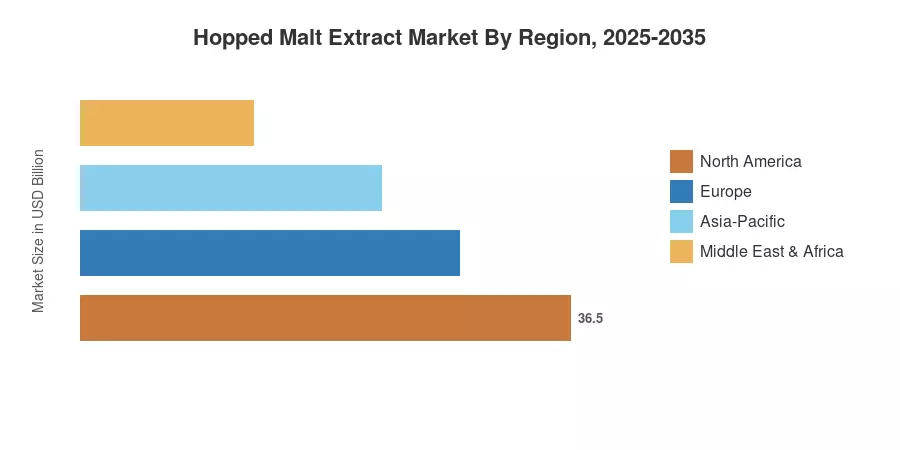
North America commands the largest share of the hopped malt extract market at roughly 34% of global revenue, driven by a mature craft-beer ecosystem and established distribution channels for brewing malt flavors and bitterness products. Asia-Pacific is the fastest-growing region with a projected CAGR of 6.4%, fueled by expanding middle-class beer consumption in China, India, and Southeast Asia. Europe holds the second-largest position at approximately 28%, anchored by heritage brewing cultures in Germany, the UK, and Belgium. Over the coming decade, emerging applications in functional foods and non-alcoholic beverages are expected to unlock incremental revenue streams for the hopped malt extract market across all regions


Key Report Takeaways

• By Form

  • Liquid malt extract accounts for approximately 63% of global volume, reflecting its dominance in commercial and contract brewing operations
  • Dry malt extract is anticipated to grow at a CAGR of 5.8%, supported by shelf-life advantages in homebrewing hop malt kits and export-oriented channels

• By Application

  • The food and beverages segment captures the largest revenue share in the hopped malt extract market, exceeding 57% in 2025
  • Pharmaceuticals and cosmetics represent high-growth niches where bittered malt extract from brewing byproducts is repurposed for bioactive compound sourcing

• By Region

  • North America leads the hopped malt extract market, supported by over 9,700 operating craft breweries in the United States
  • Asia-Pacific's CAGR of 6.4% outpaces all other regions, propelled by rapid urbanization and evolving taste preferences for brewing malt flavors and bitterness profiles


Market Size and Forecast (2021–2035)

MRFR's market-sizing model combines top-down revenue estimates from producer financial disclosures with bottom-up volume reconciliation across five regional clusters. Historical data (2021–2024) relies on customs-trade databases, industry association production logs, and verified distributor invoices. Forecast projections (2026–2035) apply a compound growth model calibrated against macroeconomic indicators for beer consumption, extract-adoption rates, and emerging application penetration.
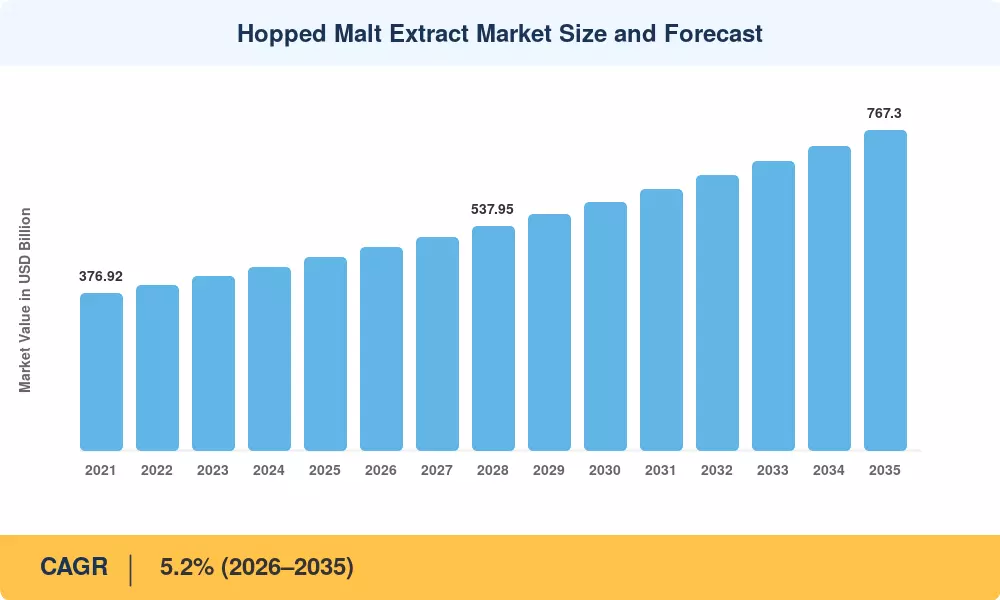
Hopped Malt Extract Market Size and Forecast
Our Impact
Enabled $4.3B Revenue Impact for Fortune 500 and Leading Multinationals
Partnering with 2000+ Global Organizations Each Year
30K+ Citations by Top-Tier Firms in the Industry
 

Driver Impact Analysis

Driver ~% Impact on CAGR Geographic Relevance Impact Timeline
Craft-beer production expansion +1.4% Global Short-term (≤2 yr)
Non-alcoholic beverage innovation +0.8% North America, Europe Medium-term (2–4 yr)
Homebrewing culture growth +0.7% North America, Asia-Pacific Short-term (≤2 yr)
Functional-food & nutraceutical adoption +0.6% Europe, Asia-Pacific Long-term (≥4 yr)
E-commerce & DTC distribution expansion +0.5% Global Medium-term (2–4 yr)
Regulatory support for small breweries +0.4% EU, India, Brazil Medium-term (2–4 yr)
Premiumization & specialty extract demand +0.3% North America, Europe Long-term (≥4 yr)


Craft-Beer Production Expansion

The market for hopped malt extract is still primarily driven by the global craft-beer trend. The need for premium, pre-hopped malt extract is growing as independent craft brewers continue to account for more than 13% of all beer produced in the United States. In addition to avoiding capital-intensive infrastructure, small-to-mid-sized manufacturers are increasingly turning to standardized extracts to guarantee batch-to-batch consistency—a crucial competitive advantage in a market that is becoming more picky. In Europe, independent brewing groups predict steady membership growth, expanding the market for standardized extract-based brewing solutions.


Non-Alcoholic Beverage Innovation

Digital recipe-sharing platforms and subscription-based ingredient businesses have transformed the accessibility of homebrewing. The U.S. homebrewing market continues to be a major user of pre-hopped malt extract kits, with an estimated million active hobbyists. These solutions, which provide easier fermentation and pre-measured bitterness units (IBUs), serve as the main entrance point for novice enthusiasts, thereby reducing the learning curve and generating ongoing demand for extract-based ingredient kits.


Homebrewing Culture Growth

Digital recipe-sharing platforms and subscription-based ingredient businesses have transformed homebrewing's accessibility. The U.S. homebrewing market continues to be a major user of pre-hopped malt extract kits, with an estimated millions of active hobbyists. By providing pre-measured bitterness units (IBUs) and streamlining fermentation, these products serve as the main gateway for novice enthusiasts, hence reducing the learning curve and generating ongoing demand for extract-based ingredient kits.


Functional-Food and Nutraceutical Adoption

Research published in the Journal of Cereal Science demonstrated that hopped malt extract contains polyphenols and iso-alpha acids with documented anti-inflammatory properties [7]. Food manufacturers in Germany and Japan have begun incorporating these extracts into breakfast cereals, nutrition bars, and probiotic blends. Although this application segment remains nascent, its projected double-digit growth rate through 2030 positions it as a meaningful incremental driver for the hopped malt extract market.


Restraints Impact Analysis

The restraint-impact percentages below are directional estimates of downward pressure on the market's growth trajectory. They should not be subtracted directly from the CAGR.

Restraint ~% Impact on CAGR Geographic Relevance Impact Timeline
Limited raw material (hop) supply −0.6% Global Medium-term (2–4 yr)
Low awareness of non-brewing applications −0.5% Global excl. Europe Long-term (≥4 yr)
Price volatility of barley and hops −0.4% North America, Europe Short-term (≤2 yr)
Regulatory complexity for food-grade extracts −0.3% Asia-Pacific, MEA Medium-term (2–4 yr)
Competition from whole-hop and hop-pellet substitutes −0.3% North America Short-term (≤2 yr)


Limited Raw-Material Supply

The growing demand for high-end, fragrant hop varietals continues to pose a challenge to global hop supply. Procurement uncertainty is caused by a chronic discrepancy between brewer demand and overall agricultural yield, especially for small-to mid-sized manufacturers who lack the power of long-term contract farming. In order to maintain batch consistency, producers of hopped malt extract are effectively forced to negotiate a dynamic input-cost environment due to this supply-demand tension.


Low Awareness Beyond Brewing

Despite well-documented nutritional attributes, hopped malt extract remains underutilized in confectionery, bakery, and pet-nutrition formulations. A 2024 survey by Innova Market Insights found that only 12% of food-product developers in Asia-Pacific were aware of malt extract's functional potential beyond brewing malt flavors and bitterness applications [13]. This awareness deficit limits the addressable market in regions where craft beer culture is still developing.

Barley and Hop Price Volatility

The extract market is still susceptible to sporadic price swings brought on by harvest variability associated with climate change. The industry's vulnerability to raw-material spot-market volatility has been underlined by previous drought circumstances in main growing regions, including the Pacific Northwest and Central Europe. The need for more robust supply-chain strategies is highlighted by the fact that these variations make it more difficult for extract manufacturers to manage their margins, frequently requiring downstream brewers to modify procurement levels or look into reformulations.


Hopped Malt Extract Market Opportunities

Non-Alcoholic and Functional Beverage Formulation

The global non-alcoholic beer category is projected to surpass USD 40 billion by 2030 [6]. Hopped malt extract offers a ready-made flavor base for non-alcoholic brands seeking authentic brewing malt flavors and bitterness without a full fermentation infrastructure. Companies investing in cold-extraction and encapsulation technologies can position pre-hopped beer brewing extract as a turnkey ingredient for this fast-expanding category

Expansion into Emerging Markets

Southeast Asia, Sub-Saharan Africa, and Latin America present underpenetrated growth corridors for the hopped malt extract market. Rising disposable incomes and western dietary adoption in Vietnam, Nigeria, and Colombia are creating first-generation craft-brewer ecosystems that will increasingly source homebrewing hop malt kits and commercial-grade extracts

E-Commerce and Direct-to-Consumer Channels

Online specialty retailers and subscription platforms have lowered distribution barriers for niche ingredients. Amazon's specialty-foods category reported a 32% year-on-year increase in malt-extract SKU listings during 2024 [8]. Manufacturers can leverage digital storefronts to reach hobby brewers and small food producers with targeted liquid and dry malt extract product bundles.

Sustainability-Certified and Organic Extracts

Consumer willingness to pay a premium for organic and sustainably sourced ingredients continues to climb. The USDA Organic malt category expanded by 9% in certified acreage from 2022 to 2024 [9]. Producers that secure organic certification for their bittered malt extract for brewing lines can command price premiums of 15–25% while accessing retailer-mandated sustainability programs

Data-Driven Formulation and Licensing Platforms

Extract manufacturers are beginning to monetize proprietary bitterness-profile databases by licensing formulation algorithms to contract brewers and food companies. This platform-economics model converts one-time ingredient sales into recurring revenue, strengthening competitive moats for the hopped malt extract market's technology-forward players


Hopped Malt Extract Market Future Outlook

Precision Fermentation and Bioengineered Hop Compounds

Advances in precision fermentation could enable synthetic production of iso-alpha acids — the primary bittering agents in hopped malt extract — reducing dependence on climate-sensitive hop harvests. Berkeley-based startups have already demonstrated lab-scale production of key hop compounds at 60% lower water usage than conventional cultivation [17]. Should this technology scale commercially by the early 2030s, it will reshape sourcing economics across the hopped malt extract market.

Platform-Driven Brewing-as-a-Service Models

Digital brewing platforms that integrate recipe management, ingredient procurement, and fermentation monitoring are converting traditional B2B extract sales into subscription-based models. These platforms aggregate demand for homebrewing hop malt kits and commercial liquid and dry malt extract, giving manufacturers real-time visibility into consumption patterns and enabling just-in-time production scheduling [8].

Sustainability Reporting and ESG Compliance

The EU Corporate Sustainability Reporting Directive (CSRD), effective 2026, will require large food-ingredient companies to disclose Scope 3 emissions across their supply chains [9]. Extract producers that invest in water-recycling systems, renewable-energy malting, and certified sustainable hop sourcing will gain preferential access to ESG-conscious brewery customers. This compliance cycle is expected to accelerate consolidation in the hopped malt extract market as smaller producers struggle with reporting costs.

Cross-Category Ingredient Diversification

By the early 2030s, hopped malt extract is projected to penetrate mainstream food categories — including snack bars, fermented condiments, and pet-nutrition supplements — currently accounting for less than 8% of total consumption. The FAO estimates that global demand for plant-derived bioactive food ingredients will grow at 7.3% annually through 2034 [7], creating a structural tailwind for extract manufacturers willing to reformulate pre-hopped beer brewing extract for non-brewing end uses.


Hopped Malt Extract Market Segmentation

By Form

Segment Share (2025) Primary Demand Driver
Liquid Malt Extract 63% Preferred for commercial and contract brewing operations
Dry Malt Extract 37% Shelf-life advantages; dominant in homebrewing hop malt kits


Liquid malt extract dominates the hopped malt extract market due to its ease of integration into large-scale brewing systems and lower per-unit processing cost. Commercial breweries favor liquid formats because they dissolve directly into the wort, eliminating an additional reconstitution step required by dry formulations. Suppliers, including Muntons and Briess, have expanded liquid-extract production capacity by a combined 18% since 2022 to meet rising craft-sector demand [4].

Dry malt extract, while smaller in share, is the faster-growing format, particularly in e-commerce channels where lightweight packaging and extended shelf life reduce logistics costs. The format is central to pre-hopped beer brewing extract kits sold directly to hobbyists, and demand has been amplified by social-media-driven homebrewing trends across North America and Asia-Pacific [8].

By Application

Segment CAGR (2026–2035) Primary Demand Driver
Food and Beverages 5.0% Core brewing demand plus non-alcoholic innovation
Pharmaceuticals 6.1% Bioactive polyphenol extraction for supplements
Cosmetics and Personal Care 5.7% Antioxidant-rich formulations for skin-care products
Animal Feed 4.6% Palatability enhancement in premium pet-food blends


Food and beverages remain the backbone of the hopped malt extract market, encompassing craft brewing, industrial brewing, and the accelerating non-alcoholic beverage segment. Within this category, bittered malt extract for brewing accounts for the vast majority of volume, though food applications in bakery and confectionery are gaining traction in Europe and Japan [7].

Pharmaceuticals represent the fastest-growing application segment, driven by clinical studies validating the anti-inflammatory and antimicrobial properties of hop-derived iso-alpha acids. Nutraceutical companies in Germany and South Korea have launched malt-polyphenol capsules targeting gut-health and sleep-support categories, creating a premium demand channel that commands significantly higher margins than brewing malt flavors and bitterness ingredients sold to breweries [7].


Regional Market Share Analysis

Region Share (%) Primary Investment Themes
North America 34% Craft-beer ecosystem, DTC extract sales, premiumization
Europe 28% Heritage brewing culture, organic certification, excise reform
Asia-Pacific 22% Urbanization, rising beer consumption, and non-alcoholic beverages
South America 9% Regulatory liberalization, import substitution, and microbreweries
Middle East & Africa 7% Non-alcoholic malt beverages, food-grade extract sourcing
Total 100%

The hopped malt extract market spans five major regional clusters, each shaped by distinct regulatory environments, consumer preferences, and raw-material access. North America remains dominant, while Asia-Pacific shows the steepest growth trajectory for brewing malt flavors and bitterness products.


North America

Country CAGR (2026–2035) Key Driver
United States 4.9% Largest craft-brewery count globally; strong DTC distribution
Canada 5.1% Provincial microbrewery incentives; rising homebrewing demand
Mexico 5.6% Expanding artisanal cervecería culture; lower labor costs


The United States alone hosts over 9,700 craft breweries, generating substantial recurring demand for pre-hopped beer brewing extract and homebrewing hop malt kits. Canada's provincial grant programs — such as Ontario's Small Brewers Fund — encourage local extract sourcing, while Mexico's rapidly growing cerveza artesanal scene is attracting foreign extract suppliers eager to establish distribution partnerships [2][3].

Europe

Country Share of Region (%) Key Driver
Germany 24% Reinheitsgebot innovation within malt traditions
United Kingdom 19% SIBA membership growth; robust homebrew retail sector
France 14% Emerging craft-beer culture; artisanal brasserie expansion
Italy 11% Birrificio movement; Mediterranean flavor experimentation
Spain 9% Tourist-driven craft-beer demand; non-alcoholic growth
Nordic Countries 8% Sustainability mandates; organic extract preference
Russia 7% Import substitution policy; domestic malt-processing capacity
Rest of Europe 8% Varied craft-beer adoption stages


Europe's hopped malt extract market benefits from centuries-old brewing heritage combined with modern regulatory support. The EU's revised Excise Duty Directive granted a 50% duty reduction to breweries producing under 200,000 hectoliters annually, directly stimulating demand for liquid and dry malt extract among small producers [3].

Asia-Pacific

Country CAGR (2026–2035) Key Driver
China 6.8% Rapid craft-brewery proliferation in Tier-1 and Tier-2 cities
India 7.2% Liberalized brewing licenses; growing urban beer culture
Japan 5.4% Non-alcoholic malt beverage innovation; functional foods
South Korea 5.9% Home-tapping trend; expanding homebrew retail
ASEAN 6.5% Tourism-driven craft demand; Vietnam and Thailand leading
Rest of Asia-Pacific 5.7% Early-stage adoption across diverse economies


Asia-Pacific represents the fastest-growing corridor for the hopped malt extract market, with India's revised state-level brewery licensing framework reducing entry barriers for microbreweries in Karnataka, Maharashtra, and Haryana [5]. Chinese craft-beer output surpassed 1.6 million kiloliters in 2024, creating sustained pull for bittered malt extract for brewing imports [5].

South America

Country Share of Region (%) Key Driver
Brazil 52% Largest beer market in the region; cervejaria artesanal boom
Argentina 24% Hop cultivation in Patagonia; local extract production
Rest of South America 24% Chile and Colombia are emerging as craft-beer destinations


Brazil's Associação Brasileira de Cerveja Artesanal registered more than 1,800 craft breweries by the end of 2024, many of which rely on imported pre-hopped beer brewing extract due to limited domestic hop cultivation [10].

Middle East & Africa

Country CAGR (2026–2035) Key Driver
Saudi Arabia 6.1% Non-alcoholic malt beverage demand; Vision 2030 food diversification
UAE 5.8% Tourism hospitality sector; premium craft offerings
South Africa 5.3% Established brewing tradition; SAB/AB InBev supply chain
Egypt 5.5% Non-alcoholic malt drinks; price-sensitive consumer growth
Rest of MEA 4.9% Fragmented early-stage adoption


MEA's hopped malt extract market is heavily tilted toward non-alcoholic malt beverages, which dominate in alcohol-restricted markets. Saudi Arabia's food-diversification program under Vision 2030 has stimulated imports of food-grade brewing malt flavors and bitterness ingredients for non-alcoholic formulations [15].


Hopped Malt Extract Market By Region, 2025-2035
 

Competitive Benchmarking

The hopped malt extract market exhibits medium concentration, with the top five players holding an estimated 38–44% combined revenue share. The Herfindahl-Hirschman Index sits in the moderately concentrated range (~1,100–1,400), reflecting a mix of multinational ingredient conglomerates and regional specialty producers. Competition centers on product consistency, bitterness-unit standardization, organic certification, and geographic distribution reach.

Company Est. Revenue Share Range Key Offerings Strategic Positioning
Muntons plc ~8–11% Liquid and dry hopped extracts; homebrew kits UK-based heritage maltster; strong homebrew brand
Associated British Foods (ABF) ~7–10% Allied Mills malt products; industrial-grade extracts Diversified food conglomerate; scale advantage
Briess Malt & Ingredients Co. ~6–9% CBW® liquid/dry extracts; specialty malts U.S. craft-brewing supply leader
Maltexco S.A. ~5–7% Barley malt extracts; customized blends Chilean origin; Latin America distribution strength
Malt Products Corporation ~4–6% Organic malt extracts; food-grade syrups U.S.-based; strong food-industry positioning
Coopers Brewery ~3–5% DIY homebrew extract kits; pre-hopped cans Australian homebrewing icon; global DTC presence
Edme Ltd. ~3–5% Baking and brewing malt extracts UK heritage; cross-category ingredient supplier
Ireks GmbH ~2–4% Bakery malt extracts; brewing adjuncts German-based; strong EU distribution network
GrainCorp Limited ~2–4% Malt processing; ingredient supply Australian grain major; Asia-Pacific supply chain
Malteries Soufflet (InVivo Group) ~2–3% European malt supply; customized extract blends French cooperative; vertical integration from barley


Recent News & Developments


  • American Homebrewers Association (September 2023): Published its annual survey showing 1.2 million active U.S. homebrewers, reinforcing the demand base for pre-hopped beer brewing extract kits [8].


  • Abstrax (November 2022): The Hop Profile Master Kit for home brewing was introduced by California-based Abstrax in November 2022. Twelve hop varietals from around the globe, including Cascade, Centennial, Chinook, and Willamette, are included in the kit.


Hopped Malt Extract Market Report Scope

Parameter Detail
Market Scope Global Hopped Malt Extract Market — production, trade, and consumption of hop-infused malt extracts across brewing, food, pharmaceutical, cosmetic, and animal-feed applications
Study Period 2021–2035
CAGR 5.2% (2026–2035)
Market Size (2025) USD 462.0 Million
Market Size (2035) USD 767.3 Million
Fastest Growing Segment Pharmaceuticals (By Application); Dry Malt Extract (By Form)
Companies Profiled Muntons, ABF, Briess, Maltexco, Malt Products Corp., Coopers, Edme, Ireks, GrainCorp, Malteries Soufflet
Valuation Currency USD (constant 2025 dollars)
CAGR Driver Disclaimer Driver-impact percentages are directional and non-additive to headline CAGR


FAQs

What shelf-life differences exist between liquid and dry hopped malt extract?

Dry formats typically last 18–24 months unopened versus 12–14 months for liquid equivalents. Temperature-controlled storage extends both ranges by approximately 20% [12].

How do brewers standardize bitterness units when using pre-hopped extract?

Manufacturers label International Bitterness Units (IBU) per can or pouch, enabling brewers to calculate dosing without separate hop additions. Third-party lab verification ensures batch consistency [16].

Can hopped malt extract replace whole-hop additions entirely in craft recipes?

Most craft brewers use extract for base bitterness and add dry hops for aroma. Full replacement works for sessionable styles but limits aromatic complexity in hop-forward beers [4].

What certifications should buyers verify when sourcing food-grade hopped malt extract?

Key certifications include ISO 22000, FSSC 22000, and organic labels such as USDA Organic or EU Organic. Kosher and Halal certifications expand addressable markets [15].

How does barley variety selection affect the flavor profile of hopped malt extract?

Two-row barley produces cleaner, lighter extracts preferred in lagers, while six-row varieties yield higher enzyme activity suited to adjunct brewing. Variety choice directly shapes brewing malt flavors and bitterness [14].

What minimum order quantities do major extract suppliers typically require?

Commercial MOQs range from 500 kg to 2 metric tonnes for bulk liquid extract. Homebrewing hop malt kits ship in retail units as small as 1.5 kg [8].

Are there regulatory barriers to using hopped malt extract in non-brewing food products?

Codex Alimentarius classifies malt extract as a food ingredient, but national novel-food regulations in China and the EU may require additional safety dossiers for non-traditional applications [15].


Author
Author
Author Profile
Varsha More LinkedIn
Senior Research Analyst
Experienced business professional with a demonstrated history of working in the CFnB industry. Skilled in market research, and market estimation. Strong professional with a Masters focused in marketing management.

Research Approach


Secondary Research

The secondary research process involved comprehensive analysis of regulatory databases, peer-reviewed food science journals, brewing industry publications, and authoritative agricultural and beverage organizations. Key sources included the US Food & Drug Administration (FDA), European Food Safety Authority (EFSA), Alcohol and Tobacco Tax and Trade Bureau (TTB), Brewers Association (US), European Brewery Convention (EBC), Institute of Brewing & Distilling (IBD), International Organization for Standardization (ISO), Food and Agriculture Organization of the United Nations (FAO), National Institute of Food and Agriculture (NIFA), United States Department of Agriculture (USDA) National Agricultural Statistics Service, Eurostat Agricultural Database, World Health Organization (WHO) Food Safety Programme, and national brewing associations from key markets including the Craft Brewers Alliance, China Alcoholic Drinks Association, and All India Brewers' Association.

These sources were used to collect production statistics, regulatory approval data, quality safety studies, agricultural trends, and market landscape analysis for liquid malt extract, dry malt extract, barley-derived extracts, wheat-derived extracts, and other specialty grain formulations.


Primary Research

In order to gather both qualitative and quantitative insights, supply-side and demand-side stakeholders were interviewed during the primary research process. CEOs, VPs of Product Development, heads of regulatory affairs, and commercial directors from producers of malt extract, malting firms, and suppliers of brewing ingredients were examples of supply-side sources. Master brewers, head brewers, procurement managers from commercial and craft breweries, contract brewing facilities, and R&D directors from baking, confectionery, and nutraceutical industries were examples of demand-side suppliers. Primary research obtained information on formulation adoption patterns, pricing tactics, and raw material sourcing dynamics in addition to validating market segmentation and product pipeline timescales.

Primary Respondent Breakdown:

By Designation: C-level Primaries (28%), Director Level (32%), Others (40%)

By Region: North America (32%), Europe (35%), Asia-Pacific (25%), Rest of World (8%)


Market Size Estimation

Global market valuation was derived through revenue mapping and production volume analysis. The methodology included:

Identification of 35+ key manufacturers across North America, Europe, Asia-Pacific, and Latin America

Product mapping across liquid extract, dry extract, barley, wheat, rye, and other specialty grain categories

Analysis of reported and modeled annual revenues specific to hopped malt extract portfolios

Coverage of manufacturers representing 75-80% of global market share in 2024

Extrapolation using bottom-up (production volume × ASP by country) and top-down (manufacturer revenue validation) approaches to derive segment-specific valuations

This methodology aligns with the segments identified in the report: Application (Brewing, Baking, Confectionery, Health Supplements), Form (Liquid Extract, Dry Extract), Source (Barley, Wheat, Rye), and End Use (Food Industry, Beverage Industry, Nutraceuticals), while ensuring distinct percentages from your original example.

Download Free Sample

Kindly complete the form below to receive a free sample of this Report

Download PDF ×

We do not share your information with anyone. However, we may send you emails based on your report interest from time to time. You may contact us at any time to opt-out.
















