Download Free Sample
Kindly complete the form below to receive a free sample of this Report
Housing Finance Market Size, Share and Research Report: By Property Type (Single-Family Homes, Multi-Family Homes, Commercial Properties), By Loan Type (Purchase Loans, Refinance Loans, Home Equity Lines of Credit (HELOCs)), By Loan Purpose (Primary Residence, Second Home, Investment Property), By Loan Size (Conforming Loans ( $425,000/$548,250), Non-Conforming Loans (>$425,000/$548,250)), By Borrower Profile (First-Time Homebuyers, Repeat Buyers, Investors) and By Regional (North America, Europe, South America, Asia Pacific, Middle East and Africa) - Industry Forecast Till 2035
As per MRFR analysis, the Housing Finance Market Size was estimated at 8269.56 USD Billion in 2024. The Housing Finance industry is projected to grow from 10113.84 USD Billion in 2025 to 75727.3 USD Billion by 2035, exhibiting a compound annual growth rate (CAGR) of 22.3% during the forecast period 2025 - 2035.
The Housing Finance Market is experiencing a transformative shift driven by technological advancements and changing consumer preferences.
| 2024 Market Size | 8269.56 (USD Billion) |
| 2035 Market Size | 75727.3 (USD Billion) |
| CAGR (2025 - 2035) | 22.3% |
The Housing Finance Market is currently experiencing a dynamic transformation, influenced by various factors such as technological advancements, regulatory changes, and shifting consumer preferences. The integration of digital platforms into lending processes appears to streamline operations, enhancing accessibility for potential borrowers. Furthermore, the increasing emphasis on sustainability and energy-efficient housing solutions suggests a growing alignment between financial products and environmental considerations. This trend may lead to innovative financing options that cater to eco-conscious consumers, thereby reshaping the landscape of housing finance. In addition, the ongoing evolution of demographic trends, including urbanization and changing family structures, indicates a potential shift in housing demand. As more individuals seek flexible living arrangements, financial institutions may need to adapt their offerings to meet these emerging needs. The Housing Finance Market, therefore, stands at a crossroads, where traditional practices intersect with modern expectations, creating opportunities for growth and adaptation. Stakeholders must remain vigilant to these changes to effectively navigate the complexities of this evolving market.
The Housing Finance Market is witnessing a significant shift towards digitalization, with lenders increasingly adopting online platforms for loan applications and approvals. This trend enhances efficiency and accessibility, allowing borrowers to engage with financial services from the comfort of their homes. As technology continues to evolve, the integration of artificial intelligence and data analytics may further refine the lending process, enabling more personalized financial solutions.
There is a noticeable trend towards sustainability within the Housing Finance Market, as consumers become more environmentally conscious. Financial institutions are beginning to offer products that incentivize energy-efficient home purchases and renovations. This alignment with eco-friendly practices not only meets consumer demand but also positions lenders favorably in a market that increasingly values sustainability.
The Housing Finance Market is influenced by changing demographics, particularly urbanization and evolving family structures. As more individuals move to urban areas and seek diverse living arrangements, financial products must adapt to these trends. Lenders may need to develop flexible financing options that cater to the unique needs of younger generations and diverse household compositions.
Demographic shifts are influencing the Global Housing Finance Market Industry, as changing population dynamics create new housing demands. The rise of millennials and Generation Z as homebuyers is altering the landscape of housing finance. These younger generations prioritize sustainability and affordability, prompting lenders to adapt their offerings accordingly. As a result, financial products are evolving to meet the preferences of these demographics. The market's value in 2024 stands at approximately 8269.6 USD Billion, with expectations of substantial growth as these demographic trends continue to unfold. Understanding these shifts is crucial for stakeholders aiming to capitalize on emerging opportunities.
The Global Housing Finance Market Industry is experiencing a notable surge due to increasing urbanization. As more individuals migrate to urban areas in search of better employment opportunities and living standards, the demand for housing finance escalates. In 2024, the market is valued at approximately 8269.6 USD Billion, reflecting the urgent need for accessible financing options. Urban centers are expanding rapidly, leading to a higher requirement for residential properties. This trend is expected to continue, with projections indicating that by 2035, the market could reach 74496.2 USD Billion. Consequently, financial institutions are adapting their offerings to cater to this growing urban population.
Government initiatives play a pivotal role in driving the Global Housing Finance Market Industry. Various countries are implementing policies aimed at promoting affordable housing and improving access to financing. For instance, subsidies, tax incentives, and low-interest loans are being offered to first-time homebuyers. Such measures are designed to stimulate demand in the housing sector, thereby fostering economic growth. As these initiatives gain traction, they are expected to contribute significantly to the market's expansion. By 2035, the market could potentially reach 74496.2 USD Billion, underscoring the importance of government support in shaping housing finance dynamics.
Technological innovations are reshaping the Global Housing Finance Market Industry, enhancing the efficiency and accessibility of housing finance solutions. Digital platforms and mobile applications facilitate streamlined loan applications and approvals, making it easier for consumers to secure financing. The integration of artificial intelligence and big data analytics allows lenders to assess creditworthiness more accurately, thereby reducing risks. As a result, the market is likely to witness significant growth, with a projected CAGR of 22.12% from 2025 to 2035. This technological evolution not only benefits lenders but also empowers borrowers with better financial products tailored to their needs.
The Global Housing Finance Market Industry is benefiting from increased investment in real estate, driven by both domestic and foreign investors. As property values rise, investors are seeking financing options to capitalize on lucrative opportunities. This influx of capital is stimulating demand for housing finance products, leading to a more competitive market landscape. The anticipated growth trajectory suggests that the market could achieve a CAGR of 22.12% from 2025 to 2035. This trend indicates a robust interest in real estate as a viable investment, further propelling the housing finance sector.
In the Housing Finance Market, the distribution of market share among different loan types reveals that Home Purchase Loans dominate the sector. This is largely due to the increasing demand for residential properties as millennials enter the housing market. In contrast, Home Improvement Loans are rapidly gaining popularity as homeowners look to enhance their living spaces, spurred by a desire for greater comfort and value in their properties. Refinancing and Construction Loans, while important, hold a smaller share in the overall market due to specific user requirements and economic conditions influencing new builds.
Home Purchase Loan: Dominant vs. Home Improvement Loan: Emerging
The Home Purchase Loan stands as the dominant force in the Housing Finance Market, driven by the growing population of first-time homebuyers and favorable mortgage rates. This category primarily attracts customers looking to secure financing for buying residential properties. Conversely, the Home Improvement Loan is emerging as a significant player, appealing to existing homeowners seeking to renovate or expand their current homes. This shift highlights a trend where individuals prioritize enhancing their living conditions over new purchases, particularly in the face of rising home prices. Both segment values cater to distinct customer needs, contributing to a dynamic and evolving landscape in housing finance.
In the housing finance market, First-Time Home Buyers represent the largest segment, reflecting a substantial portion of overall market activity. This demographic is primarily driven by younger individuals and families entering the housing market for the first time, seeking affordable financing options and incentives like low-down-payment mortgages. Additionally, Repeat Home Buyers are emerging as the fastest-growing segment, as many existing homeowners look to upgrade or relocate, aided by favorable interest rates and increased equity in their homes.
First-Time Home Buyers (Dominant) vs. Real Estate Investors (Emerging)
First-Time Home Buyers are characterized by their preference for entry-level properties, often engaged in government-backed loan programs designed to encourage home ownership. They typically have limited savings for down payments and a strong desire for stability, impacting their purchasing decisions. Conversely, Real Estate Investors represent an emerging segment, increasingly targeting rental properties and renovation projects to capitalize on market trends. They are motivated by potential returns on investment, portfolio diversification, and leveraging financing options to acquire multiple properties, positioning them dynamically within the broader housing finance landscape.
The Housing Finance Market has seen a significant distribution of loan durations, with long-term loans dominating the segment. These loans typically span over 15 to 30 years, allowing homeowners to manage their repayments more comfortably, thereby capturing the majority of the market share. On the other hand, medium-term loans, generally ranging from 5 to 15 years, are becoming increasingly popular among younger buyers looking for flexibility without the long commitment of traditional mortgages. Growth trends indicate a robust increase in medium-term loans as homebuyers seek to optimize their financial strategy in a fluctuating interest rate environment. The demand for shorter loan durations is also being driven by economic uncertainties and changing lifestyle preferences, with borrowers favoring quicker debt alleviation over prolonged payment commitments. As such, lending institutions are adjusting their products to cater to these evolving consumer demands.
Long-Term Loans (Dominant) vs. Medium-Term Loans (Emerging)
Long-term loans in the Housing Finance Market are characterized by extended repayment periods that provide homeowners with a stable financial planning environment. These loans usually come with lower monthly payments, making them attractive to those seeking to buy a home while maintaining a budget. Meanwhile, medium-term loans are emerging due to the increasing preference for shorter commitment periods. These loans balance affordability and flexibility, appealing particularly to first-time homebuyers who anticipate economic changes. As housing prices fluctuate, these borrowers value the ability to pay off loans relatively quicker, thereby reducing overall interest costs while potentially moving up in the housing market sooner.
In the Housing Finance Market, the interest rate type segment displays a diverse distribution, with Fixed Interest Rate emerging as the dominant choice among borrowers. This segment has garnered a substantial share of the market, providing borrowers with the stability of predictable repayments over the loan tenure. On the other hand, Variable Interest Rate holds a growing appeal, especially among younger buyers who are drawn to the potential for lower initial rates and the flexibility it offers in a dynamic economic environment.
As the market evolves, growth trends indicate a steady rise in popularity for Variable Interest Rates, driven by favorable economic conditions and competitive lending practices. Lenders are increasingly offering attractive introductory rates, encouraging a shift towards this flexible option. Meanwhile, Fixed Interest Rates remain a staple for those seeking long-term security, reacting to shifts in market confidence and inflation expectations, which influences consumer preferences in housing finance.
Fixed Interest Rate (Dominant) vs. Variable Interest Rate (Emerging)
The Fixed Interest Rate segment stands as the dominant force in the Housing Finance Market, appealing primarily to individuals seeking financial predictability and stability. Borrowers in this category benefit from consistent monthly payments, protecting them against fluctuations in the economy. Conversely, the Variable Interest Rate segment is emerging, particularly among first-time homebuyers and those who are more risk-tolerant. This segment thrives on the attractiveness of lower initial rates and often adjusts to changing economic conditions, making it appealing during periods of declining interest rates. The attraction to a Variable Interest Rate is further amplified by promotional offers from lenders and overall trends toward flexible financing solutions, showcasing a transformative shift in borrower behavior.
The Housing Finance Market exhibits a diverse landscape segmented by property types, with Single-Family Homes commanding the largest market share. This segment is characterized by its popularity among first-time buyers and families seeking stability, thereby securing a significant portion of financing options. In contrast, Multi-Family Homes are emerging rapidly, driven by increasing demand for rental properties, particularly in urban areas. This balance between the established Single-Family segment and the dynamic Multi-Family segment illustrates the evolving preferences among homebuyers and investors alike.
Single-Family Homes (Dominant) vs. Multi-Family Homes (Emerging)
Single-Family Homes dominate the Housing Finance Market, appealing to buyers looking for a permanent residence and investment stability. These homes are often valued by families and individuals prioritizing space, community, and home ownership as a long-term goal. Meanwhile, Multi-Family Homes represent the emerging trend, particularly appealing due to the rise in rental income opportunities and preferences for urban living. Investors are increasingly drawn to this segment, with its potential for reliable cash flow and a response to housing shortages in metropolitan areas. Clearly, both segments reflect unique consumer needs and financial dynamics within the housing landscape.
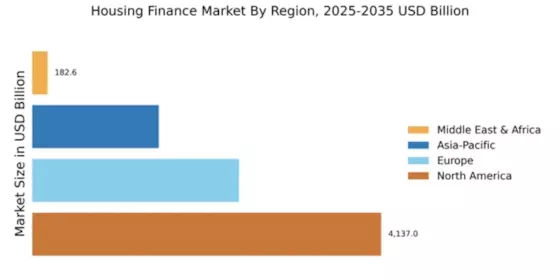
North America continues to lead the housing finance market, holding a significant share of 4137.0M in 2024. Key growth drivers include low interest rates, increasing homeownership rates, and favorable government policies. Regulatory support, such as the Federal Housing Administration's initiatives, has further stimulated demand, making housing finance more accessible to a broader population. The region's robust economic recovery post-pandemic has also fueled housing investments. The competitive landscape is characterized by major players like Fannie Mae, Freddie Mac, and Wells Fargo, which dominate the market. The U.S. remains the largest contributor, with a strong presence of financial institutions offering diverse mortgage products. The ongoing digital transformation in the sector is enhancing customer experience and operational efficiency, positioning North America as a hub for innovation in housing finance.
Europe's housing finance market is evolving, with a market size of 2450.0M in 2024. Key drivers include increasing urbanization, rising property values, and supportive regulatory frameworks aimed at enhancing housing accessibility. The European Central Bank's low interest rate policies have also played a crucial role in stimulating demand for housing finance, making it an attractive option for both first-time buyers and investors. Leading countries such as Germany, France, and the UK are at the forefront of this growth, with a competitive landscape featuring both traditional banks and fintech companies. Major players are adapting to changing consumer preferences by offering innovative mortgage solutions. The presence of organizations like the European Mortgage Federation underscores the commitment to improving housing finance standards across the region.
The Asia-Pacific region is witnessing a significant surge in housing finance, with a market size of 1500.0M in 2024. Key growth drivers include rapid urbanization, rising disposable incomes, and government initiatives aimed at promoting homeownership. Countries like China and India are experiencing a boom in housing demand, supported by favorable lending conditions and increasing investment in infrastructure, which enhances property values and accessibility. The competitive landscape is diverse, with a mix of traditional banks and emerging fintech players. Major financial institutions are expanding their offerings to cater to the growing middle class, which is increasingly seeking home financing options. The region's dynamic market is characterized by innovation and adaptability, positioning it as a key player in the global housing finance sector.
The Middle East and Africa region is developing its housing finance market, with a size of 182.56M in 2024. Key growth drivers include urbanization, population growth, and government initiatives aimed at improving housing access. Countries like South Africa and the UAE are leading the way, with regulatory frameworks being established to support mortgage lending and enhance market stability. The region's potential for growth is significant, given the increasing demand for affordable housing solutions. The competitive landscape is evolving, with both local banks and international players entering the market. The presence of key financial institutions is crucial for providing diverse mortgage products tailored to local needs. As the region continues to develop, opportunities for innovation and investment in housing finance are expected to expand, attracting more players to the market.
The Housing Finance Market is currently characterized by a dynamic competitive landscape, driven by factors such as rising interest rates, evolving consumer preferences, and technological advancements. Major players like Fannie Mae (US), Wells Fargo (US), and JPMorgan Chase (US) are strategically positioning themselves to leverage these trends. Fannie Mae (US) has focused on enhancing its digital platforms to streamline the mortgage application process, thereby improving customer experience. Meanwhile, Wells Fargo (US) has been investing in partnerships with fintech companies to expand its service offerings and reach a broader customer base. JPMorgan Chase (US) appears to be concentrating on sustainability initiatives, integrating green financing options into its mortgage products, which may attract environmentally conscious consumers.The business tactics employed by these companies reflect a competitive structure that is moderately fragmented, with a mix of large institutions and smaller players. Key tactics include localizing services to meet regional demands and optimizing supply chains to enhance efficiency. The collective influence of these major players shapes market dynamics, as they compete not only on pricing but also on service quality and technological innovation.
In November Fannie Mae (US) announced a new initiative aimed at increasing access to affordable housing by expanding its loan programs for low-income borrowers. This strategic move is significant as it aligns with the growing demand for affordable housing solutions, potentially positioning Fannie Mae (US) as a leader in this segment. The initiative may also enhance its reputation and customer loyalty among underserved populations.
In October Wells Fargo (US) launched a digital mortgage platform that utilizes AI to expedite the loan approval process. This development is crucial as it reflects the ongoing trend towards digitalization in the housing finance sector. By streamlining operations and reducing processing times, Wells Fargo (US) could improve customer satisfaction and gain a competitive edge in a market that increasingly values efficiency.
In September JPMorgan Chase (US) entered into a partnership with a leading green technology firm to offer eco-friendly mortgage options. This collaboration is indicative of a broader trend towards sustainability in housing finance. By integrating green financing into its offerings, JPMorgan Chase (US) not only addresses consumer demand for sustainable options but also positions itself favorably in a market that is progressively prioritizing environmental considerations.
As of December the Housing Finance Market is witnessing trends such as digitalization, sustainability, and the integration of AI technologies. Strategic alliances among key players are reshaping the competitive landscape, fostering innovation and enhancing service delivery. Looking ahead, it is likely that competitive differentiation will increasingly hinge on technological advancements and the ability to provide reliable supply chains, rather than solely on price. This shift underscores the importance of innovation and adaptability in navigating the evolving market.






The Housing Finance Market is projected to grow from USD 1,471.08 billion in 2023 to USD 2,557.6 billion by 2032, exhibiting a CAGR of 6.34% during the forecast period. Increasing urbanization, rising disposable income, and growing demand for affordable housing are key factors driving market growth. Government initiatives to promote homeownership and provide financial assistance to first-time homebuyers are also contributing to market expansion. The adoption of digital technologies and the emergence of fintech companies are transforming the way housing finance is accessed and delivered, leading to greater convenience and efficiency.
Recent news developments include the launch of new housing finance products tailored to specific customer segments, such as millennials and low-income households. Partnerships between banks and fintech companies are also gaining traction to leverage technology and reach a wider customer base.
The Housing Finance Market is projected to grow at a 22.3% CAGR from 2025 to 2035, driven by technological advancements, increasing urbanization, and favorable government policies.
New opportunities lie in:
By 2035, the Housing Finance Market is expected to be robust, reflecting substantial growth and innovation.
| MARKET SIZE 2024 | 8269.56(USD Billion) |
| MARKET SIZE 2025 | 10113.84(USD Billion) |
| MARKET SIZE 2035 | 75727.3(USD Billion) |
| COMPOUND ANNUAL GROWTH RATE (CAGR) | 22.3% (2025 - 2035) |
| REPORT COVERAGE | Revenue Forecast, Competitive Landscape, Growth Factors, and Trends |
| BASE YEAR | 2024 |
| Market Forecast Period | 2025 - 2035 |
| Historical Data | 2019 - 2024 |
| Market Forecast Units | USD Billion |
| Key Companies Profiled | Fannie Mae (US), Freddie Mac (US), Wells Fargo (US), Quicken Loans (US), JPMorgan Chase (US), Bank of America (US), Citigroup (US), PNC Financial Services (US), U.S. Bank (US) |
| Segments Covered | Loan Type, Borrower Profile, Loan Duration, Interest Rate Type, Property Type |
| Key Market Opportunities | Integration of digital platforms enhances accessibility and efficiency in the Housing Finance Market. |
| Key Market Dynamics | Rising interest rates are reshaping consumer borrowing behavior and influencing housing finance market dynamics. |
| Countries Covered | North America, Europe, APAC, South America, MEA |
The Housing Finance Market valuation stands at approximately 8269.56 USD Billion in 2024.
The market is projected to reach around 75727.3 USD Billion by 2035.
The expected CAGR for the Housing Finance Market during the forecast period 2025 - 2035 is 22.3%.
Key players in the Housing Finance Market include Fannie Mae, Freddie Mac, Wells Fargo, and JPMorgan Chase.
The primary loan types include Home Purchase Loans, Home Improvement Loans, Refinancing Loans, and Construction Loans.
Home Purchase Loans had a valuation of 4000.0 USD Billion in 2024, indicating strong market demand.
Significant borrower profiles include First-Time Home Buyers, Repeat Home Buyers, and Low-Income Borrowers.
Long-Term Loans had a valuation of 5000.0 USD Billion in 2024, reflecting their importance in financing.
Fixed Interest Rate loans accounted for 4000.0 USD Billion in 2024, suggesting a preference for stability among borrowers.
Single-Family Homes dominate the market with a valuation of 4000.0 USD Billion in 2024.



Kindly complete the form below to receive a free sample of this Report

“This is really good guys. Excellent work on a tight deadline. I will continue to use you going forward and recommend you to others. Nice job”


“Thanks. It’s been a pleasure working with you, please use me as reference with any other Intel employees.”


“Thanks for sending the report it gives us a good global view of the Betaïne market.”


“Thank you, this will be very helpful for OQS.”


“We found the report very insightful! we found your research firm very helpful. I'm sending this email to secure our future business.”


“I am very pleased with how market segments have been defined in a relevant way for my purposes (such as "Portable Freezers & refrigerators" and "last-mile"). In general the report is well structured. Thanks very much for your efforts.”


“I have been reading the first document or the study, ,the Global HVAC and FP market report 2021 till 2026. Must say, good info! I have not gone in depth at all parts, but got a good indication of the data inside!”


“We got the report in time, we really thank you for your support in this process. I also thank to all of your team as they did a great job.”


“The Automotive 48V ECU Components Procurement Intelligence Study” was a complex project, but the Market Research Future (MRFR) team handled it with quality, agility, and customer-centricity. They delivered all requested data on time and within the agreed scope. The team, including Shubhendra Anand and Rahul Gotadki, was always readily available to clarify questions and swiftly implement necessary adjustments, driving the project to a successful conclusion within a very demanding timeframe.
I would also like to specifically commend Akshay Agarwal for his responsiveness and support at every stage—from our initial inquiry on May 6th through to final delivery on June 18th. His dedication made the entire process seamless.”



