×
Hero Background
English
Chinese
French
Japanese
Korean
German
Spanish

Hybrid Fabric Market Analysis

ID: MRFR/CnM/6172-HCR
140 Pages
Chitranshi Jaiswal
October 2025

Hybrid Fabric Market Research Report Information by Combination (Carbon-Aramid, Aramid-Glass, Carbon-Glass, Carbon-UHMWPE), Form (Composite, Non-Composite), End-Use Industry (Automotive, Aerospace & Defense, Wind Energy, Consumer Goods) and Region - Forecast to 2035

Share:
Download PDF ×

We do not share your information with anyone. However, we may send you emails based on your report interest from time to time. You may contact us at any time to opt-out.

Hybrid Fabric Market Infographic
Purchase Options

Market Analysis

In-depth Analysis of Hybrid Fabric Market Industry Landscape

The market dynamics of the hybrid fabric market are influenced by various factors that shape supply, demand, and overall trends within the industry. Hybrid fabrics, which combine different materials like natural and synthetic fibers, offer unique properties such as durability, flexibility, and enhanced performance, making them attractive for a wide range of applications. One key aspect impacting the market dynamics is technological advancements in textile manufacturing processes. Innovations in weaving, knitting, and coating techniques allow for the production of hybrid fabrics with superior qualities, driving market growth.

The substantial factors favoring this robust growth of this market are continuously growing demand from major end-use industries namely automotive, aerospace & defense, and wind energy. In addition, increasing demand for light-weight materials in modern automobiles is expects to propel growth of the Global Hybrid Fabrics Market during the following years.

Moreover, changing consumer preferences and lifestyles contribute significantly to market dynamics. As consumers become more conscious about sustainability and eco-friendliness, there's a growing demand for hybrid fabrics made from recycled or organic materials. This shift towards sustainable products not only influences purchasing decisions but also prompts manufacturers to adapt their production processes to meet these evolving trends. Additionally, the rise of athleisure wear and sports apparel fuels demand for hybrid fabrics that offer moisture-wicking, stretchability, and breathability, catering to the active lifestyle of consumers.

Global economic factors also play a crucial role in shaping the dynamics of the hybrid fabric market. Fluctuations in raw material prices, currency exchange rates, and trade policies impact production costs and pricing strategies adopted by manufacturers. Economic growth or downturns in key regions can affect consumer spending power, influencing overall market demand. Moreover, geopolitical tensions and trade disputes may disrupt supply chains, leading to market volatility and uncertainty.

Furthermore, regulatory standards and environmental policies have a significant impact on the hybrid fabric market dynamics. Stringent regulations regarding product safety, chemical usage, and environmental sustainability drive manufacturers to comply with standards set by governing bodies. Compliance with such regulations not only ensures product quality and safety but also enhances brand reputation and consumer trust. Additionally, initiatives promoting sustainable practices, such as the reduction of carbon emissions and waste management, encourage innovation in eco-friendly materials and production processes within the hybrid fabric industry.

Competitive dynamics within the market also influence its trajectory. The presence of numerous players, ranging from large multinational corporations to small-scale manufacturers and startups, fosters competition in terms of product innovation, pricing, and distribution channels. Strategic alliances, partnerships, and mergers and acquisitions are common strategies adopted by companies to strengthen their market position, expand their product portfolio, and gain a competitive edge. Moreover, effective marketing and branding efforts play a crucial role in capturing consumer attention and driving sales in the highly competitive hybrid fabric market.

Emerging trends and opportunities further shape the market dynamics of hybrid fabrics. Growing awareness about the benefits of smart textiles, which incorporate electronic components for monitoring and enhancing functionality, opens up new avenues for market expansion. Applications in sectors such as healthcare, automotive, and military drive innovation in smart hybrid fabrics, creating opportunities for manufacturers to diversify their product offerings. Additionally, the increasing adoption of e-commerce platforms facilitates market accessibility and enables manufacturers to reach a broader consumer base, driving market growth.

Author
Chitranshi Jaiswal
Research Analyst Level I

In her 3 years of experience in the market research field, she has handled critical cross-domain projects. She has an in-depth knowledge of market estimation & analysis, problem-solving, primary as well as secondary research, and team management.She holds an engineering degree and is an MBA professional from a well-known university, capable of evaluating the market and competitive conditions. An exceptional strategist with excellent communication skills and a passion for delivering cutting-edge & practical insights for the market. Proficient in multi-tasking, and can successfully deal with competing demands, while maintaining complete confidentiality. Generated business through active client and project development, networking, and high-quality responses. Her knowledge and skills have helped in making solid business decisions, securing funding from investors, and avoiding business failures.

Leave a Comment

FAQs

How much is the global hybrid fabric market worth in the future?

The valuation of the global hybrid fabric market is estimated to reach approximately USD 420 MN by 2035.

At what CAGR is the global hybrid fabric market projected to grow in the forecast period (2018-2024)?

hybrid fabric market is expected to register over 9.1% CAGR during the assessment period (2021-2035).

Which are the major segments in the global hybrid fabric market?

By Form, the composite segment and by end-use industry, the automotive segment accounts for the major share in the global hybrid fabric market.

Which region holds the largest share in the global hybrid fabric market?

Asia Pacific holds the largest share in the global hybrid fabric market, followed by Europe and North America, respectively.

Who are the top players in the global hybrid fabric market?

Gurit (Switzerland), Koninklijke DSM N.V. (The Netherlands), Hexcel Corporation (US), BGF Industries, Inc. (US), Solvay (Belgium), Exel Composites (Finland), Textum Inc. (US), SGL Group (Germany), Arrow Technical Textiles Pvt. Ltd. (India), and HACOTECH Gmbh (Germany), are some of the major players operating in the hybrid fabric market.

Market Summary

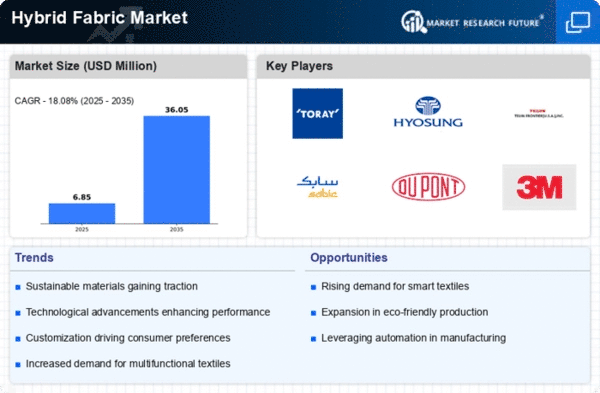
As per MRFR analysis, the Hybrid Fabric Market Size was estimated at 5.8 USD Million in 2024. The Hybrid Fabric industry is projected to grow from 6.84 in 2025 to 36.05 by 2035, exhibiting a compound annual growth rate (CAGR) of 18.08 during the forecast period 2025 - 2035.

Key Market Trends & Highlights

The Hybrid Fabric Market is poised for substantial growth driven by sustainability and technological advancements.

  • North America remains the largest market for hybrid fabrics, driven by robust demand across various industries.
  • The Asia-Pacific region is emerging as the fastest-growing market, reflecting increasing investments in innovative textile solutions.
  • The automotive segment leads in market size, while the aerospace segment is witnessing rapid growth due to advancements in material technology.
  • Key market drivers include sustainability initiatives and rising demand in the automotive sector, which are shaping the future of hybrid fabrics.

Market Size & Forecast

2024 Market Size 5.8 (USD Million)
2035 Market Size 36.05 (USD Million)
CAGR (2025 - 2035) 18.08%
Largest Regional Market Share in 2024 North America

Major Players

<p>Toray Industries (JP), BASF SE (DE), DuPont de Nemours, Inc. (US), Teijin Limited (JP), 3M Company (US), Honeywell International Inc. (US), SABIC (SA), Solvay S.A. (BE), Hyosung Corporation (KR)</p>

Market Trends

The Hybrid Fabric Market is currently experiencing a dynamic evolution, driven by a confluence of technological advancements and shifting consumer preferences. This market encompasses a diverse range of materials that combine the properties of different fibers, resulting in fabrics that offer enhanced performance, durability, and aesthetic appeal. As sustainability becomes increasingly paramount, manufacturers are exploring eco-friendly options, integrating recycled materials and innovative production techniques. This trend not only addresses environmental concerns but also aligns with the growing demand for responsible consumption among consumers. In addition to sustainability, the Hybrid Fabric Market is witnessing a surge in applications across various sectors, including automotive, fashion, and home textiles. The versatility of hybrid fabrics allows for their use in specialized products that require specific characteristics, such as moisture-wicking, breathability, and strength. Furthermore, advancements in textile technology are enabling the development of smart fabrics that can respond to environmental stimuli, thereby expanding the potential applications of hybrid materials. As the market continues to evolve, stakeholders must remain attuned to emerging trends and consumer demands to capitalize on the opportunities presented by this innovative sector.

Sustainability Initiatives

The Hybrid Fabric Market is increasingly influenced by sustainability initiatives, as manufacturers prioritize eco-friendly materials and processes. This trend reflects a broader societal shift towards responsible consumption, with consumers seeking products that minimize environmental impact. Companies are exploring the use of recycled fibers and sustainable production methods, which not only appeal to eco-conscious buyers but also enhance brand reputation.

Technological Advancements

Technological advancements play a crucial role in shaping the Hybrid Fabric Market. Innovations in textile engineering are leading to the creation of fabrics that possess unique properties, such as moisture management and enhanced durability. These developments enable manufacturers to cater to diverse consumer needs, thereby expanding the market's reach across various industries, including sportswear and automotive.

Customization and Personalization

Customization and personalization are emerging trends within the Hybrid Fabric Market, as consumers increasingly seek unique products that reflect their individual preferences. This demand is prompting manufacturers to offer tailored solutions, allowing customers to select specific fabric combinations and features. Such flexibility not only enhances consumer satisfaction but also fosters brand loyalty in a competitive landscape.

Hybrid Fabric Market Market Drivers

Market Growth Projections

The Global Hybrid Fabric Market Industry is poised for substantial growth, with projections indicating a market value of 844.8 USD Million by 2035. This anticipated growth reflects the increasing adoption of hybrid fabrics across various sectors, driven by their unique properties and versatility. The market is expected to expand at a compound annual growth rate of 19.15% from 2025 to 2035, highlighting the potential for innovation and diversification within the industry. Such growth projections underscore the importance of hybrid fabrics in meeting the evolving needs of consumers and industries alike.

Growing Fashion Industry Trends

The Global Hybrid Fabric Market Industry is significantly influenced by evolving trends within the fashion industry. As designers increasingly prioritize functionality alongside aesthetics, hybrid fabrics are becoming a staple in contemporary fashion. The ability to combine different fibers allows for the creation of unique textures and styles that appeal to modern consumers. This trend is evident in the rising popularity of athleisure and performance wear, which often utilize hybrid fabrics for their comfort and durability. As the fashion industry continues to embrace innovation, the demand for hybrid fabrics is likely to escalate, contributing to the overall market growth.

Rising Demand for Sustainable Textiles

The Global Hybrid Fabric Market Industry experiences a notable surge in demand for sustainable textiles, driven by increasing consumer awareness regarding environmental issues. As consumers become more conscious of their purchasing decisions, manufacturers are compelled to innovate and produce eco-friendly hybrid fabrics. This trend is reflected in the projected market value of 123.0 USD Million in 2024, as brands seek to align with sustainability goals. The integration of recycled materials and organic fibers into hybrid fabrics not only enhances their appeal but also contributes to a reduction in carbon footprint, thereby fostering a more sustainable textile industry.

Expanding Applications Across Industries

The versatility of hybrid fabrics is a key driver of growth within the Global Hybrid Fabric Market Industry. These fabrics find applications across various sectors, including automotive, aerospace, and healthcare, due to their unique properties such as durability, lightweight, and resistance to environmental factors. For instance, hybrid fabrics are increasingly utilized in the automotive industry for interior components, enhancing both aesthetics and functionality. This broad applicability suggests a robust market potential, with a projected compound annual growth rate of 19.15% from 2025 to 2035, indicating a sustained interest from diverse industries.

Technological Advancements in Fabric Production

Technological advancements play a pivotal role in the evolution of the Global Hybrid Fabric Market Industry. Innovations in weaving techniques and fiber technology enable the production of high-performance hybrid fabrics that cater to diverse applications, from fashion to industrial uses. The introduction of smart textiles, which incorporate sensors and electronics, exemplifies this trend. As these technologies become more accessible, manufacturers are likely to enhance product offerings, thereby attracting a broader consumer base. This technological evolution is expected to contribute to the market's growth trajectory, with projections indicating a significant increase in market value by 2035.

Increased Investment in Research and Development

Investment in research and development is crucial for the advancement of the Global Hybrid Fabric Market Industry. Companies are allocating substantial resources to explore new materials and production methods that enhance the performance and sustainability of hybrid fabrics. This focus on innovation not only drives product differentiation but also fosters competitive advantage in a rapidly evolving market. As a result, the industry is likely to witness a proliferation of novel hybrid fabric solutions that meet the changing demands of consumers and industries alike. Such investments are expected to yield significant returns, further propelling market growth.

Market Segment Insights

By Application: Automotive (Largest) vs. Aerospace (Fastest-Growing)

<p>In the Hybrid Fabric Market, the 'Automotive' application segment captures the largest share, driven by an increasing demand for lightweight, durable materials that enhance fuel efficiency and vehicle performance. This segment benefits from the automotive industry's continuous innovation towards eco-friendly vehicles, pushing manufacturers to adopt advanced fabric technologies. Meanwhile, 'Aerospace' is identified as the fastest-growing segment, spurred by rising air travel and the need for high-performance materials that can withstand extreme conditions.</p>

<p>Automotive: Traditional (Dominant) vs. Aerospace: Composites (Emerging)</p>

<p>The Automotive application represents a dominant sector in the Hybrid Fabric Market, focusing on traditional fabrics that meet stringent safety and durability standards. These materials are integral to vehicle interiors and exteriors, driving the need for innovation. On the other hand, the Aerospace application is emerging through the use of composite hybrid fabrics designed for lightweight, fuel-efficient aircraft. The demand for these advanced materials reflects the aerospace industry's shift towards reducing carbon footprints while enhancing performance. As both sectors evolve, their reliance on innovative hybrid fabrics will continue to illustrate their respective market positions.</p>

By End Use: Textiles (Largest) vs. Sportswear (Fastest-Growing)

<p>In the Hybrid Fabric Market, the 'End Use' segment is characterized by a diverse array of applications, with textiles leading the way. Textiles account for the largest share of the market, driven by their adaptability and demand across various sectors. Following textiles, protective clothing and composite applications also contribute significantly, while emerging segments like sportswear are quickly gaining traction due to their innovative features and performance benefits. Home furnishings, while important, remain a smaller niche within this expansive market. The push for sustainability and enhanced performance fuels the growth of hybrid fabrics across segments. Sportswear is experiencing the fastest growth, as awareness of health and fitness rises. Innovations in fabric technology, combined with the demand for breathable, durable, and lightweight materials, further propel the expansion of hybrid fabrics across these end-use applications, solidifying their importance in various markets.</p>

<p>Textiles (Dominant) vs. Sportswear (Emerging)</p>

<p>Textiles remain the dominant segment in the Hybrid Fabric Market, underpinned by their versatility in applications ranging from fashion to industrial uses. This segment encompasses a wide range of materials that are increasingly being engineered to improve functionality, comfort, and sustainability. On the other hand, sportswear is emerging as a significant force, driven by shifts in consumer lifestyle towards more active living. This segment prioritizes performance characteristics such as moisture-wicking, stretchability, and durability, positioning itself as a key player in the market. Sportswear brands are continuously innovating, incorporating hybrid fabrics to enhance athletic performance and appeal to the environmentally-conscious consumer, creating a dynamic landscape within the hybrid fabric space.</p>

By Material Type: Natural Fiber (Largest) vs. Synthetic Fiber (Fastest-Growing)

<p>In the Hybrid Fabric Market, the distribution of market share is notably dominated by Natural Fiber, which has established itself as the largest segment due to its sustainable appeal and consumer preference for eco-friendly materials. Natural fibers, such as cotton and wool, are favored for their breathability and comfort, making them a go-to choice for various applications including clothing and upholstery. Conversely, the Synthetic Fiber segment, while currently smaller in market share compared to Natural Fiber, is experiencing rapid growth, driven by technological advancements and increasing demand for performance-based fabrics in diverse industries.</p>

<p>Natural Fiber (Dominant) vs. Recycled Fiber (Emerging)</p>

<p>Natural Fiber stands as a dominant force in the Hybrid Fabric Market, valued for its environmental benefits and comfort. Major types within this segment, such as organic cotton and linen, cater to eco-conscious consumers seeking quality and sustainability. In contrast, Recycled Fiber presents an emerging opportunity driven by increasing awareness of environmental issues and the necessity for circular economy practices. This segment is gaining traction as brands incorporate recycled materials into their products to reduce waste, appealing to a demographic concerned with the ecological impact of their purchases. While Natural Fiber maintains strong market presence, Recycled Fiber is poised for significant growth as technological innovations enhance its quality and versatility.</p>

By Manufacturing Process: Weaving (Largest) vs. Knitting (Fastest-Growing)

<p>The Hybrid Fabric Market exhibits a varied distribution among its main manufacturing processes. Weaving is the largest segment, capturing a significant portion of the market due to its established techniques and versatile applications. In contrast, knitting, while smaller in market share, is growing rapidly, driven by innovative designs and increasing demand for stretchable fabrics. Other processes such as non-woven, coating, and laminating also contribute to the market, but to a lesser extent, indicating the unique preferences within hybrid fabrics.</p>

<p>Weaving (Dominant) vs. Knitting (Emerging)</p>

<p>Weaving is characterized by its ability to create densely woven fabrics that offer durability and structure, making it a dominant choice in the Hybrid Fabric Market. Its extensive application ranges from apparel to industrial uses, ensuring a stable demand. On the other hand, knitting is emerging rapidly, favored for its flexibility and comfort. With advancements in technology, knitted fabrics are becoming more prominent for fashion and sportswear, appealing to a younger audience looking for performance and style. This dynamic presents a balancing act, where weaving's strength competes with knitting's versatility in the evolving hybrid fabric landscape.</p>

By Functionality: Water Resistance (Largest) vs. Fire Resistance (Fastest-Growing)

<p>In the Hybrid Fabric Market, water resistance stands out as the largest segment, accounting for the majority of the market share. This functionality is critical for various applications ranging from outdoor gear to sportswear, where protection against the elements is paramount. Following closely, fire resistance is emerging as the fastest-growing segment, driven by increasing safety regulations and demand in industries such as construction and automotive. Together, these functionalities highlight the diverse needs of consumers and industries relying on hybrid fabrics. The growth trends within the functionality segment are largely influenced by advancements in material technology and sustainability goals. Brands are continuously innovating to enhance the performance of both water and fire-resistant fabrics, resulting in more durable and versatile products. The rising awareness of safety standards in various sectors reinforces the demand for fire-resistant hybrid fabrics, making it a rapidly expanding niche. Simultaneously, innovations in water resistance technology cater to a growing consumer interest in high-performance outdoor products, fostering an optimistic outlook for continued growth in these areas.</p>

<p>Water Resistance (Dominant) vs. Durability (Emerging)</p>

<p>Water resistance is characterized by its ability to repel moisture, making it vital for products designed for wet conditions. This functionality is predominant in the hybrid fabric market, significantly influenced by consumer demand for outdoor apparel and gear that withstands rainy weather. On the other hand, durability is emerging as a pivotal segment due to rising consumer expectations for long-lasting products. Enhanced durability ensures that fabrics maintain their performance over time, appealing to both consumers and brands focused on sustainability. The interconnection between water resistance and durability strengthens their market positions, as durable fabrics that also offer water resistance are increasingly sought after for both performance and longevity in consumer goods.</p>

Get more detailed insights about Hybrid Fabric Market Size, Share, Trends, Growth and Forecast to 2035

Regional Insights

North America : Market Leader in Hybrid Fabrics

North America is poised to maintain its leadership in the hybrid fabric market, holding a significant market share of 2.9 in 2024. The region's growth is driven by increasing demand in aerospace, automotive, and protective clothing sectors. Regulatory support for advanced materials and sustainability initiatives further catalyze market expansion. The focus on lightweight and high-performance materials is reshaping the industry landscape, making hybrid fabrics a preferred choice for manufacturers. The competitive landscape in North America is robust, featuring key players such as DuPont de Nemours, Inc., 3M Company, and Honeywell International Inc. These companies are investing heavily in R&D to innovate and enhance product offerings. The U.S. and Canada are leading markets, with a strong emphasis on technological advancements and sustainable practices. The presence of established manufacturers and a growing startup ecosystem contribute to a dynamic market environment.

Europe : Emerging Market with Growth Potential

Europe is witnessing a growing interest in hybrid fabrics, with a market size of 1.5 in 2024. The region's growth is fueled by increasing applications in automotive, construction, and healthcare sectors. Regulatory frameworks promoting sustainability and innovation are pivotal in driving demand. The European market is adapting to consumer preferences for eco-friendly materials, which is expected to enhance the adoption of hybrid fabrics across various industries. Leading countries in Europe include Germany, France, and Italy, where significant investments in R&D are being made. Key players like BASF SE and Solvay S.A. are at the forefront of this market, focusing on developing advanced hybrid materials. The competitive landscape is characterized by collaborations and partnerships aimed at enhancing product offerings and market reach. The European market is set to grow as manufacturers align with regulatory standards and consumer demands.

Asia-Pacific : Rapid Growth in Hybrid Fabrics

Asia-Pacific is emerging as a significant player in the hybrid fabric market, with a market size of 1.8 in 2024. The region's growth is driven by rapid industrialization, increasing urbanization, and rising disposable incomes. Countries like China and India are witnessing a surge in demand for hybrid fabrics in sectors such as automotive, sportswear, and protective gear. Regulatory initiatives aimed at promoting sustainable practices are also contributing to market growth, making hybrid fabrics more appealing to manufacturers. China is the leading country in the region, with major companies like Toray Industries and Hyosung Corporation driving innovation and production. The competitive landscape is marked by a mix of established players and emerging startups, all vying for market share. The presence of a large consumer base and increasing investments in technology are expected to propel the Asia-Pacific market forward, making it a key region for hybrid fabric development.

Middle East and Africa : Emerging Market with Untapped Potential

The Middle East and Africa (MEA) region is gradually emerging in the hybrid fabric market, with a market size of 0.6 in 2024. The growth is primarily driven by increasing demand in sectors such as construction, automotive, and military applications. The region's focus on diversifying economies and investing in infrastructure projects is expected to boost the adoption of hybrid fabrics. Regulatory support for advanced materials is also a catalyst for market growth, as governments seek to enhance local manufacturing capabilities. Leading countries in the MEA region include South Africa and the UAE, where investments in technology and innovation are on the rise. The competitive landscape is characterized by a mix of local and international players, with companies like SABIC and other regional manufacturers focusing on expanding their product portfolios. As the market matures, opportunities for growth and collaboration are expected to increase, making MEA a region to watch in the hybrid fabric sector.

Key Players and Competitive Insights

The Hybrid Fabric Market is currently characterized by a dynamic competitive landscape, driven by innovation, sustainability, and technological advancements. Key players such as Toray Industries (Japan), BASF SE (Germany), and DuPont de Nemours, Inc. (US) are at the forefront, each adopting distinct strategies to enhance their market positioning. Toray Industries (Japan) focuses on advanced material development, emphasizing lightweight and high-performance fabrics, while BASF SE (Germany) leverages its chemical expertise to create sustainable hybrid solutions. DuPont de Nemours, Inc. (US) is actively pursuing digital transformation initiatives to optimize its production processes and enhance product offerings, collectively shaping a competitive environment that prioritizes innovation and sustainability.

In terms of business tactics, companies are increasingly localizing manufacturing to reduce lead times and enhance supply chain resilience. The market structure appears moderately fragmented, with a mix of established players and emerging companies vying for market share. The collective influence of these key players is significant, as they drive trends in product development and sustainability practices, thereby shaping the overall market dynamics.

In November 2025, Toray Industries (Japan) announced a strategic partnership with a leading automotive manufacturer to develop next-generation hybrid fabrics aimed at enhancing vehicle performance and reducing weight. This collaboration is expected to position Toray as a leader in the automotive sector, aligning with the industry's shift towards lightweight materials that improve fuel efficiency and reduce emissions. The strategic importance of this partnership lies in its potential to expand Toray's market reach and reinforce its commitment to sustainability.

In October 2025, BASF SE (Germany) launched a new line of bio-based hybrid fabrics, which are designed to meet the growing demand for environmentally friendly materials. This initiative not only underscores BASF's commitment to sustainability but also enhances its competitive edge by catering to eco-conscious consumers. The introduction of these fabrics is likely to attract a broader customer base, thereby increasing market share and reinforcing BASF's position as a leader in sustainable solutions.

In September 2025, DuPont de Nemours, Inc. (US) unveiled a digital platform aimed at streamlining the supply chain for hybrid fabrics. This platform integrates AI and machine learning to optimize inventory management and production scheduling. The strategic significance of this move lies in its potential to enhance operational efficiency and reduce costs, allowing DuPont to respond more swiftly to market demands and customer needs.

As of December 2025, current competitive trends in the Hybrid Fabric Market are heavily influenced by digitalization, sustainability, and the integration of AI technologies. Strategic alliances are increasingly shaping the landscape, enabling companies to pool resources and expertise to drive innovation. Looking ahead, competitive differentiation is likely to evolve from traditional price-based competition to a focus on technological advancements, innovative product offerings, and reliable supply chains. This shift suggests that companies that prioritize innovation and sustainability will be better positioned to thrive in the evolving market.

Key Companies in the Hybrid Fabric Market market include

Industry Developments

Future Outlook

Hybrid Fabric Market Future Outlook

<p>The Hybrid Fabric Market is projected to grow at an 18.08% CAGR from 2024 to 2035, driven by technological advancements, increasing demand for sustainable materials, and diverse applications across industries.</p>

New opportunities lie in:

  • <p>Development of smart textiles integrating IoT for enhanced functionality.</p>
  • <p>Expansion into emerging markets with tailored hybrid fabric solutions.</p>
  • <p>Partnerships with automotive manufacturers for lightweight, durable materials.</p>

<p>By 2035, the Hybrid Fabric Market is expected to achieve substantial growth, solidifying its position as a key industry segment.</p>

Market Segmentation

Hybrid Fabric Market End Use Outlook

  • Textiles
  • Composites
  • Protective Clothing
  • Home Furnishings
  • Sportswear

Hybrid Fabric Market Application Outlook

  • Automotive
  • Aerospace
  • Industrial
  • Consumer Goods
  • Medical

Hybrid Fabric Market Functionality Outlook

  • Water Resistance
  • Fire Resistance
  • UV Protection
  • Breathability
  • Durability

Hybrid Fabric Market Material Type Outlook

  • Natural Fiber
  • Synthetic Fiber
  • Blended Fiber
  • Recycled Fiber
  • Hybrid Fiber

Hybrid Fabric Market Manufacturing Process Outlook

  • Weaving
  • Knitting
  • Non-woven
  • Coating
  • Laminating

Report Scope

MARKET SIZE 20245.8(USD Million)
MARKET SIZE 20256.84(USD Million)
MARKET SIZE 203536.05(USD Million)
COMPOUND ANNUAL GROWTH RATE (CAGR)18.08% (2024 - 2035)
REPORT COVERAGERevenue Forecast, Competitive Landscape, Growth Factors, and Trends
BASE YEAR2024
Market Forecast Period2025 - 2035
Historical Data2019 - 2024
Market Forecast UnitsUSD Million
Key Companies ProfiledToray Industries (JP), BASF SE (DE), DuPont de Nemours, Inc. (US), Teijin Limited (JP), 3M Company (US), Honeywell International Inc. (US), SABIC (SA), Solvay S.A. (BE), Hyosung Corporation (KR)
Segments CoveredApplication, End Use, Material Type, Manufacturing Process, Functionality
Key Market OpportunitiesGrowing demand for sustainable textiles drives innovation in the Hybrid Fabric Market.
Key Market DynamicsRising demand for sustainable materials drives innovation and competition in the hybrid fabric market.
Countries CoveredNorth America, Europe, APAC, South America, MEA

FAQs

How much is the global hybrid fabric market worth in the future?

The valuation of the global hybrid fabric market is estimated to reach approximately USD 420 MN by 2035.

At what CAGR is the global hybrid fabric market projected to grow in the forecast period (2018-2024)?

hybrid fabric market is expected to register over 9.1% CAGR during the assessment period (2021-2035).

Which are the major segments in the global hybrid fabric market?

By Form, the composite segment and by end-use industry, the automotive segment accounts for the major share in the global hybrid fabric market.

Which region holds the largest share in the global hybrid fabric market?

Asia Pacific holds the largest share in the global hybrid fabric market, followed by Europe and North America, respectively.

Who are the top players in the global hybrid fabric market?

Gurit (Switzerland), Koninklijke DSM N.V. (The Netherlands), Hexcel Corporation (US), BGF Industries, Inc. (US), Solvay (Belgium), Exel Composites (Finland), Textum Inc. (US), SGL Group (Germany), Arrow Technical Textiles Pvt. Ltd. (India), and HACOTECH Gmbh (Germany), are some of the major players operating in the hybrid fabric market.

  1. Executive Summary
  2. Scope of the Report
    1. Market Definition
    2. Scope of the Study
    3. List of Assumptions
    4. Markets Structure
  3. Market Research Methodology
    1. Research
    2. Process
    3. Primary Research
    4. Secondary Research
    5. Market Size
    6. Estimation
    7. Forecast Model
  4. Market Factor Analysis
    1. Supply
      1. Raw Material Suppliers
      2. Manufacturers/Producers
      3. Distributors/Retailers/Wholesalers/E-Commerce Merchants
      4. End
    2. Chain Analysis
    3. Users
    4. Porter’s Five Forces Model
      1. Threat of New Entrants
      2. Intensity of Competitive Rivalry
      3. Threat of Substitutes
      4. Bargaining Power of Suppliers
      5. Bargaining Power of Buyers
  5. Market Dynamics of Global Hybrid Fabrics Market
    1. Introduction
    2. Drivers
    3. Restraints
    4. Opportunities
    5. Challenges
  6. Global Hybrid Fabrics Market, by Combination
    1. Introduction
    2. Carbon-Aramid
      1. Market Estimates & Forecast, 2020-2027
      2. Market Estimates &
    3. Forecast, by Region, 2020-2027
    4. Aramid-Glass
      1. Market Estimates
      2. Market Estimates & Forecast, by Region,
    5. & Forecast, 2020-2027
    6. Carbon-Glass
      1. Market Estimates & Forecast, 2020-2027
      2. Market Estimates & Forecast, by Region, 2020-2027
    7. Carbon-UHMWPE
      1. Market Estimates & Forecast, 2020-2027
      2. Market Estimates &
    8. Forecast, by Region, 2020-2027
    9. Others
      1. Market Estimates &
      2. Market Estimates & Forecast, by Region, 2020-2027
    10. Forecast, 2020-2027
  7. Global Hybrid Fabrics Market, by Form
    1. Introduction
    2. Composite
      1. Market Estimates & Forecast, 2020-2027
      2. Market Estimates &
    3. Forecast, by Region, 2020-2027
    4. Non-Composite
      1. Market Estimates
      2. Market Estimates & Forecast, by Region,
    5. & Forecast, 2020-2027
  8. Global Hybrid Fabrics Market, by End-Use Industry
    1. Introduction
    2. Automotive
      1. Market Estimates & Forecast, 2020-2027
  9. Market Estimates & Forecast, by Region, 2020-2027
    1. Aerospace & Defense
      1. Market Estimates & Forecast, 2020-2027
      2. Market Estimates &
    2. Forecast, by Region, 2020-2027
    3. Wind Energy
      1. Market Estimates
      2. Market Estimates & Forecast, by Region,
    4. & Forecast, 2020-2027
    5. Consumer Goods
      1. Market Estimates & Forecast, 2020-2027
      2. Market Estimates & Forecast, by Region, 2020-2027
    6. Sports &
      1. Market Estimates & Forecast, 2020-2027
      2. Market
    7. Leisure
    8. Estimates & Forecast, by Region, 2020-2027
    9. Others
      1. Market
      2. Market Estimates & Forecast,
    10. Estimates & Forecast, 2020-2027
    11. by Region, 2020-2027
  10. Global Hybrid Fabrics Market, by Region
    1. Introduction
    2. North America
      1. Market Estimates & Forecast, 2020-2027
  11. Market Estimates & Forecast, by Combination, 2020-2027
    1. & Forecast, by Form, 2020-2027
    2. End-Use Industry, 2020-2027
    3. Estimates & Forecast, by End-Use Industry, 2020-2027
    4. Market Estimates & Forecast, 2020-2027
    5. by Combination, 2020-2027
    6. Estimates & Forecast, by Combination, 2020-2027
    7. & Forecast, by Form, 2020-2027
    8. End-Use Industry, 2020-2027
    9. Forecast, 2020-2027
  12. Market Estimates
  13. Market Estimates & Forecast, by
  14. US
  15. Market Estimates & Forecast,
  16. Market Estimates & Forecast, by Combination 2020-2027
  17. Market Estimates & Forecast, by Form, 2020-2027
  18. Market
  19. Canada
  20. Market Estimates & Forecast,
  21. Market Estimates & Forecast, by Form,
  22. Market Estimates & Forecast, by End-Use Industry, 2020-2027
    1. Europe
      1. Market Estimates & Forecast, 2020-2027
      2. Market
      3. Market Estimates
      4. Market Estimates & Forecast, by
      5. Germany
  23. Market Estimates & Forecast, by End-Use Industry, 2020-2027
    1. & Forecast, by Combination, 2020-2027
    2. by Form, 2020-2027
  24. France
  25. Market Estimates & Forecast, 2020-2027
  26. Market Estimates
  27. Market Estimates & Forecast,
  28. Market Estimates & Forecast, by End-Use Industry,
  29. Italy
  30. Market Estimates & Forecast, 2020-2027
  31. Market Estimates & Forecast, by Combination, 2020-2027
  32. Market Estimates & Forecast, by Form, 2020-2027
    1. & Forecast, by End-Use Industry, 2020-2027
    2. Estimates & Forecast, 2020-2027
    3. by Combination, 2020-2027
  33. Market Estimates
  34. Spain
  35. Market
  36. Market Estimates & Forecast,
  37. Market Estimates & Forecast, by Form,
  38. Market Estimates & Forecast, by End-Use Industry, 2020-2027
  39. UK
  40. Market Estimates & Forecast, 2020-2027
  41. Market Estimates & Forecast, by Combination, 2020-2027
    1. & Forecast, by Form, 2020-2027
    2. by End-Use Industry, 2020-2027
    3. & Forecast, 2020-2027
  42. Market Estimates
  43. Market Estimates & Forecast,
  44. Russia
  45. Market Estimates
  46. Market Estimates & Forecast, by Combination,
  47. Market Estimates & Forecast, by Form, 2020-2027
  48. Market Estimates & Forecast, by End-Use Industry, 2020-2027
    1. of Europe
  49. Rest
  50. Market Estimates & Forecast, 2020-2027
  51. Market Estimates & Forecast, by Combination, 2020-2027
    1. Estimates & Forecast, by Form, 2020-2027
    2. Forecast, by End-Use Industry, 2020-2027
    3. Estimates & Forecast, 2020-2027
    4. by Combination, 2020-2027
    5. China
    6. Estimates & Forecast, by Combination, 2020-2027
    7. & Forecast by Form, 2020-2027
    8. by End-Use Industry, 2020-2027
    9. Forecast, 2020-2027
  52. Market
  53. Market Estimates &
    1. Asia Pacific
      1. Market
      2. Market Estimates & Forecast,
      3. Market Estimates & Forecast, by Form, 2020-2027
      4. Market Estimates & Forecast, by End-Use Industry, 2020-2027
      5. India
  54. Market Estimates & Forecast, by End-Use Industry, 2020-2027
    1. Korea
    2. Estimates & Forecast, by Combination, 2020-2027
    3. & Forecast by Form, 2020-2027
    4. by End-Use Industry, 2020-2027
    5. & Forecast, 2020-2027
  55. South
  56. Market Estimates & Forecast, 2020-2027
  57. Market
  58. Market Estimates
  59. Market Estimates & Forecast,
  60. Indonesia
  61. Market Estimates
  62. Market Estimates & Forecast, by Combination,
  63. Market Estimates & Forecast by Form, 2020-2027
  64. Market Estimates & Forecast, by End-Use Industry, 2020-2027
    1. & New Zealand
  65. Australia
  66. Market Estimates & Forecast, 2020-2027
  67. Market Estimates & Forecast, by Combination, 2020-2027
    1. & Forecast, by Form, 2020-2027
    2. by End-Use Industry, 2020-2027
    3. Estimates & Forecast, 2020-2027
    4. by Combination, 2020-2027
    5. Estimates & Forecast by Form, 2020-2027
    6. by End-Use Industry, 2020-2027
    7. Forecast, 2020-2027
  68. Market Estimates
  69. Market Estimates & Forecast,
  70. Rest of Asia-Pacific
  71. Market
  72. Market Estimates & Forecast,
  73. Market Estimates & Forecast, by Form,
  74. Market Estimates & Forecast, by End-Use Industry, 2020-2027
    1. Middle East & Africa
      1. Market Estimates & Forecast, 2020-2027
      2. Market Estimates & Forecast, by Combination, 2020-2027
      3. Market
      4. Market Estimates & Forecast,
      5. Turkey
  75. Market Estimates & Forecast, by End-Use Industry, 2020-2027
    1. & Forecast, by Combination, 2020-2027
    2. by Form, 2020-2027
    3. Estimates & Forecast, by End-Use Industry, 2020-2027
    4. Market Estimates & Forecast, 2020-2027
    5. by Combination, 2020-2027
    6. Forecast, 2020-2027
  76. Israel
  77. Market Estimates & Forecast, 2020-2027
  78. Market Estimates
  79. Market Estimates & Forecast,
  80. Market Estimates & Forecast, by End-Use Industry,
  81. North Africa
  82. Market Estimates & Forecast,
  83. Market Estimates & Forecast, by Combination, 2020-2027
  84. Market Estimates & Forecast, by Form, 2020-2027
  85. Market
  86. GCC
  87. Market Estimates & Forecast,
  88. Market Estimates & Forecast, by Form,
  89. Market Estimates & Forecast, by End-Use Industry, 2020-2027
  90. Rest of the Middle East & Africa
  91. Market Estimates &
  92. Market Estimates & Forecast, by Combination,
  93. Market Estimates & Forecast, by Form, 2020-2027
  94. Market Estimates & Forecast, by End-Use Industry, 2020-2027
    1. Latin America
      1. Market Estimates & Forecast, 2020-2027
      2. Market Estimates &
      3. Market Estimates & Forecast,
      4. Market Estimates & Forecast, by End-Use Industry,
      5. Brazil
    2. Forecast, by Combination, 2020-2027
    3. by Form, 2020-2027
  95. Market Estimates & Forecast, by Form, 2020-2027
    1. & Forecast, by End-Use Industry, 2020-2027
    2. Market Estimates & Forecast, 2020-2027
    3. by Combination, 2020-2027
  96. Market Estimates
  97. Argentina
  98. Market Estimates & Forecast,
  99. Market Estimates & Forecast, by Form,
  100. Market Estimates & Forecast, by End-Use Industry, 2020-2027
  101. Mexico
  102. Market Estimates & Forecast, 2020-2027
  103. Market Estimates & Forecast, by Combination, 2020-2027
    1. & Forecast, by Form, 2020-2027
    2. by End-Use Industry, 2020-2027
    3. Estimates & Forecast, 2020-2027
    4. by Combination, 2020-2027
  104. Market Estimates
  105. Market Estimates & Forecast,
  106. Rest of Latin America
  107. Market
  108. Market Estimates & Forecast,
  109. Market Estimates & Forecast, by Form,
  110. Market Estimates & Forecast, by End-Use Industry, 2020-2027
  111. Competitive Landscape
    1. Introduction
    2. Market Key Strategies
    3. Key Development Analysis
    4. (Expansions/Mergers & Acquisitions/Joint
    5. Ventures/New Product Developments/Agreements/Investments)
  112. Company Profiles
    1. Koninklijke DSM N.V.
      1. Company Overview
      2. Financial
      3. Products Offered
      4. Key Developments
      5. SWOT
      6. Key Strategies
    2. Overview
    3. Analysis
    4. Gurit
      1. Company Overview
      2. Financial Overview
      3. Products Offered
      4. Key Developments
      5. SWOT Analysis
      6. Key Strategies
    5. Hexcel Corporation
      1. Company Overview
      2. Financial Overview
      3. Products Offered
      4. Key Developments
      5. SWOT Analysis
      6. Key Strategies
    6. Solvay
      1. Company Overview
      2. Financial Overview
      3. Key Developments
      4. SWOT Analysis
    7. Products Offered
    8. Key Strategies
    9. BGF Industries, Inc.
      1. Company Overview
      2. Products Offered
      3. Key Developments
      4. SWOT Analysis
      5. Key Strategies
    10. Financial Overview
    11. Exel Composites
      1. Financial Overview
      2. Products Offered
      3. Key Developments
      4. SWOT Analysis
      5. Key Strategies
    12. Company Overview
    13. SGL Group
      1. Company Overview
      2. Financial Overview
      3. Products Offered
      4. Key Developments
      5. SWOT Analysis
      6. Key Strategies
    14. Textum Inc.
      1. Company Overview
      2. Products Offered
      3. Key Developments
      4. SWOT Analysis
      5. Key Strategies
    15. Financial Overview
    16. HACOTECH Gmbh
      1. Financial Overview
      2. Products Offered
      3. Key Developments
      4. SWOT Analysis
      5. Key Strategies
    17. Company Overview
    18. Arrow Technical Textiles Pvt. Ltd.
      1. Company Overview
      2. Products Offered
      3. Key Developments
      4. SWOT Analysis
      5. Key Strategies
    19. Financial Overview
    20. • Other Companies
    21. C. Cramer, Weberei, GmbH & Co. KG (Germany)
    22. Quantum Composites,
    23. Inc. (US)
    24. COLAN AUSTRALIA (Australia)
    25. Composite Fabrics of
    26. America (US)
    27. Devold AMT AS (Norway)
  113. Conclusion
    1. LIST
    2. OF TABLES:
  114. Global Hybrid Fabrics Market, by Region, 2020-2027
  115. North America: Hybrid Fabrics Market, by Country, 2020-2027
    1. Table
  116. Europe: Hybrid Fabrics Market, by Country, 2020-2027
  117. Asia-Pacific:
  118. Hybrid Fabrics Market, by Country, 2020-2027
  119. Middle East & Africa:
  120. Hybrid Fabrics Market, by Country, 2020-2027
  121. Latin America: Hybrid
  122. Fabrics Market, by Country, 2020-2027
  123. Global Hybrid Fabrics Combination
  124. Market, by Region, 2020-2027
  125. North America: Hybrid Fabrics Combination
  126. Market, by Country, 2020-2027
  127. Europe: Hybrid Fabrics Combination Market,
    1. by Country, 2020-2027
  128. Asia-Pacific: Hybrid Fabrics Combination Market,
    1. by Country, 2020-2027
  129. Middle East & Africa: Hybrid Fabrics Combination
  130. Market, by Country, 2020-2027
  131. Latin America: Hybrid Fabrics Combination
  132. Market, by Country, 2020-2027
  133. Global Hybrid Fabrics Form Market,
    1. by Region, 2020-2027
  134. North America: Hybrid Fabrics Form Market, by
    1. Country, 2020-2027
  135. Europe: Hybrid Fabrics Form Market, by Country,
  136. Asia-Pacific: Hybrid Fabrics Form Market, by Country, 2020-2027
  137. Middle East & Africa: Hybrid Fabrics Form Market, by Country,
  138. Latin America: Hybrid Fabrics Form Market, by Country,
  139. Global Hybrid Fabrics End-Use Industry Market, by Region,
  140. North America: Hybrid Fabrics End-Use Industry Market,
    1. by Country, 2020-2027
  141. Europe: Hybrid Fabrics End-Use Industry Market,
    1. by Country, 2020-2027
  142. Asia-Pacific: Hybrid Fabrics End-Use Industry
  143. Market, by Country, 2020-2027
  144. Middle East & Africa: Hybrid Fabrics
  145. End-Use Industry Market, by Country, 2020-2027
  146. Latin America: Hybrid
  147. Fabrics End-Use Industry Market, by Country, 2020-2027
  148. Global Combination
  149. Market, by Region, 2020-2027
  150. Global Form Market, by Region, 2020-2027
  151. Global End-Use Industry Market, by Region, 2020-2027
    1. Table
  152. North America: Hybrid Fabrics Market, by Country, 2020-2027
  153. North
  154. America: Hybrid Fabrics Market, by Material, 2020-2027
  155. North America:
  156. Hybrid Fabrics Market, by Form, 2020-2027
  157. North America: Hybrid Fabrics
  158. Market, by End-Use Industry, 2020-2027
  159. Europe: Hybrid Fabrics Market,
    1. by Country, 2020-2027
  160. Europe: Hybrid Fabrics Market, by Material,
  161. Europe: Hybrid Fabrics Market, by Form, 2020-2027
    1. Table
  162. Europe: Hybrid Fabrics Market, by End-Use Industry, 2020-2027
  163. Asia-Pacific:
  164. Hybrid Fabrics Market, by Country, 2020-2027
  165. Asia-Pacific: Hybrid
  166. Fabrics Market, by Material, 2020-2027
  167. Asia-Pacific: Hybrid Fabrics
  168. Market, by Form, 2020-2027
  169. Asia-Pacific: Hybrid Fabrics Market, by
    1. End-Use Industry, 2020-2027
  170. Middle East & Africa: Hybrid Fabrics
  171. Market, by Country, 2020-2027
  172. Middle East & Africa: Hybrid Fabrics
  173. Market, by Material, 2020-2027
  174. Middle East & Africa: Hybrid Fabrics
  175. Market, by Form, 2020-2027
  176. Middle East & Africa: Hybrid Fabrics
  177. Market, by End-Use Industry, 2020-2027
  178. Latin America: Hybrid Fabrics
  179. Market, by Country, 2020-2027
  180. Latin America: Hybrid Fabrics Market,
    1. by Material, 2020-2027
  181. Latin America: Hybrid Fabrics Market, by Form,
  182. Latin America: Hybrid Fabrics Market, by End-Use Industry,
    1. LIST OF FIGURES:
  183. Global Hybrid Fabrics
    1. Market Segmentation
  184. Forecast Research Methodology
  185. Porter’s
    1. Five Forces Analysis of Global Hybrid Fabrics Market
  186. Value Chain/Supply
    1. Chain of Global Hybrid Fabrics Market
  187. Share of Global Hybrid Fabrics
  188. Market, by Country, 2020 (%)
  189. Global Hybrid Fabrics Market, 2020-2027
  190. Global Hybrid Fabrics Market Size, by Combination, 2020 (%)
    1. FIGURE
  191. Share of Global Hybrid Fabrics Market, by Combination, 2020-2027
    1. FIGURE 9
  192. Global Hybrid Fabrics Market Size, by Form, 2020 (%)
  193. Share of Global
  194. Hybrid Fabrics Market, by Form, 2020-2027
  195. Global Hybrid Fabrics Market
    1. Size, by End-Use Industry, 2020 (%)
  196. Share of Global Hybrid Fabrics
  197. Market, by End-Use Industry, 2020-2027

Hybrid Fabric Market Segmentation

Market Segmentation Overview

  • Detailed segmentation data will be available in the full report
  • Comprehensive analysis by multiple parameters
  • Regional and country-level breakdowns
  • Market size forecasts by segment
Infographic

Free Sample Request

Kindly complete the form below to receive a free sample of this Report

Get Free Sample

Customer Strories

Compare Licence

×
Features License Type
Single User Multiuser License Enterprise User
Price $4,950 $5,950 $7,250
Maximum User Access Limit 1 User Upto 10 Users Unrestricted Access Throughout the Organization
Free Customization
Direct Access to Analyst
Deliverable Format
Platform Access
Discount on Next Purchase 10% 15% 15%
Printable Versions