×
Request Free Sample ×

Kindly complete the form below to receive a free sample of this Report

* Please use a valid business email

Leading companies partner with us for data-driven Insights

clients tt-cursor
Hero Background

Hybrid Memory Cube High-Bandwidth Memory Market

ID: MRFR/SEM/4487-HCR
100 Pages
Ankit Gupta
October 2025

Hybrid Memory Cube (HMC) and High-Bandwidth Memory (HBM) Market Research Report Information By Product (Central Processing Unit (CPU), Field Programmable Gate Array (FPGA), Graphics Processing Unit (GPU), Application-Specific Integrated Circuit, and Others), By Memory Type (Hybrid Memory Cube, and High-Bandwidth Memory), By Application (High-Performance Computing, Networking & Telecommunication, Consumer Electronics, Data Centers, and Others) And By Region (North America, Europe, Asia-Pacific, & Rest Of The World)– Industry Forecast ... read more

Share:
Download PDF ×

We do not share your information with anyone. However, we may send you emails based on your report interest from time to time. You may contact us at any time to opt-out.

Hybrid Memory Cube High-Bandwidth Memory Market Infographic
Purchase Options

Hybrid Memory Cube High-Bandwidth Memory Market Summary

As per MRFR analysis, the Hybrid Memory Cube High-Bandwidth Memory Market Size was estimated at 217.57 USD Billion in 2024. The Hybrid Memory Cube High-Bandwidth Memory industry is projected to grow from 286.55 USD Billion in 2025 to 4499.04 USD Billion by 2035, exhibiting a compound annual growth rate (CAGR) of 31.7 during the forecast period 2025 - 2035.

Key Market Trends & Highlights

The Hybrid Memory Cube High-Bandwidth Memory Market is poised for substantial growth driven by technological advancements and increasing application integration.

  • North America remains the largest market for Hybrid Memory Cube High-Bandwidth Memory, reflecting its robust demand in high-performance computing.
  • Asia-Pacific is emerging as the fastest-growing region, propelled by rapid advancements in memory technology and increased data generation.
  • The Graphics Processing segment dominates the market, while the Artificial Intelligence segment is witnessing the fastest growth due to rising adoption in various applications.
  • Key market drivers include the rising demand for high-performance computing and the growing adoption of Hybrid Memory Cube technology in artificial intelligence applications.

Market Size & Forecast

2024 Market Size 217.57 (USD Billion)
2035 Market Size 4499.04 (USD Billion)
CAGR (2025 - 2035) 31.7%

Major Players

Micron Technology (US), Samsung Electronics (KR), SK Hynix (KR), Intel Corporation (US), NVIDIA Corporation (US), Advanced Micro Devices (US), Broadcom Inc. (US), Texas Instruments (US), Toshiba Corporation (JP)

Hybrid Memory Cube High-Bandwidth Memory Market Trends

The Hybrid Memory Cube High-Bandwidth Memory Market is currently experiencing a transformative phase, driven by the increasing demand for high-performance computing and data-intensive applications. This market appears to be characterized by rapid advancements in memory technology, which are essential for meeting the needs of sectors such as artificial intelligence, machine learning, and big data analytics. As organizations seek to enhance their processing capabilities, the adoption of Hybrid Memory Cube technology is likely to gain momentum, offering superior bandwidth and energy efficiency compared to traditional memory solutions. Furthermore, the integration of this innovative memory architecture into various devices, including servers and graphics processing units, suggests a growing trend towards optimizing performance in computing environments. In addition to technological advancements, the Hybrid Memory Cube High-Bandwidth Memory Market seems to be influenced by the increasing focus on energy efficiency and sustainability. Manufacturers are exploring ways to reduce power consumption while maintaining high performance, which could lead to the development of more eco-friendly memory solutions. This shift towards sustainability may not only appeal to environmentally conscious consumers but also align with regulatory pressures for greener technologies. Overall, the market appears poised for growth, driven by both technological innovation and a commitment to sustainable practices, indicating a promising future for Hybrid Memory Cube High-Bandwidth Memory solutions.

Technological Advancements

The Hybrid Memory Cube High-Bandwidth Memory Market is witnessing rapid technological advancements that enhance performance and efficiency. Innovations in memory architecture are enabling higher data transfer rates and reduced latency, which are crucial for applications requiring substantial computational power.

Sustainability Focus

There is a growing emphasis on sustainability within the Hybrid Memory Cube High-Bandwidth Memory Market. Manufacturers are increasingly prioritizing energy-efficient designs, which not only reduce operational costs but also cater to the rising demand for environmentally friendly technology solutions.

Integration in Diverse Applications

The integration of Hybrid Memory Cube technology across various applications is becoming more prevalent. This trend indicates a broader acceptance of high-bandwidth memory solutions in sectors such as gaming, cloud computing, and artificial intelligence, reflecting the versatility of this technology.

Hybrid Memory Cube High-Bandwidth Memory Market Drivers

Market Growth Projections

The Global Hybrid Memory Cube HMC and High-Bandwidth Memory HBM market industry is poised for substantial growth, with projections indicating a market size of 217.6 USD Billion in 2024 and an anticipated increase to 4499.0 USD Billion by 2035. This remarkable growth trajectory reflects a compound annual growth rate CAGR of 31.7% from 2025 to 2035, driven by various factors such as technological advancements, rising demand in high-performance computing, and increased adoption in gaming and cloud computing sectors. The market's expansion signifies the critical role of HMC and HBM technologies in shaping the future of memory solutions.

Advancements in Memory Technology

Innovations in memory technology play a pivotal role in shaping the Global Hybrid Memory Cube HMC and High-Bandwidth Memory HBM market industry. The development of advanced memory architectures, such as 3D stacking and improved bandwidth capabilities, enhances performance and efficiency. These advancements not only cater to the growing demands of data-intensive applications but also contribute to the overall reduction in power consumption. As a result, the market is expected to witness a compound annual growth rate CAGR of 31.7% from 2025 to 2035, indicating a strong potential for growth as technology continues to evolve.

Emerging Applications in Automotive and IoT

The Global Hybrid Memory Cube HMC and High-Bandwidth Memory HBM market industry is witnessing emerging applications in the automotive and Internet of Things IoT sectors. As vehicles become increasingly connected and autonomous, the demand for high-speed memory solutions to process vast amounts of data in real-time is growing. Similarly, IoT devices require efficient memory technologies to handle the influx of data generated by interconnected devices. This trend suggests a promising avenue for market expansion, as the automotive and IoT industries continue to evolve and integrate advanced memory solutions.

Rising Demand for High-Performance Computing

The Global Hybrid Memory Cube HMC and High-Bandwidth Memory HBM market industry experiences a surge in demand driven by the increasing need for high-performance computing solutions. Industries such as artificial intelligence, machine learning, and data analytics require memory technologies that can handle vast amounts of data at high speeds. The market is projected to reach 217.6 USD Billion in 2024, reflecting a robust growth trajectory. As organizations seek to enhance their computational capabilities, the adoption of HMC and HBM technologies is likely to accelerate, thereby propelling the market forward.

Growing Focus on Data Centers and Cloud Computing

The expansion of data centers and the increasing reliance on cloud computing services are key drivers of the Global Hybrid Memory Cube HMC and High-Bandwidth Memory HBM market industry. As organizations migrate to cloud-based solutions, the demand for efficient and high-capacity memory solutions rises. HMC and HBM technologies offer the necessary bandwidth and performance to support the growing workloads in data centers. This trend is expected to contribute to the market's growth, with projections indicating a potential market size of 4499.0 USD Billion by 2035, underscoring the importance of memory technologies in the cloud ecosystem.

Increased Adoption in Gaming and Graphics Applications

The Global Hybrid Memory Cube HMC and High-Bandwidth Memory HBM market industry is significantly influenced by the rising adoption of HMC and HBM technologies in gaming and graphics applications. As gaming experiences become more immersive and graphics-intensive, the need for high-speed memory solutions becomes paramount. The integration of HBM in graphics processing units GPUs enhances rendering speeds and overall performance, catering to the demands of gamers and content creators alike. This trend is likely to drive market growth, as the gaming industry continues to expand and evolve.

Market Segment Insights

By Application: Graphics Processing (Largest) vs. Artificial Intelligence (Fastest-Growing)

The Hybrid Memory Cube High-Bandwidth Memory Market showcases a diverse landscape across various application segments, with Graphics Processing securing the largest market share. This segment is pivotal due to its increasing demand in gaming, visual computing, and professional-grade graphics applications. Following closely, the Data Center and High-Performance Computing applications also exhibit substantial share, as they benefit from enhanced data handling requirements and speed enhancements that Hybrid Memory cubes offer. In contrast, segments like Artificial Intelligence and Machine Learning are emerging rapidly, characterized by exponential growth as industries leverage these technologies for advanced analytics, automation, and data-driven decision-making. These applications capitalize on the high bandwidth and low latency advantages of Hybrid Memory Cubes, which significantly bolster their performance in processing large datasets and complex algorithms.

Graphics Processing (Dominant) vs. Machine Learning (Emerging)

Graphics Processing remains the dominant application in the Hybrid Memory Cube High-Bandwidth Memory Market, driven by its extensive use in rendering high-quality graphics and facilitating real-time visual effects in gaming, animation, and simulations. This segment benefits from continuous innovations in GPU technologies that require faster memory solutions to keep up with growing data demands. On the other hand, Machine Learning is identified as an emerging application characterized by its increasing integration into various sectors, including finance, healthcare, and autonomous systems. As organizations aim to implement sophisticated models and algorithms for predictive analytics and pattern recognition, the demand for high-bandwidth memory solutions like Hybrid Memory Cubes becomes crucial, allowing for swift data processing and enhanced operational efficiencies.

By End Use: Consumer Electronics (Largest) vs. Telecommunications (Fastest-Growing)

The Hybrid Memory Cube High-Bandwidth Memory market showcases a diverse array of end-use segments, with Consumer Electronics emerging as the largest segment. This category encompasses a wide range of products, including smartphones, tablets, and gaming consoles, leveraging high-bandwidth memory for improved performance and user experience. Meanwhile, Telecommunications is rapidly gaining momentum, driven by the demand for higher data rates and the expansion of 5G technology, making it the fastest-growing segment in this market.

Consumer Electronics (Dominant) vs. Telecommunications (Emerging)

Consumer Electronics stands as a dominant force within the Hybrid Memory Cube High-Bandwidth Memory market, characterized by high adoption rates and significant technological advancements. Devices such as smartphones and gaming consoles are increasingly requiring enhanced memory solutions to support complex applications and gaming environments. Conversely, the Telecommunications sector is emerging with a focus on high-speed data transmission and network enhancements. The adoption of new technologies like 5G is propelling this segment's growth, as telecommunications companies seek to invest in efficient memory solutions to meet the ever-increasing demands for bandwidth and reduced latency in their networks.

By Technology: 3D Stacking (Largest) vs. Through-Silicon Via (Fastest-Growing)

In the Hybrid Memory Cube High-Bandwidth Memory Market, the technology segment is characterized by different advancements. Among these, 3D Stacking holds the largest market share due to its advantageous architectural benefits, allowing for increased memory density and improved performance. Following closely is Through-Silicon Via, which has emerged as a significant player, particularly noted for enhancing data transfer speeds and overall efficiency. Other technologies like High-Speed Interface, Low Power Consumption, and Scalability contribute to the market but do not currently match the prominence of these leading technologies.

Technology: 3D Stacking (Dominant) vs. Through-Silicon Via (Emerging)

3D Stacking technology is dominating the Hybrid Memory Cube High-Bandwidth Memory segment due to its capability to vertically integrate multiple memory layers, significantly improving bandwidth and energy efficiency. This technology supports intensive data workloads, making it a preferred choice in high-performance computing applications. On the other hand, Through-Silicon Via serves as an emerging technology, facilitating advanced interconnects between memory dies. This enables faster data transmission and is critical for next-generation systems that demand high levels of integration and reduced latency. Both technologies are set to evolve, but 3D Stacking's established presence positions it strongly against the rapidly advancing Through-Silicon Via.

By Form Factor: Module (Largest) vs. Chip (Fastest-Growing)

In the Hybrid Memory Cube High-Bandwidth Memory Market, the Module form factor holds the largest market share, driven by its widespread application across high-performance computing and data centers. The dominance of the Module segment reflects its superior design for optimal memory stacking and integration, enabling enhanced performance over traditional memory solutions. Meanwhile, the Chip segment is experiencing rapid growth as manufacturers innovate to reduce footprint and power consumption, making it appealing for next-generation devices.

Module (Dominant) vs. Chip (Emerging)

The Module form factor is characterized by its robust architecture that allows for multiple memory chips to be integrated into one unit, enhancing bandwidth and reducing latency. Modules serve as the backbone for various applications, particularly in server and enterprise environments requiring high-throughput data transfer. In contrast, the Chip segment, while emerging, is gaining traction due to its compact nature and efficiency. These chips are ideal for mobile and consumer electronics where space and energy efficiency are paramount. As technological advancements continue, the Chip segment is poised to witness significant adoption, bridging traditional usage and innovative applications.

By Memory Type: Dynamic Random Access Memory (Largest) vs. Static Random Access Memory (Fastest-Growing)

The Hybrid Memory Cube High-Bandwidth Memory Market is predominantly driven by Dynamic Random Access Memory (DRAM), which holds the largest share in this segment due to its widespread use in high-performance computing and server applications. Following DRAM, Static Random Access Memory (SRAM) plays a pivotal role, primarily in applications requiring faster speeds and lower latency, although its market share is smaller compared to DRAM. Flash Memory and Non-Volatile Memory contribute to the market, but their share remains limited in comparison to these leading technologies, mainly due to the specialized applications they serve.

Memory Type: DRAM (Dominant) vs. SRAM (Emerging)

Dynamic Random Access Memory (DRAM) is the dominant player in the Hybrid Memory Cube High-Bandwidth Memory Market, known for its ability to provide high-speed memory access and efficiency, making it vital for data-intensive applications. It outperforms other memory types in terms of capacity and speed, catering to sectors like cloud computing and artificial intelligence. Static Random Access Memory (SRAM), while emerging, is characterized by its fast performance and stability, making it indispensable for cache memory and critical system applications where speed is paramount. The future looks promising for SRAM as it integrates more with modern technology that demands faster data retrieval.

Get more detailed insights about Hybrid Memory Cube High-Bandwidth Memory Market

Regional Insights

North America : Market Leader in Innovation

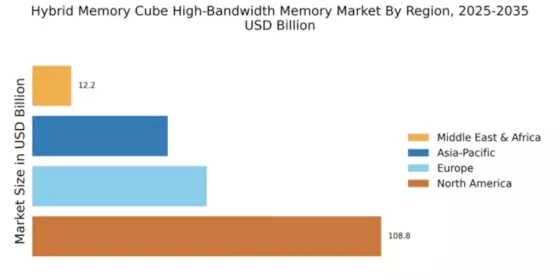
North America continues to lead the Hybrid Memory Cube High-Bandwidth Memory market, holding a significant share of 108.78M in 2025. The region's growth is driven by robust demand from data centers, AI applications, and cloud computing. Regulatory support for technology innovation and investment in R&D further catalyze market expansion. The increasing need for high-speed data processing and memory solutions is propelling the adoption of hybrid memory technologies. The competitive landscape in North America is characterized by the presence of major players such as Micron Technology, Intel Corporation, and NVIDIA Corporation. These companies are at the forefront of technological advancements, ensuring a steady supply of innovative products. The U.S. market is particularly strong, supported by government initiatives aimed at enhancing semiconductor manufacturing capabilities. This positions North America as a critical hub for hybrid memory solutions.

Europe : Emerging Market with Potential

Europe is witnessing a growing interest in the Hybrid Memory Cube High-Bandwidth Memory market, with a market size of 54.39M in 2025. The region's growth is fueled by increasing investments in AI, IoT, and automotive technologies, which demand high-performance memory solutions. Regulatory frameworks promoting digital transformation and sustainability are also key drivers, encouraging innovation in memory technologies across various sectors. Leading countries in Europe, such as Germany and France, are home to several key players, including Samsung Electronics and SK Hynix. The competitive landscape is evolving, with European firms focusing on partnerships and collaborations to enhance their market presence. The European Union's commitment to boosting semiconductor production further strengthens the region's position in The Hybrid Memory Cube High-Bandwidth Memory.

Asia-Pacific : Rapid Growth and Adoption

Asia-Pacific is emerging as a significant player in the Hybrid Memory Cube High-Bandwidth Memory market, with a market size of 42.24M in 2025. The region's growth is driven by the rapid adoption of advanced technologies in countries like China, Japan, and South Korea. The increasing demand for high-speed data processing in sectors such as telecommunications and consumer electronics is propelling the market forward. Additionally, government initiatives to support semiconductor manufacturing are enhancing the region's capabilities. China and South Korea are leading the charge in the competitive landscape, with major companies like Samsung Electronics and SK Hynix dominating the market. The presence of these key players, along with a growing number of startups focusing on innovative memory solutions, is fostering a dynamic environment for hybrid memory technologies. The region's focus on R&D and technological advancements positions it well for future growth.

Middle East and Africa : Emerging Market Opportunities

The Middle East and Africa region is gradually developing its Hybrid Memory Cube High-Bandwidth Memory market, with a market size of 12.16M in 2025. The growth is primarily driven by increasing digital transformation initiatives and investments in technology infrastructure. Governments in the region are recognizing the importance of high-performance memory solutions for enhancing data processing capabilities, which is fostering market development. Regulatory support for technology adoption is also a contributing factor. Countries like South Africa and the UAE are at the forefront of this emerging market, with a growing interest in high-tech solutions. The competitive landscape is still in its infancy, but the presence of The Hybrid Memory Cube High-Bandwidth Memory. As local companies start to invest in R&D, the region is poised for gradual growth in hybrid memory technologies, aligning with global trends.

Key Players and Competitive Insights

The Hybrid Memory Cube High-Bandwidth Memory Market is characterized by a dynamic competitive landscape, driven by rapid technological advancements and increasing demand for high-performance computing solutions. Key players such as Micron Technology (US), Samsung Electronics (KR), and SK Hynix (KR) are at the forefront, each adopting distinct strategies to enhance their market positioning. Micron Technology (US) focuses on innovation in memory solutions, emphasizing the development of advanced memory architectures that cater to data-intensive applications. Meanwhile, Samsung Electronics (KR) leverages its extensive manufacturing capabilities to maintain a competitive edge, while SK Hynix (KR) is investing heavily in R&D to push the boundaries of memory technology, collectively shaping a competitive environment that prioritizes technological superiority and operational efficiency.

In terms of business tactics, companies are increasingly localizing manufacturing and optimizing supply chains to mitigate risks and enhance responsiveness to market demands. The market structure appears moderately fragmented, with a few dominant players exerting considerable influence. This fragmentation allows for niche players to emerge, fostering innovation and competition. The collective influence of these key players is significant, as they drive advancements in memory technology and set industry standards.

In November 2025, Micron Technology (US) announced a strategic partnership with a leading AI firm to develop next-generation memory solutions tailored for artificial intelligence applications. This collaboration is poised to enhance Micron's product offerings, positioning the company as a leader in the AI memory segment. The strategic importance of this partnership lies in its potential to accelerate innovation and meet the growing demand for AI-driven technologies.

In October 2025, Samsung Electronics (KR) unveiled its latest line of high-bandwidth memory products, designed specifically for next-generation gaming consoles and high-performance computing systems. This launch underscores Samsung's commitment to maintaining its leadership position in the market, as it seeks to capitalize on the burgeoning demand for high-performance memory solutions. The introduction of these products is likely to strengthen Samsung's competitive advantage and expand its market share.

In September 2025, SK Hynix (KR) completed the acquisition of a smaller memory technology firm, enhancing its capabilities in 3D memory architecture. This acquisition is strategically significant as it allows SK Hynix to integrate innovative technologies into its existing product lines, thereby improving performance and efficiency. The move reflects a broader trend of consolidation within the industry, as companies seek to bolster their technological capabilities through strategic acquisitions.

As of December 2025, current competitive trends in the Hybrid Memory Cube High-Bandwidth Memory Market are increasingly defined by digitalization, sustainability, and the integration of AI technologies. Strategic alliances are becoming more prevalent, as companies recognize the need to collaborate to drive innovation and address complex market challenges. Looking ahead, competitive differentiation is likely to evolve, shifting from price-based competition to a focus on innovation, technological advancements, and supply chain reliability. This transition suggests that companies that prioritize R&D and strategic partnerships will be better positioned to thrive in an increasingly competitive landscape.

Key Companies in the Hybrid Memory Cube High-Bandwidth Memory Market market include

Industry Developments

  • Q2 2024: Samsung Electronics Begins Mass Production of Industry’s First 12-High HBM3E 36GB DRAM Samsung announced the start of mass production for its 12-High HBM3E 36GB DRAM, targeting AI, HPC, and advanced data center applications. This marks a significant product launch in the high-bandwidth memory sector.
  • Q2 2024: SK hynix Develops World’s First 321-Layer 4D NAND and Begins Mass Production of HBM3E SK hynix announced the development of the world’s first 321-layer 4D NAND and the commencement of mass production for HBM3E, a next-generation high-bandwidth memory product aimed at AI and data center markets.
  • Q2 2024: Micron Announces Mass Production of HBM3E for AI Applications Micron began mass production of its HBM3E memory, designed for use in AI accelerators and high-performance computing, marking a major product launch in the HBM market.
  • Q2 2024: NVIDIA Announces H200 Tensor Core GPU with HBM3E Memory NVIDIA launched its H200 Tensor Core GPU, which features HBM3E memory, representing a significant product introduction in the high-bandwidth memory ecosystem.
  • Q2 2024: AMD Launches Instinct MI300X Accelerator with HBM3E Memory AMD announced the launch of its Instinct MI300X accelerator, which incorporates HBM3E memory, targeting AI and HPC workloads.
  • Q1 2024: SK hynix to Supply HBM3E to NVIDIA for Next-Gen AI Chips SK hynix confirmed a supply agreement to provide HBM3E memory to NVIDIA for use in its next-generation AI chips, marking a major contract win in the HBM sector.
  • Q1 2024: Micron to Supply HBM3E to NVIDIA for AI GPUs Micron announced it will supply HBM3E memory to NVIDIA for integration into its AI GPU lineup, representing a significant customer contract in the high-bandwidth memory market.
  • Q2 2024: SK hynix to invest $3.87 billion in new U.S. chip packaging plant SK hynix announced a $3.87 billion investment to build an advanced chip packaging facility in Indiana, USA, which will focus on high-bandwidth memory products for AI and data center applications.
  • Q2 2024: Samsung to Build New Advanced Semiconductor R&D Facility in South Korea Samsung announced plans to construct a new advanced semiconductor R&D facility in South Korea, with a focus on next-generation memory technologies including HBM.
  • Q1 2024: SK hynix Appoints New CEO to Lead Next Phase of Growth SK hynix announced the appointment of a new CEO, with a strategic focus on expanding its leadership in high-bandwidth memory and advanced semiconductor solutions.

Future Outlook

Hybrid Memory Cube High-Bandwidth Memory Market Future Outlook

The Hybrid Memory Cube High-Bandwidth Memory Market is projected to grow at a 31.7% CAGR from 2024 to 2035, driven by increasing demand for high-performance computing and data-intensive applications.

New opportunities lie in:

  • Development of specialized HBM solutions for AI and machine learning applications.
  • Expansion into emerging markets with tailored HBM products.
  • Strategic partnerships with cloud service providers for integrated memory solutions.

By 2035, the market is expected to solidify its position as a leader in high-performance memory solutions.

Market Segmentation

Hybrid Memory Cube High-Bandwidth Memory Market End Use Outlook

  • Consumer Electronics
  • Telecommunications
  • Automotive
  • Aerospace
  • Industrial

Hybrid Memory Cube High-Bandwidth Memory Market Technology Outlook

  • 3D Stacking
  • Through-Silicon Via
  • High-Speed Interface
  • Low Power Consumption
  • Scalability

Hybrid Memory Cube High-Bandwidth Memory Market Application Outlook

  • Graphics Processing
  • Data Center
  • High-Performance Computing
  • Artificial Intelligence
  • Machine Learning

Hybrid Memory Cube High-Bandwidth Memory Market Form Factor Outlook

  • Module
  • Chip
  • Card
  • Stack

Hybrid Memory Cube High-Bandwidth Memory Market Memory Type Outlook

  • Dynamic Random Access Memory
  • Static Random Access Memory
  • Flash Memory
  • Non-Volatile Memory

Report Scope

MARKET SIZE 2024217.57(USD Billion)
MARKET SIZE 2025286.55(USD Billion)
MARKET SIZE 20354499.04(USD Billion)
COMPOUND ANNUAL GROWTH RATE (CAGR)31.7% (2024 - 2035)
REPORT COVERAGERevenue Forecast, Competitive Landscape, Growth Factors, and Trends
BASE YEAR2024
Market Forecast Period2025 - 2035
Historical Data2019 - 2024
Market Forecast UnitsUSD Billion
Key Companies ProfiledMicron Technology (US), Samsung Electronics (KR), SK Hynix (KR), Intel Corporation (US), NVIDIA Corporation (US), Advanced Micro Devices (US), Broadcom Inc. (US), Texas Instruments (US), Toshiba Corporation (JP)
Segments CoveredApplication, End Use, Technology, Form Factor, Memory Type
Key Market OpportunitiesGrowing demand for high-performance computing drives innovation in the Hybrid Memory Cube High-Bandwidth Memory Market.
Key Market DynamicsRising demand for high-performance computing drives innovation and competition in the Hybrid Memory Cube High-Bandwidth Memory market.
Countries CoveredNorth America, Europe, APAC, South America, MEA

Market Highlights

Author
Ankit Gupta
Senior Research Analyst

Ankit Gupta is an analyst in market research industry in ICT and SEMI industry. With post-graduation in "Telecom and Marketing Management" and graduation in "Electronics and Telecommunication" vertical he is well versed with recent development in ICT industry as a whole. Having worked on more than 150+ reports including consultation for fortune 500 companies such as Microsoft and Rio Tinto in identifying solutions with respect to business problems his opinions are inclined towards mixture of technical and managerial aspects.

Leave a Comment

FAQs

How much are the hybrid memory cube (HMC) and high-bandwidth memory (HBM) markets?

The hybrid memory cube (HMC) and high-bandwidth memory (HBM) market size was valued at USD 217.57 billion in 2024.

What is the growth rate of the hybrid memory cube (HMC) and high-bandwidth memory (HBM) market?

The market is projected to grow at a CAGR of 31.70% during the forecast period, 2025 to 2035.

Which region held the largest market share in the hybrid memory cube (HMC) and high-bandwidth memory (HBM) market?

North America had the largest share of the market for hybrid memory cube (HMC) and high-bandwidth memory (HBM).

Who are the key players in the hybrid memory cube (HMC) and high-bandwidth memory (HBM) market?

The key players in the market for hybrid memory cube (HMC) and high-bandwidth memory (HBM) are Samsung Group, Advanced Micro Devices, Xilinx Inc., Nvidia Corporation, Open-Silicon, Micron Technology Inc., SK Hynix, Intel Corporation, and Fujitsu Ltd.

Which product led the hybrid memory cube (HMC) and high-bandwidth memory (HBM) market?

The field programmable gate array (FPGA) category dominated the market for hybrid memory cube (HMC) and high-bandwidth memory (HBM) in 2022.

Which memory type had the largest market share in the hybrid memory cube (HMC) and high-bandwidth memory (HBM) market?

The hybrid memory cube (HMC) had the largest share of the market for hybrid memory cube (HMC) and high-bandwidth memory (HBM).

Which application had the largest market share in the hybrid memory cube (HMC) and high-bandwidth memory (HBM) market?

High-performance computing (HPC) had the largest share of the hybrid memory cube (HMC) and high-bandwidth memory (HBM) industry.

Download Free Sample

Kindly complete the form below to receive a free sample of this Report

Compare Licence

×
Features License Type
Single User Multiuser License Enterprise User
Price $4,950 $5,950 $7,250
Maximum User Access Limit 1 User Upto 10 Users Unrestricted Access Throughout the Organization
Free Customization
Direct Access to Analyst
Deliverable Format
Platform Access
Discount on Next Purchase 10% 15% 15%
Printable Versions