Hydrogen Peroxide Market

Key Players: Evonik Industries AG, Solvay SA, Arkema SA, Nouryon (formerly AkzoNobel Specialty), Mitsubishi Gas Chemical, OCI NV, Kemira Oyj, Hansol Chemical

Hydrogen Peroxide Market

Hydrogen Peroxide Market Research Report Information By Grade (Standard, Chemicals, Aseptic, and Semiconductor), By Application (Bleaching, Oxidation, and Environmental), By End-User (Pulp & Paper, Chemicals, Textile, and Food & Beverage), and By Region (North America, Europe, Asia-Pacific, and Rest Of The World) โ€“Market Forecast Till 2035
ID: MRFR/CnM/5927-HCR
140 Pages
Anshula Mandaokar
Last Updated: June 05, 2026
ย 

Hydrogen Peroxide Market Summary

The global Hydrogen Peroxide Market reached an estimated 6.54 million tons in 2025 and is projected to grow from 6.79 million tons in 2026 to 9.58 million tons by 2035, registering a CAGR of 4.30% during the forecast period. This expansion is anchored in tightening wastewater discharge standards across the EU and Southeast Asia, alongside semiconductor fabrication investments exceeding USD 380 billion globally through 2030 that require ultra-high-purity industrial oxidizing agents for wafer cleaning. The Hydrogen Peroxide Market is entering a structural shift as legacy chlorine-based bleaching chemicals give way to peroxide-based alternatives valued for their oxygen-only decomposition byproduct, making them preferred eco-friendly disinfectants in food processing and municipal water treatment chemicals applications.

Producers are implementing on-site electro-oxidation units that reduce the cost of delivery by up to 30%, thereby providing mid-tier water utilities with access that was previously dependent on chemical processing agents that were transported from afar. Vaporized hydrogen peroxide (VHP) devices have been integrated into infection-control workflows in hospitals worldwide, resulting in a consistent daily consumption of sterilization chemicals. The Hydrogen Peroxide Market also benefits from pulp mills, and consumer-goods brands paying 15โ€“20% premiums for low-carbon-validated peroxide, which is consistent with net-zero roadmaps across paper bleaching chemicals supply chains.

The Hydrogen Peroxide Market is dominated by the Asia-Pacific region, with an estimated 56.4% volume share in 2025. This dominance is attributed to the expansion of textile processing chemicals demand in India and the vast expansion of pulp capacity in China. The demand for semiconductors and environmental remediation has given North America an approximate 18.9% market share. Europe, the second-largest region, is making substantial investments in green hydrogen-fed peroxide facilities to provide disinfectant chemicals to its healthcare sector. The Hydrogen Peroxide Market outlook through 2035 remains optimistic, as regulatory pressure, electronics-grade demand, and sustainability mandates combine to maintain growth that exceeds GDP.

ย 

ย 

Section 2 โ€” Key Report Takeaways

By Product Function

  • Bleaching dominated the Hydrogen Peroxide Market with 66.1% volume share in 2025, reflecting entrenched demand from pulp mills and textile processing chemicals users
  • Disinfectant applications are forecast to expand at a 4.81% CAGR through 2035, propelled by healthcare adoption of sterilization chemicals and eco-friendly disinfectants

By Grade

  • The industrial grade segment held 45.2% of the Hydrogen Peroxide Market share in 2025
  • High-purity grades are advancing at a 5.74% CAGR, driven by semiconductor and electronics cleaning demand for specialty peroxide compounds

By End-User Industry

  • Pulp and paper accounted for 52.1% of the Hydrogen Peroxide Market in 2025, the single largest end-user of bleaching chemicals
  • Wastewater treatment is the fastest-growing end-user at a 4.64% CAGR, reflecting stricter discharge limits for water treatment chemicals globally

By Region

  • Asia-Pacific dominated the Hydrogen Peroxide Market with 56.4% share in 2025
  • North America's Hydrogen Peroxide Market is projected to reach USD 2,890 million by 2035

ย 

Section 3 โ€” Market Size and Forecast (2021โ€“2035)

MRFR's market sizing combines bottom-up capacity utilization data from over 450 production facilities worldwide with top-down demand modeling validated against trade statistics, import/export databases, and end-user consumption surveys. Historical figures (2021โ€“2024) are based on verified shipment and production records; the base year (2025) is estimated using trailing four-quarter data; forecast figures (2026โ€“2035) apply segment-specific growth assumptions calibrated to policy, technology, and capacity expansion pipelines.
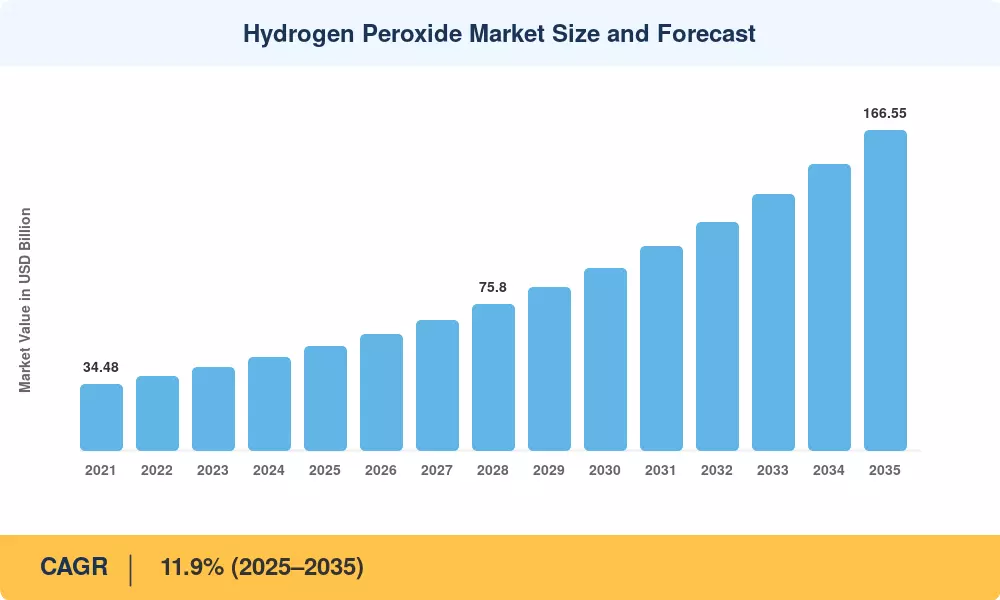
Hydrogen Peroxide Market Size and Forecast
Our Impact
Enabled $4.3B Revenue Impact for Fortune 500 and Leading Multinationals
Partnering with 2000+ Global Organizations Each Year
30K+ Citations by Top-Tier Firms in the Industry
ย 

Driver Impact Analysis

Driver ~% Impact on CAGR Geographic Relevance Impact Timeline
Semiconductor ultra-high-purity demand ~18% Asia-Pacific, North America Medium-term (2โ€“4 yr)
Municipal wastewater discharge regulations ~16% Europe, ASEAN Short-term (โ‰ค2 yr)
Healthcare VHP sterilization protocols ~14% Global Short-term (โ‰ค2 yr)
On-site electro-oxidation deployment ~13% North America, Europe Medium-term (2โ€“4 yr)
Low-carbon / green peroxide premiums ~12% Europe, North America Long-term (โ‰ฅ4 yr)
Textile & food-grade bleaching expansion ~15% Asia-Pacific, South America Medium-term (2โ€“4 yr)
Mining heap-leach oxidation adoption ~12% South America, Africa Long-term (โ‰ฅ4 yr)

ย 

Semiconductor Fabrication Demand

Advanced node semiconductor manufacturing facilities operating at highly dense sub-nanometer geometries process sophisticated multi-layer designs, which inherently require substantially higher volumes of chemical processing agents per wafer than previous nodes. Ultra-pure electronic-grade hydrogen peroxide is a baseline, non-negotiable element of the standard RCA cleaning sequence to remove organic residues and surface contaminants. The high-purity hydrogen peroxide industry is capturing a highly specialized, technically demanding volume stream that requires rigorous quality and price premiums above ordinary industrial bleaching alternatives.

ย 

Tightening Wastewater Standards

ย 

New quaternary treatment (a fourth stage of processing) is introduced in the recast European Union Urban Wastewater Treatment Directive (Directive EU 2024/3019) to address organic micropollutants. The application of this legal obligation is uniform across large wastewater treatment plants with a capacity threshold of 150,000 population equivalents and above, which greatly increases the reliance of the region on advanced oxidation processes (AOPs) using industrial-grade hydrogen peroxide as the main reagent.

ย 

Healthcare Sterilization Expansion

Official biosafety and infection-prevention guidance from organizations such as the World Health Organization highlights strict terminal cleaning procedures for healthcare environments that host high-risk pathogens. Vaporized Hydrogen Peroxide (VHP) is the recommended automated decontamination procedure within these frameworks, because of its very effective broad-spectrum sporicidal activity and its safe breakdown into residue-free by-products (water and oxygen). With healthcare networks across the globe embracing dedicated VHP systems as normal operating procedure, the technology offers a highly stable, recurrent baseline consumption model for specialized peroxide solutions that is fully independent of seasonal or pandemic infection cycles.

ย 

Green Peroxide and Sustainability Premiums

Chemical producers validating low-carbon production methodologies, like using green-hydrogen feedstocks or bio-allocated raw materials, are commanding distinct commercial premiums from pulp processors, textile manufacturers and consumer goods brands implementing strict corporate net-zero roadmaps. Major capital investments like European chemical cluster industrial low-carbon peroxide processing projects and South American bio-based feedstock adaptation strategies are confirming that eco-friendly disinfectants and chemical oxidants with fully traceable carbon footprints are creating highly resilient, differentiated pricing tiers across the global chemical supply chain.

ย 

ย 

Restraints Impact Analysis

Restraint ~% Drag on CAGR Geographic Relevance Impact Timeline
Recycled-fiber & enzyme pretreatments reducing bleaching dosage ~โ€“20% Europe, North America Medium-term (2โ€“4 yr)
Hazardous transport & storage regulations ~โ€“15% Global Short-term (โ‰ค2 yr)
Raw material (natural gas) price volatility ~โ€“18% Europe, Asia-Pacific Short-term (โ‰ค2 yr)
Competition from peracetic acid in food sanitation ~โ€“12% North America, Europe Medium-term (2โ€“4 yr)
Overcapacity in Chinese commodity grades ~โ€“10% Asia-Pacific Long-term (โ‰ฅ4 yr)

ย 

Dosage Reduction from Recycled Fiber and Enzyme Pretreatments

Recycled fiber as a component of total furnish mixes has been slowly increasing throughout European and North American paper mills, thus reducing the need for raw chemical bleaching on a per ton finished product basis. At the same time, the use of enzymatic pretreatments based on xylanases is a good biological bleach booster. The action of these enzymes enhances the bleachability of fibers by modifying the hemicellulose structures to release bound lignin. This dramatically reduces the required hydrogen peroxide dose to achieve the goal brightness.

ย 

Hazardous Transport and Storage Constraints

High-strength industrial hydrogen peroxide solutions are designated as hazardous oxidizers and corrosive chemicals under the United Nations GHS framework. Due to the high risk of violent exothermic decomposition if contaminated, these concentrations are legally required for the use of specialist transport vessels, supplementary confinement, and strict temperature-controlled storage. This logistical compliance overhead results in higher supplied pricing structures in landlocked regions, limiting bulk chemical penetration and promoting localized, on-site generation alternatives that totally circumvent transport friction.

ย 

Natural Gas Feedstock Volatility

The anthraquinone autoxidation route continues to be the dominant route for producing hydrogen peroxide worldwide and is primarily dependent on hydrogen feedstocks produced from the steam methane reforming of natural gas. International energy markets are characterized by extreme and unpredictable pricing volatility. Natural gas baselines immediately raise variable production costs for these commodity chemical processing agents. The supply pressure on global chemical producers compresses margins, requiring periodic contract price adjustments that have a direct effect on downstream demand elasticity.

ย 

ย 

Hydrogen Peroxide Market Opportunities

On-Site Generation for Municipal Water Utilities

On-site electrolytic peroxide generators eliminate hazardous chemical transport logistics and bulk storage risks for water facilities. Mid-tier municipal utilities represent a significant expansion base for peroxide-based water treatment chemicals. Equipment vendors offering flexible lease-to-own models can significantly accelerate utility adoption by converting intensive upfront capital expenditures into predictable, localized operational costs.

ย 

Electronic-Grade Peroxide for Advanced Packaging

Advanced semiconductor packaging techniques, including fan-out wafer-level packaging and hybridbonding, introduce critical micro-cleaning sequences that demand ultra-pure, electronic-grade peroxide formulations. To protect delicate sub-nanometer interconnects, these specialized solutions require strict sub-parts-per-billion metallic impurity limits, establishing a highly technical, high-margin product segment that operates independently of traditional commodity bleaching chemical volumes..

Emerging Market Penetration in Africa and South Asia

Sub-Saharan Africa's textile manufacturing output is expanding under the structural trade benefits of the African Continental Free Trade Area, outstripping localized chemical processing capacities. Similarly, Bangladeshโ€™s prominent garment export sector relies extensively on imported chemical processing inputs. Developing greenfield peroxide plants in these industrializing regions satisfies critical localized demand with minimal competitive friction.

Circular Economy Models in Pulp and Paper

Closed-loop peroxide recovery systems, which actively recapture unreacted chemical processing agents from bleach plant filtrate, are being deployed by sustainability-focused Scandinavian mills. Deploying or licensing these innovative recovery technologies to expanding pulp-producing regions across Latin America and Southeast Asia minimizes chemical waste while securing a clear commercial advantage tied to eco-friendly bleaching practices.

ย 

ย 

ย 

ย 

ย 

Hydrogen Peroxide Market Future Outlook

Green Hydrogen Integration and Decarbonized Production

Chemical producers are focusing on low-carbon manufacturing frameworks, utilizing electrolysis-fed hydrogen to develop eco-friendly alternatives to conventional anthraquinone synthesis pathways. Securing long-term renewable power purchase agreements allows companies to mitigate traditional raw material energy dependencies. This transition establishes a premium product tier oriented entirely around verified low-carbon footprints, supplying consumer brands and industrial processors requiring traceable, sustainable supply chains.

ย 

Digitalization and Smart Dosing Platforms

Industrial IoT deployments across paper mills and municipal wastewater installations utilize automated monitoring to optimize chemical inputs. Linking real-time water quality metrics and product specifications directly to automated feed pumps eliminates traditional chemical overconsumption while stabilizing operational process consistency. This digital shift supports performance-based service contracts, allowing chemical distributors to transition from simple bulk volume sales toward managed-service agreements.

ย 

Semiconductor and Electronics Supercycle

Extensive global capital investments in advanced fabrication facilities are transforming chemical supply infrastructure. Each newly commissioned foundry introduces specialized multi-step cleaning sequences requiring extensive volumes of ultra-pure electronic-grade peroxide. This microelectronics expansion fundamentally alters the broader market's product matrix, shifting production focus away from standard industrial bleaching variants and toward high-value, high-purity processing agents.

ย 

ย 

ย 

ย 

Hydrogen Peroxide Market Segmentation

By Product Function

Segment Key Metric Primary Demand Driver
Bleaching 66.1% share (2025) Pulp & paper, textile processing chemicals
Disinfectant 4.81% CAGR Healthcare sterilization chemicals, food safety
Chemical Synthesis USD 680 million (2025) Propylene oxide, caprolactam production
Environmental Remediation 4.92% CAGR Soil and groundwater cleanup with industrial oxidizing agents
Other Functions USD 290 million (2025) Mining, electronics cleaning

ย 

Bleaching remains the volume backbone of the Hydrogen Peroxide Market, with pulp mills and textile processors consuming over two-thirds of global output as paper bleaching chemicals and fabric whiteners. However, recycled-fiber adoption and enzymatic pretreatments are compressing per-ton dosage, causing this segment to grow below the market average. Disinfectant applications โ€” spanning VHP systems in hospitals, food-contact surface sanitation, and aseptic packaging sterilization โ€” represent the fastest-growing functional category, driven by regulatory mandates favoring residue-free, eco-friendly disinfectants over chlorine alternatives.

By Grade

Segment Key Metric Primary Demand Driver
Standard Grade (3โ€“35%) USD 2,150 million (2025) General bleaching chemicals, for household use
Industrial Grade (35โ€“50%) 45.2% share (2025) Pulp, textile processing chemicals, water treatment
High-Purity Grade (>50% / electronic) 5.74% CAGR Semiconductor cleaning, specialty peroxide compounds

ย 

Industrial grade dominates the Hydrogen Peroxide Market by revenue, serving the broad middle ground between dilute household products and ultra-pure electronic-grade material. High-purity grades are the fastest-growing segment, propelled by semiconductor fabs that specify sub-ppb metallic contamination levels โ€” a specification only five global producers can consistently meet, conferring pricing power and margin resilience.

By Concentration/Form

Segment Key Metric Primary Demand Driver
Aqueous Solution 85.5% share (2025) Dominant delivery form for all chemical processing agents
Powder & Granular Adducts 4.74% CAGR Laundry, dental, consumer and eco-friendly disinfectants

ย 

Aqueous solutions overwhelmingly dominate the Hydrogen Peroxide Market because liquid handling infrastructure is already installed across pulp mills, water utilities, and chemical plants. Powder and granular adducts โ€” including sodium percarbonate and carbamide peroxide โ€” are growing faster, driven by consumer demand for solid-format disinfectant chemicals in laundry pods and dental whitening products.

By End-User Industry

Segment Key Metric Primary Demand Driver
Pulp & Paper 52.1% share (2025) TCF/ECF bleaching sequences using paper bleaching chemicals
Chemical Synthesis USD 710 million (2025) HPPO process for propylene oxide
Wastewater Treatment 4.64% CAGR Advanced oxidation with water treatment chemicals
Mining USD 280 million (2025) Heap-leach oxidation, industrial oxidizing agents
Textiles 4.38% CAGR Fabric preparation, textile processing chemicals
Other Industries USD 410 million (2025) Food, electronics, healthcare and sterilization chemicals

ย 

Pulp and paper remains the anchor end-user of the Hydrogen Peroxide Market, though its relative share is gradually declining as wastewater and electronics applications grow faster. The HPPO (hydrogen peroxide to propylene oxide) process โ€” operated by BASF, Dow, and Evonik โ€” is the second-largest chemical-synthesis consumer, with each HPPO plant absorbing 100,000โ€“150,000 tons annually of industrial-grade chemical processing agents.

ย 

ย 

Regional Market Share Analysis

Region Key Metric Primary Investment Themes
Asia-Pacific 56.4% share (2025) Pulp expansion, textile processing chemicals, semiconductor fabs
North America 4.52% CAGR (2026โ€“2035) Water treatment chemicals, electronics and environmental remediation
Europe USD 1,780 million (2025) Green peroxide, healthcare sterilization chemicals and regulatory compliance
South America 3.85% CAGR (2026โ€“2035) Mining oxidation, paper bleaching chemicals and agricultural processing
Middle East & Africa USD 310 million (2025) Oil & gas, desalination and emerging textile processing chemicals
Total USD 6,340 million (2025) โ€”

The Hydrogen Peroxide Market exhibits a pronounced Asia-Pacific concentration, with the region's cost-advantaged producers and large-scale end users anchoring global volume. Regional dynamics in the Hydrogen Peroxide Market reflect differentiated growth trajectories shaped by regulatory environments, industrial mix, and infrastructure maturity.

ย 

North America

Country Key Metric Key Driver
US 72.3% of regional share Semiconductor, wastewater AOP
Canada 4.68% CAGR Pulp mill modernization
Mexico USD 105 million (2025) Textile and food-grade bleaching chemicals

ย 

The United States Hydrogen Peroxide Market benefits extensively from a massive wave of domestic semiconductor fabrication facility construction spurred by federal manufacturing incentives, with each newly commissioned foundry requiring ultra-pure electronic-grade chemical processing agents.

In Canada, pulp and paper operations across British Columbia and Quebec are increasingly utilizing hydrogen peroxide within elemental chlorine-free bleaching sequences as an advanced oxidation booster to enhance fiber brightness while lowering environmental impacts.

Meanwhile, Mexico's maquiladora textile corridors are scaling up hydrogen peroxide consumption to replace legacy chemistry, as tightening export quality standards and environmental alignment under trade provisions require cleaner, residue-free textile processing methods.

ย 

Europe

Country Key Metric Key Driver
Germany 24.8% of regional share Chemical synthesis, automotive catalysis
UK 4.39% CAGR Healthcare sterilization chemicals
France USD 215 million (2025) Nuclear decontamination, food processing
Italy 3.92% CAGR Textile processing chemicals
Spain USD 125 million (2025) Agricultural disinfection
Nordic Countries 4.61% CAGR Paper bleaching chemicals, green production
Russia USD 140 million (2025) Mining, commodity chemical processing agents
Rest of Europe 3.78% CAGR Diversified end-use

ย 

Europe's Hydrogen Peroxide Market is shaped by the EU Green Deal's push for carbon-neutral chemical production and the revised Urban Wastewater Treatment Directive mandating advanced oxidation. Evonik and Solvay operate the region's largest plants, and both have announced green peroxide capacity additions using renewable-hydrogen feedstocks, positioning Europe as the global hub for sustainably produced, eco-friendly disinfectants.

Asia-Pacific

Country Key Metric Key Driver
China 48.6% of regional share Pulp capacity, chemical synthesis
India 5.12% CAGR Textile processing chemicals, pharma
Japan USD 420 million (2025) Electronics, specialty peroxide compounds
South Korea 5.38% CAGR Semiconductor cleaning
ASEAN USD 530 million (2025) Palm oil refining, water treatment chemicals
Rest of Asia-Pacific 4.15% CAGR Diversified industrial use

ย 

China alone operates over 300 peroxide plants, and its capacity additions outpace domestic demand growth, creating export pressure that depresses commodity pricing across the Hydrogen Peroxide Market in Asia-Pacific. India's textile sector is the fastest-growing consumer of bleaching chemicals in the region, while South Korea's Yongin and Pyeongtaek semiconductor clusters are driving double-digit growth in high-purity grades.

South America

Country Key Metric Key Driver
Brazil 58.3% of regional share Pulp & paper, sugarcane processing
Argentina 4.02% CAGR Mining, agricultural disinfectant chemicals
Rest of South America USD 85 million (2025) Diversified industrial oxidizing agents

ย 

Brazil's Hydrogen Peroxide Market remains structurally tied to large-scale eucalyptus pulp capacity expansions led by major producers like Suzano and Klabin. Because bleaching short-fiber eucalyptus pulp requires optimized, eco-friendly processing agents to reach targeted brightness levels, these newly commissioned mills drive a massive, stable demand base for industrial bleaching chemicals. Meanwhile, Argentina's lithium extraction expansion across the Salta and Jujuy provinces is opening up specialized demand pockets for industrial oxidizing agents..

Middle East & Africa

Country Key Metric Key Driver
Saudi Arabia 32.1% of regional share Petrochemical, desalination
UAE 4.45% CAGR Healthcare, food safety
South Africa USD 48 million (2025) Mining oxidation
Egypt 3.95% CAGR Textile processing chemicals
Rest of MEA USD 72 million (2025) Emerging industrial base

ย 

Saudi Arabia's NEOM and Jubail industrial developments are embedding hydrogen peroxide into advanced water treatment chemicals infrastructure for desalination brine management. South Africa's platinum group metals mining sector uses peroxide-based chemical processing agents in flotation circuits. The broader MEA Hydrogen Peroxide Market remains nascent but is accelerating as local manufacturing reduces import dependence.

ย 

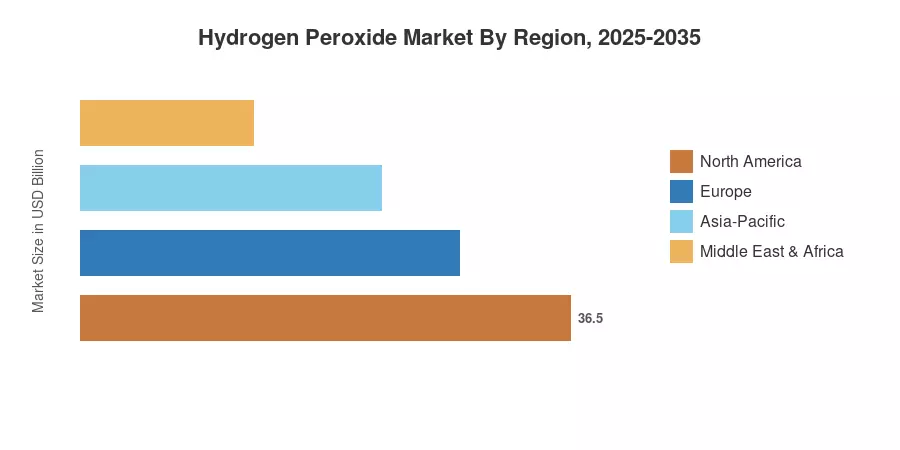
Hydrogen Peroxide Market By Region, 2025-2035
ย 

Competitive Benchmarking

The Hydrogen Peroxide Market exhibits moderate concentration, with an estimated HHI of approximately 850โ€“950 and the top five producers controlling roughly 43% of global capacity. Over 400 regional plants โ€” predominantly in China and Southeast Asia โ€” compete on freight advantage, keeping commodity pricing under pressure. Strategic differentiation increasingly hinges on electronic-grade capability, green production credentials, and integrated on-site generation offerings.

Company Est. Revenue Share Range Key Offerings Strategic Positioning
Evonik Industries AG ~8โ€“11% Standard to electronic-grade peroxide, green production Technology leader in HPPO and low-carbon peroxide
Solvay SA ~7โ€“10% Industrial and high-purity grades, eco-friendly disinfectants Integrated upstream hydrogen, global logistics network
Arkema SA ~5โ€“8% Organic peroxides, specialty peroxide compounds Specialty chemicals focus, polymer initiators
Nouryon (formerly AkzoNobel Specialty) ~5โ€“7% Pulp bleaching chemicals, on-site generation Strong Nordic pulp mill relationships
Mitsubishi Gas Chemical ~4โ€“6% Electronic-grade, semiconductor cleaning agents Asia-Pacific semiconductor supply chain integration
OCI NV ~3โ€“5% Commodity and industrial oxidizing agents Cost-competitive Middle East production base
Kemira Oyj ~3โ€“5% Water treatment chemicals, paper bleaching chemicals Pulp & paper process chemistry expertise
Hansol Chemical ~2โ€“4% High-purity electronic-grade peroxide Korean semiconductor cluster proximity
PeroxyChem (Evonik subsidiary) ~2โ€“4% Environmental remediation, chemical processing agents North American soil/groundwater remediation leader
Aditya Birla Chemicals ~2โ€“3% Industrial-grade textile processing chemicals Indian domestic market cost leadership

ย 

ย 

ย 

Recent News & Developments

ย 

(Evonik and Fuhua, 2025) In January 2025, Evonik and Fuhua officially established a joint venture company named Evonik Fuhua New Materials (Sichuan) Co., Ltd. in Leshan, China, with Evonik holding a 51% majority stake (Evonik, 2025). Under this partnership, the joint venture utilizes raw industrial-grade hydrogen peroxide from Fuhua's mega-plant and purifies it using Evonik's proprietary technology (Evonik, 2025).

(Solvay and BASF, 2025) In June 2025, Solvay and BASF announced a strategic collaboration to dramatically lower the Scope 3 greenhouse gas footprint of hydrogen peroxide production (Solvay, 2025). Solvay officially restructured its supply chain by selecting BASF as its primary local supplier of aluminum chloride for its Linne Herten plant in the Netherlands (Solvay, 2025).

ย 

ย 

ย 

ย 

ย 

ย 

ย 

ย 

ย 

ย 

Section 12 โ€” Report Scope and Methodology

Parameter Details
Market Scope Global Hydrogen Peroxide Market by product function, grade, concentration/form, end-user industry, and geography
Study Period 2021โ€“2035
CAGR (Forecast Period) 4.30% (2026โ€“2035)
Base Year Market Size USD 6,340 million (2025) / 6.54 million tons
Forecast Endpoint USD 9,580 million (2035) / 9.58 million tons
Fastest Growing Segment High-purity grade (5.74% CAGR); Wastewater treatment end-use (4.64% CAGR)
Companies Profiled 10 (Evonik, Solvay, Arkema, Nouryon, Mitsubishi Gas Chemical, OCI, Kemira, Hansol, PeroxyChem, Aditya Birla)
Valuation Currency USD Million

ย 

Section 13 โ€” Frequently Asked Questions (FAQs)

Q1. How does on-site peroxide generation compare economically to centralized supply for mid-sized industrial users?

On-site electrolytic units reduce delivered cost by 25โ€“30% for users consuming 500โ€“2,000 tons annually by eliminating transport and hazardous storage overhead. Capital payback typically falls within 3โ€“4 years for facilities with continuous process demand.

Q2. What purity certifications should semiconductor fabs require when qualifying a Hydrogen Peroxide Market supplier?

Fabs should require SEMI C30 Grade 5 compliance, which specifies sub-ppb levels for 27 metallic contaminants. Supplier audits should also verify continuous online monitoring and lot-traceability back to feedstock origin.

Q3. How are carbon-labeling regulations affecting procurement strategies in the Hydrogen Peroxide Market?

EU CBAM and France's carbon-score labeling push buyers toward verified low-carbon peroxide, which carries 15โ€“20% price premiums. Procurement teams are embedding scope-3 carbon intensity into supplier scorecards.

Q4. What role does the Hydrogen Peroxide Market play in advanced oxidation for PFAS remediation?

Peroxide-driven Fenton reactions degrade short-chain PFAS precursors in contaminated groundwater, a growing remediation niche in the US and EU. Pilot programs at Department of Defense sites have demonstrated 85โ€“92% destruction efficiency.

Q5. How do powder and granular adducts differ in shelf stability from aqueous solutions in the Hydrogen Peroxide Market?

Sodium percarbonate granules retain over 90% active oxygen for 18 months at ambient storage versus 6โ€“9 months for 35% aqueous solutions. This stability advantage drives adoption in consumer laundry and dental product formulations.

Q6. What insurance and liability considerations apply to bulk peroxide storage in the Hydrogen Peroxide Market?

Facilities storing above 3,400 kg of concentrated peroxide trigger EPA Risk Management Plan requirements and elevated insurance premiums averaging 12โ€“18% above standard chemical storage policies. Insurers increasingly require real-time temperature monitoring and automated dilution safeguards.

Q7. How is the Hydrogen Peroxide Market adapting to circular economy pressures in the European pulp sector?

Closed-loop bleach filtrate recovery systems now recapture 20โ€“30% of unreacted peroxide, reducing net consumption per ton of pulp. Scandinavian mills licensing this technology are setting procurement benchmarks that reward suppliers offering integrated recovery support.

ย 

ย 

FAQs

What is the current valuation of the Hydrogen Peroxide Market as of 2024?

The Hydrogen Peroxide Market was valued at 48.34 USD Billion in 2024.

What is the projected market valuation for Hydrogen Peroxide by 2035?

The market is projected to reach 166.55 USD Billion by 2035.

What is the expected CAGR for the Hydrogen Peroxide Market during the forecast period 2025 - 2035?

The expected CAGR for the Hydrogen Peroxide Market during 2025 - 2035 is 11.9%.

Which application segments are expected to drive growth in the Hydrogen Peroxide Market?

Key application segments include Water Treatment, projected to grow from 12.0 to 40.0 USD Billion, and Pulp and Paper, expected to rise from 10.0 to 35.0 USD Billion.

How does the Hydrogen Peroxide Market perform in the healthcare sector?

In the healthcare sector, the market is anticipated to expand from 8.0 to 30.0 USD Billion.

What are the projected values for different concentration levels of Hydrogen Peroxide by 2035?

By 2035, High Concentration Hydrogen Peroxide is expected to grow from 20.0 to 70.0 USD Billion, while Ultra High Concentration may increase from 5.34 to 18.55 USD Billion.

Which companies are considered key players in the Hydrogen Peroxide Market?

Key players in the market include Evonik Industries, Solvay, BASF, and AkzoNobel, among others.

What is the expected growth in the industrial end-use segment of the Hydrogen Peroxide Market?

The industrial end-use segment is projected to grow from 20.0 to 70.0 USD Billion by 2035.

How does the market for Hydrogen Peroxide in agriculture compare to other end-use segments?

The agriculture segment is expected to grow from 7.0 to 25.0 USD Billion, indicating a robust performance relative to other end-use segments.

What forms of Hydrogen Peroxide are anticipated to dominate the market by 2035?

Liquid forms of Hydrogen Peroxide are expected to dominate, with projections rising from 30.0 to 100.0 USD Billion by 2035.
Author
Author
Author Profile
Anshula Mandaokar LinkedIn
Team Lead - Research
Anshula Mandaokar holds an academic degree in Chemical Engineering and has been contributing to the field for more than 5 years. She has expertise in Market Research and Business Consulting and serves as a Team Lead for a reputed Market Research firm under the Chemicals and Materials domain spectrum. She has worked on multiple projects, generating explicit results in a quick turnaround time. Her understanding of data interpretation justifies her role as a leader.

Research Approach

ย 

Secondary Research

The secondary research process involved comprehensive analysis of chemical industry databases, regulatory filings, peer-reviewed industrial chemistry journals, and authoritative chemical industry organizations. Key sources included the US Environmental Protection Agency (EPA), Occupational Safety and Health Administration (OSHA), European Chemicals Agency (ECHA), European Industrial Gases Association (EIGA), American Chemistry Council (ACC), European Chemical Industry Council (Cefic), National Institute of Standards and Technology (NIST), Centers for Disease Control and Prevention (CDC) Chemical Safety Data, World Health Organization (WHO) Chemical Safety Program, Food and Drug Administration (FDA) for food-grade hydrogen peroxide regulations, US Department of Agriculture (USDA) Agricultural Chemical Usage Reports, EU Eurostat Industrial Production Database, China National Chemical Information Center (CNCIC), Japan Chemical Industry Association (JCIA), and national chemical industry statistics from key manufacturing markets.

The following sources were employed to gather production capacity data, regulatory compliance standards, industrial safety studies, import/export trade statistics, and market landscape analysis for standard grade, chemical grade, aseptic grade, and semiconductor grade hydrogen peroxide in pulp & paper, textile, water treatment, chemical synthesis, and food processing applications.

ย 

Primary Research

Qualitative and quantitative insights were obtained by interviewing supply-side and demand-side stakeholders during the primary research process. The supply-side sources consisted of CEOs, VPs of Manufacturing Operations, regulatory compliance leaders, and commercial directors from industrial gas companies, chemical distributors, and hydrogen peroxide manufacturers. Food processing quality assurance managers from industrial manufacturing facilities and commercial operations, textile bleaching facility managers, water treatment plant operators, chemical synthesis engineers, and procurement directors from pulp & paper mills constituted demand-side sources. Primary research verified market segmentation across grade categories and end-use applications, confirmed capacity expansion timelines, and collected insights on industrial adoption patterns, pricing volatility factors, and regulatory compliance costs.

Primary Respondent Breakdown:

By Designation: C-level Primaries (32%), Director Level (31%), Others (37%)

By Region: North America (32%), Europe (30%), Asia-Pacific (33%), Rest of World (5%)

ย 

Market Size Estimation

Production capacity mapping and consumption volume analysis were employed to determine the global market valuation. The methodology comprised the following:

The identification of over 50 key manufacturers in North America, Europe, Asia-Pacific, and Latin America

Product mapping across semiconductor grade, chemical grade, aseptic grade, and standard grade categories Examination of annual revenues that are specific to hydrogen peroxide portfolios, as reported and modeled

In 2024, the coverage of manufacturers will account for 75-80% of the global production capacity.

To derive segment-specific valuations across disinfection, oxidation, environmental, and other industrial applications, extrapolation is employed using bottom-up (consumption volume ร— ASP by application sector and region) and top-down (manufacturer revenue validation) approaches.

Download Free Sample

Kindly complete the form below to receive a free sample of this Report

Download PDF ×

We do not share your information with anyone. However, we may send you emails based on your report interest from time to time. You may contact us at any time to opt-out.
















