Hygienic Equipment Maintenance Market

Hygienic Equipment Maintenance Market Research Report By End Use (Manufacturers, Service Providers, Distributors, Retailers), By Technology (Automated Systems, Manual Systems, Hybrid Systems, IoT-Enabled Solutions), By Application (Food Processing, Pharmaceutical Manufacturing, Healthcare Facilities, Beverage Production), By Service Type (Routine Maintenance, Emergency Repairs, Consultation Services, Training Services), By Equipment Type (Cleaning Equipment, Disinfection Equipment, Maintenance Tools, Monitoring Systems) And By Region (North America, Europe, Asia-Pacific, And Rest Of The World) – Market Forecast Till 2035.

Forecast Period
2025 - 2035
CAGR
4.37%
2024 Market Size
$ 12.5 Billion
2035 Market Size
$ 20 Billion
MRO ● Updated April 24, 2026 Report ID: MRFR/MRO/65193-HCR | Pages: 200 | Author: Shubham Munde

Hygienic Equipment Maintenance Market Summary

As per MRFR analysis, the Hygienic Equipment Maintenance Market Size was estimated at 12.5 USD Billion in 2024. The Hygienic Equipment Maintenance industry is projected to grow from 13.05 USD Billion in 2025 to 20.0 USD Billion by 2035, exhibiting a compound annual growth rate (CAGR) of 4.37% during the forecast period 2025 - 2035.

Key Market Trends & Highlights

The Hygienic Equipment Maintenance Market is poised for growth driven by technological advancements and increasing regulatory compliance.

  • Technological advancements in maintenance solutions are reshaping the Hygienic Equipment Maintenance Market, particularly in North America.
  • The Food Processing segment remains the largest contributor to market revenue, while Healthcare Facilities are experiencing the fastest growth.
  • Sustainability in maintenance practices is becoming a focal point for companies aiming to enhance their operational efficiency.
  • Rising demand for hygiene standards and increased focus on regulatory compliance are key drivers propelling market expansion.

Market Size & Forecast

2024 Market Size 12.5 (USD Billion)
2035 Market Size 20.0 (USD Billion)
CAGR (2025 - 2035) 4.37%

Major Players

Ecolab (US), Diversey Holdings, Ltd. (US), SC Johnson Professional (US), Karcher (DE), Hygiena (US), Tennant Company (US), Zep Inc. (US), Betco Corporation (US), Procter & Gamble Professional (US)

Our Impact

Enabled $4.3B Revenue Impact for Fortune 500 and Leading Multinationals

Partnering with 2000+ Global Organizations Each Year

30K+ Citations by Top-Tier Firms in the Industry

Hygienic Equipment Maintenance Market Drivers

Rising Demand for Hygiene Standards

The Hygienic Equipment Maintenance Market is experiencing a notable increase in demand for stringent hygiene standards across various sectors, including food processing, healthcare, and pharmaceuticals. This trend is driven by heightened awareness of health and safety, leading organizations to prioritize the maintenance of hygienic equipment. According to recent data, the food and beverage sector alone has seen a 15% increase in investments towards hygienic equipment maintenance in the past year. As consumers become more health-conscious, businesses are compelled to ensure that their equipment meets rigorous hygiene standards, thereby propelling the growth of the Hygienic Equipment Maintenance Market.

Increased Focus on Regulatory Compliance

Regulatory compliance is a critical driver in the Hygienic Equipment Maintenance Market. Governments and regulatory bodies are imposing stricter guidelines to ensure that equipment used in sensitive environments adheres to hygiene standards. This has led to an increase in demand for maintenance services that can guarantee compliance with these regulations. For example, the pharmaceutical industry has reported a 10% rise in maintenance service contracts to meet new regulatory requirements. As organizations strive to avoid penalties and maintain their reputations, the emphasis on compliance is expected to bolster the Hygienic Equipment Maintenance Market.

Expansion of the Food and Beverage Sector

The expansion of the food and beverage sector is a significant driver for the Hygienic Equipment Maintenance Market. As this sector continues to grow, the need for hygienic equipment maintenance becomes increasingly critical. Recent reports suggest that the food and beverage industry is projected to grow by 5% annually, leading to heightened investments in maintenance services to ensure compliance with hygiene standards. This growth is likely to create new opportunities for maintenance service providers, as businesses seek to enhance their operational efficiency and safeguard public health, thereby propelling the Hygienic Equipment Maintenance Market.

Growing Awareness of Sustainability Practices

Sustainability is becoming an essential consideration in the Hygienic Equipment Maintenance Market. Companies are increasingly adopting eco-friendly maintenance practices to reduce their environmental footprint. This includes the use of biodegradable cleaning agents and energy-efficient equipment. Recent surveys indicate that 60% of organizations are now prioritizing sustainability in their maintenance strategies. As consumers and stakeholders demand more environmentally responsible practices, the Hygienic Equipment Maintenance Market is likely to see a shift towards sustainable solutions, which could enhance brand loyalty and market competitiveness.

Technological Innovations in Maintenance Practices

Technological advancements are significantly influencing the Hygienic Equipment Maintenance Market. The integration of IoT and AI technologies into maintenance practices is enhancing efficiency and effectiveness. For instance, predictive maintenance solutions are being adopted to anticipate equipment failures before they occur, thereby reducing downtime and maintenance costs. Recent statistics indicate that companies utilizing these technologies have reduced maintenance costs by up to 20%. This shift towards technology-driven maintenance solutions is likely to continue, as organizations seek to optimize their operations and ensure compliance with hygiene standards, further driving the growth of the Hygienic Equipment Maintenance Market.

Market Segment Insights

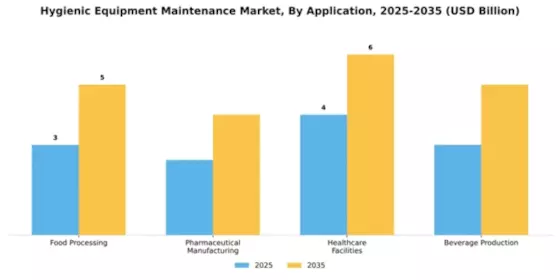
By Application: Food Processing (Largest) vs. Healthcare Facilities (Fastest-Growing)

The Hygienic Equipment Maintenance Market showcases a dynamic distribution of market share among its application segments. Food Processing is currently the largest segment, due to its stringent hygiene standards and need for thorough cleaning protocols. It holds a significant share as manufacturers are increasingly investing in hygienic solutions to adhere to regulations and consumer demands for food safety. Following closely, Healthcare Facilities represent a growing segment as they are under constant pressure to maintain sterile environments. This is leading to an uptick in hygienic equipment maintenance investments in this sector. The growth trends within this market segment highlight an increasing focus on hygiene and sanitation, particularly accelerated by global health events and rising consumer awareness. Factors driving this growth include advancements in cleaning technologies, regulatory pressures on hygiene maintenance, and the ongoing expansion of the healthcare and food production sectors. As healthcare facilities push for faster and more efficient sanitization processes, they are becoming the fastest-growing application, outpacing others in innovative maintenance solutions, thus shaping the future landscape of the market.
Hygienic Equipment Maintenance Market Segment Image 0

Food Processing: Dominant vs. Healthcare Facilities: Emerging

In the Hygienic Equipment Maintenance Market, Food Processing stands out as the dominant segment due to its essential role in ensuring food safety and quality. This sector's emphasis on compliance with stringent health regulations drives the demand for regular maintenance and cleaning of hygienic equipment. Conversely, Healthcare Facilities have emerged as a new frontier in this market, characterized by a heightened emphasis on infection control and cleanliness, especially post-pandemic. The increasing investment in advanced cleaning solutions and technologies positions healthcare facilities as an emerging segment, responding to growing public health demands and regulatory requirements. Both segments exhibit unique characteristics, with Food Processing focusing on consistent hygiene practices and Healthcare Facilities prioritizing rapid sanitation and infection prevention.
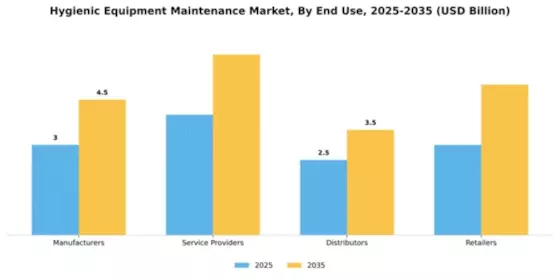
By End Use: Manufacturers (Largest) vs. Service Providers (Fastest-Growing)

Hygienic Equipment Maintenance Market Segment Image 1

The Hygienic Equipment Maintenance Market is predominantly driven by manufacturers, who hold the largest share in the end-use segment. These companies are integral in delivering essential maintenance solutions, maintaining high standards of hygiene across various sectors. Service providers follow closely, marking a significant presence due to the growing demand for specialized maintenance services tailored to specific industries. Their rising adoption has allowed them to carve out a substantial niche in the market.

Manufacturers (Dominant) vs. Service Providers (Emerging)

Manufacturers in the Hygienic Equipment Maintenance Market are viewed as the dominant players, focusing on the production of advanced hygienic solutions that cater to diverse industry needs. They prioritize innovation and quality, ensuring their products meet strict hygiene standards and regulatory requirements. On the other hand, service providers are emerging as key figures in this market, offering comprehensive maintenance services that emphasize efficiency and expertise. As industries increasingly recognize the importance of hygienic practices, service providers are swiftly adapting to meet these changing demands, thus enhancing their market position.

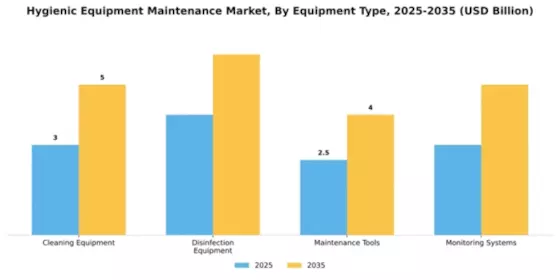
By Equipment Type: Cleaning Equipment (Largest) vs. Disinfection Equipment (Fastest-Growing)

In the Hygienic Equipment Maintenance Market, Cleaning Equipment holds the largest share, thanks to its extensive use across various industries including healthcare, food and beverage, and hospitality. This segment caters to a wide range of cleaning needs, from simple surface cleaning to specialized applications, hence attracting a broad customer base. Disinfection Equipment is experiencing rapid growth owing to heightened hygiene awareness and regulatory demands in numerous sectors, especially post-pandemic. This surge in adoption places Disinfection Equipment as a key player in the market, reflecting a significant shift towards maintaining higher hygiene standards.
Hygienic Equipment Maintenance Market Segment Image 2

Cleaning Equipment (Dominant) vs. Monitoring Systems (Emerging)

Cleaning Equipment stands out as the dominant segment in the Hygienic Equipment Maintenance Market, characterized by its variety and versatility in applications. It includes tools used for manual and mechanical cleaning processes, making it essential in sectors where hygiene is paramount. On the other hand, Monitoring Systems are emerging as a crucial segment, leveraging technology to enhance compliance and track hygiene standards efficiently. These systems provide real-time data and analytics that help organizations maintain their cleaning protocols effectively. While Cleaning Equipment emphasizes immediate physical cleanliness, Monitoring Systems represent a shift towards data-driven hygiene management, indicating an evolving market where technology complements traditional cleaning methods.
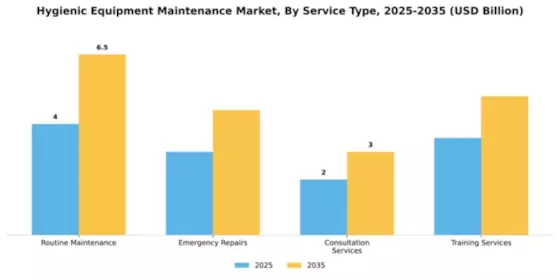
By Service Type: Routine Maintenance (Largest) vs. Emergency Repairs (Fastest-Growing)

Hygienic Equipment Maintenance Market Segment Image 3

In the Hygienic Equipment Maintenance Market, Routine Maintenance accounts for the largest share, reflecting its essential role in ensuring the ongoing functionality and compliance of hygienic systems. As facilities prioritize the reliability of their equipment to maintain hygiene standards, the demand for routine services has cemented this segment's lead in revenue generation. Conversely, Emergency Repairs have emerged as the fastest-growing segment, driven by the increased unpredictability of equipment failures that can lead to critical downtime in high-stakes environments.

Routine Maintenance (Dominant) vs. Emergency Repairs (Emerging)

Routine Maintenance is the cornerstone of the Hygienic Equipment Maintenance Market, emphasizing regular inspections, cleaning, and servicing to prevent breakdowns and ensure optimal performance of equipment used in hygiene-sensitive environments. Its prominence is a testament to the industry's focus on proactive measures that safeguard operational efficiency. On the other hand, Emergency Repairs cater to unexpected failures, characterized by a quick response requirement that reflects the urgency and importance of restoring equipment functionality. This segment’s growth can be attributed to heightened awareness of hygiene practices and the potential risks associated with equipment malfunctions that can disrupt business operations.

By Technology: Automated Systems (Largest) vs. IoT-Enabled Solutions (Fastest-Growing)

In the Hygienic Equipment Maintenance Market, the distribution of market share among the technology segment values reveals that Automated Systems hold the largest share, primarily due to their efficiency and reliability in ensuring hygiene standards. Manual Systems are also present but are gradually declining in preference as businesses shift towards more reliable and efficient solutions. Hybrid Systems provide a balanced approach that combines automation and manual oversight, appealing to organizations that transition gradually into full automation.
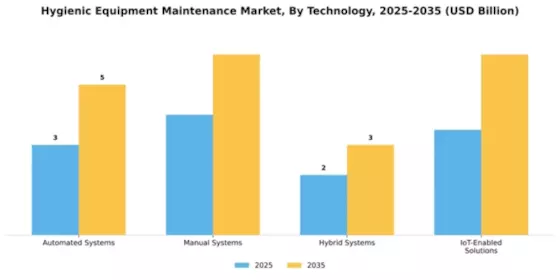
Hygienic Equipment Maintenance Market Segment Image 4

Technology: Automated Systems (Dominant) vs. IoT-Enabled Solutions (Emerging)

Automated Systems are characterized by their ability to streamline maintenance processes, reducing human error and increasing efficiency. They dominate the market due to their established presence and proven effectiveness in maintaining hygiene standards. In contrast, IoT-Enabled Solutions are emerging rapidly as they offer innovative features such as remote monitoring and predictive maintenance. This technology is appealing, particularly to tech-savvy businesses seeking to enhance their operations. The growth of IoT in this segment is driven by advancements in connectivity and data analytics, making it a crucial player for future market developments.

Get more detailed insights about Hygienic Equipment Maintenance Market Request Free Sample

Regional Insights

North America : Market Leader in Hygiene Solutions

North America is poised to maintain its leadership in the Hygienic Equipment Maintenance Market, holding a significant market share of 5.0 in 2024. The region's growth is driven by stringent regulatory standards and increasing awareness of hygiene in various sectors, including healthcare and food processing. The demand for advanced cleaning solutions is further fueled by the rise in health concerns and the need for compliance with safety regulations. The competitive landscape in North America is robust, featuring key players such as Ecolab, Diversey Holdings, and SC Johnson Professional. These companies are leveraging innovative technologies and sustainable practices to enhance their service offerings. The presence of established brands and a strong distribution network contribute to the region's market strength, ensuring a steady supply of hygienic maintenance solutions across various industries.

Europe : Emerging Market with Growth Potential

Europe's Hygienic Equipment Maintenance Market is projected to grow, with a market size of 3.5 in 2025. The region is experiencing increased demand for hygienic solutions driven by regulatory frameworks aimed at improving public health standards. The European Union's stringent regulations on hygiene practices in food and healthcare sectors are significant catalysts for market growth, encouraging investments in advanced cleaning technologies. Leading countries such as Germany, France, and the UK are at the forefront of this market, with a competitive landscape featuring companies like Karcher and Diversey Holdings. The presence of these key players, along with a focus on sustainability and innovation, positions Europe as a promising market for hygienic equipment maintenance. The region's commitment to health and safety standards further enhances its market potential.

Asia-Pacific : Rapid Growth in Hygiene Awareness

The Asia-Pacific region is witnessing a surge in the Hygienic Equipment Maintenance Market, with a market size of 3.0 in 2025. This growth is primarily driven by increasing urbanization, rising disposable incomes, and heightened awareness of hygiene practices. Governments are implementing regulations to improve sanitation standards, particularly in healthcare and food sectors, which is further propelling market demand for hygienic solutions. Countries like China, India, and Japan are leading the charge in this market, with a competitive landscape that includes both local and international players. Companies such as Hygiena and Tennant Company are expanding their presence in the region, focusing on innovative products tailored to meet local needs. The growing emphasis on cleanliness and safety in public spaces is expected to drive further growth in the Asia-Pacific hygienic equipment maintenance market.

Middle East and Africa : Emerging Market with Untapped Potential

The Middle East and Africa region is gradually emerging in the Hygienic Equipment Maintenance Market, with a market size of 1.0 in 2025. The growth is driven by increasing awareness of hygiene and sanitation, particularly in the wake of health crises. Governments are beginning to implement regulations aimed at improving hygiene standards in various sectors, which is expected to boost demand for hygienic maintenance solutions. Countries such as South Africa and the UAE are leading the market, with a competitive landscape that includes both local and international players. The presence of key companies like Zep Inc. and Betco Corporation is helping to establish a foothold in this region. As the focus on hygiene continues to grow, the Middle East and Africa present significant opportunities for expansion in the hygienic equipment maintenance market.

Key Players and Competitive Insights

The Hygienic Equipment Maintenance Market is characterized by a dynamic competitive landscape, driven by increasing regulatory standards and heightened consumer awareness regarding hygiene. Key players such as Ecolab (US), Diversey Holdings, Ltd. (US), and SC Johnson Professional (US) are strategically positioned to leverage innovation and sustainability in their operations. Ecolab (US) focuses on digital transformation and advanced cleaning technologies, while Diversey Holdings, Ltd. (US) emphasizes sustainable product development and partnerships to enhance its market presence. SC Johnson Professional (US) is also investing in eco-friendly solutions, which collectively shapes a competitive environment that prioritizes sustainability and technological advancement.The market structure appears moderately fragmented, with numerous players vying for market share. Key business tactics include localizing manufacturing to reduce costs and optimize supply chains, which enhances responsiveness to regional demands. The collective influence of these major players fosters a competitive atmosphere where innovation and operational efficiency are paramount, allowing them to adapt to evolving market needs.In November Ecolab (US) announced the launch of a new line of eco-friendly cleaning products designed to meet stringent environmental standards. This strategic move not only aligns with global sustainability trends but also positions Ecolab (US) as a leader in environmentally responsible cleaning solutions. The introduction of these products is likely to attract environmentally conscious consumers and businesses, thereby enhancing Ecolab's competitive edge.In October Diversey Holdings, Ltd. (US) entered into a strategic partnership with a leading technology firm to integrate AI-driven analytics into its cleaning solutions. This collaboration aims to optimize cleaning processes and improve operational efficiency for clients. By harnessing AI technology, Diversey Holdings, Ltd. (US) is poised to offer enhanced service delivery, which could significantly differentiate its offerings in a crowded market.In September SC Johnson Professional (US) expanded its product portfolio by acquiring a niche player specializing in antimicrobial coatings. This acquisition is strategically important as it allows SC Johnson Professional (US) to diversify its offerings and cater to the growing demand for long-lasting hygiene solutions. The integration of these products into their existing line could strengthen their market position and appeal to a broader customer base.As of December current competitive trends in the Hygienic Equipment Maintenance Market are increasingly defined by digitalization, sustainability, and AI integration. Strategic alliances are becoming more prevalent, enabling companies to pool resources and expertise to enhance their service offerings. Looking ahead, competitive differentiation is likely to evolve from traditional price-based competition to a focus on innovation, technology, and supply chain reliability. This shift underscores the importance of adapting to market demands and consumer preferences, ultimately shaping the future landscape of the industry.


Key Companies in the Hygienic Equipment Maintenance Market include

Future Outlook

Hygienic Equipment Maintenance Market Future Outlook

The Hygienic Equipment Maintenance Market is projected to grow at a 4.37% CAGR from 2025 to 2035, driven by increasing hygiene standards and technological advancements.

New opportunities lie in:

  • Integration of IoT for real-time monitoring solutions Development of eco-friendly cleaning agents Expansion of subscription-based maintenance services

By 2035, the market is expected to be robust, driven by innovation and heightened hygiene awareness.

Market Segmentation

hygienic-equipment-maintenance-market End Use Outlook

  • Manufacturers
  • Service Providers
  • Distributors
  • Retailers

hygienic-equipment-maintenance-market Technology Outlook

  • Automated Systems
  • Manual Systems
  • Hybrid Systems
  • IoT-Enabled Solutions

hygienic-equipment-maintenance-market Application Outlook

  • Food Processing
  • Pharmaceutical Manufacturing
  • Healthcare Facilities
  • Beverage Production

hygienic-equipment-maintenance-market Service Type Outlook

  • Routine Maintenance
  • Emergency Repairs
  • Consultation Services
  • Training Services

hygienic-equipment-maintenance-market Equipment Type Outlook

  • Cleaning Equipment
  • Disinfection Equipment
  • Maintenance Tools
  • Monitoring Systems

Report Scope

MARKET SIZE 2024 12.5(USD Billion)
MARKET SIZE 2025 13.05(USD Billion)
MARKET SIZE 2035 20.0(USD Billion)
COMPOUND ANNUAL GROWTH RATE (CAGR) 4.37% (2025 - 2035)
REPORT COVERAGE Revenue Forecast, Competitive Landscape, Growth Factors, and Trends
BASE YEAR 2024
Market Forecast Period 2025 - 2035
Historical Data 2019 - 2024
Market Forecast Units USD Billion
Key Companies Profiled Ecolab (US), Diversey Holdings, Ltd. (US), SC Johnson Professional (US), Karcher (DE), Hygiena (US), Tennant Company (US), Zep Inc. (US), Betco Corporation (US), Procter & Gamble Professional (US)
Segments Covered Application, End Use, Equipment Type, Service Type, Technology
Key Market Opportunities Integration of advanced automation technologies enhances efficiency in the Hygienic Equipment Maintenance Market.
Key Market Dynamics Rising regulatory standards drive demand for advanced hygienic equipment maintenance solutions across various industries.
Countries Covered North America, Europe, APAC, South America, MEA

Table of Contents

  1. SECTION I: EXECUTIVE SUMMARY AND KEY HIGHLIGHTS |
    1. 1.1 EXECUTIVE SUMMARY | |
      1. 1.1.1 Market Overview | |
      2. 1.1.2 Key Findings | |
      3. 1.1.3 Market Segmentation | |
      4. 1.1.4 Competitive Landscape | |
      5. 1.1.5 Challenges and Opportunities | |
      6. 1.1.6 Future Outlook 2
  2. SECTION II: SCOPING, METHODOLOGY AND MARKET STRUCTURE |
    1. 2.1 MARKET INTRODUCTION | |
      1. 2.1.1 Definition | |
      2. 2.1.2 Scope of the study | | |
        1. 2.1.2.1 Research Objective | | |
        2. 2.1.2.2 Assumption | | |
        3. 2.1.2.3 Limitations |
    2. 2.2 RESEARCH METHODOLOGY | |
      1. 2.2.1 Overview | |
      2. 2.2.2 Data Mining | |
      3. 2.2.3 Secondary Research | |
      4. 2.2.4 Primary Research | | |
        1. 2.2.4.1 Primary Interviews and Information Gathering Process | | |
        2. 2.2.4.2 Breakdown of Primary Respondents | |
      5. 2.2.5 Forecasting Model | |
      6. 2.2.6 Market Size Estimation | | |
        1. 2.2.6.1 Bottom-Up Approach | | |
        2. 2.2.6.2 Top-Down Approach | |
      7. 2.2.7 Data Triangulation | |
      8. 2.2.8 Validation 3
  3. SECTION III: QUALITATIVE ANALYSIS |
    1. 3.1 MARKET DYNAMICS | |
      1. 3.1.1 Overview | |
      2. 3.1.2 Drivers | |
      3. 3.1.3 Restraints | |
      4. 3.1.4 Opportunities |
    2. 3.2 MARKET FACTOR ANALYSIS | |
      1. 3.2.1 Value chain Analysis | |
      2. 3.2.2 Porter's Five Forces Analysis | | |
        1. 3.2.2.1 Bargaining Power of Suppliers | | |
        2. 3.2.2.2 Bargaining Power of Buyers | | |
        3. 3.2.2.3 Threat of New Entrants | | |
        4. 3.2.2.4 Threat of Substitutes | | |
        5. 3.2.2.5 Intensity of Rivalry | |
      3. 3.2.3 COVID-19 Impact Analysis | | |
        1. 3.2.3.1 Market Impact Analysis | | |
        2. 3.2.3.2 Regional Impact | | |
        3. 3.2.3.3 Opportunity and Threat Analysis 4
  4. SECTION IV: QUANTITATIVE ANALYSIS |
    1. 4.1 Healthcare, BY Application (USD Billion) | |
      1. 4.1.1 Food Processing | |
      2. 4.1.2 Pharmaceutical Manufacturing | |
      3. 4.1.3 Healthcare Facilities | |
      4. 4.1.4 Beverage Production |
    2. 4.2 Healthcare, BY End Use (USD Billion) | |
      1. 4.2.1 Manufacturers | |
      2. 4.2.2 Service Providers | |
      3. 4.2.3 Distributors | |
      4. 4.2.4 Retailers |
    3. 4.3 Healthcare, BY Equipment Type (USD Billion) | |
      1. 4.3.1 Cleaning Equipment | |
      2. 4.3.2 Disinfection Equipment | |
      3. 4.3.3 Maintenance Tools | |
      4. 4.3.4 Monitoring Systems |
    4. 4.4 Healthcare, BY Service Type (USD Billion) | |
      1. 4.4.1 Routine Maintenance | |
      2. 4.4.2 Emergency Repairs | |
      3. 4.4.3 Consultation Services | |
      4. 4.4.4 Training Services |
    5. 4.5 Healthcare, BY Technology (USD Billion) | |
      1. 4.5.1 Automated Systems | |
      2. 4.5.2 Manual Systems | |
      3. 4.5.3 Hybrid Systems | |
      4. 4.5.4 IoT-Enabled Solutions |
    6. 4.6 Healthcare, BY Region (USD Billion) | |
      1. 4.6.1 North America | | |
        1. 4.6.1.1 US | | |
        2. 4.6.1.2 Canada | |
      2. 4.6.2 Europe | | |
        1. 4.6.2.1 Germany | | |
        2. 4.6.2.2 UK | | |
        3. 4.6.2.3 France | | |
        4. 4.6.2.4 Russia | | |
        5. 4.6.2.5 Italy | | |
        6. 4.6.2.6 Spain | | |
        7. 4.6.2.7 Rest of Europe | |
      3. 4.6.3 APAC | | |
        1. 4.6.3.1 China | | |
        2. 4.6.3.2 India | | |
        3. 4.6.3.3 Japan | | |
        4. 4.6.3.4 South Korea | | |
        5. 4.6.3.5 Malaysia | | |
        6. 4.6.3.6 Thailand | | |
        7. 4.6.3.7 Indonesia | | |
        8. 4.6.3.8 Rest of APAC | |
      4. 4.6.4 South America | | |
        1. 4.6.4.1 Brazil | | |
        2. 4.6.4.2 Mexico | | |
        3. 4.6.4.3 Argentina | | |
        4. 4.6.4.4 Rest of South America | |
      5. 4.6.5 MEA | | |
        1. 4.6.5.1 GCC Countries | | |
        2. 4.6.5.2 South Africa | | |
        3. 4.6.5.3 Rest of MEA 5
  5. SECTION V: COMPETITIVE ANALYSIS |
    1. 5.1 Competitive Landscape | |
      1. 5.1.1 Overview | |
      2. 5.1.2 Competitive Analysis | |
      3. 5.1.3 Market share Analysis | |
      4. 5.1.4 Major Growth Strategy in the Healthcare | |
      5. 5.1.5 Competitive Benchmarking | |
      6. 5.1.6 Leading Players in Terms of Number of Developments in the Healthcare | |
      7. 5.1.7 Key developments and growth strategies | | |
        1. 5.1.7.1 New Product Launch/Service Deployment | | |
        2. 5.1.7.2 Merger & Acquisitions | | |
        3. 5.1.7.3 Joint Ventures | |
      8. 5.1.8 Major Players Financial Matrix | | |
        1. 5.1.8.1 Sales and Operating Income | | |
        2. 5.1.8.2 Major Players R&D Expenditure. 2023 |
    2. 5.2 Company Profiles | |
      1. 5.2.1 Ecolab (US) | | |
        1. 5.2.1.1 Financial Overview | | |
        2. 5.2.1.2 Products Offered | | |
        3. 5.2.1.3 Key Developments | | |
        4. 5.2.1.4 SWOT Analysis | | |
        5. 5.2.1.5 Key Strategies | |
      2. 5.2.2 Diversey Holdings, Ltd. (US) | | |
        1. 5.2.2.1 Financial Overview | | |
        2. 5.2.2.2 Products Offered | | |
        3. 5.2.2.3 Key Developments | | |
        4. 5.2.2.4 SWOT Analysis | | |
        5. 5.2.2.5 Key Strategies | |
      3. 5.2.3 SC Johnson Professional (US) | | |
        1. 5.2.3.1 Financial Overview | | |
        2. 5.2.3.2 Products Offered | | |
        3. 5.2.3.3 Key Developments | | |
        4. 5.2.3.4 SWOT Analysis | | |
        5. 5.2.3.5 Key Strategies | |
      4. 5.2.4 Karcher (DE) | | |
        1. 5.2.4.1 Financial Overview | | |
        2. 5.2.4.2 Products Offered | | |
        3. 5.2.4.3 Key Developments | | |
        4. 5.2.4.4 SWOT Analysis | | |
        5. 5.2.4.5 Key Strategies | |
      5. 5.2.5 Hygiena (US) | | |
        1. 5.2.5.1 Financial Overview | | |
        2. 5.2.5.2 Products Offered | | |
        3. 5.2.5.3 Key Developments | | |
        4. 5.2.5.4 SWOT Analysis | | |
        5. 5.2.5.5 Key Strategies | |
      6. 5.2.6 Tennant Company (US) | | |
        1. 5.2.6.1 Financial Overview | | |
        2. 5.2.6.2 Products Offered | | |
        3. 5.2.6.3 Key Developments | | |
        4. 5.2.6.4 SWOT Analysis | | |
        5. 5.2.6.5 Key Strategies | |
      7. 5.2.7 Zep Inc. (US) | | |
        1. 5.2.7.1 Financial Overview | | |
        2. 5.2.7.2 Products Offered | | |
        3. 5.2.7.3 Key Developments | | |
        4. 5.2.7.4 SWOT Analysis | | |
        5. 5.2.7.5 Key Strategies | |
      8. 5.2.8 Betco Corporation (US) | | |
        1. 5.2.8.1 Financial Overview | | |
        2. 5.2.8.2 Products Offered | | |
        3. 5.2.8.3 Key Developments | | |
        4. 5.2.8.4 SWOT Analysis | | |
        5. 5.2.8.5 Key Strategies | |
      9. 5.2.9 Procter & Gamble Professional (US) | | |
        1. 5.2.9.1 Financial Overview | | |
        2. 5.2.9.2 Products Offered | | |
        3. 5.2.9.3 Key Developments | | |
        4. 5.2.9.4 SWOT Analysis | | |
        5. 5.2.9.5 Key Strategies |
    3. 5.3 Appendix | |
      1. 5.3.1 References | |
      2. 5.3.2 Related Reports 6 LIST OF FIGURES |
    4. 6.1 MARKET SYNOPSIS |
    5. 6.2 NORTH AMERICA MARKET ANALYSIS |
    6. 6.3 US MARKET ANALYSIS BY APPLICATION |
    7. 6.4 US MARKET ANALYSIS BY END USE |
    8. 6.5 US MARKET ANALYSIS BY EQUIPMENT TYPE |
    9. 6.6 US MARKET ANALYSIS BY SERVICE TYPE |
    10. 6.7 US MARKET ANALYSIS BY TECHNOLOGY |
    11. 6.8 CANADA MARKET ANALYSIS BY APPLICATION |
    12. 6.9 CANADA MARKET ANALYSIS BY END USE |
    13. 6.10 CANADA MARKET ANALYSIS BY EQUIPMENT TYPE |
    14. 6.11 CANADA MARKET ANALYSIS BY SERVICE TYPE |
    15. 6.12 CANADA MARKET ANALYSIS BY TECHNOLOGY |
    16. 6.13 EUROPE MARKET ANALYSIS |
    17. 6.14 GERMANY MARKET ANALYSIS BY APPLICATION |
    18. 6.15 GERMANY MARKET ANALYSIS BY END USE |
    19. 6.16 GERMANY MARKET ANALYSIS BY EQUIPMENT TYPE |
    20. 6.17 GERMANY MARKET ANALYSIS BY SERVICE TYPE |
    21. 6.18 GERMANY MARKET ANALYSIS BY TECHNOLOGY |
    22. 6.19 UK MARKET ANALYSIS BY APPLICATION |
    23. 6.20 UK MARKET ANALYSIS BY END USE |
    24. 6.21 UK MARKET ANALYSIS BY EQUIPMENT TYPE |
    25. 6.22 UK MARKET ANALYSIS BY SERVICE TYPE |
    26. 6.23 UK MARKET ANALYSIS BY TECHNOLOGY |
    27. 6.24 FRANCE MARKET ANALYSIS BY APPLICATION |
    28. 6.25 FRANCE MARKET ANALYSIS BY END USE |
    29. 6.26 FRANCE MARKET ANALYSIS BY EQUIPMENT TYPE |
    30. 6.27 FRANCE MARKET ANALYSIS BY SERVICE TYPE |
    31. 6.28 FRANCE MARKET ANALYSIS BY TECHNOLOGY |
    32. 6.29 RUSSIA MARKET ANALYSIS BY APPLICATION |
    33. 6.30 RUSSIA MARKET ANALYSIS BY END USE |
    34. 6.31 RUSSIA MARKET ANALYSIS BY EQUIPMENT TYPE |
    35. 6.32 RUSSIA MARKET ANALYSIS BY SERVICE TYPE |
    36. 6.33 RUSSIA MARKET ANALYSIS BY TECHNOLOGY |
    37. 6.34 ITALY MARKET ANALYSIS BY APPLICATION |
    38. 6.35 ITALY MARKET ANALYSIS BY END USE |
    39. 6.36 ITALY MARKET ANALYSIS BY EQUIPMENT TYPE |
    40. 6.37 ITALY MARKET ANALYSIS BY SERVICE TYPE |
    41. 6.38 ITALY MARKET ANALYSIS BY TECHNOLOGY |
    42. 6.39 SPAIN MARKET ANALYSIS BY APPLICATION |
    43. 6.40 SPAIN MARKET ANALYSIS BY END USE |
    44. 6.41 SPAIN MARKET ANALYSIS BY EQUIPMENT TYPE |
    45. 6.42 SPAIN MARKET ANALYSIS BY SERVICE TYPE |
    46. 6.43 SPAIN MARKET ANALYSIS BY TECHNOLOGY |
    47. 6.44 REST OF EUROPE MARKET ANALYSIS BY APPLICATION |
    48. 6.45 REST OF EUROPE MARKET ANALYSIS BY END USE |
    49. 6.46 REST OF EUROPE MARKET ANALYSIS BY EQUIPMENT TYPE |
    50. 6.47 REST OF EUROPE MARKET ANALYSIS BY SERVICE TYPE |
    51. 6.48 REST OF EUROPE MARKET ANALYSIS BY TECHNOLOGY |
    52. 6.49 APAC MARKET ANALYSIS |
    53. 6.50 CHINA MARKET ANALYSIS BY APPLICATION |
    54. 6.51 CHINA MARKET ANALYSIS BY END USE |
    55. 6.52 CHINA MARKET ANALYSIS BY EQUIPMENT TYPE |
    56. 6.53 CHINA MARKET ANALYSIS BY SERVICE TYPE |
    57. 6.54 CHINA MARKET ANALYSIS BY TECHNOLOGY |
    58. 6.55 INDIA MARKET ANALYSIS BY APPLICATION |
    59. 6.56 INDIA MARKET ANALYSIS BY END USE |
    60. 6.57 INDIA MARKET ANALYSIS BY EQUIPMENT TYPE |
    61. 6.58 INDIA MARKET ANALYSIS BY SERVICE TYPE |
    62. 6.59 INDIA MARKET ANALYSIS BY TECHNOLOGY |
    63. 6.60 JAPAN MARKET ANALYSIS BY APPLICATION |
    64. 6.61 JAPAN MARKET ANALYSIS BY END USE |
    65. 6.62 JAPAN MARKET ANALYSIS BY EQUIPMENT TYPE |
    66. 6.63 JAPAN MARKET ANALYSIS BY SERVICE TYPE |
    67. 6.64 JAPAN MARKET ANALYSIS BY TECHNOLOGY |
    68. 6.65 SOUTH KOREA MARKET ANALYSIS BY APPLICATION |
    69. 6.66 SOUTH KOREA MARKET ANALYSIS BY END USE |
    70. 6.67 SOUTH KOREA MARKET ANALYSIS BY EQUIPMENT TYPE |
    71. 6.68 SOUTH KOREA MARKET ANALYSIS BY SERVICE TYPE |
    72. 6.69 SOUTH KOREA MARKET ANALYSIS BY TECHNOLOGY |
    73. 6.70 MALAYSIA MARKET ANALYSIS BY APPLICATION |
    74. 6.71 MALAYSIA MARKET ANALYSIS BY END USE |
    75. 6.72 MALAYSIA MARKET ANALYSIS BY EQUIPMENT TYPE |
    76. 6.73 MALAYSIA MARKET ANALYSIS BY SERVICE TYPE |
    77. 6.74 MALAYSIA MARKET ANALYSIS BY TECHNOLOGY |
    78. 6.75 THAILAND MARKET ANALYSIS BY APPLICATION |
    79. 6.76 THAILAND MARKET ANALYSIS BY END USE |
    80. 6.77 THAILAND MARKET ANALYSIS BY EQUIPMENT TYPE |
    81. 6.78 THAILAND MARKET ANALYSIS BY SERVICE TYPE |
    82. 6.79 THAILAND MARKET ANALYSIS BY TECHNOLOGY |
    83. 6.80 INDONESIA MARKET ANALYSIS BY APPLICATION |
    84. 6.81 INDONESIA MARKET ANALYSIS BY END USE |
    85. 6.82 INDONESIA MARKET ANALYSIS BY EQUIPMENT TYPE |
    86. 6.83 INDONESIA MARKET ANALYSIS BY SERVICE TYPE |
    87. 6.84 INDONESIA MARKET ANALYSIS BY TECHNOLOGY |
    88. 6.85 REST OF APAC MARKET ANALYSIS BY APPLICATION |
    89. 6.86 REST OF APAC MARKET ANALYSIS BY END USE |
    90. 6.87 REST OF APAC MARKET ANALYSIS BY EQUIPMENT TYPE |
    91. 6.88 REST OF APAC MARKET ANALYSIS BY SERVICE TYPE |
    92. 6.89 REST OF APAC MARKET ANALYSIS BY TECHNOLOGY |
    93. 6.90 SOUTH AMERICA MARKET ANALYSIS |
    94. 6.91 BRAZIL MARKET ANALYSIS BY APPLICATION |
    95. 6.92 BRAZIL MARKET ANALYSIS BY END USE |
    96. 6.93 BRAZIL MARKET ANALYSIS BY EQUIPMENT TYPE |
    97. 6.94 BRAZIL MARKET ANALYSIS BY SERVICE TYPE |
    98. 6.95 BRAZIL MARKET ANALYSIS BY TECHNOLOGY |
    99. 6.96 MEXICO MARKET ANALYSIS BY APPLICATION |
    100. 6.97 MEXICO MARKET ANALYSIS BY END USE |
    101. 6.98 MEXICO MARKET ANALYSIS BY EQUIPMENT TYPE |
    102. 6.99 MEXICO MARKET ANALYSIS BY SERVICE TYPE |
    103. 6.100 MEXICO MARKET ANALYSIS BY TECHNOLOGY |
    104. 6.101 ARGENTINA MARKET ANALYSIS BY APPLICATION |
    105. 6.102 ARGENTINA MARKET ANALYSIS BY END USE |
    106. 6.103 ARGENTINA MARKET ANALYSIS BY EQUIPMENT TYPE |
    107. 6.104 ARGENTINA MARKET ANALYSIS BY SERVICE TYPE |
    108. 6.105 ARGENTINA MARKET ANALYSIS BY TECHNOLOGY |
    109. 6.106 REST OF SOUTH AMERICA MARKET ANALYSIS BY APPLICATION |
    110. 6.107 REST OF SOUTH AMERICA MARKET ANALYSIS BY END USE |
    111. 6.108 REST OF SOUTH AMERICA MARKET ANALYSIS BY EQUIPMENT TYPE |
    112. 6.109 REST OF SOUTH AMERICA MARKET ANALYSIS BY SERVICE TYPE |
    113. 6.110 REST OF SOUTH AMERICA MARKET ANALYSIS BY TECHNOLOGY |
    114. 6.111 MEA MARKET ANALYSIS |
    115. 6.112 GCC COUNTRIES MARKET ANALYSIS BY APPLICATION |
    116. 6.113 GCC COUNTRIES MARKET ANALYSIS BY END USE |
    117. 6.114 GCC COUNTRIES MARKET ANALYSIS BY EQUIPMENT TYPE |
    118. 6.115 GCC COUNTRIES MARKET ANALYSIS BY SERVICE TYPE |
    119. 6.116 GCC COUNTRIES MARKET ANALYSIS BY TECHNOLOGY |
    120. 6.117 SOUTH AFRICA MARKET ANALYSIS BY APPLICATION |
    121. 6.118 SOUTH AFRICA MARKET ANALYSIS BY END USE |
    122. 6.119 SOUTH AFRICA MARKET ANALYSIS BY EQUIPMENT TYPE |
    123. 6.120 SOUTH AFRICA MARKET ANALYSIS BY SERVICE TYPE |
    124. 6.121 SOUTH AFRICA MARKET ANALYSIS BY TECHNOLOGY |
    125. 6.122 REST OF MEA MARKET ANALYSIS BY APPLICATION |
    126. 6.123 REST OF MEA MARKET ANALYSIS BY END USE |
    127. 6.124 REST OF MEA MARKET ANALYSIS BY EQUIPMENT TYPE |
    128. 6.125 REST OF MEA MARKET ANALYSIS BY SERVICE TYPE |
    129. 6.126 REST OF MEA MARKET ANALYSIS BY TECHNOLOGY |
    130. 6.127 KEY BUYING CRITERIA OF HEALTHCARE |
    131. 6.128 RESEARCH PROCESS OF MRFR |
    132. 6.129 DRO ANALYSIS OF HEALTHCARE |
    133. 6.130 DRIVERS IMPACT ANALYSIS: HEALTHCARE |
    134. 6.131 RESTRAINTS IMPACT ANALYSIS: HEALTHCARE |
    135. 6.132 SUPPLY / VALUE CHAIN: HEALTHCARE |
    136. 6.133 HEALTHCARE, BY APPLICATION, 2024 (% SHARE) |
    137. 6.134 HEALTHCARE, BY APPLICATION, 2024 TO 2035 (USD Billion) |
    138. 6.135 HEALTHCARE, BY END USE, 2024 (% SHARE) |
    139. 6.136 HEALTHCARE, BY END USE, 2024 TO 2035 (USD Billion) |
    140. 6.137 HEALTHCARE, BY EQUIPMENT TYPE, 2024 (% SHARE) |
    141. 6.138 HEALTHCARE, BY EQUIPMENT TYPE, 2024 TO 2035 (USD Billion) |
    142. 6.139 HEALTHCARE, BY SERVICE TYPE, 2024 (% SHARE) |
    143. 6.140 HEALTHCARE, BY SERVICE TYPE, 2024 TO 2035 (USD Billion) |
    144. 6.141 HEALTHCARE, BY TECHNOLOGY, 2024 (% SHARE) |
    145. 6.142 HEALTHCARE, BY TECHNOLOGY, 2024 TO 2035 (USD Billion) |
    146. 6.143 BENCHMARKING OF MAJOR COMPETITORS 7 LIST OF TABLES |
    147. 7.1 LIST OF ASSUMPTIONS | |
      1. 7.1.1 |
    148. 7.2 North America MARKET SIZE ESTIMATES; FORECAST | |
      1. 7.2.1 BY APPLICATION, 2025-2035 (USD Billion) | |
      2. 7.2.2 BY END USE, 2025-2035 (USD Billion) | |
      3. 7.2.3 BY EQUIPMENT TYPE, 2025-2035 (USD Billion) | |
      4. 7.2.4 BY SERVICE TYPE, 2025-2035 (USD Billion) | |
      5. 7.2.5 BY TECHNOLOGY, 2025-2035 (USD Billion) |
    149. 7.3 US MARKET SIZE ESTIMATES; FORECAST | |
      1. 7.3.1 BY APPLICATION, 2025-2035 (USD Billion) | |
      2. 7.3.2 BY END USE, 2025-2035 (USD Billion) | |
      3. 7.3.3 BY EQUIPMENT TYPE, 2025-2035 (USD Billion) | |
      4. 7.3.4 BY SERVICE TYPE, 2025-2035 (USD Billion) | |
      5. 7.3.5 BY TECHNOLOGY, 2025-2035 (USD Billion) |
    150. 7.4 Canada MARKET SIZE ESTIMATES; FORECAST | |
      1. 7.4.1 BY APPLICATION, 2025-2035 (USD Billion) | |
      2. 7.4.2 BY END USE, 2025-2035 (USD Billion) | |
      3. 7.4.3 BY EQUIPMENT TYPE, 2025-2035 (USD Billion) | |
      4. 7.4.4 BY SERVICE TYPE, 2025-2035 (USD Billion) | |
      5. 7.4.5 BY TECHNOLOGY, 2025-2035 (USD Billion) |
    151. 7.5 Europe MARKET SIZE ESTIMATES; FORECAST | |
      1. 7.5.1 BY APPLICATION, 2025-2035 (USD Billion) | |
      2. 7.5.2 BY END USE, 2025-2035 (USD Billion) | |
      3. 7.5.3 BY EQUIPMENT TYPE, 2025-2035 (USD Billion) | |
      4. 7.5.4 BY SERVICE TYPE, 2025-2035 (USD Billion) | |
      5. 7.5.5 BY TECHNOLOGY, 2025-2035 (USD Billion) |
    152. 7.6 Germany MARKET SIZE ESTIMATES; FORECAST | |
      1. 7.6.1 BY APPLICATION, 2025-2035 (USD Billion) | |
      2. 7.6.2 BY END USE, 2025-2035 (USD Billion) | |
      3. 7.6.3 BY EQUIPMENT TYPE, 2025-2035 (USD Billion) | |
      4. 7.6.4 BY SERVICE TYPE, 2025-2035 (USD Billion) | |
      5. 7.6.5 BY TECHNOLOGY, 2025-2035 (USD Billion) |
    153. 7.7 UK MARKET SIZE ESTIMATES; FORECAST | |
      1. 7.7.1 BY APPLICATION, 2025-2035 (USD Billion) | |
      2. 7.7.2 BY END USE, 2025-2035 (USD Billion) | |
      3. 7.7.3 BY EQUIPMENT TYPE, 2025-2035 (USD Billion) | |
      4. 7.7.4 BY SERVICE TYPE, 2025-2035 (USD Billion) | |
      5. 7.7.5 BY TECHNOLOGY, 2025-2035 (USD Billion) |
    154. 7.8 France MARKET SIZE ESTIMATES; FORECAST | |
      1. 7.8.1 BY APPLICATION, 2025-2035 (USD Billion) | |
      2. 7.8.2 BY END USE, 2025-2035 (USD Billion) | |
      3. 7.8.3 BY EQUIPMENT TYPE, 2025-2035 (USD Billion) | |
      4. 7.8.4 BY SERVICE TYPE, 2025-2035 (USD Billion) | |
      5. 7.8.5 BY TECHNOLOGY, 2025-2035 (USD Billion) |
    155. 7.9 Russia MARKET SIZE ESTIMATES; FORECAST | |
      1. 7.9.1 BY APPLICATION, 2025-2035 (USD Billion) | |
      2. 7.9.2 BY END USE, 2025-2035 (USD Billion) | |
      3. 7.9.3 BY EQUIPMENT TYPE, 2025-2035 (USD Billion) | |
      4. 7.9.4 BY SERVICE TYPE, 2025-2035 (USD Billion) | |
      5. 7.9.5 BY TECHNOLOGY, 2025-2035 (USD Billion) |
    156. 7.10 Italy MARKET SIZE ESTIMATES; FORECAST | |
      1. 7.10.1 BY APPLICATION, 2025-2035 (USD Billion) | |
      2. 7.10.2 BY END USE, 2025-2035 (USD Billion) | |
      3. 7.10.3 BY EQUIPMENT TYPE, 2025-2035 (USD Billion) | |
      4. 7.10.4 BY SERVICE TYPE, 2025-2035 (USD Billion) | |
      5. 7.10.5 BY TECHNOLOGY, 2025-2035 (USD Billion) |
    157. 7.11 Spain MARKET SIZE ESTIMATES; FORECAST | |
      1. 7.11.1 BY APPLICATION, 2025-2035 (USD Billion) | |
      2. 7.11.2 BY END USE, 2025-2035 (USD Billion) | |
      3. 7.11.3 BY EQUIPMENT TYPE, 2025-2035 (USD Billion) | |
      4. 7.11.4 BY SERVICE TYPE, 2025-2035 (USD Billion) | |
      5. 7.11.5 BY TECHNOLOGY, 2025-2035 (USD Billion) |
    158. 7.12 Rest of Europe MARKET SIZE ESTIMATES; FORECAST | |
      1. 7.12.1 BY APPLICATION, 2025-2035 (USD Billion) | |
      2. 7.12.2 BY END USE, 2025-2035 (USD Billion) | |
      3. 7.12.3 BY EQUIPMENT TYPE, 2025-2035 (USD Billion) | |
      4. 7.12.4 BY SERVICE TYPE, 2025-2035 (USD Billion) | |
      5. 7.12.5 BY TECHNOLOGY, 2025-2035 (USD Billion) |
    159. 7.13 APAC MARKET SIZE ESTIMATES; FORECAST | |
      1. 7.13.1 BY APPLICATION, 2025-2035 (USD Billion) | |
      2. 7.13.2 BY END USE, 2025-2035 (USD Billion) | |
      3. 7.13.3 BY EQUIPMENT TYPE, 2025-2035 (USD Billion) | |
      4. 7.13.4 BY SERVICE TYPE, 2025-2035 (USD Billion) | |
      5. 7.13.5 BY TECHNOLOGY, 2025-2035 (USD Billion) |
    160. 7.14 China MARKET SIZE ESTIMATES; FORECAST | |
      1. 7.14.1 BY APPLICATION, 2025-2035 (USD Billion) | |
      2. 7.14.2 BY END USE, 2025-2035 (USD Billion) | |
      3. 7.14.3 BY EQUIPMENT TYPE, 2025-2035 (USD Billion) | |
      4. 7.14.4 BY SERVICE TYPE, 2025-2035 (USD Billion) | |
      5. 7.14.5 BY TECHNOLOGY, 2025-2035 (USD Billion) |
    161. 7.15 India MARKET SIZE ESTIMATES; FORECAST | |
      1. 7.15.1 BY APPLICATION, 2025-2035 (USD Billion) | |
      2. 7.15.2 BY END USE, 2025-2035 (USD Billion) | |
      3. 7.15.3 BY EQUIPMENT TYPE, 2025-2035 (USD Billion) | |
      4. 7.15.4 BY SERVICE TYPE, 2025-2035 (USD Billion) | |
      5. 7.15.5 BY TECHNOLOGY, 2025-2035 (USD Billion) |
    162. 7.16 Japan MARKET SIZE ESTIMATES; FORECAST | |
      1. 7.16.1 BY APPLICATION, 2025-2035 (USD Billion) | |
      2. 7.16.2 BY END USE, 2025-2035 (USD Billion) | |
      3. 7.16.3 BY EQUIPMENT TYPE, 2025-2035 (USD Billion) | |
      4. 7.16.4 BY SERVICE TYPE, 2025-2035 (USD Billion) | |
      5. 7.16.5 BY TECHNOLOGY, 2025-2035 (USD Billion) |
    163. 7.17 South Korea MARKET SIZE ESTIMATES; FORECAST | |
      1. 7.17.1 BY APPLICATION, 2025-2035 (USD Billion) | |
      2. 7.17.2 BY END USE, 2025-2035 (USD Billion) | |
      3. 7.17.3 BY EQUIPMENT TYPE, 2025-2035 (USD Billion) | |
      4. 7.17.4 BY SERVICE TYPE, 2025-2035 (USD Billion) | |
      5. 7.17.5 BY TECHNOLOGY, 2025-2035 (USD Billion) |
    164. 7.18 Malaysia MARKET SIZE ESTIMATES; FORECAST | |
      1. 7.18.1 BY APPLICATION, 2025-2035 (USD Billion) | |
      2. 7.18.2 BY END USE, 2025-2035 (USD Billion) | |
      3. 7.18.3 BY EQUIPMENT TYPE, 2025-2035 (USD Billion) | |
      4. 7.18.4 BY SERVICE TYPE, 2025-2035 (USD Billion) | |
      5. 7.18.5 BY TECHNOLOGY, 2025-2035 (USD Billion) |
    165. 7.19 Thailand MARKET SIZE ESTIMATES; FORECAST | |
      1. 7.19.1 BY APPLICATION, 2025-2035 (USD Billion) | |
      2. 7.19.2 BY END USE, 2025-2035 (USD Billion) | |
      3. 7.19.3 BY EQUIPMENT TYPE, 2025-2035 (USD Billion) | |
      4. 7.19.4 BY SERVICE TYPE, 2025-2035 (USD Billion) | |
      5. 7.19.5 BY TECHNOLOGY, 2025-2035 (USD Billion) |
    166. 7.20 Indonesia MARKET SIZE ESTIMATES; FORECAST | |
      1. 7.20.1 BY APPLICATION, 2025-2035 (USD Billion) | |
      2. 7.20.2 BY END USE, 2025-2035 (USD Billion) | |
      3. 7.20.3 BY EQUIPMENT TYPE, 2025-2035 (USD Billion) | |
      4. 7.20.4 BY SERVICE TYPE, 2025-2035 (USD Billion) | |
      5. 7.20.5 BY TECHNOLOGY, 2025-2035 (USD Billion) |
    167. 7.21 Rest of APAC MARKET SIZE ESTIMATES; FORECAST | |
      1. 7.21.1 BY APPLICATION, 2025-2035 (USD Billion) | |
      2. 7.21.2 BY END USE, 2025-2035 (USD Billion) | |
      3. 7.21.3 BY EQUIPMENT TYPE, 2025-2035 (USD Billion) | |
      4. 7.21.4 BY SERVICE TYPE, 2025-2035 (USD Billion) | |
      5. 7.21.5 BY TECHNOLOGY, 2025-2035 (USD Billion) |
    168. 7.22 South America MARKET SIZE ESTIMATES; FORECAST | |
      1. 7.22.1 BY APPLICATION, 2025-2035 (USD Billion) | |
      2. 7.22.2 BY END USE, 2025-2035 (USD Billion) | |
      3. 7.22.3 BY EQUIPMENT TYPE, 2025-2035 (USD Billion) | |
      4. 7.22.4 BY SERVICE TYPE, 2025-2035 (USD Billion) | |
      5. 7.22.5 BY TECHNOLOGY, 2025-2035 (USD Billion) |
    169. 7.23 Brazil MARKET SIZE ESTIMATES; FORECAST | |
      1. 7.23.1 BY APPLICATION, 2025-2035 (USD Billion) | |
      2. 7.23.2 BY END USE, 2025-2035 (USD Billion) | |
      3. 7.23.3 BY EQUIPMENT TYPE, 2025-2035 (USD Billion) | |
      4. 7.23.4 BY SERVICE TYPE, 2025-2035 (USD Billion) | |
      5. 7.23.5 BY TECHNOLOGY, 2025-2035 (USD Billion) |
    170. 7.24 Mexico MARKET SIZE ESTIMATES; FORECAST | |
      1. 7.24.1 BY APPLICATION, 2025-2035 (USD Billion) | |
      2. 7.24.2 BY END USE, 2025-2035 (USD Billion) | |
      3. 7.24.3 BY EQUIPMENT TYPE, 2025-2035 (USD Billion) | |
      4. 7.24.4 BY SERVICE TYPE, 2025-2035 (USD Billion) | |
      5. 7.24.5 BY TECHNOLOGY, 2025-2035 (USD Billion) |
    171. 7.25 Argentina MARKET SIZE ESTIMATES; FORECAST | |
      1. 7.25.1 BY APPLICATION, 2025-2035 (USD Billion) | |
      2. 7.25.2 BY END USE, 2025-2035 (USD Billion) | |
      3. 7.25.3 BY EQUIPMENT TYPE, 2025-2035 (USD Billion) | |
      4. 7.25.4 BY SERVICE TYPE, 2025-2035 (USD Billion) | |
      5. 7.25.5 BY TECHNOLOGY, 2025-2035 (USD Billion) |
    172. 7.26 Rest of South America MARKET SIZE ESTIMATES; FORECAST | |
      1. 7.26.1 BY APPLICATION, 2025-2035 (USD Billion) | |
      2. 7.26.2 BY END USE, 2025-2035 (USD Billion) | |
      3. 7.26.3 BY EQUIPMENT TYPE, 2025-2035 (USD Billion) | |
      4. 7.26.4 BY SERVICE TYPE, 2025-2035 (USD Billion) | |
      5. 7.26.5 BY TECHNOLOGY, 2025-2035 (USD Billion) |
    173. 7.27 MEA MARKET SIZE ESTIMATES; FORECAST | |
      1. 7.27.1 BY APPLICATION, 2025-2035 (USD Billion) | |
      2. 7.27.2 BY END USE, 2025-2035 (USD Billion) | |
      3. 7.27.3 BY EQUIPMENT TYPE, 2025-2035 (USD Billion) | |
      4. 7.27.4 BY SERVICE TYPE, 2025-2035 (USD Billion) | |
      5. 7.27.5 BY TECHNOLOGY, 2025-2035 (USD Billion) |
    174. 7.28 GCC Countries MARKET SIZE ESTIMATES; FORECAST | |
      1. 7.28.1 BY APPLICATION, 2025-2035 (USD Billion) | |
      2. 7.28.2 BY END USE, 2025-2035 (USD Billion) | |
      3. 7.28.3 BY EQUIPMENT TYPE, 2025-2035 (USD Billion) | |
      4. 7.28.4 BY SERVICE TYPE, 2025-2035 (USD Billion) | |
      5. 7.28.5 BY TECHNOLOGY, 2025-2035 (USD Billion) |
    175. 7.29 South Africa MARKET SIZE ESTIMATES; FORECAST | |
      1. 7.29.1 BY APPLICATION, 2025-2035 (USD Billion) | |
      2. 7.29.2 BY END USE, 2025-2035 (USD Billion) | |
      3. 7.29.3 BY EQUIPMENT TYPE, 2025-2035 (USD Billion) | |
      4. 7.29.4 BY SERVICE TYPE, 2025-2035 (USD Billion) | |
      5. 7.29.5 BY TECHNOLOGY, 2025-2035 (USD Billion) |
    176. 7.30 Rest of MEA MARKET SIZE ESTIMATES; FORECAST | |
      1. 7.30.1 BY APPLICATION, 2025-2035 (USD Billion) | |
      2. 7.30.2 BY END USE, 2025-2035 (USD Billion) | |
      3. 7.30.3 BY EQUIPMENT TYPE, 2025-2035 (USD Billion) | |
      4. 7.30.4 BY SERVICE TYPE, 2025-2035 (USD Billion) | |
      5. 7.30.5 BY TECHNOLOGY, 2025-2035 (USD Billion) |
    177. 7.31 PRODUCT LAUNCH/PRODUCT DEVELOPMENT/APPROVAL | |
      1. 7.31.1 |
    178. 7.32 ACQUISITION/PARTNERSHIP | |

FAQs

What is the current valuation of the Hygienic Equipment Maintenance Market?

The market valuation reached 12.5 USD Billion in 2024.

What is the projected market size for the Hygienic Equipment Maintenance Market by 2035?

The market is expected to grow to 20.0 USD Billion by 2035.

What is the expected CAGR for the Hygienic Equipment Maintenance Market during the forecast period?

The market is projected to experience a CAGR of 4.37% from 2025 to 2035.

Which segments are included in the Hygienic Equipment Maintenance Market by application?

Key application segments include Food Processing, Pharmaceutical Manufacturing, Healthcare Facilities, and Beverage Production.

What are the projected valuations for the Food Processing segment by 2035?

The Food Processing segment is anticipated to grow from 3.0 to 5.0 USD Billion.

Who are the key players in the Hygienic Equipment Maintenance Market?

Prominent players include Ecolab, Diversey Holdings, SC Johnson Professional, and Karcher.

What types of equipment are included in the Hygienic Equipment Maintenance Market?

The market encompasses Cleaning Equipment, Disinfection Equipment, Maintenance Tools, and Monitoring Systems.

What is the expected growth for the Healthcare Facilities segment by 2035?

The Healthcare Facilities segment is projected to increase from 4.0 to 6.0 USD Billion.

What services are offered in the Hygienic Equipment Maintenance Market?

Services include Routine Maintenance, Emergency Repairs, Consultation Services, and Training Services.

What technology trends are emerging in the Hygienic Equipment Maintenance Market?

Emerging technologies include Automated Systems, Manual Systems, Hybrid Systems, and IoT-Enabled Solutions.

Author
Author
Author Profile
Shubham Munde LinkedIn
Team Lead - Research
Shubham brings over 7 years of expertise in Market Intelligence and Strategic Consulting, with a strong focus on the Automotive, Aerospace, and Defense sectors. Backed by a solid foundation in semiconductors, electronics, and software, he has successfully delivered high-impact syndicated and custom research on a global scale. His core strengths include market sizing, forecasting, competitive intelligence, consumer insights, and supply chain mapping. Widely recognized for developing scalable growth strategies, Shubham empowers clients to navigate complex markets and achieve a lasting competitive edge. Trusted by start-ups and Fortune 500 companies alike, he consistently converts challenges into strategic opportunities that drive sustainable growth.
Share::
Request Free Sample
Download Free Sample

Kindly complete the form below to receive a free sample of this Report

Share::
Request Free Sample
Download PDF ×

We do not share your information with anyone. However, we may send you emails based on your report interest from time to time. You may contact us at any time to opt-out.