India Epoxy Resins Market (2026 - 2035)

India Epoxy Resins Market Research Report Information Raw Material (DGBEA (Bisphenol A and ECH), DGBEF (Bisphenol F and ECH), Novolac (Formaldehyde and Phenols), Aliphatic (Aliphatic Alcohols), Glycidylamine (Aromatic Amines and ECH) And Other Raw Materials), By Application (Paints and Coatings, Adhesives and Sealants, Composites, Electrical and Electronics And Other Applications) – India Market Forecast Till 2035.
ID: MRFR/CnM/19846-HCR
111 Pages
Chitranshi Jaiswal
Last Updated: July 02, 2026
India Epoxy Resins Market
Market Size
Forecast Period2026-2035
CAGR (2026-2035)7.1%
2025 Market Size238.5 Kilotons
2035 Market Size473.5 Kilotons
Key Players
Aditya Birla Chemicals
Atul Ltd
Huntsman Corporation
BASF SE
Dow Inc.
Kukdo Chemicals
Opportunities
  • Bio-Based and Recyclable Epoxy Chemistries
  • Data-Center and Semiconductor Encapsulant Demand
  • Green-Building Certification and Construction-Chemical Upgrades

India Epoxy Resins Market Summary

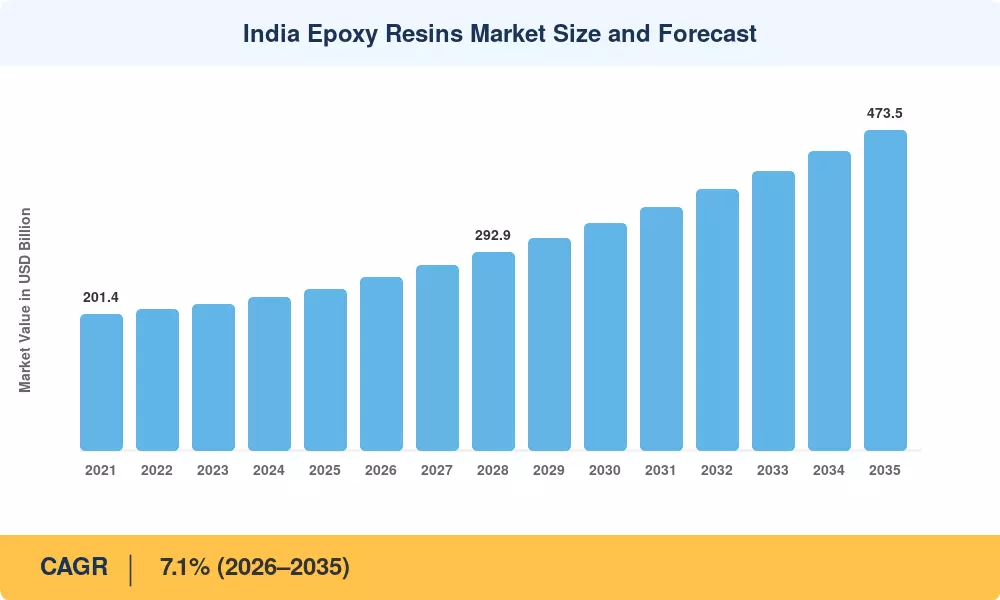
The India Epoxy Resins Market reached an estimated 238.5 kilotons in 2025, and is projected to grow from 255.4 kilotons in 2026 to approximately 473.5 kilotons by 2035, reflecting a compound annual growth rate of 7.1% over the forecast period. Two structural tailwinds anchor this trajectory: the government's Production-Linked Incentive (PLI) scheme for advanced chemistry cell manufacturing and the USD 1.4 trillion National Infrastructure Pipeline, both of which channel heavy downstream demand for protective and structural resin systems [1][2]. The removal of U.S. anti-dumping duties on certain Indian chemical exports in late 2024 has further bolstered domestic producer margins and export competitiveness.

India's resin landscape is in the middle of a materials-science shift. Legacy solvent-borne coating formulations are being displaced by waterborne and high-solid epoxy systems that meet the Bureau of Indian Standards' updated VOC limits (IS 15489:2024) [3]. Large-scale capacity additions — including Aditya Birla Chemicals' 60,000-TPA greenfield line at Vilayat and Atul Ltd's debottlenecking program — signal manufacturer confidence. The India Epoxy Resins Market is also benefiting from a parallel ramp-up of wind-turbine blade manufacturing under the National Wind-Solar Hybrid Policy, which requires high-performance laminating resins [4].

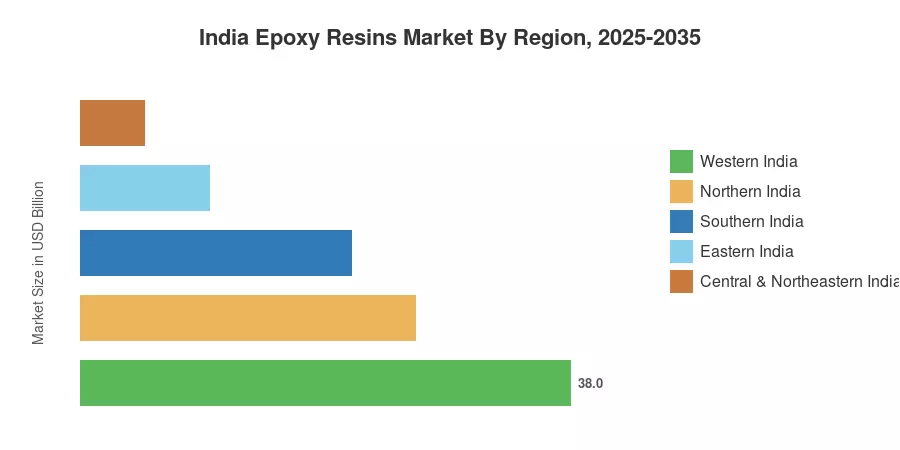
Western India commands roughly 38% of total consumption, anchored by Gujarat's chemical corridor and Maharashtra's automotive-OEM cluster. Southern India is the fastest-growing region, registering a projected CAGR above 8%, driven by electronics-manufacturing hubs in Tamil Nadu and Karnataka. Northern India holds the second-largest share at around 26%, supported by construction and metro-rail expansion across the National Capital Region. As India targets a USD 5 trillion economy, the India Epoxy Resins Market stands to benefit from every pillar of that growth ambition.


Key Report Takeaways

• By Raw Material

  • DGEBA (Bisphenol A diglycidyl ether) accounted for approximately 60% of India Epoxy Resins Market volume in 2025, reinforcing its status as the default building-block chemistry for protective and structural applications.
  • Novolac-based epoxies are advancing at the strongest growth rate among raw-material segments, propelled by demand from high-temperature electrical laminates and aerospace prepregs.
  • DGEBF resins held a volume share of roughly 11% in 2025, favored in low-viscosity flooring and tank-lining formulations.

• By Application

  • Paints and coatings represented the largest end-use segment of the India Epoxy Resins Market in 2025, registering a CAGR of approximately 8.9% through 2035.
  • Adhesives and sealants are forecast to reach 71 kilotons by 2035, fueled by lightweight bonding trends in automotive and rail coach manufacturing.
  • The composites application segment is growing at a CAGR of roughly 9.3%, the fastest among all application categories, driven by wind-energy and defense orders.

• By Region

  • Western India contributed about 38% of India Epoxy Resins Market consumption in 2025.
  • Southern India is projected to register a CAGR of 8.2% through 2035, the highest of any Indian region.


Market Size and Forecast (2021–2035)

Market Research Future's volume model integrates production-capacity filings from India's Department of Chemicals and Petrochemicals, import–export data from the Directorate General of Commercial Intelligence and Statistics (DGCI&S), and proprietary demand-side surveys across 120+ resin converters and formulators. Historical figures (2021–2024) are reconciled against actual plant utilization rates, while forecast values (2026–2035) embed announced capacity expansions and policy-driven demand scenarios for the India Epoxy Resins Market.
India Epoxy Resins Market Size and Forecast
Our Impact
Enabled $4.3B Revenue Impact for Fortune 500 and Leading Multinationals
Partnering with 2000+ Global Organizations Each Year
30K+ Citations by Top-Tier Firms in the Industry

Driver Impact Analysis

Driver ~% Impact on CAGR Geographic Relevance Impact Timeline
National Infrastructure Pipeline spending ~22% Pan-India Long-term
PLI scheme for advanced chemistry & electronics ~18% Western & Southern India Medium-term
Wind and solar capacity additions (500 GW target) ~16% Southern & Western India Long-term
Automotive lightweighting and EV adoption ~14% Northern & Western India Medium-term
BIS VOC regulation driving reformulation ~12% Pan-India Short-term
Anti-dumping duty removal on resin exports ~10% Export-oriented corridors Short-term
Defense indigenization (Make in India) ~8% Pan-India Long-term


National Infrastructure Pipeline Spending

India’s National Infrastructure Pipeline has allocated USD 1.4 trillion for over 9,000 projects including highways, metro rail, water treatment and smart cities through 2030 [1]. Epoxy-based systems are specified for bridge-deck waterproofing, structural grouts and anti-corrosion coatings for steel reinforcement – all high-volume consumption categories. With every new tranche of capex, the India Epoxy Resins Market gains disproportionately because epoxy intensity per dollar of infrastructure investment has increased by nearly 15% since 2020 as engineers migrate from cementitious to polymer-modified protection schemes.


PLI Scheme for Advanced Chemistry and Electronics

The government's PLI allocations for electronic components and advanced chemistry cells total over INR 18,100 crore (approximately USD 9.1 billion) [2]. Electronics-grade encapsulants and printed-circuit-board laminates consume high-purity liquid and solid epoxies. As Apple, Samsung, and Tata Electronics scale Indian production, the India Epoxy Resins Market gains a captive downstream buyer base that barely existed five years ago.

Renewable-Energy Capacity Build-Out

India's 500 GW non-fossil-fuel capacity target by 2030 requires roughly 120 GW of new wind installations, each turbine blade consuming 6–12 metric tons of infusion-grade resin [4]. Domestic blade manufacturers such as LM Wind Power and Suzlon (Daman) are adding capacity, creating a structural demand floor for the India Epoxy Resins Market that is insulated from cyclical downturns in the construction segment.

Automotive Lightweighting and EV Transition

India’s CAFE-II emission requirements are pushing manufacturers toward lighter body constructions, and epoxy-bonded carbon-fiber-reinforced panels are replacing welded steel in premium EV platforms [5]. Tata Motors, Mahindra, and Hyundai India have all unveiled composite-intensive EV architectures, collectively indicating another 8,000-12,000 TPA of structural-adhesive demand by 2030 for the India Epoxy Resins Market.



Restraints Impact Analysis

The impact percentages in the table below are directional analytical weights, not precise subtractions from the headline CAGR. They reflect the relative drag each restraint exerts on the India Epoxy Resins Market growth outlook.

Restraint ~% Negative Impact Geographic Relevance Impact Timeline
Bisphenol A supply volatility and import dependence ~30% Pan-India Medium-term
Stringent REACH-aligned chemical registration ~25% Export corridors Short-term
Competition from polyurethane and vinyl-ester substitutes ~20% Pan-India Long-term
Energy-cost inflation at curing and processing stage ~15% Northern & Eastern India Short-term
Skilled-labor gaps in advanced composite lay-up ~10% Eastern India Medium-term


Bisphenol A Import Dependence

India imports about 65% of its Bisphenol A (BPA) requirements mainly from South Korea, Taiwan and Thailand [8]. Any disturbance — tariff increases, shipping delays or plant turnarounds in exporting countries — is passed straight through to the cost of making resin. The India Epoxy Resins Market faced two significant BPA price surges since 2022, which briefly pressured converter margins by 300–500 basis points.


Regulatory Complexity for Chemical Registration

The Indian Chemical Management and Safety Rules (ICMSR), which are based on Europe’s REACH framework, require resin makers to register, evaluate, and share data [9]. The compliance costs for small- and mid-size formulators are likely to be INR 25-40 lakh per substance dossier in India, which could lead to consolidation and hinder new product releases in the India Epoxy Resins Market over the next 3-5 years.


Substitution Pressure from Alternative Resin Chemistries

Vinyl-ester and polyurethane systems are being used for flooring, pipe-lining and wind-blade root joints, because of their faster cure profiles and lower exotherm, which give processing advantages [10]. Epoxy continues to deliver better adhesion and chemical resistance, but price-sensitive converters are shifting to blended systems, a trend that is eroding 1-2 percentage points of market from the India Epoxy Resins Market annually in commodity-grade applications.


India Epoxy Resins Market Opportunities

Bio-Based and Recyclable Epoxy Chemistries

Driven by global brand-owner sustainability standards, pull-through demand for bio-epoxies from cashew-nut-shell liquid (CNSL) and lignin [13] is being created. India has a big cashew processing industry that gives it a feedstock advantage no other major resin manufacturing country has. If the manufacturers scale up pilot facilities being run in Goa and Kerala, the India Epoxy Resins Market can grab 5-8% of the worldwide bio-epoxy supply chain by 2032.


Data-Center and Semiconductor Encapsulant Demand

India's semiconductor fabrication ambitions — anchored by the Tata-PSMC and CG Power fabs — will require ultra-high-purity mold compounds and underfill resins [14]. This is a low-volume, high-margin niche where the India Epoxy Resins Market can diversify away from commodity coatings into specialty electronics applications.

Green-Building Certification and Construction-Chemical Upgrades

IGBC and GRIHA green-building certifications now cover over 10 billion square feet of registered floor space in India [15]. Certified projects specify low-VOC, high-durability epoxy flooring and waterproofing systems, translating rating-system adoption directly into premium resin consumption for the India Epoxy Resins Market.

Drone-Delivered Maintenance Coatings for Remote Infrastructure

This emerging service model creates a new distribution channel for single-component, fast-cure epoxy systems within the India Epoxy Resins Market.

Export-Oriented Formulation and Contract Manufacturing

With anti-dumping barriers easing and Indian labor costs 40–60% below Chinese competitors, contract formulators can position India as a global supply hub for finished resin systems [6]. The India Epoxy Resins Market stands to add 15,000–20,000 TPA of export-grade production by 2030 under current capacity-expansion plans.


India Epoxy Resins Market Future Outlook

Circular-Economy Resin Models

Thermally and chemically recyclable epoxy matrices — sometimes branded "vitrimers" — are moving from laboratory curiosity to commercial pilot scale. If these systems achieve cost parity by 2030, the India Epoxy Resins Market could see a fundamental shift in its value chain, with resin-recovery service providers emerging alongside traditional converters.

Digitalization of Resin Formulation and Quality Control

AI-driven combinatorial chemistry platforms can screen thousands of hardener-resin-filler combinations in silico, cutting development cycles from 18 months to under 6 [17]. Indian specialty-chemical startups are licensing these platforms, which will accelerate the India Epoxy Resins Market's shift toward application-specific grades and reduce reliance on imported formulation know-how.

Electrification and EV-Infrastructure Buildout

India's target of 30% EV penetration by 2030 translates into roughly 50,000 fast-charging stations, each requiring potting compounds, transformer insulation, and cable-joint encapsulants [5]. This electrification super-cycle positions the India Epoxy Resins Market to capture a high-value niche that barely registered in 2020.

ESG Reporting and Sustainable Procurement Mandates

SEBI's Business Responsibility and Sustainability Reporting (BRSR) framework now requires the top 1,000 listed companies to disclose chemical-safety and lifecycle-impact data for procurement inputs [18]. Resin suppliers who pre-certify products with Environmental Product Declarations (EPDs) will gain preferential listing status, reshaping competitive dynamics in the India Epoxy Resins Market toward transparency-ready manufacturers.


India Epoxy Resins Market Segmentation

By Raw Material

Segment Key Metric Primary Demand Driver
DGEBA ~60% market share (2025) Dominant workhorse for coatings and adhesives
DGEBF CAGR ~7.4% Low-viscosity flooring and tank linings
Novolac CAGR ~8.8% High-temperature laminates and aerospace
Aliphatic ~5% market share (2025) UV-stable outdoor coatings
Glycidylamine CAGR ~9.1% Aerospace prepregs and tooling
Other Raw Materials ~4% market share (2025) Niche bio-based chemistries


DGEBA remains the backbone of the India Epoxy Resins Market by raw material, commanding about 60% of 2025 volume. Its dominance stems from cost efficiency, broad hardener compatibility, and decades of formulation heritage across protective coatings and civil-engineering grouts. Domestic producers like Aditya Birla Chemicals and Atul Ltd operate integrated BPA-to-DGEBA chains that keep landed costs 10–15% below imports.

Novolac epoxies represent the fastest-growing raw-material category in the India Epoxy Resins Market, driven by aerospace MRO expansion at HAL Bengaluru and defense-composite programs under Make in India. Glycidylamine resins, while smaller in absolute volume, are advancing at roughly 9.1% CAGR as carbon-fiber prepreg manufacturers localize production in Hyderabad and Pune.

By Application

Segment Key Metric Primary Demand Driver
Paints and Coatings CAGR ~8.9% Infrastructure and industrial maintenance
Adhesives and Sealants ~71 KT by 2035 Automotive lightweighting, rail bonding
Composites CAGR ~9.3% Wind blades, aerospace structures
Electrical and Electronics ~14% market share (2025) PCB laminates, encapsulants
Other Applications ~6% market share (2025) Tooling, art, and craft resins


Paints and coatings drive the largest share of India Epoxy Resins Market demand, spanning marine anti-corrosion primers, industrial-floor coatings, and architectural waterproofing. The segment's 8.9% CAGR reflects both volume growth from new construction and reformulation-driven value growth as manufacturers shift to low-VOC, high-solid systems under BIS mandates [3].

Composites represent the India Epoxy Resins Market's most dynamic application frontier. Wind-turbine blade production, which consumes infusion and prepreg resins in multi-ton quantities per unit, is the primary accelerant. Defense orders for composite-bodied UAVs, naval vessels, and armored vehicles add a second growth layer that is largely insulated from commercial-cycle volatility.


Regional Market Share Analysis

Region Share of Market (2025) Primary Investment Themes
Western India ~38% Chemical corridor expansion, automotive OEM coatings
Northern India ~26% Metro rail, smart-city infrastructure
Southern India ~21% Electronics manufacturing, wind energy
Eastern India ~10% Steel-plant maintenance coatings, mining
Central & Northeastern India ~5% Hydropower projects, defense installations
Total 100%  

The India Epoxy Resins Market is analyzed across five domestic regions reflecting industrial-cluster regions rather than administrative boundaries alone.


Western India

State / Cluster Key Metric Key Driver
Gujarat ~45% of regional volume PCPIR chemical-investment zone
Maharashtra CAGR ~7.5% Automotive and pharma coatings
Rajasthan ~8% of regional volume Solar-park protective coatings


Gujarat's Petroleum, Chemicals and Petrochemicals Investment Region (PCPIR) in Dahej–Vilayat hosts the largest concentration of epoxy-resin capacity in India, including integrated BPA-to-resin lines [1]. Maharashtra's Chakan–Pune auto corridor drives primer and e-coat consumption, while Rajasthan's Bhadla solar complex requires UV-resistant encapsulants. The India Epoxy Resins Market draws its single largest regional contribution from this western belt.

Northern India

State / Cluster Key Metric Key Driver
Delhi-NCR CAGR ~7.8% Metro and commercial construction
Uttar Pradesh ~30% of regional volume Industrial-flooring demand
Haryana ~18% of regional volume Automotive ancillary plants


The Delhi–Meerut RRTS and Noida International Airport projects together represent over INR 60,000 crore of infrastructure spend that specifies epoxy grouts and deck coatings [2]. The India Epoxy Resins Market in Northern India also benefits from rapid warehouse construction along the Delhi–Mumbai Industrial Corridor.

Southern India

State / Cluster Key Metric Key Driver
Tamil Nadu CAGR ~8.5% Electronics and wind-blade manufacturing
Karnataka ~28% of regional volume Aerospace composites, IT-park flooring
Andhra Pradesh / Telangana ~20% of regional volume Pharma and bulk-drug coatings


Chennai's Foxconn and Tata Electronics campuses are scaling encapsulant and PCB-laminate demand at a pace that makes Southern India the fastest-growing region in the India Epoxy Resins Market [14]. Wind-blade manufacturing around Tirunelveli and Udumalpet adds further structural demand.

Eastern India

State / Cluster Key Metric Key Driver
West Bengal ~40% of regional volume Steel-plant lining and shipyard coatings
Odisha CAGR ~6.8% Mining-equipment protective coatings
Jharkhand ~15% of regional volume Heavy-engineering fabrication


Eastern India's resin consumption is tightly linked to heavy industry. Tata Steel's Kalinganagar expansion and SAIL's modernization program specify epoxy-phenolic linings for blast-furnace cooling systems, sustaining a steady but lower-growth demand profile within the India Epoxy Resins Market.

Central & Northeastern India

State / Cluster Key Metric Key Driver
Madhya Pradesh ~45% of regional volume Defense-ordnance coatings
Northeast states CAGR ~7.0% Hydropower penstock linings


Hydroelectric projects along the Brahmaputra and Teesta basins require corrosion-resistant epoxy linings for penstocks and intake structures. Defense facilities in Jabalpur and Itarsi consume specialty resin systems. This region remains the smallest contributor to the India Epoxy Resins Market but carries strategic significance.


India Epoxy Resins Market By Region, 2025-2035

Competitive Benchmarking

The India Epoxy Resins Market exhibits medium concentration, with the top five producers accounting for an estimated 52–58% of domestic volume. The Herfindahl-Hirschman Index sits in the 1,200–1,500 range, indicating a moderately competitive structure where incumbents hold scale advantages in BPA backward integration but smaller formulators compete aggressively on application-specific grades and technical service.

Company Est. Revenue Share Range Key Offerings Strategic Positioning
Aditya Birla Chemicals ~12–16% DGEBA liquid and solid resins, hardeners Largest domestic integrated producer; BPA-to-resin chain
Atul Ltd ~10–13% Liquid epoxies, curing agents, diluents Vertically integrated via ECH production at Ankleshwar
Huntsman Corporation ~8–11% Specialty and commodity liquid resins Global technology; Indian blending and distribution
BASF SE ~6–9% Coating resins, construction chemicals Strong brand in protective-coatings specification
Dow Inc. ~5–8% Liquid epoxies, waterborne dispersions Focus on automotive and electronics OEMs
Kukdo Chemicals ~4–7% DGEBA, DGEBF, and novolac resins South Korean parent; Indian joint venture operations
Nan Ya Plastics ~3–6% Solid and solution epoxies Formosa group; PCB-laminate supply chain
Hexion Inc. ~3–5% Specialty novolac and phenolic epoxies Strong in wind-energy and aerospace composites
Jubilant Ingrevia ~2–4% Specialty pyridine-based curing agents Niche position in pharma and agri-chemical coatings
Cardolite Corporation ~1–3% CNSL-based bio-epoxies and phenalkamines Sustainability-focused; bio-based hardener pioneer


Recent News & Developments

  • Aditya Birla Chemicals (June 2026): Collaborated with Lubrizol to officially inaugurate a state-of-the-art Chlorinated Polyvinyl Chloride (CPVC) resin manufacturing plant at Vilayat, Bharuch (Gujarat), optimizing local specialized chemical pipelines to meet surging high-pressure water distribution and construction engineering infrastructure needs.


  • Bureau of Indian Standards (January 2025): Published revised implementation guidelines for IS 15489 to standardize eco-label testing parameters for water-based plastic emulsion paints, prompting architectural material developers to adjust indoor volatile organic compound limits across residential housing lines.


  • Tata Electronics (March 2024): Broke ground on a semiconductor-assembly and testing facility in Dholera, Gujarat, signaling future encapsulant and underfill resin demand [14].
  • Kukdo Chemicals India (November 2020): Officially finalized the construction and mechanical commissioning of its primary localized synthetic polymer and advanced epoxy manufacturing plant within the high-density Dahej GIDC chemical zone in Gujarat, scaling up to serve as a key domestic processing hub for electronics-grade laminates and heavy industrial coatings.


India Epoxy Resins Market Report Scope

Parameter Detail
Market Scope India Epoxy Resins Market — production, consumption, and trade of epoxy resin systems
Study Period 2021–2035
CAGR (Forecast Period) 7.1% (2026–2035)
Market Size — Base Year (2025) 238.5 Kilotons
Market Size — Forecast Endpoint (2035) 473.5 Kilotons
Fastest Growing Segment (Raw Material) Glycidylamine (CAGR ~9.1%)
Fastest Growing Segment (Application) Composites (CAGR ~9.3%)
Companies Profiled 10
Valuation Unit Volume (Kilotons)


FAQs

What differentiates DGEBA from DGEBF in procurement decisions for the India Epoxy Resins Market?
DGEBA offers higher glass-transition temperature and better chemical resistance, making it the standard for structural applications. DGEBF provides lower viscosity for casting and potting where processability matters more than peak thermal performance.
How does the India Epoxy Resins Market compare with China in terms of cost competitiveness?
Indian producers operate at roughly 8–12% higher per-ton costs than Chinese counterparts due to BPA import dependence. However, removal of anti-dumping duties and lower labor costs are narrowing that gap.
What curing-agent trends should industrial buyers of the India Epoxy Resins Market monitor?
Phenalkamine hardeners derived from cashew-nut-shell liquid are gaining adoption for their surface-tolerance and sustainability credentials. They cure at ambient temperature and reduce reliance on petrochemical amines.
Are waterborne epoxies technically ready for heavy-industrial use in the India Epoxy Resins Market?
Recent two-component waterborne systems achieve 85–90% of solvent-borne performance on adhesion and corrosion resistance. They are now specified for interior tank linings and industrial floors.
How do PLI-scheme timelines affect procurement planning for the India Epoxy Resins Market?
PLI disbursements are tied to production milestones over five years, meaning incentive-driven demand peaks between 2026 and 2029. Buyers should lock supply agreements ahead of those ramp cycles.
What quality certifications matter when sourcing from the India Epoxy Resins Market?
BIS certification under IS 15489 is mandatory for coatings, while aerospace-grade resins require NABL-accredited testing. Export-bound products increasingly need REACH pre-registration documentation.
How resilient is the India Epoxy Resins Market to global BPA price shocks?
Domestic BPA capacity covers only about 35% of demand, leaving the market exposed to import-price volatility. The massive integrated Rs. 14,000 crore Phenol-Acetone-Bisphenol A-Polycarbonate import substitution mega-complex is being built by Deepak Nitrite (Deepak Phenolics) through 2027–2028.    
Author
Author
Author Profile
Chitranshi Jaiswal LinkedIn
Team Lead - Research
Chitranshi is a Team Leader in the Chemicals & Materials (CnM) and Energy & Power (EnP) domains, with 6+ years of experience in market research. She leads and mentors teams to deliver cross-domain projects that equip clients with actionable insights and growth strategies. She is skilled in market estimation, forecasting, competitive benchmarking, and both primary & secondary research, enabling her to turn complex data into decision-ready insights. An engineer and MBA professional, she combines technical expertise with strategic acumen to solve dynamic market challenges. Chitranshi has successfully managed projects that support market entry, investment planning, and competitive positioning, while building strong client relationships. Certified in Advanced Excel & Power BI she leverages data-driven approaches to ensure accuracy, clarity, and impactful outcomes.
Download Free Sample

Kindly complete the form below to receive a free sample of this Report

Download PDF ×

We do not share your information with anyone. However, we may send you emails based on your report interest from time to time. You may contact us at any time to opt-out.