India Flexible Packaging Market (2025 - 2035)

ID: MRFR/PCM/19764-HCR
111 Pages
Snehal Singh
Last Updated: July 11, 2026
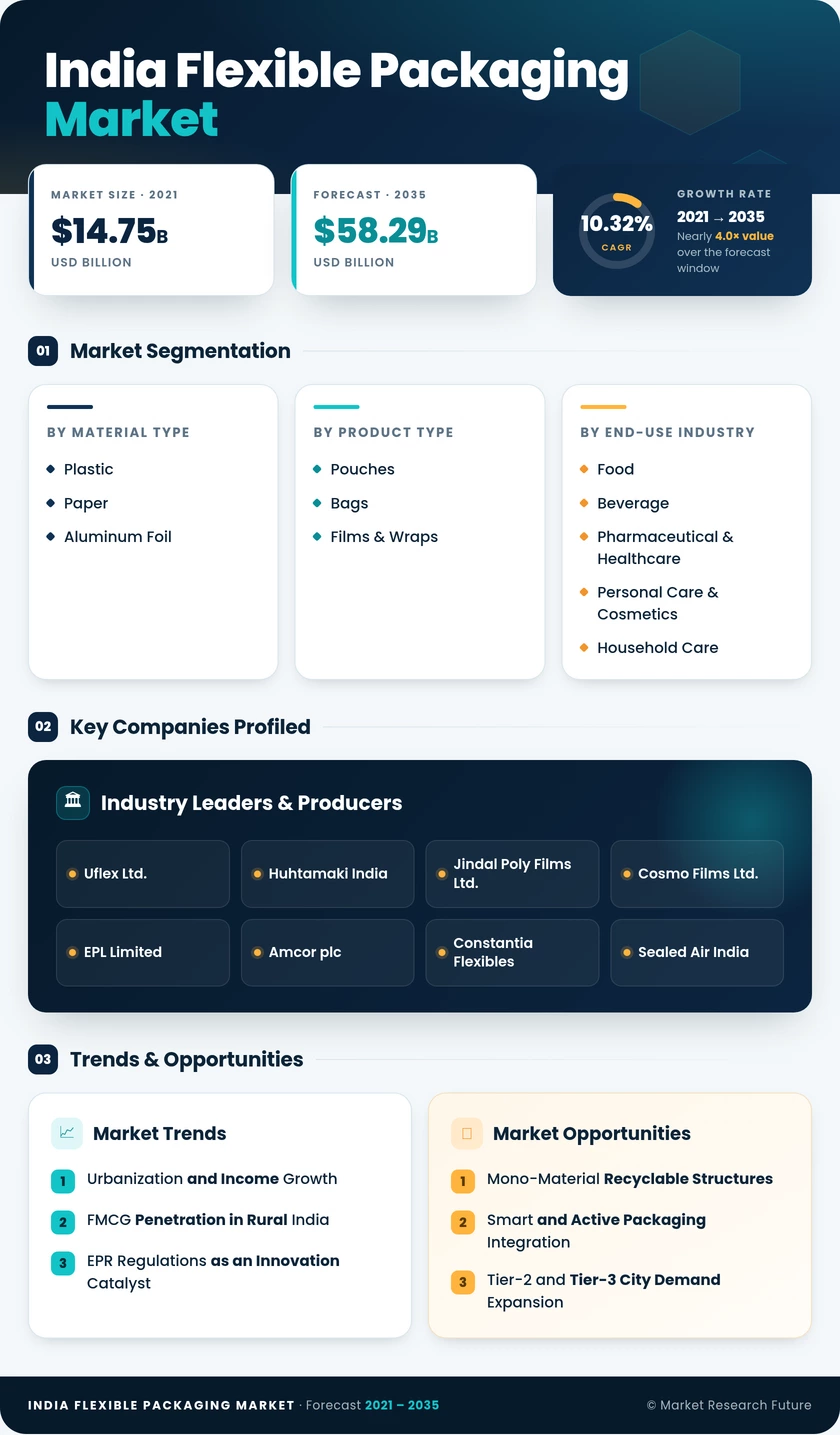
India Flexible Packaging Market Research Report: By Material (Plastic, Paper, Aluminum Foil, others), By Product Type (Pouches, Bags, Wraps, others), By Printing Technology (Flexography, Digital Printing, others) and By Application (Food and Beverages, Pharmaceuticals, Personal Care, Others) - Forecast to 2035.
India Flexible Packaging Market
Market Size
Forecast Period2025-2035
CAGR (2025-2035)10.32%
2025 Market SizeUSD 21.84 Billion
2035 Market SizeUSD 58.29 Billion
Key Players
Uflex Ltd.
Huhtamaki India
Jindal Poly Films Ltd.
Cosmo Films Ltd.
EPL Limited
Amcor plc
Opportunities
  • Mono-Material Recyclable Structures
  • Smart and Active Packaging Integration
  • Tier-2 and Tier-3 City Demand Expansion
  1. 1 Market Overview |
    1. 1.1 Study Assumptions & Market Definition |
    2. 1.2 Scope of the Study |
    3. 1.3 Research Methodology
  2. 2 Market Summary & Key Takeaways
  3. 3 Market Dynamics |
    1. 3.1 Market Drivers Analysis | |
      1. 3.1.1 Urbanization and Rising Disposable Incomes | |
      2. 3.1.2 FMCG Sector Expansion into Rural Markets | |
      3. 3.1.3 EPR Regulations Driving Format Innovation | |
      4. 3.1.4 Quick-Commerce and E-Commerce Growth | |
      5. 3.1.5 Pharmaceutical Export Manufacturing Scale-Up | |
      6. 3.1.6 Technological Upgrades in Converting Machinery | |
      7. 3.1.7 Premiumization of Personal Care and Household Products |
    2. 3.2 Market Restraints Analysis | |
      1. 3.2.1 Volatile Petrochemical Feedstock Prices | |
      2. 3.2.2 Regulatory Complexity Around Single-Use Plastic Bans | |
      3. 3.2.3 Fragmented Converter Base Limiting Scale Economies | |
      4. 3.2.4 Skilled Workforce Shortages in Advanced Converting | |
      5. 3.2.5 Import Dependency for Specialty Resins and Adhesives |
    3. 3.3 Market Opportunity Analysis | |
      1. 3.3.1 Mono-Material Recyclable Structures | |
      2. 3.3.2 Smart and Active Packaging Integration | |
      3. 3.3.3 Tier-2 and Tier-3 City Demand Expansion | |
      4. 3.3.4 Export-Oriented Contract Converting | |
      5. 3.3.5 Digital Printing and Short-Run Customization |
    4. 3.4 Industry Value Chain Analysis |
    5. 3.5 Porter's Five Forces Analysis
  4. 4 India Flexible Packaging Market Size & Forecast (2021–2035) |
    1. 4.1 Historical Market Size (2021–2025) |
    2. 4.2 Current & Forecast Market Size (2026–2035) |
    3. 4.3 Market Size by Revenue (USD Billion) |
    4. 4.4 Year-over-Year Growth Analysis
  5. 5 Segmentation Analysis |
    1. 5.1 By Material Type | |
      1. 5.1.1 Plastic | |
      2. 5.1.2 Paper | |
      3. 5.1.3 Aluminum Foil |
    2. 5.2 By Product Type | |
      1. 5.2.1 Pouches | |
      2. 5.2.2 Bags | |
      3. 5.2.3 Films & Wraps |
    3. 5.3 By End-Use Industry | |
      1. 5.3.1 Food | |
      2. 5.3.2 Beverage (Juices, Energy Drinks, Milk, etc.) | |
      3. 5.3.3 Pharmaceutical & Healthcare | |
      4. 5.3.4 Personal Care & Cosmetics | |
      5. 5.3.5 Household Care
  6. 6 Regional Analysis |
    1. 6.1 West India | |
      1. 6.1.1 Gujarat | |
      2. 6.1.2 Maharashtra | |
      3. 6.1.3 Rajasthan | |
      4. 6.1.4 Goa & Others |
    2. 6.2 South India | |
      1. 6.2.1 Telangana & Andhra Pradesh | |
      2. 6.2.2 Tamil Nadu | |
      3. 6.2.3 Karnataka | |
      4. 6.2.4 Kerala & Others |
    3. 6.3 North India | |
      1. 6.3.1 Uttar Pradesh | |
      2. 6.3.2 Delhi-NCR | |
      3. 6.3.3 Punjab & Haryana | |
      4. 6.3.4 Others |
    4. 6.4 East India | |
      1. 6.4.1 West Bengal | |
      2. 6.4.2 Odisha | |
      3. 6.4.3 Jharkhand & Bihar | |
      4. 6.4.4 Northeast States
  7. 7 Competitive Landscape |
    1. 7.1 Market Share Analysis (2025) |
    2. 7.2 Competitive Benchmarking Matrix |
    3. 7.3 Company Profiles | |
      1. 7.3.1 Uflex Ltd. | |
      2. 7.3.2 Huhtamaki India | |
      3. 7.3.3 Jindal Poly Films Ltd. | |
      4. 7.3.4 Cosmo Films Ltd. (Cosmo First) | |
      5. 7.3.5 EPL Limited | |
      6. 7.3.6 Amcor plc | |
      7. 7.3.7 Constantia Flexibles | |
      8. 7.3.8 Sealed Air India | |
      9. 7.3.9 Mondi Group | |
      10. 7.3.10 Novapack Industries
  8. 8 Future Outlook & Strategic Recommendations (2026–2035) |
    1. 8.1 Circular Economy and Material Science Transformation |
    2. 8.2 Digital-First Manufacturing |
    3. 8.3 E-Commerce and Direct-to-Consumer Packaging |
    4. 8.4 Health, Safety, and Regulatory Convergence
  9. 9 Recent Developments & News
  10. 10 Frequently Asked Questions (FAQs)
  11. 11 Report Scope & Methodology |
    1. 11.1 Study Period & Base Year |
    2. 11.2 Data Sources & Citations |
    3. 11.3 Abbreviations
  12. 12 LIST OF TABLES |
  13. TABLE 1 India Flexible Packaging Market Size & Forecast, by Revenue (USD Billion), 2021–2035 |
  14. TABLE 2 India Flexible Packaging Market — Year-over-Year Growth Analysis, 2021–2035 |
  15. TABLE 3 India Flexible Packaging Market — Driver Impact Analysis |
  16. TABLE 4 India Flexible Packaging Market — Restraint Impact Analysis |
  17. TABLE 5 India Flexible Packaging Market Size, by Material Type, 2021–2035 (USD Billion) |
  18. TABLE 6 India Flexible Packaging Market Size, by Product Type, 2021–2035 (USD Billion) |
  19. TABLE 7 India Flexible Packaging Market Size, by End-Use Industry, 2021–2035 (USD Billion) |
  20. TABLE 8 India Flexible Packaging Market Size, by Region, 2021–2035 (USD Billion) |
  21. TABLE 9 West India Flexible Packaging Market Size, by State/Zone, 2021–2035 (USD Billion) |
  22. TABLE 10 South India Flexible Packaging Market Size, by State/Zone, 2021–2035 (USD Billion) |
  23. TABLE 11 North India Flexible Packaging Market Size, by State/Zone, 2021–2035 (USD Billion) |
  24. TABLE 12 East India Flexible Packaging Market Size, by State/Zone, 2021–2035 (USD Billion) |
  25. TABLE 13 Competitive Benchmarking Matrix — India Flexible Packaging Market, 2025 |
  26. TABLE 14 Company Profiles — Key Players, India Flexible Packaging Market |
  27. TABLE 15 Recent Developments & Strategic Announcements, 2023–2025 |
  28. TABLE 16 Report Scope & Methodology Summary |
  29. TABLE 17 Detailed Sources and Citations
  30. 13 LIST OF FIGURES |
  31. FIGURE 1 India Flexible Packaging Market Dynamics — Drivers, Restraints, Opportunities |
  32. FIGURE 2 Industry Value Chain Analysis — India Flexible Packaging Market |
  33. FIGURE 3 Porter's Five Forces Analysis — India Flexible Packaging Market |
  34. FIGURE 4 India Flexible Packaging Market Size Trend (USD Billion), 2021–2035 |
  35. FIGURE 5 India Flexible Packaging Market Share, by Material Type (%), 2025 |
  36. FIGURE 6 India Flexible Packaging Market Share, by Product Type (%), 2025 |
  37. FIGURE 7 India Flexible Packaging Market Share, by End-Use Industry (%), 2025 |
  38. FIGURE 8 India Flexible Packaging Market Share, by Region (%), 2025 |
  39. FIGURE 9 Competitive Landscape — Market Share of Top 10 Players, 2025

Segmentation Quick Reference

DimensionSub-SegmentsDominant SegmentFastest Growing Segment
By Material TypePlastic, Paper, Aluminum FoilPlastic (~68% share)Paper (CAGR 13.15%)
By Product TypePouches, Bags, Films & WrapsPouches (~42% share)Films & Wraps (CAGR 10.87%)
By End-Use IndustryFood, Beverage, Pharmaceutical & Healthcare, Personal Care & Cosmetics, Household CareFood (~45% share)Pharmaceutical & Healthcare (CAGR 12.41%)
By RegionEast, West, North, SouthWest India (~38% share)East India (CAGR 11.78%)


Market Segmentation Overview

By Material Type

Sub-SegmentKey Trend
PlasticDominates via cost-per-unit economics; mono-material PE/PP structures gaining development focus under EPR mandates
PaperFastest-growing substrate as FMCG brands commit to recyclability targets; technology gaps remain in moisture barriers
Aluminum FoilStable demand anchored by pharmaceutical blister packs and dairy lidding; supply dependent on imported foil stock


Plastic remains the default substrate for the vast majority of Indian flexible packaging applications due to unrivaled cost efficiency at sachet-scale volumes. Paper-based alternatives are accelerating as converter R&D scales and brand owners seek EPR credit optimization through material substitution.

By Product Type

Sub-SegmentKey Trend
PouchesSachet economy drives volumes; stand-up and retort pouches gaining share in premium segments
BagsIndustrial and retail carry-bag formats remain high-volume but face regulatory headwinds from SUP bans
Films & WrapsGrowth led by modern retail expansion requiring stretch-wrapped trays and flow-packed fresh produce


Pouches dominate across price points — from INR 1 sachets to premium resealable packs — and their adaptability to diverse product viscosities ensures continued relevance. Films and wraps are the fastest-growing product type as cold-chain infrastructure and organized retail formats expand nationally.

By End-Use Industry

Sub-SegmentKey Trend
FoodLargest vertical; packaged food penetration below 15% signals substantial headroom
BeverageDairy pouches and aseptic juice cartons drive steady demand; premiumization trends emerging
Pharmaceutical & HealthcareFastest-growing end-use; India's generic drug export volumes sustain high-barrier packaging demand
Personal Care & CosmeticsD2C brand proliferation increases demand for differentiated pack formats and short-run printing
Household CareRefill pouch adoption reducing rigid container dependency; growth linked to environmental messaging


Food applications anchor the market, though pharmaceutical and healthcare packaging is closing the gap in growth rate terms as India's position as a global generics hub continues to strengthen.

By Region

Sub-SegmentKey Trend
West IndiaDominant region; Gujarat's converter cluster and Maharashtra's FMCG headquarters drive concentration
South IndiaPharma-led demand in Hyderabad; technology-forward converters in Bengaluru and Chennai
North IndiaDairy and food processing clusters in UP; D2C brand activity centered in Delhi-NCR
East IndiaFastest growth; greenfield FMCG investments in Odisha and West Bengal attract packaging co-location


West India's dominance reflects decades of industrial clustering, while East India's accelerating growth is a more recent phenomenon driven by proactive state-level industrial policy and the strategic eastward expansion of national FMCG distribution networks.


 

Download PDF ×

We do not share your information with anyone. However, we may send you emails based on your report interest from time to time. You may contact us at any time to opt-out.