Advancements in Satellite Technology
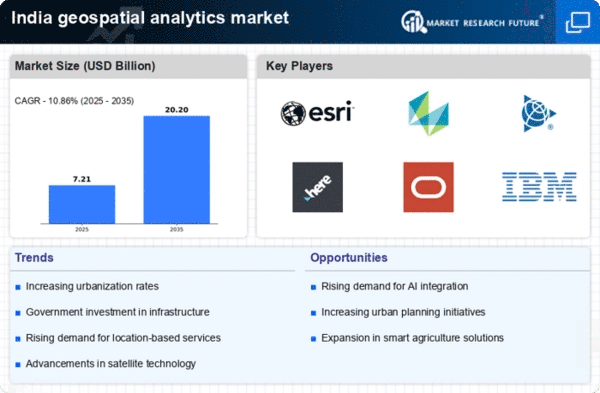
Technological advancements in satellite imagery and remote sensing are significantly influencing the geospatial analytics market in India. The availability of high-resolution satellite data has enhanced the accuracy and reliability of geospatial analysis, enabling businesses and government agencies to make informed decisions. For example, the Indian Space Research Organisation (ISRO) has been actively launching satellites that provide critical data for agriculture, urban planning, and disaster management. The market for satellite data is expected to grow at a CAGR of around 20% over the next five years, driven by the increasing need for precise geospatial information. This trend indicates a robust future for the geospatial analytics market, as organizations increasingly adopt satellite-based solutions for various applications.
Rising Demand for Location-Based Services
The increasing reliance on location-based services is a pivotal driver for the geospatial analytics market in India. Businesses across various sectors, including retail, logistics, and transportation, are leveraging geospatial data to enhance operational efficiency and customer engagement. For instance, the retail sector is projected to grow by approximately 15% annually, with geospatial analytics playing a crucial role in optimizing supply chains and improving customer targeting. Furthermore, the proliferation of smartphones and mobile applications has led to a surge in demand for location-based services, which is expected to contribute significantly to the market's growth. As organizations recognize the value of spatial data in decision-making processes, is likely to witness substantial expansion in the coming years.
Increased Focus on Environmental Sustainability
The growing emphasis on environmental sustainability is driving the geospatial analytics market in India. Organizations are increasingly utilizing geospatial data to monitor environmental changes, assess natural resources, and implement sustainable practices. For instance, the agricultural sector is adopting precision farming techniques, which rely on geospatial analytics to optimize resource use and minimize environmental impact. The market for environmental monitoring solutions is projected to grow by approximately 18% annually, reflecting the rising demand for sustainable practices. This trend suggests that the geospatial analytics market will continue to expand as businesses and government agencies prioritize environmental sustainability in their operations.
Growing Urbanization and Infrastructure Development
The rapid urbanization in India is a significant driver for the geospatial analytics market. As cities expand, the need for effective urban planning and infrastructure development becomes paramount. Geospatial analytics provides valuable insights into land use, transportation networks, and resource allocation, facilitating better decision-making for urban planners. The Indian government has allocated substantial funds for infrastructure projects, with an estimated investment of over $1 trillion planned for the next decade. This investment is likely to create a favorable environment for the geospatial analytics market, as stakeholders seek advanced analytical tools to manage urban growth and enhance service delivery. Consequently, the market is poised for growth as urbanization continues to accelerate.
Integration of Geospatial Data in Business Intelligence
The integration of geospatial data into business intelligence (BI) systems is emerging as a crucial driver for the geospatial analytics market in India. Organizations are increasingly recognizing the value of spatial data in enhancing their analytical capabilities and improving decision-making processes. By incorporating geospatial analytics into BI tools, companies can gain deeper insights into market trends, customer behavior, and operational efficiency. The market for BI solutions is expected to grow at a CAGR of around 12% over the next few years, with geospatial analytics playing a vital role in this transformation. This integration indicates a promising future for the geospatial analytics market, as businesses seek to leverage spatial insights for competitive advantage.