×
Request Free Sample ×

Kindly complete the form below to receive a free sample of this Report

* Please use a valid business email

Leading companies partner with us for data-driven Insights

clients tt-cursor
Hero Background

India Geospatial Imagery Analytics Market

ID: MRFR/ICT/61018-HCR
200 Pages
Aarti Dhapte
October 2025

India Geospatial Imagery Analytics Market Research Report By Analytics type (Video-based Analytics, Imagery Analytics), By Deployment Type (Cloud, On-Premises) and By End-User Type (Government, Defense & Security, Engineering & Construction, Mining & Manufacturing, Agriculture, Insurance, Healthcare, Environment Monitoring, Energy, Utility, Natural Resources, Others) - Forecast to 2035

Share:
Download PDF ×

We do not share your information with anyone. However, we may send you emails based on your report interest from time to time. You may contact us at any time to opt-out.

India Geospatial Imagery Analytics Market Infographic
Purchase Options

India Geospatial Imagery Analytics Market Summary

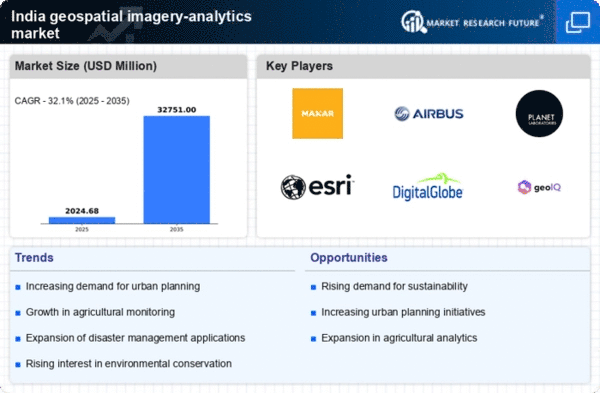
As per MRFR analysis, the geospatial imagery-analytics market size was estimated at 1532.69 USD Million in 2024. The geospatial imagery-analytics market is projected to grow from 2024.68 USD Million in 2025 to 32751.0 USD Million by 2035, exhibiting a compound annual growth rate (CAGR) of 32.1% during the forecast period 2025 - 2035.

Key Market Trends & Highlights

The India The India geospatial imagery-analytics market is poised for substantial growth. This growth is driven by technological advancements and an increasing demand for data-driven insights.

  • Technological advancements are enhancing the capabilities of geospatial imagery-analytics, leading to more accurate and efficient data processing.
  • The largest segment in the market is environmental monitoring, while precision farming emerges as the fastest-growing segment due to its critical role in agricultural optimization.
  • Government initiatives and support are fostering a favorable environment for the adoption of geospatial technologies across various sectors.
  • Rising urbanization and infrastructure development, along with advancements in satellite technology, are key drivers propelling market growth.

Market Size & Forecast

2024 Market Size 1532.69 (USD Million)
2035 Market Size 32751.0 (USD Million)
CAGR (2025 - 2035) 32.1%

Major Players

Maxar Technologies (US), Airbus (FR), Planet Labs (US), Esri (US), DigitalGlobe (US), GeoIQ (US), BlackSky (US), Satellogic (AR)

India Geospatial Imagery Analytics Market Trends

The geospatial imagery-analytics market is experiencing notable growth, driven by advancements in technology and increasing demand for data-driven insights. The integration of artificial intelligence and machine learning into geospatial analytics tools enhances the ability to process vast amounts of data efficiently. This evolution allows organizations to derive actionable insights from imagery, which is crucial for sectors such as agriculture, urban planning, and disaster management. Furthermore, the proliferation of satellite imagery and drone technology is expanding the accessibility of geospatial data, enabling more stakeholders to leverage these resources for strategic planning and operational efficiency. In addition, government initiatives aimed at promoting digital infrastructure and smart city projects are likely to bolster the geospatial imagery-analytics market. The emphasis on sustainable development and environmental monitoring is also contributing to the demand for sophisticated analytics solutions. As organizations increasingly recognize the value of geospatial data in enhancing operational capabilities, the market is poised for continued expansion. The convergence of various technologies and the growing awareness of the benefits of geospatial analytics suggest a promising future for this sector.

Technological Advancements

The geospatial imagery-analytics market is witnessing rapid technological advancements, particularly in artificial intelligence and machine learning. These innovations enhance data processing capabilities, allowing for more accurate and timely insights. As tools become more sophisticated, organizations can analyze complex datasets more effectively, leading to improved decision-making across various sectors.

Increased Demand for Data-Driven Insights

There is a growing demand for data-driven insights across industries, which is significantly impacting the geospatial imagery-analytics market. Organizations are increasingly recognizing the value of geospatial data in optimizing operations, enhancing customer experiences, and driving strategic initiatives. This trend is likely to continue as more sectors adopt analytics solutions.

Government Initiatives and Support

Government initiatives aimed at enhancing digital infrastructure and promoting smart city projects are playing a crucial role in the geospatial imagery-analytics market. These efforts not only facilitate the adoption of advanced analytics solutions but also encourage collaboration between public and private sectors, fostering innovation and growth in the market.

India Geospatial Imagery Analytics Market Drivers

Growing Adoption of Smart City Initiatives

The push towards smart city initiatives in India serves as a significant driver for the geospatial imagery-analytics market. These initiatives aim to enhance urban living through technology integration, requiring comprehensive data analysis for effective implementation. Geospatial analytics plays a vital role in optimizing urban services, traffic management, and resource allocation. The Indian government has allocated substantial funding for smart city projects, with an estimated budget of over $1.5 billion for the Smart Cities Mission. This financial commitment is likely to spur demand for geospatial analytics solutions, as cities seek to leverage data for improved governance and citizen engagement. The market is poised for growth as stakeholders recognize the potential of geospatial technologies in transforming urban landscapes.

Agricultural Optimization and Precision Farming

Agriculture remains a cornerstone of the Indian economy, contributing approximately 18% to the GDP. The geospatial imagery-analytics market is significantly influenced by the need for agricultural optimization. Farmers and agribusinesses are increasingly adopting precision farming techniques, which rely on geospatial data to enhance crop yields and resource efficiency. By utilizing satellite imagery and analytics, stakeholders can monitor crop health, soil conditions, and weather patterns. This data-driven approach not only improves productivity but also aids in sustainable practices, aligning with government initiatives for food security. The market for geospatial imagery analytics in agriculture is projected to grow as more farmers recognize the benefits of integrating technology into their operations.

Environmental Monitoring and Disaster Management

India's diverse geography and susceptibility to natural disasters underscore the importance of environmental monitoring, a key driver for the geospatial imagery-analytics market. The ability to analyze land use changes, deforestation, and climate impacts is vital for sustainable development. Geospatial analytics enables authorities to assess risks and implement effective disaster management strategies. For instance, satellite imagery can be utilized to monitor flood-prone areas, allowing for timely interventions. The Indian government has invested in satellite technology to enhance disaster response capabilities, which is likely to further stimulate demand for geospatial analytics solutions. As environmental concerns grow, the market is expected to expand, driven by the need for comprehensive monitoring and management tools.

Rising Urbanization and Infrastructure Development

Rapid urbanization in India is a crucial driver for the geospatial imagery-analytics market. As cities expand, the need for effective urban planning and infrastructure management becomes paramount. Geospatial imagery provides valuable insights into land use, transportation networks, and resource allocation. According to recent estimates, urban areas in India are expected to house over 600 million people by 2031, necessitating advanced analytics to manage urban sprawl. This growth creates a demand for precise geospatial data to inform decision-making processes in urban development. Consequently, stakeholders in the geospatial imagery-analytics market are likely to experience increased opportunities as municipalities and private developers seek to leverage these technologies for sustainable urban growth.

Advancements in Satellite Technology and Data Accessibility

The evolution of satellite technology has significantly impacted the geospatial imagery-analytics market in India. With the launch of new satellites and improved imaging capabilities, access to high-resolution data has become more widespread. This advancement allows for more accurate and timely analysis across various sectors, including urban planning, agriculture, and environmental monitoring. The Indian Space Research Organisation (ISRO) has been pivotal in enhancing satellite data availability, which is likely to drive market growth. As organizations increasingly rely on satellite imagery for decision-making, the demand for analytics tools that can process and interpret this data is expected to rise, fostering innovation within the geospatial imagery-analytics market.


Market Segment Insights

By Analytics Type: Video-Based Analytics (Largest) vs. Imagery Analytics (Fastest-Growing)

In the India geospatial imagery-analytics market, Video-Based Analytics commands a significant share, benefiting from the increasing demand for real-time monitoring and surveillance applications across various industries. It has established itself as a reliable choice for businesses seeking enhanced decision-making capabilities based on video data. Conversely, Imagery Analytics is witnessing a remarkable rise in adoption, primarily driven by advancements in satellite technology and the proliferation of drone imagery in sectors such as agriculture and urban planning. The growth trends for these segments indicate a strong preference for Video-Based Analytics due to its established presence and robustness in providing actionable insights. However, the rapid innovations in Imagery Analytics, such as machine learning techniques and improved algorithms, are propelling it to become a critical player in the future. As businesses strive to harness geographic and spatial data, the integration of both segment types is expected to catalyze growth in the India geospatial imagery-analytics market.
Video-Based Analytics (Dominant) vs. Imagery Analytics (Emerging)

Video-Based Analytics stands as the dominant segment in the India geospatial imagery-analytics market, characterized by its broad applications in security, traffic management, and smart cities. It is preferred for its capability to process and analyze live video feeds for real-time insights, making it essential for organizations focusing on operational efficiency. On the other hand, Imagery Analytics is an emerging segment gaining traction due to its unique attributes that allow for extensive geospatial analysis derived from photographs and remote sensing data. With advancements in AI and cloud computing, this segment is rapidly evolving, making it increasingly attractive for industries such as agriculture and environmental monitoring, where spatial data plays a crucial role.

By Deployment Type: Cloud (Largest) vs. On-Premises (Fastest-Growing)

The market share distribution within the deployment type segment shows that Cloud solutions hold the largest portion of usage in the India geospatial imagery-analytics market. This preference is attributed to the increasing demand for scalable solutions that offer flexibility and lower upfront costs, making them a favorable option for various organizations. On the other hand, On-Premises solutions, while currently a smaller segment, are gaining traction due to specific enterprise needs for data security and compliance that cloud infrastructures may not meet. Growth trends in the deployment type segment reflect a significant shift towards Cloud-based solutions. This trend is driven by the advantages of accessibility, real-time data processing, and collaboration. Meanwhile, On-Premises solutions are rising as organizations increasingly recognize the importance of data sovereignty and centralized control over their data. This dynamic creates a competitive landscape where both deployment types can coexist and continue to evolve based on user requirements and technological advancements.

Cloud (Dominant) vs. On-Premises (Emerging)

The Cloud deployment type has established itself as the dominant choice in the India geospatial imagery-analytics market, primarily due to its ability to offer extensive storage, advanced analytics capabilities, and ease of access. Its elasticity allows businesses to scale resources on demand, making it ideal for fluctuating workloads. In contrast, On-Premises solutions are emerging as a compelling alternative for organizations that prioritize data security, privacy regulations, and high-performance computing. Companies in sectors like defense and banking often lean towards On-Premises setups to maintain strict control over sensitive information. The coexistence of these deployment types reflects a diverse market catering to various organizational needs and preferences.

By End-User Type: Government (Largest) vs. Agriculture (Fastest-Growing)

In the India geospatial imagery-analytics market, the distribution of market share among end-user types reveals that the Government sector holds the largest share, followed by Defense & Security and Engineering & Construction. These segments benefit from significant investments in infrastructure and security initiatives, driving demand for advanced geospatial analytics solutions. Other notable areas include Agriculture and Environment Monitoring, which are witnessing growing adoption of geospatial technologies for enhanced decision-making and resource management. Growth trends reflect an increasing reliance on geospatial analytics across various sectors, particularly in Agriculture, where the technology is enabling precision farming and improving yield predictions. The Defense & Security sector is also experiencing substantial growth as national security concerns drive investments in surveillance and monitoring technologies. Government initiatives promoting smart cities and infrastructure development are further propelling the adoption of geospatial solutions, effectively expanding their market reach.

Government: Defense & Security (Dominant) vs. Agriculture (Emerging)

The Government sector remains the dominant force in the India geospatial imagery-analytics market, thanks to its vast applications in urban planning, disaster management, and resource allocation. With substantial government spending on infrastructure projects and public safety, this segment continues to lead in market share. In contrast, the Agricultural sector is emerging rapidly, leveraging geospatial analytics to optimize farming practices, monitor crop health, and make data-driven decisions that enhance productivity. As agricultural policies increasingly focus on sustainability and efficiency, technologies providing real-time insights are gaining traction, thus marking Agriculture as a crucial area of growth and innovation within the overall market landscape.

Get more detailed insights about India Geospatial Imagery Analytics Market

Key Players and Competitive Insights

The geospatial imagery-analytics market in India is characterized by a dynamic competitive landscape, driven by advancements in technology and increasing demand for data-driven insights across various sectors. Key players such as Maxar Technologies (US), Airbus (FR), and Planet Labs (US) are strategically positioned to leverage their technological capabilities and extensive satellite networks. Maxar Technologies (US) focuses on high-resolution satellite imagery and analytics, while Airbus (FR) emphasizes its strengths in Earth observation and data integration. Planet Labs (US) is known for its agile satellite deployment and rapid data acquisition, which collectively enhance the competitive environment by fostering innovation and responsiveness to market needs.

The business tactics employed by these companies reflect a nuanced understanding of the market's structure, which appears moderately fragmented yet increasingly competitive. Localizing manufacturing and optimizing supply chains are pivotal strategies that enhance operational efficiency and reduce costs. The collective influence of these key players shapes a landscape where collaboration and competition coexist, driving advancements in geospatial analytics and imagery.

In September 2025, Maxar Technologies (US) announced a partnership with a leading Indian agricultural firm to provide precision farming solutions through satellite imagery. This strategic move is significant as it not only expands Maxar's footprint in the Indian market but also aligns with the growing trend of utilizing geospatial data to enhance agricultural productivity. The partnership is expected to facilitate data-driven insights for farmers, thereby improving crop yields and sustainability.

In August 2025, Airbus (FR) launched a new satellite designed specifically for urban monitoring and disaster management in India. This initiative underscores Airbus's commitment to addressing local challenges through tailored solutions. The satellite's capabilities are likely to enhance urban planning and emergency response efforts, positioning Airbus as a key player in the Indian geospatial analytics sector.

In October 2025, Planet Labs (US) expanded its satellite constellation, increasing its data acquisition capabilities significantly. This expansion is crucial as it allows Planet Labs to provide more frequent and detailed imagery, catering to the growing demand for real-time data across various industries, including environmental monitoring and urban development. The enhanced capabilities may solidify Planet Labs' competitive edge in the market.

As of November 2025, current trends in the geospatial imagery-analytics market indicate a strong emphasis on digitalization, sustainability, and the integration of artificial intelligence (AI) into analytics processes. Strategic alliances are increasingly shaping the competitive landscape, enabling companies to pool resources and expertise. Looking ahead, competitive differentiation is likely to evolve from traditional price-based competition to a focus on innovation, technological advancements, and supply chain reliability. This shift suggests that companies that prioritize these aspects may gain a substantial advantage in the rapidly evolving market.

Key Companies in the India Geospatial Imagery Analytics Market market include

Industry Developments

The India Geospatial Imagery Analytics Market has recently witnessed significant developments, with a growing demand for advanced analytics services across various sectors such as agriculture, urban planning, and disaster management. Companies like Pixxel and SatSure are enhancing their offerings by leveraging satellite imagery and machine learning for more precise analytics. In terms of mergers and acquisitions, noteworthy movements include DigitalGlobe's collaboration with NRSC from April 2023, aimed at bolstering satellite data accuracy and availability for governmental projects. Furthermore, MapmyIndia launched new features in September 2022 that incorporate real-time analytics, catering to the increasing market needs. 

The government of India has been actively promoting geospatial data usage, particularly through the National Geospatial Policy introduced in 2021, which encourages the integration of satellite imagery into national planning processes. Companies like Oracle and Esri India are expanding their solutions to cater to the heightened focus on sustainable development, while Wipro and TCS are investing in Research and Development to innovate geospatial solutions. The market is expected to experience robust growth as digital transformation accelerates, driven by advancements in imaging technology and analytics capabilities.

Future Outlook

India Geospatial Imagery Analytics Market Future Outlook

The Geospatial Imagery Analytics Market in India is poised for growth at 32.1% CAGR from 2024 to 2035, driven by technological advancements and increasing demand for data-driven insights.

New opportunities lie in:

  • Development of AI-driven predictive analytics tools for urban planning.
  • Integration of geospatial data with IoT for real-time monitoring solutions.
  • Expansion of subscription-based models for continuous data access and analysis.

By 2035, the market is expected to achieve substantial growth, driven by innovation and strategic investments.

Market Segmentation

India Geospatial Imagery Analytics Market End-User Type Outlook

  • Government
  • Defense & Security
  • Engineering & Construction
  • Mining & Manufacturing
  • Agriculture
  • Insurance
  • Healthcare
  • Environment Monitoring
  • Energy, Utility, and Natural Resources
  • Others

India Geospatial Imagery Analytics Market Analytics Type Outlook

  • Video-Based Analytics
  • Imagery Analytics

India Geospatial Imagery Analytics Market Deployment Type Outlook

  • Cloud
  • On-Premises

Report Scope

MARKET SIZE 2024 1532.69(USD Million)
MARKET SIZE 2025 2024.68(USD Million)
MARKET SIZE 2035 32751.0(USD Million)
COMPOUND ANNUAL GROWTH RATE (CAGR) 32.1% (2024 - 2035)
REPORT COVERAGE Revenue Forecast, Competitive Landscape, Growth Factors, and Trends
BASE YEAR 2024
Market Forecast Period 2025 - 2035
Historical Data 2019 - 2024
Market Forecast Units USD Million
Key Companies Profiled Maxar Technologies (US), Airbus (FR), Planet Labs (US), Esri (US), DigitalGlobe (US), GeoIQ (US), BlackSky (US), Satellogic (AR)
Segments Covered Analytics Type, Deployment Type, End-User Type
Key Market Opportunities Integration of artificial intelligence in geospatial imagery-analytics enhances data interpretation and decision-making capabilities.
Key Market Dynamics Rising demand for advanced geospatial analytics driven by urbanization and regulatory support for smart city initiatives.
Countries Covered India

Leave a Comment

FAQs

What is the expected market size of the India Geospatial Imagery Analytics Market in 2024?

The India Geospatial Imagery Analytics Market is expected to be valued at 1.75 billion USD in 2024.

What is the projected market size of the India Geospatial Imagery Analytics Market by 2035?

By 2035, the market is projected to grow to 14.08 billion USD.

What is the expected compound annual growth rate (CAGR) for the India Geospatial Imagery Analytics Market from 2025 to 2035?

The expected CAGR for the market is 20.872 percent during the forecast period from 2025 to 2035.

Which segment of the India Geospatial Imagery Analytics Market holds a significant share in 2024?

In 2024, the Video-based Analytics segment is valued at 0.5 billion USD.

What is the projected value of the Video-based Analytics segment by 2035?

The Video-based Analytics segment is expected to reach 4.5 billion USD by 2035.

What is the market value for the Imagery Analytics segment in 2024?

The Imagery Analytics segment is valued at 1.25 billion USD in 2024.

How much is the Imagery Analytics segment projected to be worth in 2035?

By 2035, the Imagery Analytics segment is expected to grow to 9.58 billion USD.

Who are the major players in the India Geospatial Imagery Analytics Market?

Key players in the market include Oracle, DigitalGlobe, and Esri India among others.

What challenges are currently faced by the India Geospatial Imagery Analytics Market?

The market currently faces challenges such as data privacy regulations and integration across various technological platforms.

What growth opportunities exist for the India Geospatial Imagery Analytics Market?

There are substantial growth opportunities driven by increased demand for smart city solutions and enhanced decision-making tools across industries.

Download Free Sample

Kindly complete the form below to receive a free sample of this Report

Compare Licence

×
Features License Type
Single User Multiuser License Enterprise User
Price $4,950 $5,950 $7,250
Maximum User Access Limit 1 User Upto 10 Users Unrestricted Access Throughout the Organization
Free Customization
Direct Access to Analyst
Deliverable Format
Platform Access
Discount on Next Purchase 10% 15% 15%
Printable Versions