×
Request Free Sample ×

Kindly complete the form below to receive a free sample of this Report

* Please use a valid business email

Leading companies partner with us for data-driven Insights

clients tt-cursor
Hero Background

Japan Geospatial Imagery Analytics Market

ID: MRFR/ICT/61015-HCR
200 Pages
Aarti Dhapte
October 2025

Japan Geospatial Imagery Analytics Market Research Report By Analytics type (Video-based Analytics, Imagery Analytics), By Deployment Type (Cloud, On-Premises) and By End-User Type (Government, Defense & Security, Engineering & Construction, Mining & Manufacturing, Agriculture, Insurance, Healthcare, Environment Monitoring, Energy, Utility, Natural Resources, Others) - Forecast to 2035

Share:
Download PDF ×

We do not share your information with anyone. However, we may send you emails based on your report interest from time to time. You may contact us at any time to opt-out.

Japan Geospatial Imagery Analytics Market Infographic
Purchase Options

Japan Geospatial Imagery Analytics Market Summary

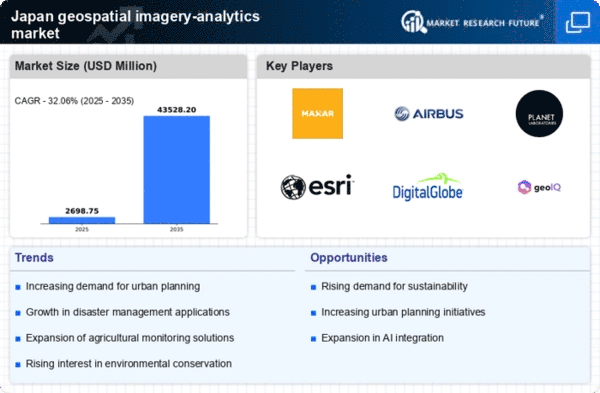
As per MRFR analysis, the geospatial imagery-analytics market size was estimated at 2043.58 USD Million in 2024. The geospatial imagery-analytics market is projected to grow from 2698.75 USD Million in 2025 to 43528.2 USD Million by 2035, exhibiting a compound annual growth rate (CAGR) of 32.06% during the forecast period 2025 - 2035.

Key Market Trends & Highlights

The Japan geospatial imagery-analytics market is poised for substantial growth driven by technological advancements and increasing demand for urban planning solutions.

  • The integration of AI and Machine Learning is transforming data analysis in the geospatial imagery-analytics sector.
  • Government initiatives aimed at developing smart cities are propelling the adoption of geospatial technologies.
  • Environmental monitoring and sustainability efforts are gaining traction, particularly in urban areas.
  • Technological advancements in remote sensing and rising demand for urban planning solutions are key drivers of market growth.

Market Size & Forecast

2024 Market Size 2043.58 (USD Million)
2035 Market Size 43528.2 (USD Million)
CAGR (2025 - 2035) 32.06%

Major Players

Maxar Technologies (US), Airbus (FR), Planet Labs (US), Esri (US), DigitalGlobe (US), GeoIQ (US), BlackSky (US), L3Harris Technologies (US)

Japan Geospatial Imagery Analytics Market Trends

The geospatial imagery-analytics market is experiencing notable growth, driven by advancements in technology and increasing demand for data-driven decision-making. In Japan, the integration of artificial intelligence and machine learning into geospatial analytics is transforming how organizations utilize spatial data. This evolution allows for enhanced predictive modeling and improved operational efficiency across various sectors, including agriculture, urban planning, and disaster management. Furthermore, the government's emphasis on smart city initiatives and infrastructure development is likely to bolster the adoption of geospatial technologies, as stakeholders seek innovative solutions to address urban challenges. Moreover, the rising awareness of environmental issues and the need for sustainable practices are propelling the geospatial imagery-analytics market forward. Organizations are increasingly leveraging spatial data to monitor environmental changes, assess natural resources, and implement conservation strategies. The collaboration between public and private sectors in Japan is fostering a conducive environment for innovation, enabling the development of tailored solutions that meet specific regional needs. As the market continues to evolve, it appears poised for further expansion, with potential applications extending into various industries, thereby enhancing overall productivity and sustainability.

Integration of AI and Machine Learning

The incorporation of artificial intelligence and machine learning technologies into geospatial analytics is reshaping the landscape. This trend enables organizations to process vast amounts of spatial data more efficiently, leading to improved insights and decision-making capabilities.

Government Initiatives and Smart Cities

Japan's focus on smart city projects and infrastructure development is driving the demand for geospatial technologies. These initiatives aim to enhance urban living conditions and optimize resource management through advanced spatial analysis.

Environmental Monitoring and Sustainability

The increasing emphasis on environmental sustainability is pushing organizations to utilize geospatial imagery for monitoring ecological changes. This trend supports efforts in resource management and conservation, aligning with global sustainability goals.

Japan Geospatial Imagery Analytics Market Drivers

Expansion of Agricultural Technologies

The agricultural sector in Japan is increasingly adopting geospatial imagery-analytics to enhance productivity and sustainability. Farmers and agribusinesses are utilizing geospatial data to optimize crop management, monitor soil health, and improve yield forecasting. The integration of precision agriculture techniques, supported by geospatial analytics, is transforming traditional farming practices. Reports indicate that the agricultural technology market is expected to grow by over 15% annually, with a significant portion of this growth attributed to geospatial technologies. As the demand for food security rises, the geospatial imagery-analytics market is likely to see increased investment and innovation, reflecting the sector's commitment to leveraging data for improved agricultural outcomes.

Increased Focus on Disaster Management

Japan's geographical location makes it prone to natural disasters, necessitating robust disaster management strategies. The geospatial imagery-analytics market plays a pivotal role in this context, providing critical data for risk assessment and emergency response. Advanced analytics can help in predicting disaster impacts and optimizing resource allocation during emergencies. The government has been investing heavily in technologies that enhance disaster preparedness, with estimates suggesting an allocation of approximately $300 million towards geospatial technologies in disaster management. This focus on leveraging geospatial data for safety and resilience is likely to drive growth in the geospatial imagery-analytics market, as stakeholders seek to improve their capabilities in managing disaster risks.

Rising Demand for Urban Planning Solutions

Urbanization in Japan is accelerating, leading to an increased demand for effective urban planning solutions. The geospatial imagery-analytics market is positioned to benefit from this trend, as city planners and local governments seek to utilize geospatial data for infrastructure development and resource management. The integration of geospatial analytics into urban planning processes allows for better visualization of land use, transportation networks, and environmental impacts. Reports indicate that the urban planning sector is expected to allocate over $500 million to geospatial technologies in the coming years. This investment reflects a growing recognition of the value of data-driven decision-making in managing urban growth, thereby enhancing the prospects for the geospatial imagery-analytics market.

Technological Advancements in Remote Sensing

The geospatial imagery-analytics market in Japan is experiencing a surge due to rapid technological advancements in remote sensing technologies. Innovations in satellite imaging, drones, and sensor technologies have enhanced the quality and accuracy of geospatial data. For instance, the resolution of satellite imagery has improved significantly, allowing for more detailed analysis. This is particularly relevant in urban planning and disaster management, where precise data is crucial. The market is projected to grow at a CAGR of approximately 12% over the next five years, driven by these advancements. As organizations increasingly rely on high-resolution imagery for decision-making, the demand for sophisticated analytics tools is likely to rise, further propelling the geospatial imagery-analytics market in Japan.

Growing Interest in Environmental Conservation

Environmental conservation efforts in Japan are gaining momentum, leading to an increased reliance on geospatial imagery-analytics. The market is witnessing a rise in demand for tools that can monitor environmental changes, assess biodiversity, and manage natural resources. Organizations are utilizing geospatial data to track deforestation, water quality, and land use changes, which are critical for sustainable development. The government has set ambitious targets for reducing carbon emissions, and geospatial analytics is seen as a vital component in achieving these goals. With an estimated investment of $200 million in environmental monitoring technologies, the geospatial imagery-analytics market is likely to expand as stakeholders prioritize sustainability and conservation initiatives.


Market Segment Insights

By Analytics Type: Video-Based Analytics (Largest) vs. Imagery Analytics (Fastest-Growing)

In the Japan geospatial imagery-analytics market, the distribution of market share between Video-Based Analytics and Imagery Analytics reveals that Video-Based Analytics holds the largest share, benefiting from widespread adoption across various sectors including transportation and security. In contrast, Imagery Analytics, while currently smaller in market share, is rapidly gaining traction as industries increasingly leverage high-resolution imagery for advanced analysis and decision-making processes. The growing importance of data-driven strategies enhances the appeal of both analytics types. Looking at growth trends, Imagery Analytics is identified as the fastest-growing segment, driven by advancements in machine learning and artificial intelligence that augment the capabilities of imagery analysis. Factors such as increasing investment in smart city initiatives and the need for accurate spatial data are propelling this segment forward. In contrast, Video-Based Analytics continues to thrive due to its extensive applications in real-time monitoring, boosting operational efficiency across various sectors in the market.

Analytics Type: Video-Based (Dominant) vs. Imagery (Emerging)

Video-Based Analytics is the dominant player in the Japan geospatial imagery-analytics market, primarily due to its established applications in areas like public safety, traffic management, and environmental monitoring. This segment leverages real-time data processing to provide immediate insights, making it invaluable for sectors that require timely decision-making. On the other side, Imagery Analytics is emerging as a potent alternative, driven by innovations in data capturing technologies and analytic methods. Its strength lies in detailed spatial analysis and change detection over time, which is critical for sectors such as agriculture, urban planning, and disaster management. As industries increasingly recognize the value of comprehensive data insights, Imagery Analytics is set to redefine market dynamics in the coming years.

By Deployment Type: Cloud (Largest) vs. On-Premises (Fastest-Growing)

In the deployment type segment of the Japan geospatial imagery-analytics market, Cloud solutions hold the largest market share. This is largely because of their scalability, flexibility, and lower upfront costs, making them appealing for organizations of all sizes. Businesses are increasingly shifting towards Cloud-based solutions as they offer enhanced collaboration and access to advanced analytics tools that are crucial for extracting meaningful insights from geospatial data. Conversely, On-Premises solutions have been identified as the fastest-growing segment within this market. The growth is primarily driven by organizations seeking greater control over their data and compliance with local regulations. Additionally, the ability to customize software for specific operational needs supports the increasing demand for On-Premises deployment among certain sectors, particularly those handling sensitive information or requiring robust security measures.

Deployment Type: Cloud (Dominant) vs. On-Premises (Emerging)

Cloud deployment has emerged as the dominant force in the Japan geospatial imagery-analytics market, primarily due to its cost-effectiveness and ability to support complex analytics without heavy infrastructure investments. This makes it particularly attractive for small to medium-sized enterprises looking to leverage geospatial insights without significant upfront costs. In contrast, On-Premises solutions are seen as an emerging trend, appealing to businesses that prioritize data security and customization. These organizations often invest in On-Premises systems to address specific regulatory requirements and to maintain control over their sensitive geospatial data, thereby establishing a niche market that continues to grow despite the dominance of Cloud deployment.

By End-User Type: Government (Largest) vs. Agriculture (Fastest-Growing)

In the Japan geospatial imagery-analytics market, the government sector holds the largest share, driven by extensive applications in urban planning, disaster management, and environmental monitoring. Following the government, industries like defense and security also command significant market presence, thanks to increasing demand for surveillance and national security. The agriculture sector, although smaller, is gaining traction as precision farming practices elevate its prominence in utilizing geospatial data. The growth trends in this segment are influenced by advancements in technology and an increasing focus on data-driven decision-making. The agriculture sector is emerging as the fastest-growing end-user thanks to the increasing adoption of drones and IoT devices for crop monitoring and management. Additionally, the engineering and construction sectors are witnessing growth due to ongoing infrastructure projects, thereby contributing to the demand for high-resolution imagery and analytics services.

Government (Dominant) vs. Agriculture (Emerging)

The government segment stands as the dominant force in the Japan geospatial imagery-analytics market, leveraging vast datasets for improved public service delivery and resource management. This segment utilizes aerial imagery and satellite data to enhance urban planning, regulatory compliance, and emergency response solutions. In contrast, the agriculture sector represents an emerging market segment characterized by rapid technological adoption, notably through precision agriculture techniques. Farmers are increasingly relying on geospatial analytics to enhance yield and optimize resource utilization. This shift is supported by government initiatives promoting smart farming practices, presenting significant growth opportunities for geospatial imagery solutions in agricultural applications.

Get more detailed insights about Japan Geospatial Imagery Analytics Market

Key Players and Competitive Insights

The geospatial imagery-analytics market in Japan is characterized by a dynamic competitive landscape, driven by technological advancements and increasing demand for data-driven decision-making across various sectors. Key players such as Maxar Technologies (US), Airbus (FR), and Planet Labs (US) are strategically positioned to leverage their innovative capabilities and extensive satellite networks. Maxar Technologies (US) focuses on enhancing its Earth observation capabilities through advanced imaging technologies, while Airbus (FR) emphasizes partnerships with local entities to expand its market reach. Planet Labs (US) is notable for its agile satellite deployment strategy, which allows for rapid data acquisition and analysis, thereby shaping a competitive environment that prioritizes speed and accuracy in data delivery.

The market structure appears moderately fragmented, with several players vying for market share through localized strategies and supply chain optimization. Companies are increasingly localizing their operations to better serve the Japanese market, which may enhance responsiveness to customer needs and regulatory requirements. This localized approach, combined with strategic partnerships, enables these firms to navigate the complexities of the market while maintaining competitive pricing and service offerings.

In October 2025, Maxar Technologies (US) announced a collaboration with a leading Japanese telecommunications company to enhance satellite data integration into urban planning initiatives. This partnership is strategically significant as it aligns with Japan's focus on smart city development, potentially positioning Maxar as a key player in the urban analytics space. The integration of satellite data into urban planning could lead to more efficient resource allocation and improved infrastructure development.

In September 2025, Airbus (FR) launched a new satellite designed specifically for high-resolution imaging, aimed at supporting disaster management efforts in Japan. This move underscores Airbus's commitment to addressing regional challenges, particularly in a country prone to natural disasters. By providing timely and accurate imagery, Airbus enhances its value proposition to government agencies and emergency responders, thereby solidifying its market position.

In August 2025, Planet Labs (US) expanded its operations in Japan by establishing a data center in Tokyo, aimed at improving data processing capabilities for local clients. This strategic expansion is likely to enhance Planet's service delivery and responsiveness, allowing for quicker turnaround times on data requests. The establishment of a local data center may also foster stronger relationships with Japanese businesses and government entities, further entrenching Planet's presence in the market.

As of November 2025, the competitive trends in the geospatial imagery-analytics market are increasingly defined by digitalization, sustainability, and the integration of artificial intelligence (AI). Strategic alliances are becoming more prevalent, as companies recognize the need to collaborate to enhance technological capabilities and market reach. The shift from price-based competition to a focus on innovation and technology is evident, with firms investing in advanced analytics and reliable supply chains to differentiate themselves. Looking ahead, competitive differentiation is likely to evolve further, emphasizing the importance of technological advancements and sustainable practices in shaping the future landscape of the market.

Key Companies in the Japan Geospatial Imagery Analytics Market market include

Industry Developments

The Japan Geospatial Imagery Analytics Market has seen significant developments recently. In October 2023, Mitsubishi Electric announced advancements in satellite technology aimed at enhancing high-resolution imagery for various urban applications. In the same month, JAXA (Japan Aerospace Exploration Agency) collaborated with various entities to launch new Earth observation satellites intended to improve data accessibility for environmental monitoring. Moreover, the partnership between Planet Labs and the Remote Sensing Technology Center of Japan, formalized in September 2023, aims to leverage advanced analytics for more accurate agriculture monitoring and disaster management. 

Regarding mergers and acquisitions, Maxar Technologies completed a significant acquisition of a data analytics firm in August 2023, aiming to strengthen its position in the Asia-Pacific market, including Japan. The market is poised for growth, with estimates indicating an increased valuation driven by heightened governmental focus on environmental sustainability, urban planning, and disaster response. Companies like Google and IBM continue to expand their analytics capabilities for geospatial data, fostering innovation across various sectors in Japan. As the market evolves, ongoing partnerships and technological advancements are expected to facilitate progressive enhancements in geospatial analytics applications.

Future Outlook

Japan Geospatial Imagery Analytics Market Future Outlook

The Geospatial Imagery Analytics Market is projected to grow at a 32.06% CAGR from 2024 to 2035, driven by advancements in satellite technology and increasing demand for data-driven decision-making.

New opportunities lie in:

  • Development of AI-driven analytics platforms for real-time data processing.
  • Expansion of geospatial data services for urban planning and infrastructure development.
  • Integration of geospatial analytics in supply chain optimization solutions.

By 2035, the market is expected to achieve substantial growth, driven by innovative applications and technological advancements.

Market Segmentation

Japan Geospatial Imagery Analytics Market End-User Type Outlook

  • Government
  • Defense & Security
  • Engineering & Construction
  • Mining & Manufacturing
  • Agriculture
  • Insurance
  • Healthcare
  • Environment Monitoring
  • Energy, Utility, and Natural Resources
  • Others

Japan Geospatial Imagery Analytics Market Analytics Type Outlook

  • Video-Based Analytics
  • Imagery Analytics

Japan Geospatial Imagery Analytics Market Deployment Type Outlook

  • Cloud
  • On-Premises

Report Scope

MARKET SIZE 2024 2043.58(USD Million)
MARKET SIZE 2025 2698.75(USD Million)
MARKET SIZE 2035 43528.2(USD Million)
COMPOUND ANNUAL GROWTH RATE (CAGR) 32.06% (2024 - 2035)
REPORT COVERAGE Revenue Forecast, Competitive Landscape, Growth Factors, and Trends
BASE YEAR 2024
Market Forecast Period 2025 - 2035
Historical Data 2019 - 2024
Market Forecast Units USD Million
Key Companies Profiled Maxar Technologies (US), Airbus (FR), Planet Labs (US), Esri (US), DigitalGlobe (US), GeoIQ (US), BlackSky (US), L3Harris Technologies (US)
Segments Covered Analytics Type, Deployment Type, End-User Type
Key Market Opportunities Integration of artificial intelligence in geospatial imagery-analytics enhances data processing and decision-making capabilities.
Key Market Dynamics Rising demand for advanced geospatial analytics driven by urbanization and environmental monitoring initiatives in Japan.
Countries Covered Japan

Leave a Comment

FAQs

What is the projected market size of the Japan Geospatial Imagery Analytics Market in 2024?

The Japan Geospatial Imagery Analytics Market is projected to be valued at 1.5 USD Billion in 2024.

What is the expected valuation of the market by 2035?

By 2035, the Japan Geospatial Imagery Analytics Market is expected to reach a valuation of 12.0 USD Billion.

What is the expected CAGR for the market from 2025 to 2035?

The market is expected to grow at a CAGR of 20.809% from 2025 to 2035.

Which segment is expected to dominate the market value in 2024?

In 2024, the Imagery Analytics segment is valued at 0.9 USD Billion, while Video-based Analytics is valued at 0.6 USD Billion.

What will be the market value of Video-based Analytics by 2035?

By 2035, the Video-based Analytics segment is expected to reach 4.8 USD Billion.

What is the expected market value of Imagery Analytics by 2035?

The Imagery Analytics segment is projected to be valued at 7.2 USD Billion by 2035.

Who are the key players in the Japan Geospatial Imagery Analytics Market?

Key players in the market include Mitsubishi Electric, DigitalGlobe, Google, and others.

What are the main applications driving growth in this market?

Applications such as urban planning, disaster management, and environmental monitoring are driving market growth.

What are some emerging trends in the Japan Geospatial Imagery Analytics Market?

Emerging trends include the increasing use of artificial intelligence and machine learning in analytics.

How is the current global scenario impacting the Japan Geospatial Imagery Analytics Market?

The current global scenario affects demand fluctuations and may influence investment in geospatial technologies.

Download Free Sample

Kindly complete the form below to receive a free sample of this Report

Compare Licence

×
Features License Type
Single User Multiuser License Enterprise User
Price $4,950 $5,950 $7,250
Maximum User Access Limit 1 User Upto 10 Users Unrestricted Access Throughout the Organization
Free Customization
Direct Access to Analyst
Deliverable Format
Platform Access
Discount on Next Purchase 10% 15% 15%
Printable Versions