Download Free Sample
Kindly complete the form below to receive a free sample of this Report
India Herpes Zoster Market Research Report By Diagnosis (Laboratory Testing, Immunofluorescent Microscopy, Real-Time Polymerase Chain Reaction (PCR), Serological Testing, Others), By Treatment and Prevention (Antiviral Medications, Narcotic Medications, Anti-Inflammatory Medications, Antihistamines, Anticonvulsants, Capsaicin, Numbing Creams, Gels, or Patches, Vaccines, Others), By Route of Administration (Oral, Topical, Others) and By End User (Hospitals & Clinics, Diagnostic Centers, Research & Academic Institutes, Home Care Settings, Others) -Forecast to 2035
As per Market Research Future analysis, the India herpes zoster market size was estimated at 8.4 USD Million in 2024. The India herpes zoster market is projected to grow from 8.87 USD Million in 2025 to 15.2 USD Million by 2035, exhibiting a compound annual growth rate (CAGR) of 5.5% during the forecast period 2025 - 2035
The India herpes zoster market is experiencing notable growth driven by increased awareness and healthcare initiatives.
| 2024 Market Size | 8.4 (USD Million) |
| 2035 Market Size | 15.2 (USD Million) |
| CAGR (2025 - 2035) | 5.54% |
GSK (GB), Merck & Co (US), Sanofi (FR), Pfizer (US), AstraZeneca (GB), Bristol-Myers Squibb (US), Novartis (CH), AbbVie (US), Teva Pharmaceutical Industries (IL)
Our Impact
Enabled $4.3B Revenue Impact for Fortune 500 and Leading Multinationals
Partnering with 2000+ Global Organizations Each Year
30K+ Citations by Top-Tier Firms in the Industry
Currently, notable developments are occurring in the herpes zoster market., driven by an increasing awareness of the condition and its potential complications. Herpes zoster, commonly known as shingles, results from the reactivation of the varicella-zoster virus, which can lead to severe pain and discomfort. In India, the rising incidence of this condition, particularly among older adults, has prompted healthcare providers to focus on prevention and treatment options. Vaccination programs are being emphasized, as they may significantly reduce the risk of developing herpes zoster and its associated complications. Furthermore, the healthcare infrastructure is gradually adapting to meet the growing demand for effective management of this condition. In addition to vaccination efforts, advancements in treatment modalities are shaping the herpes zoster market. New antiviral medications and pain management therapies are being introduced, which could enhance patient outcomes. The increasing prevalence of comorbidities among the aging population may also contribute to a higher demand for effective treatment options. As healthcare professionals continue to educate patients about the importance of early intervention, the market is likely to expand further. Overall, the herpes zoster market is poised for growth, driven by a combination of preventive measures and innovative treatment strategies.
There is a growing emphasis on educating the public about herpes zoster, its symptoms, and potential complications. Healthcare providers are increasingly focusing on awareness campaigns, which may lead to earlier diagnosis and treatment.
Vaccination programs targeting at-risk populations are gaining traction. These initiatives aim to reduce the incidence of herpes zoster, particularly among older adults, thereby potentially decreasing the burden on healthcare systems.
The introduction of new antiviral therapies and pain management strategies is transforming the treatment landscape. These advancements may improve patient outcomes and enhance the overall management of herpes zoster.
Government health initiatives aimed at improving public health are significantly impacting the herpes zoster market. The Indian government has launched various programs to enhance vaccination coverage and promote awareness about herpes zoster. These initiatives are likely to lead to increased vaccination rates, particularly among high-risk populations such as the elderly and immunocompromised individuals. With the government investing approximately $50 million in public health campaigns, the herpes zoster market is poised for growth. Enhanced access to healthcare services and educational resources will likely result in earlier diagnosis and treatment, further driving market expansion.
The increase in healthcare expenditure in India is a crucial driver for the herpes zoster market. As the country witnesses economic growth, healthcare spending is projected to rise by 10% annually, leading to improved access to medical services and treatments. This trend is likely to facilitate the availability of antiviral medications and vaccines for herpes zoster, making them more accessible to the population. Additionally, as patients become more willing to invest in their health, the demand for effective treatment options is expected to surge. Consequently, the herpes zoster market is likely to benefit from this upward trend in healthcare expenditure.
The herpes zoster market is experiencing growth due to the rising incidence of herpes zoster cases in India. Recent studies indicate that approximately 1 in 3 individuals will develop herpes zoster in their lifetime, with a notable increase in cases among the elderly population. This demographic shift, characterized by an aging population, is likely to drive demand for effective treatment options. Furthermore, the incidence rate is projected to rise by 20% over the next decade, emphasizing the need for healthcare providers to address this growing health concern. As awareness of the condition increases, the herpes zoster market is expected to expand, with more patients seeking medical intervention and treatment.
Advancements in diagnostic technologies are playing a pivotal role in shaping the herpes zoster market. The introduction of rapid diagnostic tests and improved imaging techniques is enabling healthcare providers to diagnose herpes zoster more accurately and efficiently. This is particularly important in India, where timely diagnosis can significantly affect treatment outcomes. Enhanced diagnostic capabilities are likely to lead to earlier intervention, which may reduce the incidence of complications such as postherpetic neuralgia. As a result, the herpes zoster market is expected to grow as healthcare providers increasingly adopt these innovative diagnostic tools.
The increasing awareness of postherpetic neuralgia (PHN) among healthcare professionals and patients is influencing the herpes zoster market. PHN, a common complication of herpes zoster, can lead to chronic pain and significantly impact the quality of life. As awareness of this condition grows, more patients are likely to seek timely treatment for herpes zoster to prevent the onset of PHN. Educational campaigns and healthcare provider training are expected to enhance understanding of the condition, potentially leading to a 15% increase in treatment-seeking behavior. This heightened awareness is likely to drive growth in the herpes zoster market.
In the India herpes zoster market, the diagnosis segment is primarily driven by Laboratory Testing, which holds the largest market share due to its widespread application and effectiveness in detecting the virus. Other methods, such as Serological Testing and Immunofluorescent Microscopy, contribute significantly but do not match the dominance of Laboratory Testing. Real-Time Polymerase Chain Reaction (PCR) has emerged as a substantial method, gaining a larger share as awareness of its accuracy and efficiency grows within the medical community. The growth trends in the diagnosis segment reveal a strong preference for modern testing techniques, particularly Real-Time PCR, which is categorized as the fastest-growing due to its rapid and precise results. The increasing incidence of herpes zoster cases and the rising demand for accurate diagnostic tools are key drivers. Healthcare providers are increasingly adopting innovative diagnostic technologies to enhance patient outcomes, further boosting the market expansion.
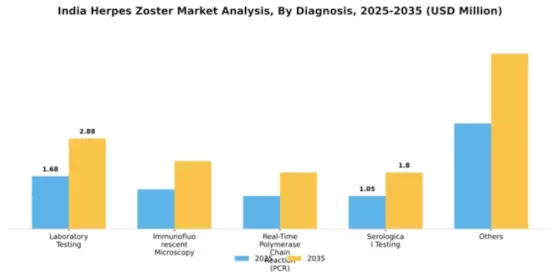
Laboratory Testing (Dominant) vs. Real-Time Polymerase Chain Reaction (PCR) (Emerging)
Laboratory Testing remains the dominant force in the India herpes zoster market, offering reliable results and established protocols. This method utilizes traditional techniques that have been proven effective over time, making it a trusted choice among healthcare professionals. In contrast, Real-Time Polymerase Chain Reaction (PCR) is gaining traction as an emerging diagnostic tool, characterized by its rapid processing time and high specificity for detecting varicella-zoster virus. As healthcare facilities embrace technological advancements, PCR is expected to increase its foothold in the market, driven by the need for more efficient diagnostics in an evolving healthcare landscape.
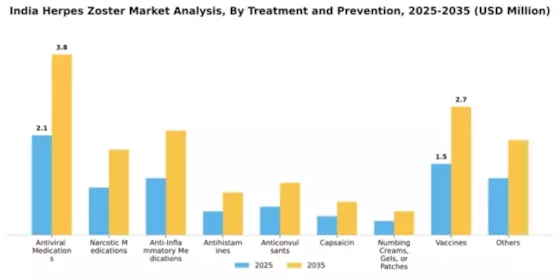
In the India herpes zoster market, Antiviral Medications hold the largest market share, driven by their primary role in managing herpes zoster symptoms and preventing complications. This category is crucial for patient management, accounting for a significant portion of the treatment landscape, while Vaccines are gaining traction as a preventative approach, reflecting a shift towards proactive healthcare strategies. The emergence of newer antiviral options continues to bolster this segment's dominance against emerging competitors in the vaccine space. Growth trends indicate that as awareness of herpes zoster increases, so does the demand for both antiviral medications and vaccines. The expanding healthcare infrastructure and increasing investments in research and development are pivotal in propelling this segment forward. Furthermore, the rise in older populations, who are more susceptible to herpes zoster, is expected to drive future sales, with a notable focus on improving vaccination rates as a preventive measure against the virus.
Antiviral Medications (Dominant) vs. Vaccines (Emerging)
Antiviral Medications, characterized by their effectiveness in reducing the duration and severity of herpes zoster outbreaks, remain the dominant treatment option in the India herpes zoster market. Their established role in clinical practice, coupled with ongoing innovations and formulations, keeps them at the forefront of treatment strategies. In contrast, Vaccines are an emerging segment, designed to enhance immunity against the virus among at-risk populations. With growing public awareness and healthcare initiatives promoting vaccination, this segment is witnessing accelerated growth. The adoption of vaccines is supported by favorable government policies and rising healthcare expenditure, aimed at reducing the incidence and burden of herpes zoster.
The India herpes zoster market showcases a diverse distribution across different routes of administration, with the oral segment holding a dominant position. The oral route is preferred due to its ease of use and patient compliance, accounting for a significant share in the market. On the other hand, topical applications are gaining traction, becoming increasingly popular among patients seeking immediate relief and targeted action, although they represent a smaller share compared to oral medications. In recent years, there has been a notable shift in preferences among healthcare providers and patients towards topical formulations, which are perceived as more effective and provide localized treatment. Factors such as rising awareness of herpes zoster treatment options and innovative formulation developments are driving the growth of the topical segment, making it the fastest-growing route of administration. This trend indicates a promising future for topical medications as they adapt to meet the evolving needs of patients.
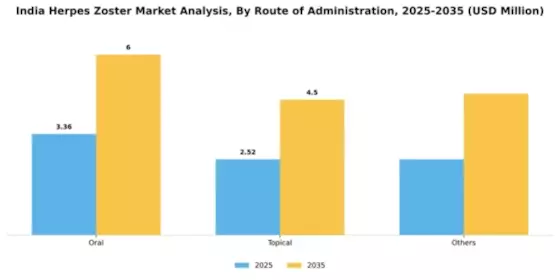
Oral (Dominant) vs. Topical (Emerging)
The oral segment of the India herpes zoster market is characterized by its widespread acceptance and ease of administration, making it the dominant choice for both healthcare providers and patients. Oral medications are designed for systemic effects, allowing for comprehensive treatment of herpes zoster symptoms. Conversely, the topical segment represents an emerging alternative that is quickly capturing interest due to its localized application. Topical treatments are formulated for direct application on affected areas, providing quick relief from pain and irritation. This segment appeals particularly to patients looking for immediate comfort, thus showing substantial growth potential. As innovations in formulation and delivery systems continue to evolve, both segments are expected to coexist, catering to varied patient preferences.
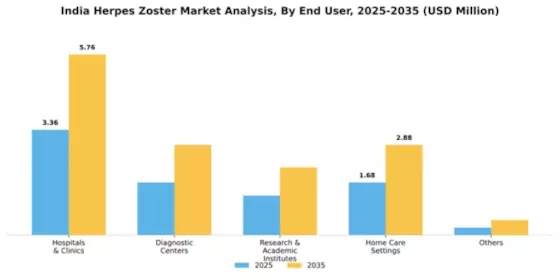
The market share distribution in the segment of end users showcases a significant dominance of Hospitals & Clinics, which cater to the majority of patients seeking treatment for herpes zoster. Diagnostic Centers and Research & Academic Institutes follow, providing necessary diagnostic services and research opportunities that enrich the market. Home Care Settings have emerged as a vital player in recent years, reflecting a growing preference for convenience and personalized care among patients. Growth trends in this segment indicate a robust increase in the adoption of Home Care Settings, driven by the rising aging population and a shift towards outpatient care. Patients are increasingly looking for options that allow treatment in the comfort of their homes, thereby fostering a surge in growth for this category. Furthermore, advancements in telemedicine and at-home diagnostic tools are propelling the demand for these services, making them an essential component of the overall market landscape.
Hospitals & Clinics (Dominant) vs. Home Care Settings (Emerging)
Hospitals & Clinics have established themselves as a dominant force in the market due to their comprehensive treatment capabilities and access to advanced medical technologies. They offer critical care, timely interventions, and are staffed with skilled healthcare professionals, making them the go-to choice for patients with herpes zoster. In contrast, Home Care Settings are emerging as a popular alternative, especially among patients preferring to manage their health at home. This segment's growth is attributed to increased demand for personalized care and the convenience of receiving services in a familiar environment. The transition towards home care has been further amplified by technological innovations that make monitoring and managing conditions more efficient, appealing to a broader patient base.
Get more detailed insights about India Herpes Zoster Market Request Free Sample
The herpes zoster market in India is characterized by a competitive landscape that is increasingly shaped by innovation, strategic partnerships, and regional expansion. Key players such as GSK (GB), Merck & Co (US), and Sanofi (FR) are actively pursuing strategies that enhance their market presence. GSK (GB) has focused on expanding its vaccine portfolio, which is crucial given the rising incidence of herpes zoster in the aging population. Merck & Co (US) appears to be leveraging its strong research capabilities to develop next-generation vaccines, while Sanofi (FR) is likely concentrating on strategic collaborations to enhance its distribution networks across India. Collectively, these strategies indicate a market that is not only competitive but also dynamic, with companies striving to differentiate themselves through innovation and operational efficiency.In terms of business tactics, companies are increasingly localizing manufacturing to reduce costs and improve supply chain efficiency. This approach is particularly relevant in a moderately fragmented market where several players vie for market share. The competitive structure is influenced by the presence of both multinational corporations and local firms, which together create a diverse landscape. The collective influence of these key players is significant, as they drive advancements in vaccine technology and distribution strategies, thereby shaping the overall market dynamics.
In October GSK (GB) announced a partnership with a local pharmaceutical company to enhance the distribution of its shingles vaccine across rural areas in India. This strategic move is likely to improve access to vaccination, addressing a critical gap in healthcare delivery. By collaborating with local entities, GSK (GB) not only strengthens its market position but also aligns with the Indian government's initiatives to improve healthcare access in underserved regions.
In September Merck & Co (US) launched a new marketing campaign aimed at raising awareness about the importance of vaccination against herpes zoster among the elderly population. This initiative is significant as it reflects a proactive approach to public health education, potentially increasing vaccine uptake. By focusing on awareness, Merck & Co (US) is likely to enhance its brand visibility and foster a stronger connection with healthcare providers and patients alike.
In August Sanofi (FR) expanded its manufacturing capabilities in India by investing in a new facility dedicated to vaccine production. This expansion is indicative of Sanofi's commitment to meeting the growing demand for herpes zoster vaccines in the region. By increasing production capacity, Sanofi (FR) positions itself to respond more effectively to market needs, thereby enhancing its competitive edge.
As of November current trends in the herpes zoster market are increasingly defined by digitalization, sustainability, and the integration of artificial intelligence in vaccine development and distribution. Strategic alliances are becoming more prevalent, as companies recognize the value of collaboration in navigating complex market dynamics. Looking ahead, competitive differentiation is expected to evolve, with a notable shift from price-based competition to a focus on innovation, technological advancements, and supply chain reliability. This transition suggests that companies that prioritize these areas will likely emerge as leaders in the market.






The India Herpes Zoster Market has seen significant developments recently, particularly with a focus on vaccination and treatment options. Notably, GlaxoSmithKline has been actively involved in promoting its shingles vaccine, which has garnered attention due to increased awareness about the disease. In May 2023, Dr. Reddy's Laboratories announced the launch of its generic version of a popular antiviral used in herpes zoster treatment, thereby expanding treatment options for patients and enhancing its market standing.
In terms of market growth, the sector has witnessed a steady increase in valuation, attributed to rising incidences of shingles among the aging population and greater healthcare investment from the Indian government, emphasizing preventive healthcare initiatives. Moreover, in August 2022, Hetero Labs expanded its manufacturing capabilities for antiviral medications, which contributed positively to the availability of critical therapies. There have been no recent mergers or acquisitions reported among key players like Pfizer, Biocon, or Lupin Pharmaceuticals in this specific market, indicating a stable competitive landscape.
Overall, the India Herpes Zoster Market is evolving with advancements in treatment and preventive strategies aligned with national health priorities.
The Herpes Zoster Market in India is projected to grow at a 5.54% CAGR from 2025 to 2035, driven by increasing awareness and vaccination initiatives.
New opportunities lie in:
By 2035, the herpes zoster market is expected to achieve substantial growth and enhanced accessibility.
| MARKET SIZE 2024 | 8.4(USD Million) |
| MARKET SIZE 2025 | 8.87(USD Million) |
| MARKET SIZE 2035 | 15.2(USD Million) |
| COMPOUND ANNUAL GROWTH RATE (CAGR) | 5.54% (2025 - 2035) |
| REPORT COVERAGE | Revenue Forecast, Competitive Landscape, Growth Factors, and Trends |
| BASE YEAR | 2024 |
| Market Forecast Period | 2025 - 2035 |
| Historical Data | 2019 - 2024 |
| Market Forecast Units | USD Million |
| Key Companies Profiled | GSK (GB), Merck & Co (US), Sanofi (FR), Pfizer (US), AstraZeneca (GB), Bristol-Myers Squibb (US), Novartis (CH), AbbVie (US), Teva Pharmaceutical Industries (IL) |
| Segments Covered | Diagnosis, Treatment and Prevention, Route of Administration, End User |
| Key Market Opportunities | Emerging vaccine technologies and increased awareness drive growth in the herpes zoster market. |
| Key Market Dynamics | Rising demand for herpes zoster vaccines driven by increased awareness and regulatory support in India. |
| Countries Covered | India |
The market valuation was $8.4 Million in 2024.
The projected valuation for 2035 is $15.2 Million.
The expected CAGR is 5.54% during the forecast period 2025 - 2035.
Key players include GSK, Merck & Co, Sanofi, Pfizer, AstraZeneca, Bristol-Myers Squibb, Novartis, AbbVie, and Teva Pharmaceutical Industries.
The segment valuations for diagnosis included Laboratory Testing at $1.68 Million, Immunofluorescent Microscopy at $1.26 Million, and Real-Time PCR at $1.05 Million.
Main segments include Antiviral Medications at $2.1 Million, Narcotic Medications at $1.0 Million, and Vaccines at $1.5 Million.
Routes of administration include Oral at $3.36 Million and Topical at $2.52 Million.
End-user segments include Hospitals & Clinics at $3.36 Million and Diagnostic Centers at $1.68 Million.
Antiviral Medications, valued at $2.1 Million, appear to lead compared to Narcotic Medications at $1.0 Million and Anti-Inflammatory Medications at $1.2 Million.
The market is expected to grow from $8.4 Million in 2024 to $15.2 Million by 2035, indicating a robust growth trajectory.


Kindly complete the form below to receive a free sample of this Report

“This is really good guys. Excellent work on a tight deadline. I will continue to use you going forward and recommend you to others. Nice job”


“Thanks. It’s been a pleasure working with you, please use me as reference with any other Intel employees.”


“Thanks for sending the report it gives us a good global view of the Betaïne market.”


“Thank you, this will be very helpful for OQS.”


“We found the report very insightful! we found your research firm very helpful. I'm sending this email to secure our future business.”


“I am very pleased with how market segments have been defined in a relevant way for my purposes (such as "Portable Freezers & refrigerators" and "last-mile"). In general the report is well structured. Thanks very much for your efforts.”


“I have been reading the first document or the study, ,the Global HVAC and FP market report 2021 till 2026. Must say, good info! I have not gone in depth at all parts, but got a good indication of the data inside!”


“We got the report in time, we really thank you for your support in this process. I also thank to all of your team as they did a great job.”


“The Automotive 48V ECU Components Procurement Intelligence Study” was a complex project, but the Market Research Future (MRFR) team handled it with quality, agility, and customer-centricity. They delivered all requested data on time and within the agreed scope. The team, including Shubhendra Anand and Rahul Gotadki, was always readily available to clarify questions and swiftly implement necessary adjustments, driving the project to a successful conclusion within a very demanding timeframe.
I would also like to specifically commend Akshay Agarwal for his responsiveness and support at every stage—from our initial inquiry on May 6th through to final delivery on June 18th. His dedication made the entire process seamless.”



