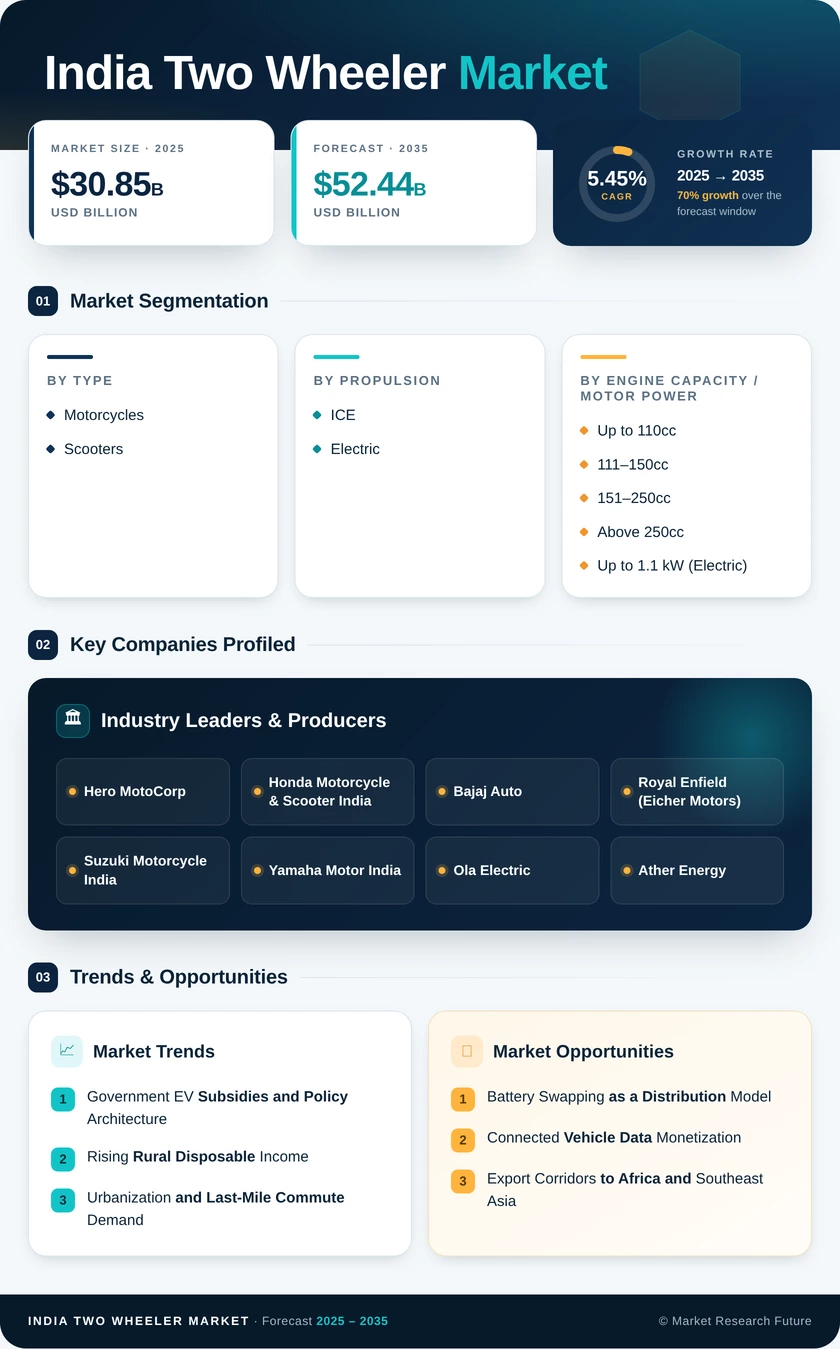
Segmentation Quick Reference
| Dimension | Sub-Segments | Dominant Segment | Fastest Growing Segment |
| Vehicle Type | Motorcycles, Scooters | Motorcycles (79.2% share, 2025) | Scooters (CAGR 6.50%) |
| Propulsion | ICE, Electric | ICE (93.4% share, 2025) | Electric (CAGR 7.55%) |
| Engine Capacity / Motor Power | Up to 110cc, 111–150cc, 151–250cc, Above 250cc, Up to 1.1 kW, 1.1–3.0 kW, Above 3.0 kW | Up to 110cc (46.7% share, 2025) | 1.1–3.0 kW Electric (CAGR 7.68%) |
| Price Band | Up to USD 1,000; USD 1,001–1,500; USD 1,501–2,000; Above USD 2,000 | Up to USD 1,000 (51.6% share, 2025) | USD 1,501–2,000 (CAGR 7.97%) |
| End User | B2C, B2B (Delivery & Logistics) | B2C (96.8% share, 2025) | B2B Delivery & Logistics (CAGR 7.02%) |
| Sales Channel | Offline, Online | Offline (~89% share, 2025) | Online (CAGR 7.55%) |
Market Segmentation Overview
By Vehicle Type
| Sub-Segment | Key Trend |
| Motorcycles | Dominant volume driver; rural-focused economy models lead, while premium adventure and sport touring categories grow among urban riders |
| Scooters | Urban adoption accelerating; electric entrants concentrate almost exclusively on this form factor, driving model proliferation |
Motorcycles account for the largest share of units sold, anchored by the sub-110cc commuter class that serves India's vast rural and semi-urban commute base. Scooters are narrowing the gap in urban metros, driven by convenience, automatic transmissions, and the concentration of new EV launches in this category.
By Propulsion
| Sub-Segment | Key Trend |
| ICE | Still dominant by revenue and volume; OBD-II/III compliance costs are rising, but refuelling infrastructure advantage sustains share |
| Electric | Fastest-growing propulsion type; subsidy frameworks, battery swapping, and declining cell costs accelerate adoption |
ICE platforms retain overwhelming share but face margin compression from tightening emission standards. Electric two-wheelers, while still in single-digit percentage penetration, benefit from a policy-plus-technology tailwind that positions them for rapid share gains over the forecast period.
By Engine Capacity / Motor Power
| Sub-Segment | Key Trend |
| Up to 110cc | Economy backbone; fuel efficiency is the primary purchase criterion |
| 111–150cc | Performance-commuter crossover; Apache, Pulsar families drive this band |
| 151–250cc | Young urban riders; sport and street-naked styling |
| Above 250cc | Premium leisure; Royal Enfield and KTM anchor this tier |
| Up to 1.1 kW (Electric) | Low-speed urban and campus vehicles |
| 1.1–3.0 kW (Electric) | Mainstream electric scooters — Ola S1, Ather 450, TVS iQube |
| Above 3.0 kW (Electric) | Performance electric motorcycles; emerging segment |
The sub-110cc displacement class remains the largest by both volume and value, while the 1.1–3.0 kW electric band is the fastest-growing, powered by mainstream electric scooter launches from both legacy OEMs and EV-native brands.
By Price Band
| Sub-Segment | Key Trend |
| Up to USD 1,000 | Largest band; rural first-time and replacement buyers |
| USD 1,001–1,500 | Mid-range commuters and entry scooters |
| USD 1,501–2,000 | Premium scooters, mid-displacement motorcycles; fastest-growing tier |
| Above USD 2,000 | Leisure, touring, and high-performance motorcycles |
The sub-USD 1,000 band dominates by unit share, but the USD 1,501–2,000 tier is expanding fastest as aspirational buyers trade up and electric scooter pricing clusters in this range after subsidies.
By End User
| Sub-Segment | Key Trend |
| B2C | Personal commute and family transport; overwhelming majority of sales |
| B2B (Delivery & Logistics) | Quick-commerce and food-delivery fleet expansion drives rapid growth |
B2C purchases form the structural base of the market, while B2B fleet procurement — driven by Swiggy, Zomato, Amazon, and Flipkart delivery operations — is the fastest-expanding end-user category with increasing electrification mandates.
By Sales Channel
| Sub-Segment | Key Trend |
| Offline (Dealer Network) | Dominant channel; test rides, financing tie-ups, and after-sales service drive preference |
| Online | Fast-growing channel; OEM direct-booking platforms and marketplace aggregators gain traction |
Offline dealerships retain the vast majority of transactions due to the tactile nature of two-wheeler purchases and the embedded financing ecosystem. Online channels are growing from a small base as OEMs invest in digital booking, doorstep delivery, and virtual showroom experiences.