Market Growth Projections
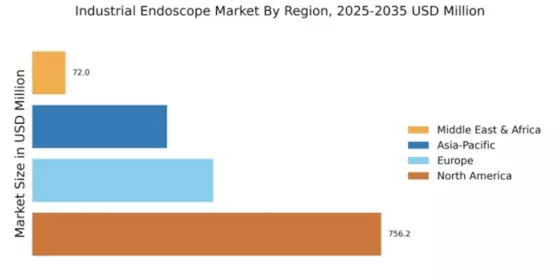
The Global Industrial Endoscope Market Industry is projected to experience substantial growth over the coming years. With a market value expected to reach 1500 USD Million in 2024 and potentially expanding to 3500 USD Million by 2035, the industry is poised for significant development. The compound annual growth rate of 8.01% from 2025 to 2035 indicates a robust demand for industrial endoscopes across various sectors. This growth is driven by technological advancements, increasing awareness of inspection technologies, and the necessity for compliance with safety standards.
Technological Advancements
The Global Industrial Endoscope Market Industry is experiencing rapid technological advancements that enhance inspection capabilities. Innovations such as high-definition imaging, flexible articulation, and wireless connectivity are transforming the way inspections are conducted. For instance, the introduction of 4K resolution endoscopes allows for clearer visuals, enabling technicians to identify issues with greater precision. These advancements not only improve efficiency but also reduce downtime in various industrial sectors. As a result, the market is projected to reach 1500 USD Million in 2024, reflecting a growing demand for sophisticated inspection tools.
Expansion of End-User Industries
The Global Industrial Endoscope Market Industry is benefiting from the expansion of end-user industries such as aerospace, automotive, and energy. These sectors increasingly rely on endoscopes for internal inspections of complex machinery and components. For instance, in aerospace, endoscopes are utilized to inspect turbine engines, ensuring safety and compliance with stringent regulations. As these industries continue to grow, the demand for reliable inspection tools is expected to rise, further propelling the market. The integration of industrial endoscopes into standard operating procedures is likely to enhance operational efficiency and safety.
Rising Demand for Preventive Maintenance
Preventive maintenance is becoming increasingly critical across industries, driving growth in the Global Industrial Endoscope Market Industry. Companies are recognizing the importance of regular inspections to avoid costly downtimes and repairs. For example, in the manufacturing sector, routine checks using industrial endoscopes can identify wear and tear before they lead to equipment failure. This proactive approach is expected to contribute to the market's expansion, with projections indicating a growth to 3500 USD Million by 2035. The emphasis on maintenance strategies is likely to sustain a compound annual growth rate of 8.01% from 2025 to 2035.
Regulatory Compliance and Safety Standards
Stringent regulatory compliance and safety standards are pivotal drivers of the Global Industrial Endoscope Market Industry. Industries such as oil and gas, pharmaceuticals, and food processing are subject to rigorous inspections to meet safety and quality regulations. The use of industrial endoscopes facilitates compliance by enabling thorough internal inspections without disassembly. This capability not only ensures adherence to regulations but also enhances product quality and safety. As regulatory frameworks evolve, the demand for advanced inspection technologies is expected to grow, reinforcing the market's trajectory.
Growing Awareness of Inspection Technologies
There is a growing awareness of the benefits of inspection technologies within various industries, which is positively influencing the Global Industrial Endoscope Market Industry. Companies are increasingly recognizing that utilizing industrial endoscopes can lead to cost savings, improved safety, and enhanced operational efficiency. Educational initiatives and industry conferences are promoting the advantages of these technologies, leading to wider adoption. As awareness continues to spread, the market is likely to see increased investments in inspection tools, contributing to its overall growth.
Key Buying Factors
Key Buying Factors
Introduction
Endoscopes are instruments that allow viewing locations that are normally inaccessible. Simple optical devices, such as lenses, mirrors, and external light sources, can provide insights that would otherwise be impossible to get. A digital camera is integrated into a contemporary endoscope camera, allowing photos of the seen region to be saved and analyzed. There are devices with highly varying equipment because of the numerous conceivable uses for the endoscope camera. Weak points and flaws may be rapidly recognized during the current inspection cycle and in the event of damage, thanks to the easy positioning of the endoscope camera's probe at the locations to be checked and the instantaneous imaging of the targeted regions. Consequently, significantly more focused maintenance and preventative actions may be implemented. The endoscope camera allows for fast analysis of difficult-to-reach places without the need for time-consuming disassembly or component openings.
Even inexperienced workers may readily grasp the functioning of the endoscope camera. The endoscope camera is used by electricians, safety professionals, experts from various industries, mechatronics engineers, precision mechanics, and vehicle mechanics for inspections and troubleshooting. The endoscope camera is also a great instrument for demonstrating and visualizing technical facts or difficulties in technical schools and universities and the trade. Inspections and quality controls may be carried out faster, more accurately, and more cost-effectively using the endoscope camera in industry and plant building.
Before choosing among the vast array of available devices, it is important to figure out the endoscope camera's basic needs. The following review will discuss the most crucial things to think about when buying an industrial endoscope. The following features may frequently be determined ahead of time: flexibility probes for the camera, the diameter of the camera head, multiple articulation endoscope cameras, IP degree of protection for the probes of the camera, viewing angles of the camera, focus, and depth of field of view, image resolutions, interfaces for data transfer and image storage, cameras with multiple probes, support and services, and finally the availability of accessories.
Flexibility Probes for Endoscope Camera
A stiff rod or a flexible cable can be used as the endoscope camera's probe. The camera is at the tip, and there are data, light, and, if necessary, control wires within. Rigid endoscopes are frequently used without acquiring and analyzing pictures. However, rigid endoscopes with a digital camera are also available, allowing for the recording, processing, and storing of the pictures displayed. The endoscope camera with a stiff probe is ideal for fast inspections, such as under cars or components or installations located higher up. The rigid probes are oriented at 90 degrees in the top section for this purpose, or a moveable camera head protrudes from the hard probe rod for this purpose. Telescopic variants of the rod can have a length of up to 3 meters. The endoscope camera allows for quick and safe visual inspections in hard-to-reach areas. If a problem location is identified, the appropriate repair equipment may be put up right there.
Endoscope cameras can check pipelines and cavities with restricted access using flexible and semi-rigid probes. Flexible probes are offered in lengths ranging from 1 to 120 meters. Cables with lengths of ten meters or more are normally coiled up on a cable drum. There are extra features that shield the camera head and assist movement through the inspected region to move the lengthy lengths safely. An endoscope cable holder can help access regions that are difficult to reach with a flexible probe. The flexible cable is directed and fastened in this endoscope cable holder by a sturdy sheath tube.
Diameter of the Camera Head
The diameter of the camera head is significant if the endoscope camera has to be placed into cavities through existing limited apertures for quality control or in the search for mistake reasons. The camera head and probe cable must fit through the opening on the one hand, and the probe must be able to travel within the cavity to the locations to be studied on the other. The bending radius of angled cameras is also affected by the camera head size.
Multiple Articulation Endoscope Camera
There are some scenarios where working with a fixed, front-facing camera is adequate. On the other hand, side cameras are excellent for inspecting the interior of pipe walls and other similarly shaped components. Two fixed cameras for front and side views can be included in a probe. On the control panel, one may choose between the current view of the front and side cameras for the monitor.
For various examinations, it is helpful if the camera head can be tilted in different directions regardless of the probe rod or probe cable's existing orientation. The four directions of movement are distinguished: up, down, right, and left. A two-way or four-way angulation, for example, can be added to an endoscope camera. This implies that a rotary switch, buttons, or joystick may operate the endoscope camera in two or four directions. Multiple articulations is another term for multiple mobilities. Furthermore, the camera head may be rotated 360 degrees around the probe's axis. In each case, it is specified if the endoscope camera probe can be manipulated in two or four directions and whether it may be rotated around the probe axis. Some manufacturers additionally list the angulation's maximum angle.
IP Degree of Protection for the Probe of the Endoscope Camera
Because probes, unlike monitors, are more likely to come into touch with moisture, dust, and foreign matter, they are frequently constructed with high IP protection levels. An international rating for the protection of electrical equipment by housing is the IP degree of protection. The first of the two numbers indicates that the electrical components are protected from dust and other objects, while the second indicates that they are protected from water. The greater the number, the more protected the interior components are. The IP 67 classification for the probe of an endoscope camera, for example, indicates that the camera probe is totally dust-proof and may be submerged in water for up to 30 minutes. As a result, the endoscope camera may be used with this probe to inspect pipelines, components, and containers that are filled but not pressured.
Viewing Angles of the Camera
There are varied criteria for the amount of detail and sharpness of the photographs depending on the application. The size of the picture portion is determined by the camera's viewing angle or aperture angle. The camera's large viewing angle allows for a greater overview and faster alignment. Details and spatially extremely narrow examinations benefit greatly from very tiny angles of view. An inspection endoscope camera, for example, may have an aperture angle of 60, 67, 90, 105, 120, 135, or 150 degrees.
Focus and Depth of Field of View
Optical systems can provide an exceptionally crisp image of the collected items for a given distance. Closer or further away, objects look less detailed. Sharpness may be altered within specified limitations with focusable devices. A probe with a proper depth of viewing field should be used for examinations in very tiny cavities.
Image Resolution
The picture resolution is one of the most important variables in the display's detail sharpness, especially for stored photos and movies. The camera's resolution is higher than the resolution of the saved photos and videos on some devices.
Interfaces for Data Transfer and Image Storage
The USB port on the control unit may be used to link the endoscope camera to a computer. In most situations, two separate modes are available: one for transmitting stored data and another for transmitting current picture data. Almost every endoscope camera with video recording capability also has an interface for sending the video signal directly to a different display, such as a television. NTSC and PAL are two common video output standards. Instead of using the endoscope camera's display, the recordings from the examination can be viewed directly on an external bigger screen.
It is beneficial to retain the photos or video sequences of an examination for documentation purposes in many cases. Many digital endoscope cameras currently allow capturing photographs and films and saving them to an SD card in the device. These photos and videos can be given a time and date stamp while being recorded for easier identification. JPEG is a popular image format, and MP4 or ASF is a popular video format. If necessary, the data can be transmitted to a PC or laptop for additional processing.
Cameras with Multiple Connectable Probes
Various flexible probes can be linked to different model series. This has the benefit of requiring just one control unit to be purchased, and the user is familiar with the handling and functioning of the probe when replacing it. The probes may differ not just in the properties listed above. There are also variances in the way the examination spot is illuminated, such as using specific UV light.
Service and Support
This is crucial if anything does not function. Of all, one cannot just assess a company's performance from the outside. After all, the customer must consider whether they will acquire assistance or order spare parts for their endoscope camera in a few years. Calling the providing firms and speaking with one of the technicians or the order acceptance department is a good idea. Make decisions regarding the consulting quality and faith in the Instruments global corporate network.
Accessories
Special attachments are available for several applications to help reach and show the regions to be investigated. It is critical that the accessories match the model series is utilized.
For easy placement of the probe wire and camera protection, the following items are used: Endoscope cable holders, Guide balls, Camera Carriage, and Centring Brushes are among the accessories available. Magnetic and non-magnetic parts can be removed using screw-on magnetic attachments with hooks with the endoscope camera. Mirror attachments allow the probes with a fixed camera to be seen from different angles.
Receivers for identifying damaged regions can be used to locate the damaged area in buried channels when the precise location is unclear (for example, sewers on private property). Once the place has been determined, only at this phase should excavation begin. For some types of endoscope cameras, additional software can be purchased. This unique program includes features such as a measurement capability for measuring and documenting cracks and fractures.