Industrial Vacuum Cleaner Market (2026 - 2035)

Industrial Vacuum Cleaner Market Size, Share & Growth Analysis Report By Product Type (Canister, Upright, Backpack, Central/Fixed, Explosion-Proof/ATEX, Other), By Power Source (Electric Corded, Battery-Electric, Pneumatic), By End-User Industry (General Manufacturing, Electronics & Semiconductor, Food & Beverage, Metalworking & Foundries, Pharmaceuticals & Biotechnology, Other) and By Regional (North America, Europe, South America, Asia Pacific, Middle East and Africa) – Industry Growth & Forecast to 2035
ID: MRFR/Equip/6971-HCR
111 Pages
Snehal Singh
Last Updated: July 02, 2026
Industrial Vacuum Cleaner Market
Market Size
Forecast Period2026-2035
CAGR (2026-2035)5.9%
2025 Market SizeUSD 1.12 Billion
2035 Market SizeUSD 1.99 Billion
Key Players
Alfred Kärcher SE & Co. KG
Nilfisk Group
Nederman Group
Delfin Industrial Vacuums
Ruwac Industriesauger GmbH
Goodway Technologies
Opportunities
  • Emerging-Market Contract Cleaning Expansion
  • IoT Telemetry and Recurring-Revenue Models
  • Battery-Electric Platform Penetration

Industrial Vacuum Cleaner Market Summary

The Industrial Vacuum Cleaner Market stood at USD 1.12 billion in 2025 and is set to open the forecast window at USD 1.19 billion in 2026, climbing to USD 1.99 billion by 2035 at a 5.9% CAGR. Two forces anchor this trajectory: tightening combustible-dust enforcement under NFPA 660 in North America, and the European Union's ATEX Directive (2014/34/EU), both of which are pushing factories toward certified explosion-proof equipment on faster replacement cycles than a decade ago. Capital budgets at mid-size manufacturers are increasingly earmarked for dust-control compliance rather than treated as discretionary maintenance spend, a shift that gives this Industrial Vacuum Cleaner Market unusual resilience against broader capex pullbacks.

Three-phase, sensor-enabled systems that provide filter life and runtime to facility-management software are replacing legacy single-phase, manually emptied canister devices. Vendors are retooling supply chains to satisfy this demand without compromising margin, as Kärcher’s expenditure of about EUR 200 million in 2024 to expand Vietnam manufacturing and automate German operations indicates. Connected, IoT-enabled vacuum fleets are not a luxury anymore; they are becoming the default standard in semiconductor, pharmaceutical and food-grade facilities, where contamination audits are becoming the norm.


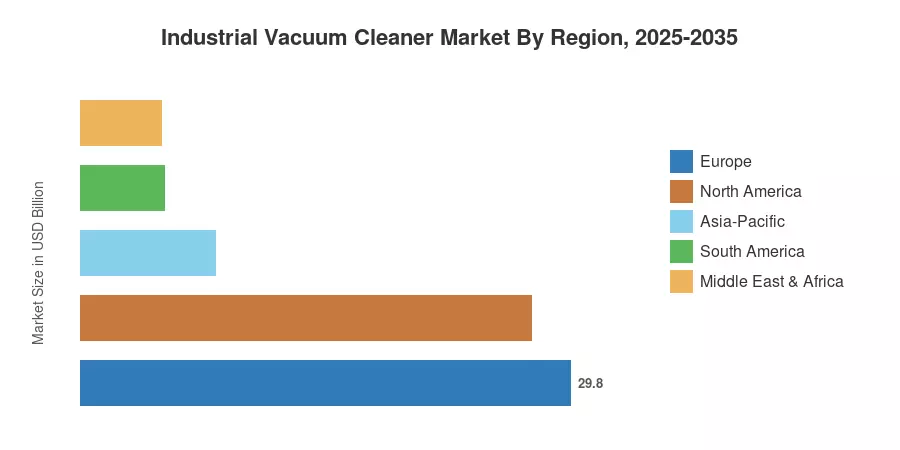
Europe accounts for the largest portion of the revenue with around 29.8% in 2025, owing to dense industrial clusters in Germany and Italy and stringent ATEX compliance standards. Asia-Pacific is projected to be the fastest developing area with an estimated CAGR of 8.2% as China and India expand contract-cleaning services and electronics production. North America is the second pillar, close behind Europe, and has been helped by OSHA combustible dust enforcement operations. In the next decade, competitive advantage in this Industrial Vacuum Cleaner Market will be driven by filtration certification and connection, and total cost of ownership, rather than motor horsepower.


Key Report Takeaways

• By Technology

  • Canister systems held an estimated 44.7% share of the Industrial Vacuum Cleaner Market in 2025, the largest single product format.
  • Explosion-proof, ATEX-certified units are projected to expand at an 8.5% CAGR through 2035, the fastest-growing product category.
  • Electric corded platforms accounted for roughly 58.3% of 2025 revenue, though this share will compress as battery platforms scale.

• By Sector

  • General manufacturing contributed an estimated 27.1% of 2025 revenue, the largest end-user vertical.
  • Electronics and semiconductor facilities are forecast to grow at an 8.9% CAGR, the fastest of any end-user industry.
  • Dry-only systems held close to 57.0% share in 2025, reflecting continued dominance in bulk-debris environments.

• By Geography

  • Europe retained an estimated 29.8% revenue share in 2025, the largest of any region.
  • Asia-Pacific is projected to post an 8.2% CAGR, the fastest regional growth rate through 2035.
  • North America's market is expanding on the back of stepped-up OSHA combustible-dust citations.

Market Size and Forecast (2021–2035)

Numbers are modeled from MRFR's proprietary estimating methodology, triangulating vendor shipment data, regulatory filing patterns and industry-association survey inputs. For the historical period, numbers are reconstructed based on public business disclosures when accessible.
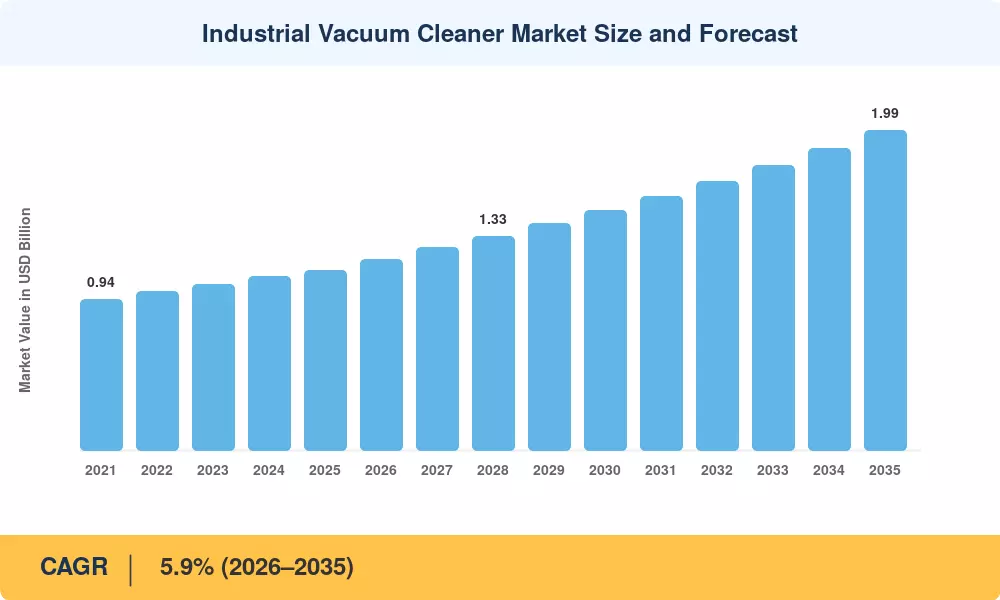
Industrial Vacuum Cleaner Market Size and Forecast
Our Impact
Enabled $4.3B Revenue Impact for Fortune 500 and Leading Multinationals
Partnering with 2000+ Global Organizations Each Year
30K+ Citations by Top-Tier Firms in the Industry

Driver Impact Analysis

Driver ~% Impact on CAGR Geographic Relevance Impact Timeline
Combustible-dust enforcement (NFPA 660) 22% North America Medium-term
ATEX Directive compliance 19% Europe Short-term
Electronics/semiconductor fab expansion 17% Asia-Pacific, North America Long-term
Automation and lights-out manufacturing 14% Global Long-term
Contract-cleaning sector growth 12% Asia-Pacific Short-term
Battery-electric platform adoption 10% Global Medium-term
Pharmaceutical cleanroom expansion 6% North America, Europe Medium-term


Combustible-Dust Regulation as a Replacement-Cycle Accelerant

OSHA's combustible-dust National Emphasis Program has driven a measurable rise in facility citations across grain handling, metalworking, and woodworking operations, prompting plant managers to retire uncertified vacuum equipment ahead of its normal service life. Facilities found non-compliant face shutdown orders, which makes certified ATEX or NFPA-rated equipment a near-mandatory line item rather than a discretionary upgrade.

ATEX Compliance and the European Replacement Wave

The EU's ATEX Directive 2014/34/EU requires equipment used in explosive atmospheres to carry specific zone certification, and enforcement audits have intensified across German and Italian manufacturing corridors since 2024. This has pulled forward purchasing decisions that would otherwise have waited for full equipment depreciation.

Semiconductor and Electronics Fab Buildout

New fab capacity announced across the US, Japan, and South Korea under various national semiconductor incentive programs is driving demand for cleanroom-rated, HEPA-filtered backpack and central vacuum systems, since contamination control is a binding constraint on yield in advanced-node production.

Restraints Impact Analysis

Restraint impacts below are directional estimates of downward pressure on CAGR and should not be summed against driver impacts.

Restraint ~% Impact on CAGR Geographic Relevance Impact Timeline
High upfront cost of ATEX-certified units -14% Global, acute in the SME segment Short-term
Copper and steel price volatility -11% Global Short-term
Skilled technician shortage for servicing -8% North America, Europe Medium-term
Slow replacement cycles in legacy facilities -7% Global Long-term
Fragmented regional certification standards -5% Asia-Pacific, MEA Medium-term


Capital Intensity as a Barrier for Small Manufacturers

Certified central and explosion-proof systems can carry price premiums of several multiples over uncertified equivalents, putting them out of reach for small and mid-size facilities operating on thin maintenance budgets. This dynamic slows fleet-wide upgrades even where regulatory pressure is mounting.

Input-Cost Volatility Compressing Vendor Margins

Sustained volatility in copper and steel pricing has squeezed manufacturer margins industry-wide, a pressure several vendors have addressed by shifting toward value-added service contracts rather than hardware-only sales.

Industrial Vacuum Cleaner Market Opportunities

Emerging-Market Contract Cleaning Expansion

India and Southeast Asia's expanding contract-cleaning sector represents a largely underpenetrated channel for mid-tier industrial vacuum systems, particularly as multinational manufacturers extend standardized safety protocols to regional supplier facilities.

IoT Telemetry and Recurring-Revenue Models

Vendors that bundle hardware with filter-life sensors and predictive-maintenance subscriptions can shift from cyclical equipment sales to recurring service revenue, a model several major OEMs are already piloting through fleet-management dashboards.

Battery-Electric Platform Penetration

Improving lithium-ion energy density is opening cordless operation to heavier-duty applications previously limited to corded or pneumatic systems, expanding the addressable use cases for battery platforms in confined or mobile work environments.

Cleanroom and Pharmaceutical-Grade Specialization

Growth in biologics manufacturing and advanced electronics packaging is creating demand for vacuum systems engineered to cleanroom particulate standards. This niche commands premium pricing relative to general-purpose industrial units.

Autonomous and Robotics-Integrated Cleaning

Partnerships pairing established vacuum manufacturers with autonomous-navigation specialists are enabling round-the-clock, human-supervision-light cleaning in large-footprint facilities, a capability increasingly bundled into broader factory-automation procurement.

Industrial Vacuum Cleaner Market Future Outlook

Autonomous and AI-Assisted Operations

Cleaning equipment is increasingly being integrated into broader factory-automation roadmaps, with autonomous-navigation partnerships allowing vacuum units to operate on scheduled routes without continuous human supervision, complementing the rise of collaborative robots on the same factory floors.

Platform Economics and Service Bundling

Vendors are moving toward subscription-style maintenance and filter-replacement contracts, a shift that smooths revenue volatility tied to capital equipment cycles and deepens customer retention.

Electrification of the Installed Base

Battery-electric platforms are expected to take a meaningfully greater share of new unit sales by the early 2030s as charging infrastructure and energy density continue improving, gradually displacing pneumatic and some corded-electric configurations in mobile applications.

ESG and Sustainability Reporting Integration

Manufacturers are increasingly required to document dust-control and waste-handling practices as part of corporate ESG disclosures, making vacuum-system specification and maintenance records a documented compliance input rather than a purely operational decision.

Industrial Vacuum Cleaner Market Segmentation

By Product Type

Segment Share / CAGR (one metric only) Primary Demand Driver
Canister 44.7% share Versatility across applications
Upright 14.2% share Compact floor-cleaning needs
Backpack 11.6% share Mobile, confined-space cleaning
Central/Fixed 16.8% share Large-facility centralized systems
Explosion-Proof/ATEX 8.5% CAGR Combustible-dust compliance
Other 12.7% share Niche specialty applications


Canister systems remain the largest product category in the Industrial Vacuum Cleaner Market, prized for their maneuverability across varied factory-floor layouts. Explosion-proof, ATEX-certified units are the fastest-growing category as regulatory enforcement intensifies, a dynamic explored further in Section 4.

By Power Source

Segment Share / CAGR (one metric only) Primary Demand Driver
Electric Corded 58.3% share Established infrastructure compatibility
Battery-Electric 9.7% CAGR Lithium-ion energy density gains
Pneumatic 18.9% share Hazardous-atmosphere applications


Electric corded platforms remain dominant given existing facility wiring infrastructure, but battery-electric systems are scaling quickly as improved cell chemistry extends runtime for heavier-duty cleaning tasks.

By End-User Industry

Segment Share / CAGR (one metric only) Primary Demand Driver
General Manufacturing 27.1% share Broad-based industrial activity
Electronics & Semiconductor 8.9% CAGR Fab capacity expansion
Food & Beverage 14.8% share Hygiene and sanitation compliance
Metalworking & Foundries 13.6% share Particulate and swarf management
Pharmaceuticals & Biotechnology 11.2% share Cleanroom-grade requirements
Other 23.3% share Diversified industrial use


General manufacturing remains the largest single end-user vertical for the Industrial Vacuum Cleaner Market. At the same time, electronics and semiconductor facilities post the fastest growth as global fab investment accelerates contamination-control spending.

Regional Market Share Analysis

Region Share / CAGR (one metric only) Primary Investment Themes
North America 27.4% share Combustible-dust compliance, semiconductor fabs
Europe 29.8% share ATEX certification, sustainability mandates
Asia-Pacific 8.2% CAGR Contract cleaning, electronics manufacturing
South America 5.1% share Mining and metals processing
Middle East & Africa 4.9% share Oil & gas, construction
Total 100%


North America

Country Share of Region (one metric only) Key Driver
US 71.2% OSHA combustible-dust enforcement
Canada 19.8% Mining sector demand
Mexico 9.0% Nearshoring-driven manufacturing growth


North America's market continues to be shaped by escalating OSHA citation activity, which has pushed facility managers toward NFPA 660-compliant equipment well ahead of scheduled replacement. Nearshoring of electronics and automotive assembly into Mexico is adding incremental, if smaller, demand.

Europe

Country Share of Region (one metric only) Key Driver
Germany 26.5% Automotive and metalworking density
UK 14.1% Pharmaceutical manufacturing
France 12.8% Aerospace component cleaning
Italy 11.6% Industrial vacuum equipment manufacturing base
Spain 8.4% Food and beverage processing
Nordic Countries 7.2% Sustainability-linked procurement
Russia 6.9% Heavy industry legacy fleet replacement
Rest of Europe 12.5% Diversified manufacturing


Germany anchors European demand through its dense automotive and metalworking base, while ATEX audit activity across Italy — itself home to several major vacuum-equipment manufacturers — has accelerated domestic replacement cycles.

Asia-Pacific

Country CAGR (one metric only) Key Driver
China 7.8% Electronics manufacturing scale-up
India 9.6% Contract-cleaning sector formalization
Japan 5.4% Semiconductor fab modernization
South Korea 6.9% Advanced-node fab buildout
ASEAN 8.7% Manufacturing relocation from China
Rest of Asia-Pacific 7.1% Industrial base diversification


The formalization of the contract-cleaning industry leads India's growth as multinational manufacturers extend uniform safety protocols to regional suppliers, while China and South Korea benefit from continued electronics and semiconductor capacity expansion.

South America

Country Share of Region (one metric only) Key Driver
Brazil 58.3% Mining and metals processing
Argentina 21.4% Food processing sector
Rest of South America 20.3% Energy sector demand


Brazil's mining and metals base remains the region's primary demand anchor, with combustible-dust safety practices gradually converging toward North American norms as multinational operators expand local operations.

Middle East & Africa

Country Share of Region (one metric only) Key Driver
Saudi Arabia 31.7% Construction and petrochemical projects
UAE 24.2% Diversified industrial investment
South Africa 19.5% Mining sector
Egypt 13.1% Manufacturing zone expansion
Rest of MEA 11.5% Infrastructure development


Saudi Arabia and the UAE lead regional demand through large-scale industrial and construction projects, while South Africa's established mining sector sustains steady replacement demand for heavy-duty units.

Industrial Vacuum Cleaner Market By Region, 2025-2035

Competitive Benchmarking

The Industrial Vacuum Cleaner Market is moderately fragmented with a projected top-five concentration of around 38-42% of global sales and an HHI consistent with workable competition rather than dominance by any single vendor. Below this tier is a vast range of regional experts, mainly ATEX-certification specialized firms in Italy and Germany, who compete on application-specific engineering rather than scale.

Company Est. Revenue Share Range Key Offerings for Industrial Vacuum Cleaner Market Strategic Positioning
Alfred Kärcher SE & Co. KG ~10–13% Full-line industrial and commercial vacuum systems Global scale, manufacturing automation investment
Nilfisk Group ~8–11% Industrial vacuums, battery-electric lines Robotics partnerships, recycled-material product design
Tennant Company ~6–9% Industrial and floor-care cleaning equipment Software-enabled maintenance, recurring-revenue push
Nederman Group ~5–7% Central extraction and filtration systems Industrial air-filtration specialization
Delfin Industrial Vacuums ~4–6% Wet/dry, ATEX-certified vacuum systems European cleanroom and pharma focus
Ruwac Industriesauger GmbH ~3–5% Explosion-proof and central vacuum systems German engineering, ATEX specialization
Goodway Technologies ~3–4% Industrial vacuums and maintenance tools North American MRO channel strength
Tiger-Vac International ~2–4% Cleanroom and pharmaceutical vacuum systems Niche cleanroom-grade certification
Vac-U-Max ~2–3% Pneumatic conveying and vacuum systems Bulk-material handling integration
Depureco Industrial Vacuums ~2–3% Single/three-phase and centralized vacuum systems Italian manufacturing heritage, export focus


Recent News & Developments

  • Nilfisk (April 2024): Launched an upgraded VP300 R industrial vacuum incorporating recycled plastic content and certified HEPA filtration, reflecting a broader sustainability push across its product line [20].
  • Alfred Kärcher (2024): Announced an approximately EUR 200 million investment program to expand Vietnam production capacity and automate German manufacturing plants, aimed at shortening lead times [21].
  • Nilfisk (2024–2025): Deepened a robotics partnership with autonomous-navigation specialist LionsBot, adding self-navigating capability to select industrial cleaning platforms [22].
  • Tennant Company (June 2025): Partnered with LTTS to establish an offshore development center supporting smart and sustainable cleaning technology initiatives [23].
  • Great Star Tools (ongoing): Continued integration of its Shop-Vac acquisition, illustrating cross-category entry by hand-tool conglomerates into adjacent cleaning-equipment segments [24].
  • OSHA (2024–2025): Sustained enforcement activity under its combustible-dust National Emphasis Program, increasing citation volume across grain, metalworking, and woodworking facilities [3].
  • European Commission (ongoing): Continued ATEX Directive 2014/34/EU enforcement audits across manufacturing corridors in Germany and Italy [4].

Industrial Vacuum Cleaner Market Report Scope

Field Detail
Market Scope Global Industrial Vacuum Cleaner Market by product type, power source, cleaner type, end-user industry, and geography
Study Period 2021–2035
CAGR 5.9% (2026–2035)
Market Size (2025) USD 1.12 Billion
Market Size (2035) USD 1.99 Billion
Fastest Growing Segments ATEX/explosion-proof product type; battery-electric power source; electronics & semiconductor end-user
Companies Profiled 10
Valuation Currency USD Billion


FAQs

What should buyers prioritize when comparing ATEX-certified vacuum systems from different vendors?
Buyers should verify zone-specific ATEX certification, not just a general explosion-proof label, since equipment rated for one dust-hazard zone may not satisfy another. Service-network proximity also matters for certified-equipment maintenance.
How does the cost of central vacuum system installation compare to portable unit fleets over time?
Central systems carry a higher upfront installation cost but lower per-point operating expense at scale. Facilities with many fixed cleaning stations typically reach breakeven within a few years versus maintaining a portable fleet [18].
What integration challenges arise when adding battery-electric units to an existing corded fleet?
Mixed fleets require separate charging infrastructure and runtime scheduling, which can complicate shift planning. Maintenance teams also need parallel parts inventories for two distinct power architectures.
Are pneumatic vacuum systems becoming obsolete given electrification trends?
No — pneumatic systems retain a strong niche in hazardous-atmosphere zones where electrical ignition risk must be eliminated [19]. Electrification is displacing them mainly in lower-risk, general-purpose applications.
How does HEPA backpack vacuum performance vary across cleanroom classifications?
Performance depends on filter rating against the cleanroom's particle-count class, not just the HEPA label itself. Facilities should request third-party filtration efficiency data rather than relying on manufacturer specifications alone [8].
What regulatory nuance affects 3-phase industrial vacuum cleaner deployment across regions?
Voltage and frequency standards differ by region, and ATEX or NFPA certification does not automatically transfer across jurisdictions. Importers must re-certify equipment for the destination market's electrical and safety codes.
Is vendor consolidation likely to reduce buyer choice in this market?
Some consolidation is occurring, as seen with cross-category acquisitions like Shop-Vac, but the long tail of regional ATEX specialists remains fragmented [24]. Buyers in niche applications still have multiple credible suppliers to choose from.
Author
Author
Author Profile
Snehal Singh LinkedIn
Manager - Research
High acumen in analyzing complex macro & micro markets with more than 6 years of work experience in the field of market research. By implementing her analytical skills in forecasting and estimation into market research reports, she has expertise in Packaging, Construction, and Equipment domains. She handles a team size of 20-25 resources and ensures smooth running of the projects, associated marketing activities, and client servicing.

Research Approach


Secondary Research

The secondary research process involved comprehensive analysis of regulatory frameworks, industry standards, trade publications, and authoritative industrial databases. Key sources included the US Occupational Safety and Health Administration (OSHA), Environmental Protection Agency (EPA), National Fire Protection Association (NFPA), International Electrotechnical Commission (IEC), European Committee for Standardization (CEN), International Organization for Standardization (ISO), United Nations Industrial Development Organization (UNIDO), US Bureau of Labor Statistics (BLS), Eurostat Manufacturing Database, National Institute of Standards and Technology (NIST), International Sanitary Supply Association (ISSA), Building Service Contractors Association International (BSCAI), VDMA (German Mechanical Engineering Industry Association), Japan Industrial Cleaning Association, and national industrial safety directories. These sources were used to collect manufacturing sector statistics, occupational health & safety compliance data, electrotechnical certification requirements, technical performance standards (ATEX directives for explosion-proof equipment), and market landscape analysis for upright, canister, and backpack configurations across pneumatic and electric operating modes.


Primary Research

To gather both qualitative and quantitative information, the primary research process involved interviewing players from both the supply and demand sides. Members of the supply side included regional sales directors, product engineering heads, and CEOs or VPs of manufacturing from industrial vacuum cleaner manufacturers, CEMs, and component suppliers (filtering systems, motor assembly, suction units). Individuals from the automotive, pharmaceutical, food processing, and metal fabrication industries served as demand-side sources, along with facility managers, EHS (Environment, Health & Safety) directors, plant maintenance supervisors, and procurement officers. The market segmentation was validated for both stationary and portable systems through primary research. The product development roadmaps for explosion-proof and heavy-duty systems were also confirmed. Information regarding industrial adoption patterns, the dynamics of rental vs. purchase, and total cost of ownership (TCO) were gathered through primary research.

Primary Respondent Breakdown:

By Designation: C-level Primaries (28%), Director Level (35%), Others (37%)

By Region: North America (32%), Europe (30%), Asia-Pacific (25%), Rest of World (13%)


Market Size Estimation

Global market valuation was derived through revenue mapping and equipment deployment analysis. The methodology included:

Identification of 60+ key manufacturers and industrial equipment suppliers across North America, Europe, Asia-Pacific, and Latin America

Product mapping across upright, canister, and backpack categories, segmented by electric and pneumatic operation modes, heavy-duty/medium-duty/explosion-proof applications, and end-use verticals (pharmaceuticals, food & beverage, metal working, construction, automotive)

Analysis of reported and modeled annual revenues specific to industrial cleaning equipment portfolios, including aftermarket services (parts, maintenance, rental income)

Coverage of manufacturers representing 75-80% of global market share in 2024

Extrapolation using bottom-up (unit shipment volume × ASP by country and end-use sector) and top-down (manufacturer revenue validation and distributor markup analysis) approaches to derive segment-specific valuations, with specific calibration for explosion-proof equipment premiums and stationary central vacuum system installations

Download Free Sample

Kindly complete the form below to receive a free sample of this Report

Download PDF ×

We do not share your information with anyone. However, we may send you emails based on your report interest from time to time. You may contact us at any time to opt-out.
















