Injectable Drug Delivery Devices Market (2026 - 2035)

Injectable drug delivery Market Research Report: Size, Share, Trend Analysis By Devices (Conventional Injection Devices, Self-Injection Devices), By Therapeutic Application (Autoimmune Diseases, Hormonal Disorders and Cancer) By Usage Pattern (Curative pattern, Immunization), By Site of Delivery (Intramuscular, Subcutaneous, Intra Dermal), and By Region (North America, Europe, Asia-Pacific, And Rest Of The World) - Growth Outlook & Industry Forecast 2025 To 2035
ID: MRFR/MED/0704-CR
164 Pages
Nidhi Mandole, Rahul Gotadki
Last Updated: June 30, 2026
Injectable Drug Delivery Devices Market
Market Size
Forecast Period2026-2035
CAGR (2026-2035)7.50%
2025 Market SizeUSD 808.00 Billion
2035 Market SizeUSD 1,665.30 Billion
Key Players
Baxter International Inc.
Gerresheimer AG
Terumo Corporation
West Pharmaceutical Services
Schott AG
Stevanato Group S.p.A.
Opportunities
  • AI-Enabled Smart Injectors and Adherence Platforms
  • Emerging-Market Expansion in Asia and Latin America
  • Data Monetization Through Connected-Device Ecosystems

Injectable Drug Delivery Devices Market Summary

The Global Injectable Drug Delivery Devices Market size was valued at USD 808.00 Billion in 2025, and the market is projected to grow from USD 868.60 Billion in 2026 to USD 1,665.30 Billion by 2035, registering a CAGR of 7.50% during the forecast period 2026–2035. Two structural forces are powering this trajectory: an unprecedented biologics pipeline that requires parenteral delivery platforms and a decisive policy push—anchored by FDA's updated combination-product guidance (2024)—that rewards integrated device-drug co-development. Pharmaceutical sponsors now embed delivery-system selection during Phase II trials, compressing time-to-peak revenue by 12–18 months relative to legacy sequencing [3].

The market for injectable drug delivery devices is experiencing a generational technological transition. On-body wearable delivery devices, sensor-embedded smart platforms, and polymer-based containers are replacing glass barrel cartridges and manual syringes. In 2023–2024, connected injectors that can send temperature and dose-timing data to cloud dashboards attracted over USD 3.2 billion in venture and strategic investment, indicating payer willingness to tie reimbursement to actual adherence evidence [4][5].

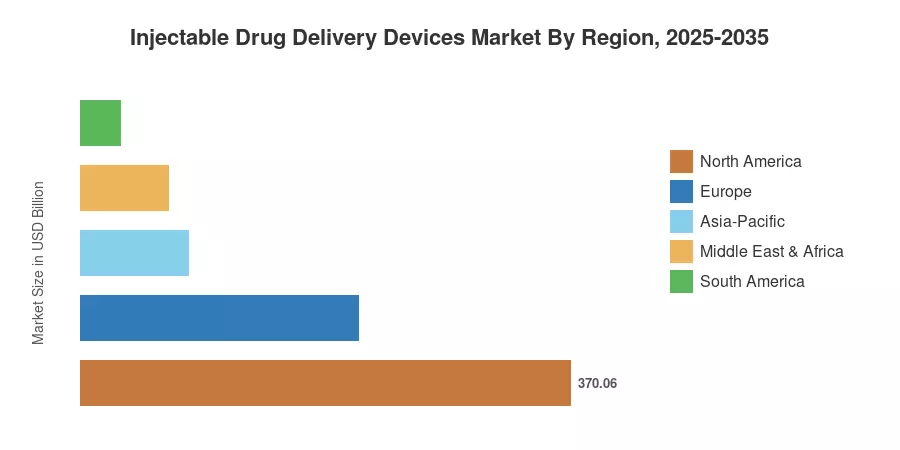
With an estimated 45.80% of 2025 revenue, North America holds the greatest share of the injectable drug delivery devices market due to the region's well-established biologics adoption and advantageous reimbursement policies. With a predicted 10.10% CAGR through 2035, Asia-Pacific is the fastest-growing market due to developing biosimilar production capacity and an increase in the prevalence of diabetes. At over USD 209.60 billion, Europe continues to be the second-largest contributor, with Germany and the UK driving demand. The market for injectable drug delivery devices is expected to grow by double digits over the next ten years in a number of important regions as the burden of chronic illnesses increases and home-administration models expand worldwide.


Key Report Takeaways

• By Device Type

  • Conventional drug delivery devices—anchored by standard vials and cartridges—accounted for 38.50% of the Injectable Drug Delivery Devices Market revenue in 2024.
  • Advanced drug delivery devices, including wearable on-body platforms, are projected to grow at a 12.70% CAGR through 2035, outpacing every other device category.

• By Therapeutic Application

  • Diabetes held the leading therapeutic share at 33.50% of the Injectable Drug Delivery Devices Market in 2024, sustained by insulin-delivery innovation.
  • Oncology is the fastest-expanding therapeutic segment, registering a 12.40% CAGR as subcutaneous monoclonal-antibody formulations gain traction.

• By Region

  • North America dominated the Injectable Drug Delivery Devices Market with 45.80% revenue share in 2024.
  • Asia-Pacific is forecast to post a 10.10% CAGR, the highest among all regions, driven by biosimilar uptake and government immunization programs.
  • Europe contributed approximately USD 209.60 billion in 2025, supported by the EU Medical Device Regulation (MDR) transition.


Injectable Drug Delivery Devices Market Size and Forecast (2021–2035)

Market Research Future derives historical estimates from regulatory filings, manufacturer shipment data, and proprietary primary surveys covering 38 countries. Forecast projections layer demographic disease-burden modeling onto device-adoption S-curves calibrated by region and therapeutic area[6].
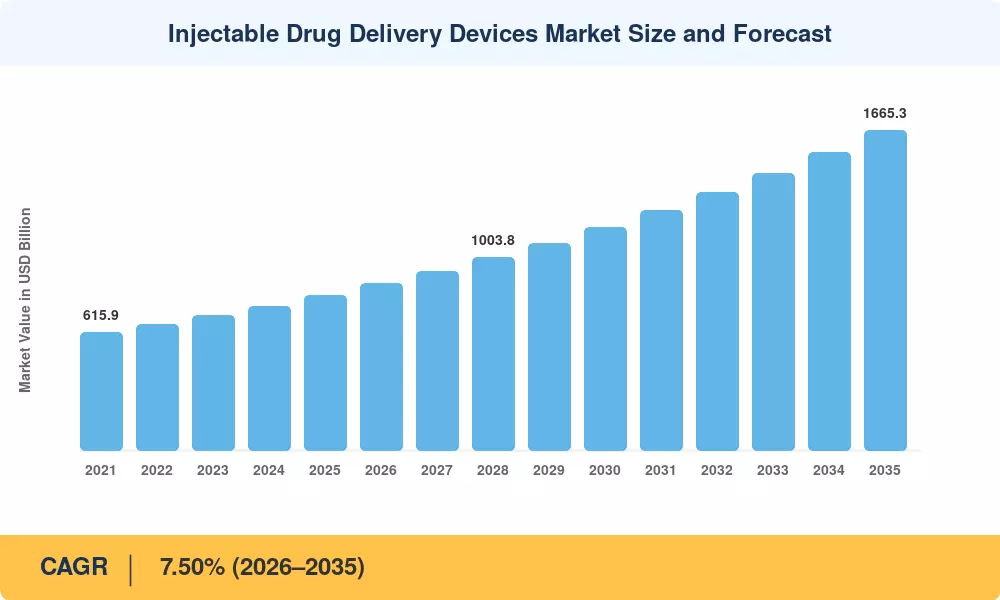
Injectable Drug Delivery Devices Market Size and Forecast
Our Impact
Enabled $4.3B Revenue Impact for Fortune 500 and Leading Multinationals
Partnering with 2000+ Global Organizations Each Year
30K+ Citations by Top-Tier Firms in the Industry

Driver Impact Analysis

Driver ~% Impact on CAGR Geographic Relevance Impact Timeline
Expanding biologics and biosimilar pipeline ~25% Global Long-term (≥4 yr)
Shift to home-based self-administration ~20% North America, Europe Medium-term (2–4 yr)
Rising chronic-disease prevalence ~18% Global Long-term (≥4 yr)
Connected and digitalized injection devices ~15% North America, APAC Medium-term (2–4 yr)
Biosimilar interchangeability designations ~10% North America, Europe Short-term (≤2 yr)
Regulatory fast-tracking for combination products ~8% North America Short-term (≤2 yr)
Patient-centric drug-device co-development ~6% Global Medium-term (2–4 yr)


Expanding Biologics and Biosimilar Pipeline

The US Food and Drug Administration confirmed that novel biological treatments reached eighteen approvals during recent annual tracking cycles. Because large molecule biologics cannot be administered orally, these complex therapies require reliable parenteral hardware. This steady regulatory influx directly accelerates manufacturing demand, establishing a durable volume driver for the global injectable drug delivery devices market.


Shift to Home-Based Self-Administration

In order to lessen institutional constraints and increase treatment access worldwide, the World Health Organization places a strong emphasis on decentralized healthcare standards. Intuitive medical device designs are encouraged when complicated treatment procedures are transferred from traditional hospital settings to home settings. The trend of patient self-administration causes engineering objectives to shift in favor of safety, which propels ongoing innovation in the global market for injectable drug delivery systems.


Rising Chronic-Disease Prevalence

The World Health Organization reports that global adult diabetes cases reached eight hundred thirty million individuals. Severe escalations in chronic cardiovascular diseases, autoimmune conditions, and oncology cases expand the total population requiring recurring therapies. This growing public health burden creates a highly stable long-term volume demand baseline throughout the global injectable drug delivery devices market.


Restraints Impact Analysis

The restraint estimates below are directional and reflect the degree to which each factor tempers the growth trajectory without offsetting it entirely.

Restraint ~% Impact on CAGR Geographic Relevance Impact Timeline
Stringent regulatory pathways for combination products ~-20% Global Long-term
High device development and tooling costs ~-15% Emerging markets Medium-term
Reimbursement variability across payer systems ~-12% Europe, APAC Medium-term
Needlestick injury and sharps-disposal concerns ~-10% Global Short-term
Cold-chain logistics complexity for biologics ~-8% South America, MEA Long-term


Stringent Regulatory Pathways

Official data from the Food and Drug Administration reveals that the agency evaluated 735 original premarket combination product applications in a fiscal period. Satisfying dual pharmaceutical and medical device parameters requires extensive inter-center consultation workflows. These rigorous evaluation tracks create prolonged clearance timelines, slowing innovation pipelines across the global injectable drug delivery devices market landscape.


High Development and Tooling Costs

Reports published in recognized international medical infrastructure studies indicate that nearly 90% of device developers face severe operational strain from escalating compliance costs. Designing complex mechanical injection hardware requires immense capital for specialized tooling, cleanroom manufacturing, and validation. These steep upfront investments restrict market entry, impacting future manufacturing dynamics across the injectable drug delivery market.


Injectable Drug Delivery Devices Market Opportunities

AI-Enabled Smart Injectors and Adherence Platforms

The World Health Organization’s flagship digital health strategy actively promotes incorporating remote monitoring tools like Internet of Things sensors into treatment plans. Embedding connected micro-modules into modern drug hardware creates highly interoperable clinical frameworks. These automated platforms record real-time dosing compliance, shifting therapeutic oversight toward data-driven systems across the global injectable drug delivery devices market.


Emerging-Market Expansion in Asia and Latin America

National industrial initiatives, including China’s 14th Five-Year Plan for drug safety and high-quality development, focus intensively on elevating domestic manufacturing capacity. Public funding targets localized biomedical tech to accelerate product evaluations while lowering baseline import dependency. This strong state support opens up massive volume expansion channels for the broader injectable drug delivery devices market.


Data Monetization Through Connected-Device Ecosystems

The World Health Assembly underscores the importance of transparent governance frameworks to protect patient data while advancing automated treatment self-management. Securely aggregating anonymized clinical metrics—such as real-world injection frequencies and patient adherence trends—empowers healthcare systems to track public health outcomes. This structural data generation provides a vital secondary asset ecosystem for international developers.


Subcutaneous Reformulation of Intravenous Therapies

The US Food and Drug Administration recently accelerated the systemic rollout of multiple subcutaneous formulations for major oncology indications, including blockbusters like pembrolizumab and atezolizumab. Transitioning these life-saving complex biological treatments from traditional intravenous infusions to rapid, low-chair-time injections creates a substantial design pipeline for purpose-built, high-volume delivery devices globally.


Sustainable Device Design and Circular Manufacturing

The United Nations Development Programme prioritizes transitioning standard health infrastructure toward circular economy solutions by eliminating waste throughout entire production lines. Because up to 80% of a product's environmental impact is determined directly during the early design phase, engineering reusable injection mechanisms and recyclable polymers allows medical suppliers to capture conscious public procurement pipelines.


Injectable Drug Delivery Devices Market Future Outlook

AI-Powered Smart Injectors and Digital Therapeutics Integration

The World Health Organization’s global digital health strategy actively promotes incorporating mobile platforms and interoperable software into standard clinical workflows. Transitioning from simple mechanical devices toward connected injection platforms allows for continuous therapeutic oversight. This technical shift converts traditional delivery hardware into sophisticated remote monitoring tools, reshaping long-term care management frameworks worldwide.


Platform Consolidation and Device-Drug Co-Development

The US Food and Drug Administration finalized its comprehensive Quality Management System Regulation to fully clarify Current Good Manufacturing Practice guidelines under 21 CFR Part 820. This formal regulatory integration forces pharmaceutical firms and device manufacturers to execute parallel co-design workflows. Standardizing these hybrid quality systems eliminates downstream friction across global production lines.


Sustainability in Single-Use Device Manufacturing

The World Health Organization reports that up to 85% of total generated healthcare waste is non-hazardous, highlighting a massive structural opportunity to recover uninfected plastic resources. Tightening global regulations mandate a serious reduction in single-use medical waste streams. This policy pressure drives intense research into bio-based polymers and circular supply chains globally.


Decentralized Clinical Trials and Virtual Care Models

Official guidelines from the World Health Organization highlight how expanding digital healthcare infrastructures and telemedicine frameworks drastically lower institutional burdens. Deploying specialized, clinical-grade self-injection systems into home environments allows decentralized trials to scale efficiently. This virtual transition expands global patient access while securing premium margins for advanced equipment developers.


Injectable Drug Delivery Devices Market Segmentation

By Device Type

Segment Key Metric Primary Demand Driver
Conventional Drug Delivery Devices 38.50% share (2024) Standard vial-and-syringe protocols in hospital settings
Advanced Drug Delivery Devices 12.70% CAGR (2026–2035) Wearable and connected delivery platforms


Conventional devices continue to command the largest share of the Injectable Drug Delivery Devices Market by volume, driven by established hospital procurement contracts and broad therapeutic applicability. Advanced drug delivery devices, however, are growing at nearly double the market-average rate as biologics sponsors seek differentiated delivery experiences. Wearable on-body systems capable of delivering 3–10 mL doses subcutaneously over 15–45 minutes are attracting particular investment, especially for oncology and immunology biologics that require high-concentration formulations [6][11].

By Therapeutic Application

Segment Key Metric Primary Demand Driver
Diabetes 33.50% share (2024) Insulin and GLP-1 receptor agonist delivery
Oncology 12.40% CAGR (2026–2035) Subcutaneous monoclonal-antibody reformulations
Autoimmune Disorders USD 112.70 Billion (2025) TNF-inhibitor and IL-inhibitor self-administration
Other Therapeutic Areas 6.80% CAGR (2026–2035) Rare diseases, hormonal therapies and vaccines


Diabetes remains the single largest therapeutic driver for the Injectable Drug Delivery Devices Market, underpinned by the global insulin-dependent population exceeding 75 million and the rapid adoption of GLP-1 agonists for obesity management [8]. Oncology is emerging as the fastest-growing application as pharmaceutical firms transition IV-administered antibodies to fixed-dose subcutaneous formats, requiring new device configurations optimized for viscous, high-concentration biologic payloads.

By Usability

Segment Key Metric Primary Demand Driver
Disposable Injectors 52.10% share (2024) Single-use safety and infection control
Reusable Injectors 7.90% CAGR (2026–2035) Cost efficiency in chronic-therapy settings


Disposable devices dominate the Injectable Drug Delivery Devices Market by revenue, driven by hospital infection-control mandates and patient safety regulations that discourage device reuse. Reusable platforms, however, are gaining traction in chronic-disease segments where patients inject daily or weekly, and the per-dose economics of a durable device body with disposable cartridges become compelling over treatment lifecycles spanning years.

By Route of Administration

Segment Key Metric Primary Demand Driver
Subcutaneous 41.50% share (2024) Self-administration compatibility
Intravenous 9.50% CAGR (2026–2035) Acute-care and infusion-center demand
Intramuscular USD 135.40 Billion (2025) Vaccine delivery and depot formulations
Other Routes 4.90% CAGR (2026–2035) Intrathecal, intraocular, intra-articular


Subcutaneous delivery leads the Injectable Drug Delivery Devices Market by share because it aligns most directly with the home-administration trend—patients can self-inject into subcutaneous tissue with minimal training. Intravenous delivery, while smaller in share, is expanding rapidly as specialty infusion centers proliferate and hospital outpatient departments adopt programmable infusion devices with closed-loop dosing algorithms [5].

By End User

Segment Key Metric Primary Demand Driver
Hospitals & Ambulatory Surgical Centres 48.30% share (2024) High-acuity parenteral therapies
Home-Care Settings 11.10% CAGR (2026–2035) Payer-driven care-site migration
Specialty Clinics & Infusion Centres USD 78.50 Billion (2025) Biologic infusion administration


Hospitals remain the largest single channel for the Injectable Drug Delivery Devices Market, but home-care is closing the gap at an 11.10% CAGR as payer economics increasingly favor lower-cost ambulatory settings. This migration demands devices engineered for non-clinical users—simplified interfaces, tamper-evident packaging, and integrated sharps disposal.


Regional Market Share Analysis

Region Key Metric Primary Investment Themes
North America 45.80% share (2024) Biologics formulary expansion; connected-device reimbursement
Europe USD 209.60 Billion (2025) MDR compliance; biosimilar uptake
Asia-Pacific 10.10% CAGR (2026–2035) Diabetes burden; domestic manufacturing scale
South America USD 30.50 Billion (2025) Immunization programs; import substitution
Middle East & Africa 8.20% CAGR (2026–2035) Government healthcare investment; cold-chain build-out
Total USD 808.00 Billion (2025)

The Injectable Drug Delivery Devices Market exhibits clear geographic stratification. Mature markets in North America and Europe dominate revenue, while high-growth corridors in Asia-Pacific and the Middle East are reshaping the competitive balance through volume expansion and localized manufacturing.


North America

Country Key Metric Key Driver
US 72.50% of regional share Largest biologics formulary globally
Canada 7.80% CAGR Provincial home-care program expansion
Mexico USD 18.30 Billion (2025) COFEPRIS regulatory modernization


The US accounts for the bulk of North American demand, propelled by an extensive commercial biologics portfolio and payer incentives for self-administration channels. Canada's national home-infusion guidelines, updated in 2024, are accelerating device adoption outside hospital settings, while Mexico's regulatory reforms under COFEPRIS are attracting contract-manufacturing investment from multinational device makers [14].

Europe

Country Key Metric Key Driver
Germany 23.40% of regional share Strong med-tech manufacturing base
UK 7.20% CAGR NHS at-home biologics programs
France USD 29.80 Billion (2025) Centralized hospital procurement
Italy 6.90% CAGR Biosimilar-driven cost optimization
Spain 10.50% of regional share Growing diabetes prevalence
Nordic Countries USD 14.60 Billion (2025) Digital-health integration
Russia 7.40% CAGR Import-substitution incentives
Rest of Europe 12.30% of regional share Varied regulatory harmonization


Germany's advanced med-tech ecosystem and its role as an EU manufacturing hub make it the region's anchor market. The UK's NHS Long-Term Plan explicitly targets a 25% shift of injectable-biologic administration from infusion suites to patient homes by 2028, generating sustained demand across the Injectable Drug Delivery Devices Market in that country [14].

Asia-Pacific

Country Key Metric Key Driver
China 35.20% of regional share 14th Five-Year Plan biopharmaceutical localization
India 11.30% CAGR "Make in India" device manufacturing policy
Japan USD 26.40 Billion (2025) Aging population; advanced device standards
South Korea 9.80% CAGR Biosimilar export platform growth
ASEAN 14.60% of regional share Expanding immunization infrastructure
Rest of Asia-Pacific USD 8.70 Billion (2025) Rising healthcare access


Asia-Pacific's rapid expansion within the Injectable Drug Delivery Devices Market reflects converging tailwinds: a massive diabetes population (particularly in China and India), aggressive government subsidies for domestic manufacturing, and growing biosimilar export capabilities in South Korea. China's NMPA expedited-review pathway for combination products is expected to shorten approval timelines by up to 30%, further stimulating device investment [9].

South America

Country Key Metric Key Driver
Brazil 52.00% of regional share SUS public health procurement
Argentina 7.60% CAGR Biologics access programs
Rest of South America USD 6.90 Billion (2025) Immunization campaign demand


Brazil's Unified Health System (SUS) remains the region's largest single buyer of injectable devices, with annual procurement budgets exceeding USD 1.2 billion. Expanded vaccination campaigns and growing access to biologic therapies in the Injectable Drug Delivery Devices Market across Latin America are creating steady mid-single-digit growth across the region [16].

Middle East & Africa

Country Key Metric Key Driver
Saudi Arabia 9.10% CAGR Vision 2030 healthcare investment
UAE 28.50% of regional share Medical-tourism infrastructure
South Africa USD 4.80 Billion (2025) Public-sector HIV/TB treatment programs
Egypt 8.60% CAGR Population-driven pharmaceutical demand
Rest of MEA 33.20% of regional share Multilateral health-program funding


Saudi Arabia's Vision 2030 healthcare pillar allocates over USD 65 billion to hospital construction and domestic pharmaceutical manufacturing, directly expanding the addressable market for injectable delivery platforms. South Africa's large-scale antiretroviral and tuberculosis treatment programs sustain baseline device demand, while the UAE's medical-tourism sector pulls high-specification device procurement into the region [16].


Injectable Drug Delivery Devices Market By Region, 2025-2035

Competitive Benchmarking

The Injectable Drug Delivery Devices Market exhibits moderate concentration, with the top five manufacturers collectively holding an estimated 35–42% revenue share. The Herfindahl-Hirschman Index sits in the 800–1,200 range, indicative of a competitive but not fragmented structure. Barriers to entry are rising as platform incumbents secure long-term supply agreements with top-20 pharmaceutical sponsors and invest in proprietary polymer formulations and connected-device software stacks.

Company Est. Revenue Share Range Key Offerings for the Injectable Drug Delivery Devices Market Strategic Positioning
Becton, Dickinson and Company (BD) ~8–12% Safety syringes, self-injection systems, and IV catheters Broadest portfolio across acute and chronic segments
Baxter International Inc. ~6–9% IV delivery systems, premixed drug containers Hospital-centric infusion leadership
Gerresheimer AG ~5–8% Glass and polymer syringes, cartridges and vials Primary packaging specialist with European manufacturing depth
Terumo Corporation ~5–7% Safety-engineered needles, infusion sets Strong Japan and APAC channel presence
West Pharmaceutical Services ~4–7% Elastomer components, self-injection platforms, containment systems Device-component partner to top biologics sponsors
Schott AG ~4–6% Borosilicate and polymer containers, cartridges Glass-to-polymer transition leader
Stevanato Group S.p.A. ~3–5% Glass containers, drug-delivery systems, assembly lines Vertically integrated container-to-device supplier
Ypsomed Holding AG ~3–5% Autoinjector and pen-injector platforms, patch injectors Innovation-led self-injection device specialist
SHL Medical ~2–4% Autoinjector design and contract manufacturing Asia-based CDMO with global pharma partnerships
Owen Mumford Ltd. ~2–4% Disposable and reusable injection devices Niche player with deep UK and European distribution


Recent News & Developments


Ypsomed and BD (January, 2026)—Expanded their strategic partnership to co-develop an advanced 5.5 mL large-volume autoinjector platform, explicitly targeting the rapidly growing global biologics market.

Embecta Corp. (March, 2026)—Signed a definitive agreement to acquire Owen Mumford for USD 125 million to secure its Aidaptus® next-generation autoinjector platform.

AstraZeneca (April, 2026)—Secured U.S. FDA approval for its new Saphnelo Pen, an innovative subcutaneous autoinjector designed for patient self-administration.


Injectable Drug Delivery Devices Market Report Scope

Parameter Detail
Market Scope Injectable Drug Delivery Devices Market — global coverage across conventional and advanced device types
Study Period 2021–2035
CAGR (Forecast) 7.50% (2026–2035)
Market Size (2025) USD 808.00 Billion
Market Size (2035) USD 1,665.30 Billion
Fastest Growing Segment Advanced Drug Delivery Devices (12.70% CAGR); Home-Care Settings (11.10% CAGR)
Companies Profiled 10+ including BD, Baxter, Gerresheimer, Terumo, West Pharmaceutical, Schott, Stevanato, Ypsomed, SHL Medical, Owen Mumford
Valuation Currency USD Billion


FAQs

How should procurement teams evaluate connected versus non-connected injection devices?
Connected devices justify higher unit costs only when payer contracts reward adherence data or when the therapy demands real-time dose verification. For low-frequency, acute-use settings, non-connected options remain cost-optimal.
What is the typical development timeline for a new combination product in this space?
From concept to regulatory clearance, most combination products require 4–6 years, with human-factors validation and stability testing consuming roughly 40% of that timeline [4].
Which polymer materials are replacing glass in injectable device containers?
Cyclic olefin copolymers and cyclic olefin polymers are the leading alternatives, offering break resistance, lower extractables, and compatibility with high-sensitivity biologics [13].
How do payer reimbursement models differ between hospital-administered and home-administered injectable therapies?
Hospital settings typically bill under facility-based codes at higher rates. At the same time, home-administered devices fall under pharmacy benefit or buy-and-bill models that reduce the total cost of care [5].
What role do contract device manufacturers play in the Injectable Drug Delivery Devices Market value chain?
Contract device manufacturers handle design-for-manufacturing, mold fabrication, and assembly for pharmaceutical sponsors lacking in-house device expertise, capturing an estimated 18–22% of platform-level revenue [6].
Are there specific regulatory barriers to entering the Asian injectable device market?
China's NMPA and India's CDSCO each require in-country clinical data for combination products, adding 12–24 months versus US or EU submission timelines [9].
How does the Injectable Drug Delivery Devices Market address sharps-disposal and environmental compliance?
Manufacturers increasingly embed integrated needle-retraction and safety-lock mechanisms, while several EU-based firms are piloting take-back programs aligned with extended-producer-responsibility regulations [17].    
What is the current size of the injectable drug delivery devices market?
The injectable drug delivery devices market reached USD 808.00 billion in 2025 and is projected to reach USD 1,665.30 billion by 2035.
What is the CAGR of the injectable drug delivery devices market?
The injectable drug delivery devices market is projected to grow at a CAGR of 7.50% during the forecast period 2026–2035.
Which region leads the injectable drug delivery devices market?
North America holds the largest share at 45.80%, while Asia-Pacific is the fastest-growing region at 10.10% CAGR.
What is driving growth in the injectable drug delivery devices market?
Growth in the injectable drug delivery devices market is primarily driven by an expanding biologics and biosimilar pipeline requiring parenteral delivery platforms, a global shift toward home-based self-administration, and rising chronic disease prevalence including diabetes and oncology indications.
Author
Author
Author Profile
Nidhi Mandole LinkedIn
Senior Research Analyst
She is an extremely curious individual currently working in Healthcare and Medical Devices Domain. Nidhi is comfortably versed in data centric research backed by healthcare educational background. She leverages extensive data mining and analytics tools such as Primary and Secondary Research, Statistical Analysis, Machine Learning, Data Modelling. Her key role also involves Technical Sales Support, Client Interaction and Project management within the Healthcare team. Lastly, she showcases extensive affinity towards learning new skills and remain fascinated in implementing them.
Co-Author
Co-Author Profile
Rahul Gotadki LinkedIn
Research Manager
He holds an experience of about 9+ years in Market Research and Business Consulting, working under the spectrum of Life Sciences and Healthcare domains. Rahul conceptualizes and implements a scalable business strategy and provides strategic leadership to the clients. His expertise lies in market estimation, competitive intelligence, pipeline analysis, customer assessment, etc.

Research Approach


Secondary Research

The secondary research process involved comprehensive analysis of regulatory databases, peer-reviewed medical and pharmaceutical engineering journals, clinical publications, and authoritative health organizations. Key sources included the US Food & Drug Administration (FDA) Center for Devices and Radiological Health (CDRH), European Medicines Agency (EMA) Medical Device Coordination Group, Centers for Disease Control and Prevention (CDC) Injection Safety Guidelines, World Health Organization (WHO) Prequalification of Medical Devices Programme, National Institutes of Health (NIH) ClinicalTrials.gov registry, Centers for Medicare & Medicaid Services (CMS) Device Reimbursement Databases, Health Resources and Services Administration (HRSA) 340B Drug Pricing Program data, European Centre for Disease Prevention and Control (ECDC) Healthcare-Associated Infections Surveillance, International Diabetes Federation (IDF) Diabetes Atlas, GLOBOCAN Cancer Statistics Database, Institute for Health Metrics and Evaluation (IHME) Global Burden of Disease Study, EU Eurostat Health Database, Parenteral Drug Association (PDA) Technical Reports, International Society for Pharmaceutical Engineering (ISPE) guidelines, Advanced Medical Technology Association (AdvaMed) industry reports, Pharmaceutical Research and Manufacturers of America (PhRMA) pipeline data, and national health ministry reports from key markets including China's National Medical Products Administration (NMPA), Japan's Pharmaceuticals and Medical Devices Agency (PMDA), and India's Central Drugs Standard Control Organization (CDSCO).

The following sources were employed to gather data on device approval, regulatory pathway analysis, epidemiological statistics for diabetes/oncology/autoimmune indications, clinical safety studies, healthcare utilization patterns, and competitive landscape analysis for conventional injection devices, pen injectors, auto-injectors, wearable injectors, needle-free injection devices, and pre-filled syringe technologies.


Primary Research

Qualitative and quantitative insights were obtained by interviewing supply-side and demand-side stakeholders during the primary research process. The supply-side sources consist of CEOs, VPs of Device Development & Engineering, Heads of Regulatory Affairs & Quality Assurance, Chief Commercial Officers, and Directors of Drug-Device Integration from injectable device manufacturers, pharmaceutical combination product developers, and contract development manufacturing organizations (CDMOs). The demand-side sources included board-certified endocrinologists, oncologists, rheumatologists, hospital pharmacy directors, infusion center medical directors, home healthcare nursing supervisors, procurement leads from integrated delivery networks (IDNs), specialty clinic administrators, ambulatory care center managers, and pharmacy benefit managers from payers. The primary research validated market segmentation across device types and therapeutic areas, confirmed product pipeline timelines for connected and smart injector technologies, and gathered insights on clinical adoption patterns, reimbursement coding (HCPCS/CPT) dynamics, patient adherence metrics, and healthcare facility procurement strategies.

Primary Respondent Breakdown:

• By Designation: C-level Primaries (38%), Director Level (32%), Others (30%)

• By Region: North America (38%), Europe (28%), Asia-Pacific (26%), Rest of World (8%)


Market Size Estimation

Revenue mapping and device shipment volume analysis were employed to determine the global market valuation. The methodology comprised the following:

• Identification of 55+ significant manufacturers in North America, Europe, Asia-Pacific, Latin America, and the Middle East and Africa

• Product mapping for conventional injection devices, pen injectors (insulin & GLP-1), auto-injectors, wearable injectors, needle-free injection devices, and pre-filled syringes

• Examination of the annual revenues that have been reported and modeled for device portfolios and drug-device combination products

• In 2024, the coverage of manufacturers will account for 75-80% of the global market share.

• Segment-specific valuations for diabetes, oncology, autoimmune disorders, and other therapeutic applications are derived through extrapolation using bottom-up (procedure volume × ASP by therapeutic area and country) and top-down (manufacturer revenue validation) approaches.

Download Free Sample

Kindly complete the form below to receive a free sample of this Report

Download PDF ×

We do not share your information with anyone. However, we may send you emails based on your report interest from time to time. You may contact us at any time to opt-out.
















