×
Request Free Sample ×

Kindly complete the form below to receive a free sample of this Report

* Please use a valid business email

Leading companies partner with us for data-driven Insights

clients tt-cursor
Hero Background

Integrated Marine Automation System Market

ID: MRFR/AD/8145-HCR
168 Pages
Swapnil Palwe
October 2025

Integrated Marine Automation System Market Research Report Information by Solution (Power Management System, Vessel Management System, Process Control and Safety System), Ship Type (Commercial and Defense), End User (OEM and Aftermarket), Component (Product and Service) and Region (North America, Europe, Asia-Pacific and Rest of the World) - Forecast till 2035

Share:
Download PDF ×

We do not share your information with anyone. However, we may send you emails based on your report interest from time to time. You may contact us at any time to opt-out.

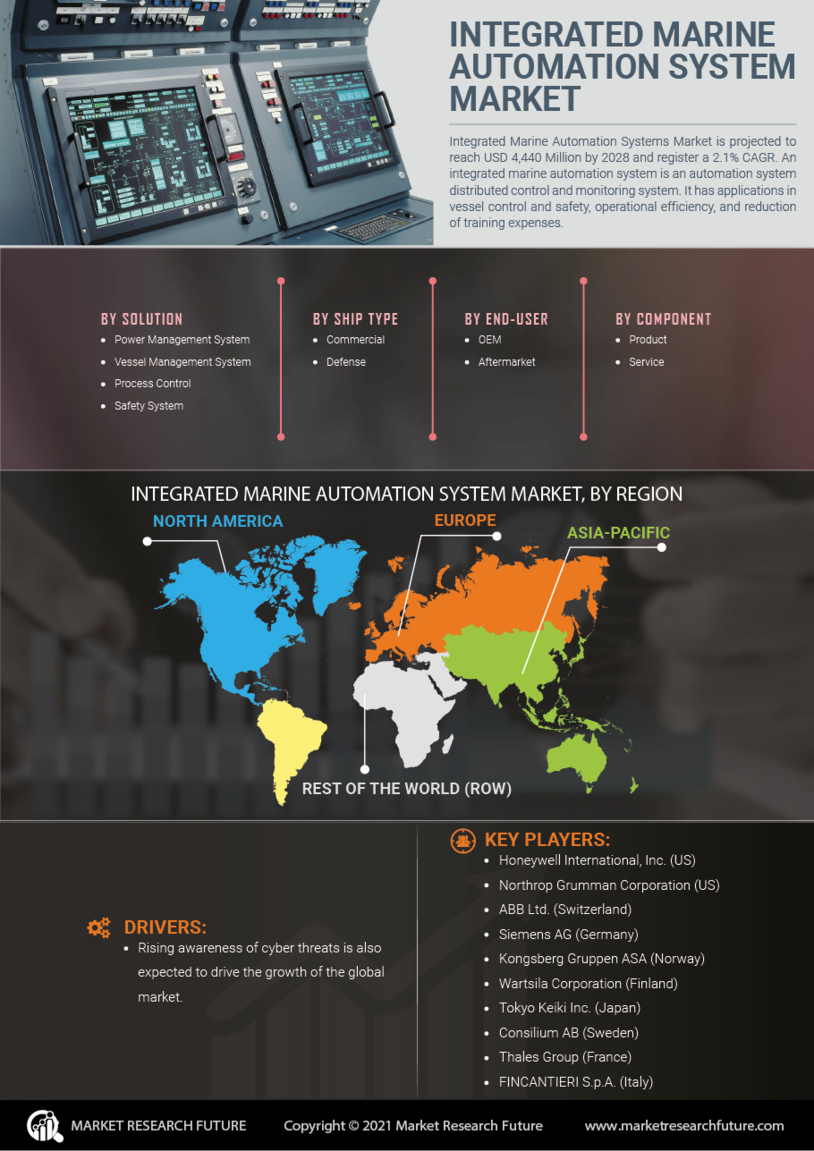
Integrated Marine Automation System Market Infographic
Purchase Options

Integrated Marine Automation System Market Summary

As per MRFR analysis, the Integrated Marine Automation System Market was estimated at 19.5 USD Billion in 2024. The Integrated Marine Automation System industry is projected to grow from 20.8 USD Billion in 2025 to 41.0 USD Billion by 2035, exhibiting a compound annual growth rate (CAGR) of 7.02 during the forecast period 2025 - 2035.

Key Market Trends & Highlights

The Integrated Marine Automation System Market is poised for substantial growth driven by technological advancements and regulatory compliance.

  • North America remains the largest market for integrated marine automation systems, reflecting a robust demand for advanced maritime technologies.
  • The Asia-Pacific region is emerging as the fastest-growing market, fueled by increasing investments in maritime infrastructure and modernization efforts.
  • The navigation segment continues to dominate the market, while the communication segment is experiencing rapid growth due to advancements in connectivity solutions.
  • Key market drivers include technological advancements and rising demand for enhanced safety measures, which are shaping the future of marine automation.

Market Size & Forecast

2024 Market Size 19.5 (USD Billion)
2035 Market Size 41.0 (USD Billion)
CAGR (2025 - 2035) 7.02%

Major Players

Kongsberg Gruppen (NO), ABB Ltd (CH), Siemens AG (DE), Rolls-Royce Holdings plc (GB), Wärtsilä Corporation (FI), Honeywell International Inc. (US), General Electric Company (US), Thales Group (FR), Navis (NL)

Integrated Marine Automation System Market Trends

The Integrated Marine Automation System Market is currently experiencing a transformative phase, driven by advancements in technology and increasing demand for operational efficiency in maritime operations. The integration of automation systems enhances safety, reduces human error, and optimizes resource management on vessels. As the maritime industry evolves, stakeholders are increasingly recognizing the value of these systems in streamlining processes and improving overall performance. Furthermore, the growing emphasis on environmental sustainability is prompting the adoption of innovative solutions that minimize the ecological footprint of marine activities. In December 2025, the market landscape appears to be shaped by several factors, including regulatory changes, technological innovations, and shifting consumer preferences. The rise of smart shipping initiatives and the Internet of Things (IoT) integration into marine operations suggest a future where automation plays a pivotal role in enhancing operational capabilities. As the industry adapts to these changes, the Integrated Marine Automation System Market is likely to witness significant growth, driven by the need for enhanced safety, efficiency, and sustainability in maritime operations.

Technological Advancements

The ongoing evolution of technology is a key driver in the Integrated Marine Automation System Market. Innovations such as artificial intelligence, machine learning, and advanced sensor technologies are being integrated into marine systems, enhancing decision-making processes and operational efficiency. These advancements not only improve safety but also facilitate real-time data analysis, allowing for proactive management of maritime operations.

Regulatory Compliance

Increasingly stringent regulations regarding safety and environmental standards are influencing the Integrated Marine Automation System Market. Companies are compelled to adopt automation solutions that ensure compliance with international maritime regulations. This trend indicates a shift towards systems that not only enhance operational efficiency but also align with global sustainability goals.

Focus on Sustainability

The growing awareness of environmental issues is prompting a shift towards sustainable practices within the maritime sector. The Integrated Marine Automation System Market is likely to benefit from this trend, as companies seek to implement solutions that reduce emissions and optimize fuel consumption. This focus on sustainability may drive innovation and the development of eco-friendly automation technologies.

Integrated Marine Automation System Market Drivers

Regulatory Compliance

Stringent regulatory requirements in the maritime industry are propelling the Global Integrated Marine Automation Systems Market Industry. Governments worldwide are enforcing regulations aimed at enhancing safety, environmental protection, and operational efficiency. Compliance with these regulations often necessitates the adoption of advanced automation systems that can monitor and manage various operational parameters. For example, the International Maritime Organization has set guidelines that encourage the use of automated systems to ensure compliance with safety standards. This regulatory landscape is expected to contribute to market growth, with projections indicating a market size of 4.73 USD Billion by 2035 as companies invest in compliant technologies.

Market Growth Projections

The Global Integrated Marine Automation Systems Market Industry is poised for substantial growth, with projections indicating a market size of 0.82 USD Billion in 2024 and an anticipated increase to 4.73 USD Billion by 2035. This growth trajectory suggests a compound annual growth rate (CAGR) of 17.29% from 2025 to 2035, driven by various factors including technological advancements, regulatory compliance, and the increasing demand for safety and efficiency in maritime operations. The market's expansion reflects the ongoing transformation of the maritime industry towards more automated and integrated solutions.

Technological Advancements

The Global Integrated Marine Automation Systems Market Industry is experiencing rapid technological advancements that enhance operational efficiency and safety. Innovations such as artificial intelligence and machine learning are being integrated into marine automation systems, allowing for predictive maintenance and real-time data analysis. For instance, the implementation of advanced sensors and automation technologies can reduce human error and improve decision-making processes on vessels. This trend is likely to drive market growth, as companies seek to adopt cutting-edge solutions to remain competitive. As a result, the market is projected to reach 0.82 USD Billion in 2024, reflecting the increasing demand for sophisticated automation solutions.

Increased Demand for Safety and Security

The growing emphasis on safety and security in maritime operations is a critical driver for the Global Integrated Marine Automation Systems Market Industry. With rising concerns over piracy, accidents, and environmental hazards, shipping companies are increasingly investing in automation systems that enhance situational awareness and response capabilities. Automated systems can provide real-time monitoring and alerts, significantly reducing the risk of incidents at sea. This heightened focus on safety is likely to result in a compound annual growth rate (CAGR) of 17.29% from 2025 to 2035, as stakeholders prioritize investments in technologies that bolster security and operational integrity.

Growing Maritime Trade and Fleet Expansion

The expansion of global maritime trade and fleet size is a significant driver for the Global Integrated Marine Automation Systems Market Industry. As international trade continues to grow, there is an increasing need for efficient and reliable shipping solutions. The expansion of fleets, particularly in emerging markets, necessitates the adoption of integrated marine automation systems to manage complex operations effectively. This trend is likely to contribute to the market's growth trajectory, with projections indicating a substantial increase in demand for automation solutions to support the expanding maritime sector.

Cost Efficiency and Operational Optimization

Cost efficiency remains a pivotal factor influencing the Global Integrated Marine Automation Systems Market Industry. Companies are under constant pressure to optimize operations and reduce costs, leading to a growing interest in automation solutions that streamline processes. Integrated marine automation systems can significantly lower operational expenses by minimizing fuel consumption, reducing maintenance costs, and enhancing crew productivity. For instance, automated systems can optimize routing and speed, leading to fuel savings and improved delivery times. This focus on cost reduction is expected to drive market growth, as organizations recognize the long-term financial benefits of investing in automation technologies.

Market Segment Insights

By Application: Navigation (Largest) vs. Communication (Fastest-Growing)

In the Integrated Marine Automation System Market, the Application segment showcases a diverse distribution of functionalities. Navigation holds the largest market share due to its critical role in facilitating safe maritime operations and enhancing route efficiency. Following closely behind, Communication systems are rapidly gaining traction as the fastest-growing segment, driven by advancements in maritime communication technologies and increasing demand for real-time data exchange among vessels and shore-based operations.

Safety: Monitoring (Dominant) vs. Control (Emerging)

In the Integrated Marine Automation System market, Monitoring applications dominate past trends, ensuring compliance with safety regulations and operational efficiency. These systems enhance situational awareness and enable proactive decision-making, critical to maintaining safety at sea. Conversely, Control systems are emerging as vital components due to their growing role in automating vessel operations and reducing human error. As the industry pushes for smarter and more integrated systems, Control applications are experiencing substantial growth, driven by innovations in automation technologies and increasing investments from maritime stakeholders.

By End Use: Commercial Vessels (Largest) vs. Offshore Vessels (Fastest-Growing)

In the Integrated Marine Automation System Market, the end-use segment is predominantly driven by Commercial Vessels, which represent the largest share of the market. This category encompasses various types of merchant shipping, including container ships and bulk carriers, which utilize advanced automation systems to enhance efficiency and safety at sea. Following closely are Offshore Vessels, which are experiencing rapid adoption of maritime automation technologies as exploration and drilling activities increase in challenging environments.

Commercial Vessels (Dominant) vs. Offshore Vessels (Emerging)

Commercial Vessels are currently the dominant segment in the Integrated Marine Automation System Market due to their extensive operational requirements and increasing operational efficiency mandates. They leverage advanced automation systems to optimize voyage management, enhance safety features, and comply with regulatory standards. On the other hand, Offshore Vessels are emerging as a significant segment, characterized by their rapid growth driven by evolving offshore exploration technologies and the demand for automated systems in harsh marine environments. Their integration of automation not only improves operational safety but also enables better management of resources and positioning during diverse offshore activities.

By System Type: Integrated Bridge System (Largest) vs. Engine Room Automation (Fastest-Growing)

The Integrated Marine Automation System Market exhibits a varied distribution of market share among its key components, notably dominated by the Integrated Bridge System. This segment holds a substantial portion of the market due to its critical role in improving navigational efficiency and safety in modern vessels. The Engine Room Automation segment, while trailing in share, has begun to capture significant attention as operators increasingly recognize its essential contribution to optimizing engine performance and reducing operational costs. The growth trends within this segment are driven by advancements in technology and increasing regulatory requirements for safety and efficiency in marine operations. The rising adoption of automation technologies is enabling ships to operate with reduced crew size and enhanced precision. Moreover, as environmental concerns escalate, the demand for efficient power management and monitoring has surged, spurring innovation and investment in this area.

Integrated Bridge System (Dominant) vs. Engine Room Automation (Emerging)

The Integrated Bridge System segment is marked by its pivotal role in enhancing navigational control and decision-making processes aboard vessels. This system facilitates seamless integration of various navigational functions, enabling crews to manage multiple operations efficiently. Its dominance is attributed to the growing need for advanced navigational aids and safety systems across commercial and leisure marine sectors. Meanwhile, the Engine Room Automation segment is rapidly emerging as a critical player in the market. This system automates various engine operations, leading to optimized fuel consumption and preventative maintenance, which are essential in today's cost-conscious market. The shift towards environmentally friendly operations is driving innovation in this sector, as stakeholders seek advanced solutions to reduce emissions and increase efficiency.

By Technology: Hardware (Largest) vs. Software (Fastest-Growing)

Within the Integrated Marine Automation System Market, the technology segment is crucial for enhancing operational efficiency and safety. Hardware solutions currently dominate this segment with a substantial market share, driven by demand for reliable physical components like sensors and controllers. Conversely, software solutions are emerging rapidly, capturing attention due to the increasing reliance on data analytics and automated decision-making systems in marine operations.

Technology: Hardware (Dominant) vs. Software (Emerging)

Hardware solutions in the Integrated Marine Automation System Market represent the backbone of marine operations, incorporating critical components such as navigational aids, control systems, and monitoring equipment. These solutions are characterized by their reliability and performance, appealing to operators seeking to improve efficiency and reduce the risk of human error. On the other hand, software solutions are gaining momentum, leveraging advancements in artificial intelligence and machine learning to provide predictive analytics and enhanced decision-making capabilities. This emerging segment is vital for adapting to new regulatory requirements and optimizing operational workflows.

Get more detailed insights about Integrated Marine Automation System Market

Regional Insights

North America : Leading Market Innovators

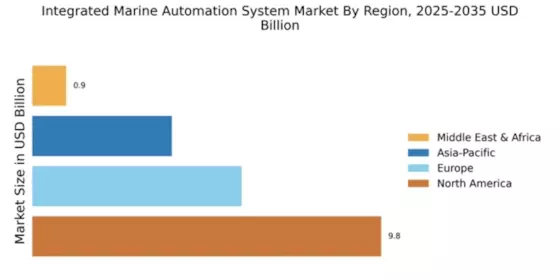
North America is poised to maintain its leadership in the Integrated Marine Automation System market, holding a significant market share of 8.0 in 2024. The region's growth is driven by increasing investments in maritime technology, stringent safety regulations, and a rising demand for automation in shipping operations. The regulatory environment is supportive, encouraging innovation and adoption of advanced systems to enhance operational efficiency. The United States and Canada are the primary contributors to this market, with major players like Honeywell International Inc. and General Electric Company leading the charge. The competitive landscape is characterized by a mix of established firms and emerging startups, all vying for a share of the lucrative market. The presence of key players ensures a continuous flow of innovation, making North America a hub for marine automation advancements.

Europe : Regulatory Framework and Growth

Europe, with a market size of 6.5, is a critical player in the Integrated Marine Automation System market. The region benefits from robust regulatory frameworks that promote safety and environmental sustainability in maritime operations. The demand for automation is further fueled by the European Union's initiatives aimed at enhancing maritime efficiency and reducing emissions, making it a fertile ground for technological advancements. Leading countries such as Germany, France, and the Netherlands are at the forefront of this market, hosting key players like Siemens AG and Thales Group. The competitive landscape is marked by collaboration between industry leaders and research institutions, fostering innovation. The presence of established companies ensures a steady supply of advanced solutions, positioning Europe as a stronghold in marine automation.

Asia-Pacific : Emerging Market Potential

Asia-Pacific, with a market size of 4.5, is rapidly emerging as a significant player in the Integrated Marine Automation System market. The region's growth is driven by increasing maritime trade, investments in port infrastructure, and a growing emphasis on safety and efficiency in shipping operations. Governments are actively promoting the adoption of automation technologies to enhance competitiveness in the global market. Countries like China, Japan, and South Korea are leading the charge, with major companies such as Kongsberg Gruppen and Wärtsilä Corporation establishing a strong presence. The competitive landscape is evolving, with both local and international players vying for market share. The region's potential for growth is immense, making it a focal point for future investments in marine automation technologies.

Middle East and Africa : Untapped Market Opportunities

The Middle East and Africa region, with a market size of 0.5, presents untapped opportunities in the Integrated Marine Automation System market. The growth is primarily driven by increasing maritime activities, investments in port development, and a rising focus on safety and efficiency in shipping operations. Regulatory bodies are beginning to recognize the importance of automation, paving the way for future advancements in the sector. Countries like the UAE and South Africa are emerging as key players, with local firms and international companies exploring opportunities in this developing market. The competitive landscape is still in its infancy, but the presence of global players indicates a growing interest in the region. As investments increase, the Middle East and Africa are set to become significant contributors to the marine automation landscape.

Key Players and Competitive Insights

The Integrated Marine Automation System Market is currently characterized by a dynamic competitive landscape, driven by technological advancements and increasing demand for operational efficiency in maritime operations. Key players such as Kongsberg Gruppen (NO), ABB Ltd (CH), and Wärtsilä Corporation (FI) are strategically positioned to leverage innovation and digital transformation to enhance their offerings. Kongsberg Gruppen (NO) focuses on integrating advanced automation technologies with a strong emphasis on sustainability, while ABB Ltd (CH) is enhancing its portfolio through strategic partnerships and acquisitions, aiming to expand its global footprint. These strategies collectively shape a competitive environment that is increasingly focused on technological differentiation and operational excellence.

In terms of business tactics, companies are localizing manufacturing and optimizing supply chains to enhance responsiveness to market demands. The market structure appears moderately fragmented, with several key players exerting significant influence. This fragmentation allows for a diverse range of solutions, catering to various customer needs while fostering competition that drives innovation.

In November 2025, Kongsberg Gruppen (NO) announced a partnership with a leading shipping company to develop a next-generation autonomous vessel. This strategic move underscores Kongsberg's commitment to pioneering automation technologies that align with the industry's shift towards sustainability and efficiency. The collaboration is expected to enhance operational capabilities and reduce environmental impact, positioning Kongsberg as a leader in the autonomous maritime sector.

In October 2025, ABB Ltd (CH) launched a new integrated marine automation platform designed to optimize vessel performance and reduce operational costs. This initiative reflects ABB's focus on digitalization and the integration of AI technologies into marine operations. By enhancing data analytics capabilities, ABB aims to provide customers with actionable insights that can lead to improved decision-making and operational efficiency.

In September 2025, Wärtsilä Corporation (FI) expanded its service offerings by introducing a predictive maintenance solution that utilizes AI and machine learning. This development is indicative of Wärtsilä's strategy to enhance customer value through innovative service solutions. By enabling proactive maintenance, the company aims to minimize downtime and extend the lifecycle of marine assets, thereby reinforcing its competitive position in the market.

As of December 2025, current trends in the Integrated Marine Automation System Market are heavily influenced by digitalization, sustainability, and the integration of AI technologies. Strategic alliances are increasingly shaping the competitive landscape, allowing companies to pool resources and expertise to drive innovation. The shift from price-based competition to a focus on technological advancement and supply chain reliability is evident, suggesting that future competitive differentiation will hinge on the ability to innovate and deliver sustainable solutions.

Key Companies in the Integrated Marine Automation System Market market include

Future Outlook

Integrated Marine Automation System Market Future Outlook

The Integrated Marine Automation System Market is projected to grow at a 7.02% CAGR from 2024 to 2035, driven by advancements in technology, regulatory compliance, and increasing demand for operational efficiency.

New opportunities lie in:

  • Development of AI-driven predictive maintenance solutions
  • Integration of IoT for real-time monitoring and analytics
  • Expansion of cybersecurity measures for marine automation systems

By 2035, the market is expected to achieve substantial growth, reflecting evolving technological advancements and increased operational demands.

Market Segmentation

Integrated Marine Automation System Market End Use Outlook

  • Commercial Vessels
  • Naval Vessels
  • Offshore Vessels
  • Fishing Vessels

Integrated Marine Automation System Market Technology Outlook

  • Hardware
  • Software
  • Cloud-based Solutions
  • Artificial Intelligence

Integrated Marine Automation System Market Application Outlook

  • Navigation
  • Communication
  • Monitoring
  • Control
  • Safety

Integrated Marine Automation System Market System Type Outlook

  • Integrated Bridge System
  • Engine Room Automation
  • Cargo Management System
  • Power Management System

Report Scope

MARKET SIZE 202419.5(USD Billion)
MARKET SIZE 202520.8(USD Billion)
MARKET SIZE 203541.0(USD Billion)
COMPOUND ANNUAL GROWTH RATE (CAGR)7.02% (2024 - 2035)
REPORT COVERAGERevenue Forecast, Competitive Landscape, Growth Factors, and Trends
BASE YEAR2024
Market Forecast Period2025 - 2035
Historical Data2019 - 2024
Market Forecast UnitsUSD Billion
Key Companies ProfiledKongsberg Gruppen (NO), ABB Ltd (CH), Siemens AG (DE), Rolls-Royce Holdings plc (GB), Wärtsilä Corporation (FI), Honeywell International Inc. (US), General Electric Company (US), Thales Group (FR), Navis (NL)
Segments CoveredApplication, End Use, System Type, Technology
Key Market OpportunitiesIntegration of artificial intelligence enhances operational efficiency in the Integrated Marine Automation System Market.
Key Market DynamicsRising demand for automation in maritime operations drives technological advancements and competitive dynamics in the Integrated Marine Automation System market.
Countries CoveredNorth America, Europe, APAC, South America, MEA

Market Highlights

Author
Swapnil Palwe
Team Lead - Research

With a technical background as Bachelor's in Mechanical Engineering, with MBA in Operations Management , Swapnil has 6+ years of experience in market research, consulting and analytics with the tasks of data mining, analysis, and project execution. He is the POC for our clients, for their consulting projects running under the Automotive/A&D domain. Swapnil has worked on major projects in verticals such as Aerospace & Defense, Automotive and many other domain projects. He has worked on projects for fortune 500 companies' syndicate and consulting projects along with several government projects.

Leave a Comment

FAQs

What is the projected market value of the global Integrated Marine Automation System market?

Global Integrated Marine Automation System market is touted to record a substantial market valuation of USD 4.44 billion by 2030.

What is the estimated growth rate of the global Integrated Marine Automation Systems market?

Global Integrated Marine Automation System market is projected to register a moderate 2.1% CAGR in the forecast period.

Which component segment is expected to observe the highest growth?

The product segment is expected to secure the highest CAGR.

What is the end-use segment of the global Integrated Marine Automation Systems market expected to witness the highest growth?

The OEM segment is slated to expand as the fastest-growing segment.

Who are the significant players operative in the global Integrated Marine Automation System market?

A few eminent market players operating in the global Integrated Marine Automation System market are Honeywell International, Inc. (US), Northrop Grumman Corporation (US), ABB Ltd. (Switzerland), among others.

Download Free Sample

Kindly complete the form below to receive a free sample of this Report

Compare Licence

×
Features License Type
Single User Multiuser License Enterprise User
Price $4,950 $5,950 $7,250
Maximum User Access Limit 1 User Upto 10 Users Unrestricted Access Throughout the Organization
Free Customization
Direct Access to Analyst
Deliverable Format
Platform Access
Discount on Next Purchase 10% 15% 15%
Printable Versions