Intrathecal Pumps Market Summary
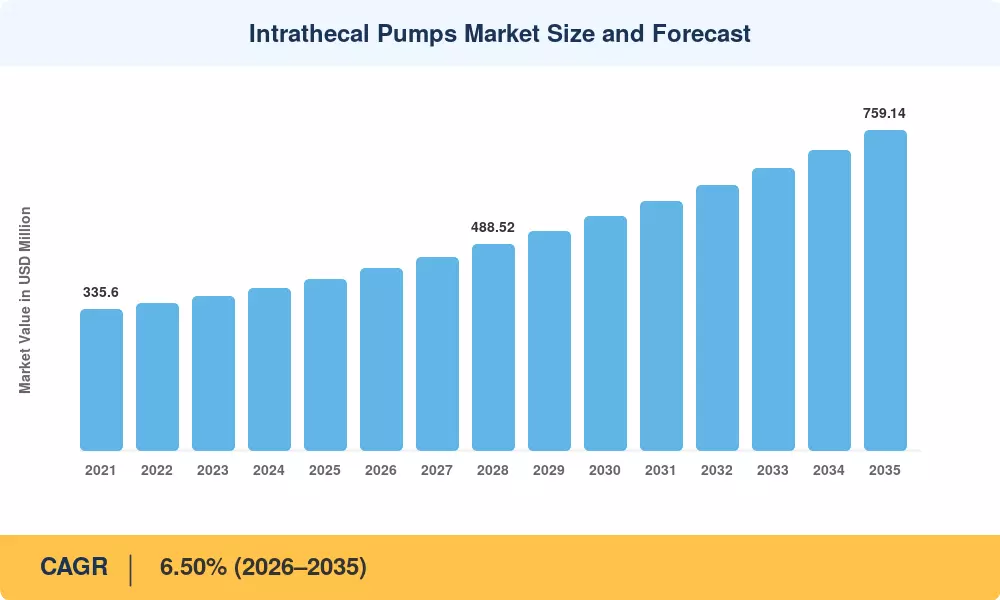
The Intrathecal Pumps Market reached an estimated USD 404.50 Million in 2025 and is projected to grow from USD 430.70 Million in 2026 to USD 759.14 Million by 2035, registering a CAGR of 6.50% during the forecast period (2026–2035). Clinical momentum behind targeted drug delivery — where medication bypasses systemic circulation and reaches the spinal cord directly — continues to accelerate adoption. The U.S. Centers for Medicare & Medicaid Services expanded reimbursement codes for programmable pump refills in 2024, lowering out-of-pocket barriers for patients with refractory chronic pain or severe spasticity [1]. That policy signal, combined with the FDA's streamlined 510(k) pathway for next-generation pump hardware, anchors the Intrathecal Pumps Market in a durable growth cycle.
Technology-wise, the sector is transitioning from constant-flow mechanical devices to microprocessor-driven programmable systems capable of circadian dosing and remote telemetry. Medtronic's SynchroMed III platform and Flowonix's Prometra II illustrate how embedded sensors and MRI-conditional housings are displacing legacy fixed-rate pumps that offered limited physician control. Health-economic evidence now shows that programmable pump implantation recovers its upfront cost within two to three years compared with oral opioid regimens, a finding that payers in North America and Europe increasingly cite when authorizing coverage [2].
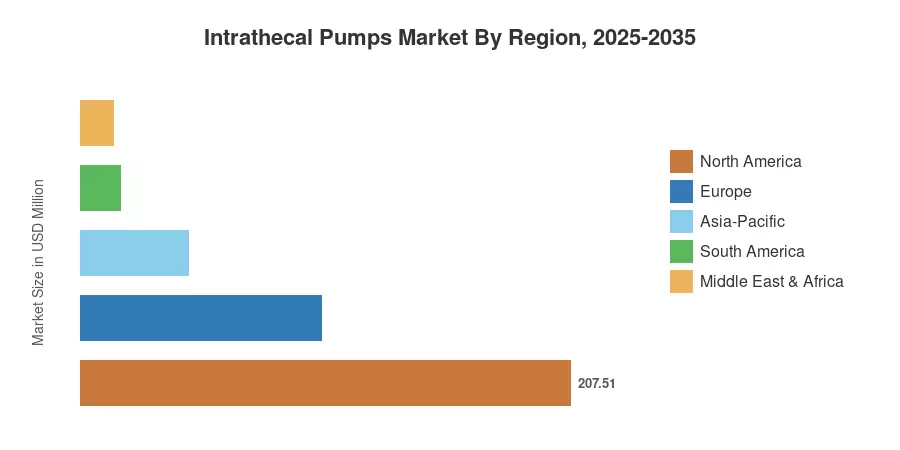
North America commands roughly 51.3% of Intrathecal Pumps Market revenue, supported by a deep specialist base and broad private-payer coverage. Asia-Pacific stands as the fastest-growing region at a projected CAGR of 11.27% through 2035, driven by rising chronic-pain prevalence and expanding neurology infrastructure in China and India. Europe holds the second-largest share at approximately 25.2%, where the CE MDR transition is reshaping competitive entry. As global aging accelerates, the Intrathecal Pumps Market is positioned for sustained expansion across all major geographies through 2035.
Key Report Takeaways
• By Pump Type
- Programmable and variable-rate systems accounted for approximately 82.0% of the Intrathecal Pumps Market share in 2025, reflecting physician preference for dose-titration flexibility.
- Constant-flow (fixed-rate) pumps are forecast to expand at a more modest pace as hospitals transition to digitally controlled alternatives.
• By Product Class
- Baclofen held roughly 43.8% of Intrathecal Pumps Market revenue in 2025, driven by widespread spasticity prescribing.
- Ziconotide is anticipated to post a CAGR of 12.24% through 2035, gaining traction in opioid-refractory patient populations.
• By Application
- Chronic pain management captured an estimated 68.6% of the Intrathecal Pumps Market in 2025 and remains the core demand driver.
- Spasticity management is growing at a projected 9.76% CAGR, fueled by expanded pediatric and post-stroke indications.
• By Region
- North America led the Intrathecal Pumps Market with a 51.3% revenue share in 2025, underpinned by strong reimbursement and clinical guideline adoption.
- Asia-Pacific is on track for the highest regional CAGR of 11.27% through 2035.
Market Size and Forecast (2021–2035)
Market Research Future's sizing methodology combines primary interviews with device manufacturers and implanting physicians, hospital procurement databases, surgical procedure volume tracking from the American Society of Interventional Pain Physicians and equivalent regional registries, and validated secondary sources including WHO surgical data and national health expenditure databases [3][4].