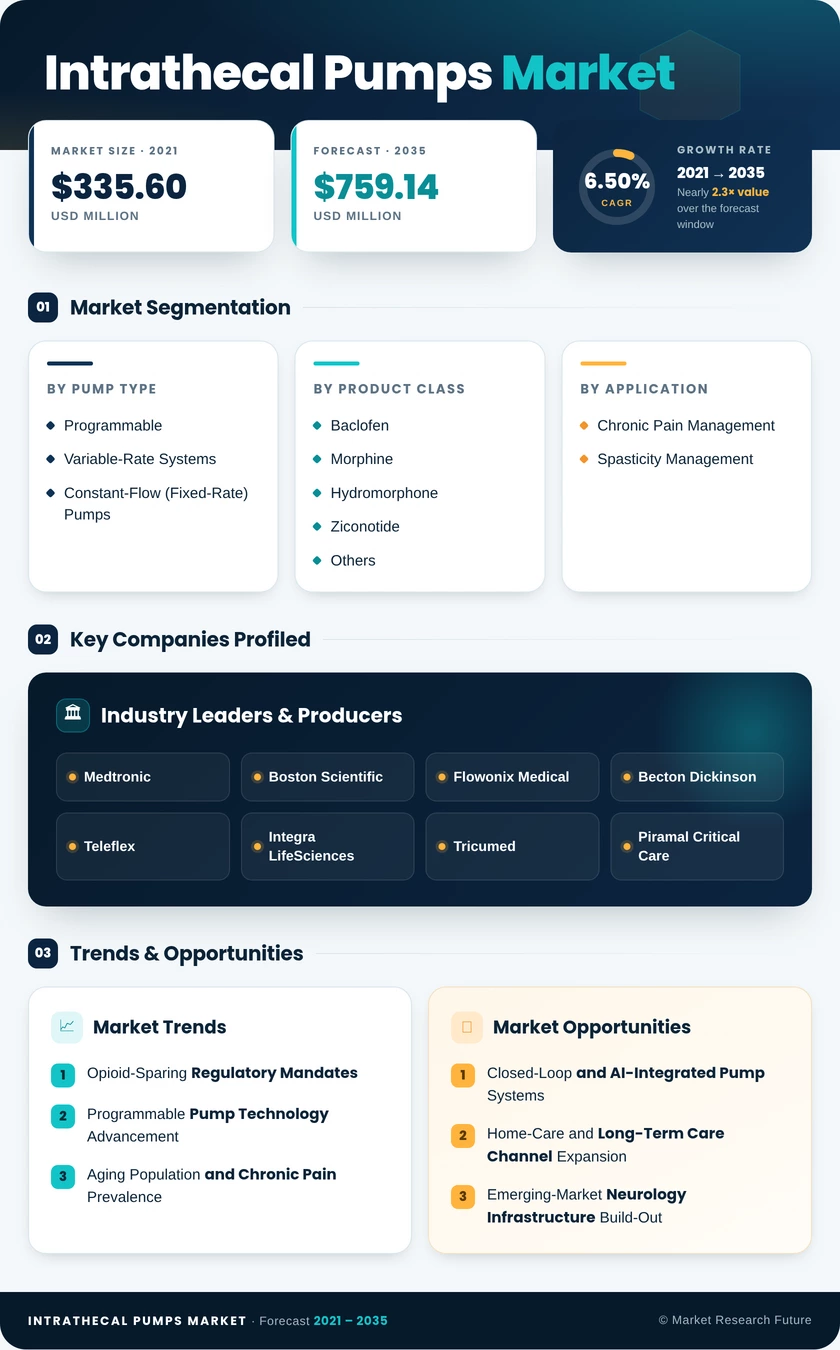
Intrathecal Pumps Market (2026 - 2035)

ID: MRFR/HC/9987-HCR
141 Pages
Vikita Thakur
Last Updated: July 20, 2026
Intrathecal Pumps Market Research Report Information by Product Class (Baclofen, Hydromorphone, Morphine, Bupivacaine, and Others), by Application (Pain Management and Spasticity Management) by End User (Hospitals & Clinics, Ambulatory Surgery Centers), by Region (North America, Europe, Asia-Pacific, and Rest of the World) - Forecast till 2035
Intrathecal Pumps Market
Market Size
Forecast Period2026-2035
CAGR (2026-2035)6.50%
2025 Market SizeUSD 404.50 Million
2035 Market SizeUSD 759.14 Million
Key Players
Medtronic
Boston Scientific
Flowonix Medical
Becton Dickinson
Teleflex
Integra LifeSciences
Opportunities
  • Closed-Loop and AI-Integrated Pump Systems
  • Home-Care and Long-Term Care Channel Expansion
  • Emerging-Market Neurology Infrastructure Build-Out
  1. 1 Market Overview |
    1. 1.1 Study Assumptions & Market Definition |
    2. 1.2 Scope of the Study |
    3. 1.3 Research Methodology
  2. 2 Market Summary & Key Takeaways
  3. 3 Market Dynamics |
    1. 3.1 Market Drivers Analysis | |
      1. 3.1.1 Opioid-Sparing Regulatory Mandates | |
      2. 3.1.2 Programmable Pump Technology Advancement | |
      3. 3.1.3 Aging Population and Chronic Pain Prevalence | |
      4. 3.1.4 Expansion of Spasticity Treatment Guidelines | |
      5. 3.1.5 Reimbursement Broadening for Home-Care Infusion | |
      6. 3.1.6 MRI-Conditional Device Clearances | |
      7. 3.1.7 Emerging-Market Hospital Modernization |
    2. 3.2 Market Restraints Analysis | |
      1. 3.2.1 High Upfront Implantation Cost | |
      2. 3.2.2 Surgical Complication Risks | |
      3. 3.2.3 Limited Specialist Availability | |
      4. 3.2.4 Stringent EU MDR Compliance Burden | |
      5. 3.2.5 Drug Stability and Catheter Failure |
    3. 3.3 Market Opportunity Analysis | |
      1. 3.3.1 Closed-Loop and AI-Integrated Pump Systems | |
      2. 3.3.2 Home-Care and Long-Term Care Channel Expansion | |
      3. 3.3.3 Emerging-Market Neurology Infrastructure Build-Out | |
      4. 3.3.4 Pediatric and Rare-Disease Indication Expansion | |
      5. 3.3.5 Data Monetization Through Connected Pump Ecosystems |
    4. 3.4 Industry Value Chain Analysis |
    5. 3.5 Porter's Five Forces Analysis
  4. 4 Global Intrathecal Pumps Market Size & Forecast (2021–2035) |
    1. 4.1 Historical Market Size (2021–2025) |
    2. 4.2 Current & Forecast Market Size (2026–2035) |
    3. 4.3 Market Size by Revenue (USD Million) |
    4. 4.4 Year-over-Year Growth Analysis
  5. 5 Segmentation Analysis |
    1. 5.1 By Pump Type | |
      1. 5.1.1 Programmable and Variable-Rate Systems | |
      2. 5.1.2 Constant-Flow (Fixed-Rate) Pumps |
    2. 5.2 By Product Class | |
      1. 5.2.1 Baclofen | |
      2. 5.2.2 Morphine | |
      3. 5.2.3 Hydromorphone | |
      4. 5.2.4 Ziconotide | |
      5. 5.2.5 Others |
    3. 5.3 By Application | |
      1. 5.3.1 Chronic Pain Management | |
      2. 5.3.2 Spasticity Management |
    4. 5.4 By End User | |
      1. 5.4.1 Hospitals & Clinics | |
      2. 5.4.2 Ambulatory Surgery Centers | |
      3. 5.4.3 Home-Care & Long-Term Care
  6. 6 Regional Analysis |
    1. 6.1 North America | |
      1. 6.1.1 United States | |
      2. 6.1.2 Canada | |
      3. 6.1.3 Mexico |
    2. 6.2 Europe | |
      1. 6.2.1 Germany | |
      2. 6.2.2 United Kingdom | |
      3. 6.2.3 France | |
      4. 6.2.4 Italy | |
      5. 6.2.5 Spain | |
      6. 6.2.6 Nordic Countries | |
      7. 6.2.7 Russia | |
      8. 6.2.8 Rest of Europe |
    3. 6.3 Asia-Pacific | |
      1. 6.3.1 China | |
      2. 6.3.2 India | |
      3. 6.3.3 Japan | |
      4. 6.3.4 South Korea | |
      5. 6.3.5 ASEAN | |
      6. 6.3.6 Rest of Asia-Pacific |
    4. 6.4 South America | |
      1. 6.4.1 Brazil | |
      2. 6.4.2 Argentina | |
      3. 6.4.3 Rest of South America |
    5. 6.5 Middle East & Africa | |
      1. 6.5.1 Saudi Arabia | |
      2. 6.5.2 UAE | |
      3. 6.5.3 South Africa | |
      4. 6.5.4 Egypt | |
      5. 6.5.5 Rest of MEA
  7. 7 Competitive Landscape |
    1. 7.1 Market Share Analysis (2025) |
    2. 7.2 Competitive Benchmarking Matrix |
    3. 7.3 Company Profiles | |
      1. 7.3.1 Medtronic | |
      2. 7.3.2 Boston Scientific | |
      3. 7.3.3 Flowonix Medical | |
      4. 7.3.4 Becton Dickinson | |
      5. 7.3.5 Teleflex | |
      6. 7.3.6 Integra LifeSciences | |
      7. 7.3.7 Tricumed | |
      8. 7.3.8 Piramal Critical Care | |
      9. 7.3.9 Jazz Pharmaceuticals | |
      10. 7.3.10 Saol Therapeutics
  8. 8 Future Outlook & Strategic Recommendations (2026–2035) |
    1. 8.1 AI-Enabled Dose Optimization and Closed-Loop Systems |
    2. 8.2 Biocompatible Materials and Extended Device Longevity |
    3. 8.3 Decentralization of Care to Home and Ambulatory Settings |
    4. 8.4 ESG and Sustainability Considerations in Device Manufacturing
  9. 9 Recent Developments & News
  10. 10 Frequently Asked Questions (FAQs)
  11. 11 Report Scope & Methodology |
    1. 11.1 Study Period & Base Year |
    2. 11.2 Data Sources & Citations |
    3. 11.3 Abbreviations
  12. 12 LIST OF TABLES |
  13. TABLE 1 Global Intrathecal Pumps Market Size & Forecast, by Revenue (USD Million), 2021–2035 |
  14. TABLE 2 Global Intrathecal Pumps Market — Year-over-Year Growth Analysis, 2021–2035 |
  15. TABLE 3 Global Intrathecal Pumps Market — Driver Impact Analysis |
  16. TABLE 4 Global Intrathecal Pumps Market — Restraint Impact Analysis |
  17. TABLE 5 Global Intrathecal Pumps Market Size, by Pump Type, 2021–2035 (USD Million) |
  18. TABLE 6 Global Intrathecal Pumps Market Size, by Product Class, 2021–2035 (USD Million) |
  19. TABLE 7 Global Intrathecal Pumps Market Size, by Application, 2021–2035 (USD Million) |
  20. TABLE 8 Global Intrathecal Pumps Market Size, by End User, 2021–2035 (USD Million) |
  21. TABLE 9 Global Intrathecal Pumps Market Size, by Region, 2021–2035 (USD Million) |
  22. TABLE 10 North America Intrathecal Pumps Market Size, by Country, 2021–2035 (USD Million) |
  23. TABLE 11 Europe Intrathecal Pumps Market Size, by Country, 2021–2035 (USD Million) |
  24. TABLE 12 Asia-Pacific Intrathecal Pumps Market Size, by Country, 2021–2035 (USD Million) |
  25. TABLE 13 South America Intrathecal Pumps Market Size, by Country, 2021–2035 (USD Million) |
  26. TABLE 14 Middle East & Africa Intrathecal Pumps Market Size, by Country, 2021–2035 (USD Million) |
  27. TABLE 15 Competitive Benchmarking Matrix — Global Intrathecal Pumps Market, 2025 |
  28. TABLE 16 Company Profiles — Key Players, Global Intrathecal Pumps Market |
  29. TABLE 17 Recent Developments & Strategic Announcements, 2023–2025 |
  30. TABLE 18 Report Scope & Methodology Summary |
  31. TABLE 19 Detailed Sources and Citations
  32. 13 LIST OF FIGURES |
  33. FIGURE 1 Global Intrathecal Pumps Market Dynamics — Drivers, Restraints, Opportunities |
  34. FIGURE 2 Industry Value Chain Analysis — Intrathecal Pumps Market |
  35. FIGURE 3 Porter's Five Forces Analysis — Intrathecal Pumps Market |
  36. FIGURE 4 Global Intrathecal Pumps Market Size Trend (USD Million), 2021–2035 |
  37. FIGURE 5 Intrathecal Pumps Market Share, by Pump Type (%), 2025 |
  38. FIGURE 6 Intrathecal Pumps Market Share, by Product Class (%), 2025 |
  39. FIGURE 7 Intrathecal Pumps Market Share, by Application (%), 2025 |
  40. FIGURE 8 Intrathecal Pumps Market Share, by End User (%), 2025 |
  41. FIGURE 9 Intrathecal Pumps Market Share, by Region (%), 2025 |
  42. FIGURE 10 North America Intrathecal Pumps Market Share, by Country (%), 2025 |
  43. FIGURE 11 Europe Intrathecal Pumps Market Share, by Country (%), 2025 |
  44. FIGURE 12 Asia-Pacific Intrathecal Pumps Market Share, by Country (%), 2025 |
  45. FIGURE 13 Competitive Landscape — Market Share Distribution, 2025

Segmentation Quick Reference

DimensionSub-SegmentsDominant SegmentFastest Growing Segment
Pump TypeProgrammable and Variable-Rate Systems; Constant-Flow (Fixed-Rate) PumpsProgrammable and Variable-Rate SystemsProgrammable and Variable-Rate Systems
Product ClassBaclofen; Morphine; Hydromorphone; Ziconotide; OthersBaclofenZiconotide
ApplicationChronic Pain Management; Spasticity ManagementChronic Pain ManagementSpasticity Management
End UserHospitals & Clinics; Ambulatory Surgery Centers; Home-Care & Long-Term CareHospitals & ClinicsHome-Care & Long-Term Care
GeographyNorth America; Europe; Asia-Pacific; South America; Middle East & AfricaNorth AmericaAsia-Pacific


Market Segmentation Overview

By Pump Type

Sub-SegmentKey Trend
Programmable and Variable-Rate SystemsCircadian dosing algorithms and remote telemetry integration driving adoption
Constant-Flow (Fixed-Rate) PumpsCost-competitive positioning in price-sensitive and stable-dose applications


Programmable systems continue to capture the vast majority of new implantation procedures, particularly in North America and Europe where reimbursement structures reward technology sophistication. Constant-flow devices retain relevance in emerging markets and in clinical scenarios where dosing stability makes programmable features unnecessary.

By Product Class

Sub-SegmentKey Trend
BaclofenDominant drug class anchored by spasticity prescribing guidelines
MorphineEstablished chronic pain workhorse; steady volume
HydromorphoneGaining share as alternative for morphine-intolerant patients
ZiconotideFastest-growing class on opioid-refractory pain evidence
OthersIncludes clonidine, bupivacaine, and combination formulations


Baclofen's dominance reflects the large installed base of spasticity patients on long-term intrathecal therapy. Ziconotide's rapid growth is propelled by clinical evidence positioning it as a first-line non-opioid intrathecal option, aligning with the broader opioid-sparing trend in pain management.

By Application

Sub-SegmentKey Trend
Chronic Pain ManagementCore demand driver; encompasses cancer pain, FBSS, and CRPS
Spasticity ManagementExpanding through broadened pediatric and post-stroke guidelines


Chronic pain management generates the majority of pump implantation volume, while spasticity management is growing at a faster rate as neurologists gain confidence in intrathecal baclofen for broader patient populations including pediatric and post-stroke cases.

By End User

Sub-SegmentKey Trend
Hospitals & ClinicsPrimary implantation and refill site; surgical expertise concentration
Ambulatory Surgery CentersRising share through cost-efficient outpatient implantation models
Home-Care & Long-Term CareFastest-growing channel enabled by remote monitoring and home infusion reimbursement


The migration of post-implantation care from hospital outpatient departments to home-care settings represents a structural shift in service delivery. Ambulatory surgery centers are capturing a growing share of initial implantation procedures as payers recognize cost advantages over inpatient surgical settings.


 

Download PDF ×

We do not share your information with anyone. However, we may send you emails based on your report interest from time to time. You may contact us at any time to opt-out.