Download Free Sample
Kindly complete the form below to receive a free sample of this Report
IT Cloud Platform Management Services Market Research Report Information By End User (Small And Medium Enterprises, Large Enterprises, Government Organizations, Educational Institutions), By Service Type (Infrastructure As A Service, Platform As A Service, Software As A Service, Function As A Service), By Deployment Model (Public Cloud, Private Cloud, Hybrid Cloud, Multi-Cloud), By Industry Vertical (Healthcare, Financial Services, Retail, Telecommunications), By Management Function (Resource Management, Cost Management, Security Management, Compliance Management) And By Region (North America, Europe, Asia-Pacific, And Rest Of The World) – Market Forecast Till 2035.
As per MRFR analysis, the IT Cloud Platform Management Services Market was estimated at 77.0 USD Billion in 2024. The IT Cloud Platform Management Services industry is projected to grow from 82.88 USD Billion in 2025 to 173.0 USD Billion by 2035, exhibiting a compound annual growth rate (CAGR) of 7.64% during the forecast period 2025 - 2035.
The IT Cloud Platform Management Services Market is experiencing robust growth driven by evolving technological demands and strategic shifts in cloud adoption.
| 2024 Market Size | 77.0 (USD Billion) |
| 2035 Market Size | 173.0 (USD Billion) |
| CAGR (2025 - 2035) | 7.64% |
Amazon Web Services (US), Microsoft (US), Google Cloud (US), IBM (US), Oracle (US), Alibaba Cloud (CN), Salesforce (US), VMware (US), SAP (DE)
Our Impact
Enabled $4.3B Revenue Impact for Fortune 500 and Leading Multinationals
Partnering with 2000+ Global Organizations Each Year
30K+ Citations by Top-Tier Firms in the Industry
The IT Cloud Platform Management Services Market is currently experiencing a transformative phase characterized by rapid technological advancements and evolving consumer demands. Organizations are increasingly recognizing the necessity of efficient cloud management solutions to optimize their operations and enhance service delivery. This market appears to be driven by the growing adoption of cloud technologies across various sectors, which necessitates robust management services to ensure seamless integration, security, and scalability. As businesses strive for digital transformation, the emphasis on cloud platform management is likely to intensify, leading to innovative service offerings and strategic partnerships among providers. Moreover, the competitive landscape of the IT Cloud Platform Management Services Market is becoming increasingly dynamic. Companies are focusing on developing comprehensive solutions that not only address current challenges but also anticipate future needs. This proactive approach may involve leveraging artificial intelligence and machine learning to enhance service efficiency and customer experience. Additionally, the rise of hybrid and multi-cloud environments is prompting service providers to adapt their strategies, ensuring they can cater to diverse client requirements. Overall, the market appears poised for sustained growth as organizations continue to prioritize cloud management in their operational frameworks.
As organizations migrate to cloud environments, there is a heightened emphasis on security and compliance. Service providers are likely to enhance their offerings to include advanced security measures, ensuring data protection and regulatory adherence.
The integration of artificial intelligence and automation tools into cloud management services is becoming more prevalent. This trend suggests that businesses may benefit from improved efficiency and reduced operational costs through automated processes.
Organizations are increasingly adopting hybrid and multi-cloud strategies to leverage the strengths of various cloud platforms. This shift indicates a growing demand for management services that can seamlessly operate across different environments.
The IT Cloud Platform Management Services Market experiences a notable surge in demand for scalable solutions. Organizations increasingly seek to expand their IT capabilities without incurring substantial costs. This trend is driven by the need for flexibility in resource allocation, allowing businesses to adapt to fluctuating workloads. According to recent data, the market for cloud services is projected to grow at a compound annual growth rate of approximately 22% over the next five years. This growth indicates a strong inclination towards scalable cloud solutions, which enable enterprises to efficiently manage their resources. As companies continue to embrace digital transformation, the emphasis on scalability within the IT Cloud Platform Management Services Market becomes increasingly pronounced.
Cost efficiency remains a pivotal driver within the IT Cloud Platform Management Services Market. Organizations are increasingly recognizing the financial advantages of migrating to cloud-based solutions. By leveraging cloud services, businesses can significantly reduce their capital expenditures on hardware and maintenance. Recent statistics suggest that companies can save up to 30% on IT costs by adopting cloud management services. This financial incentive encourages enterprises to optimize their resource allocation and streamline operations. Furthermore, the ability to pay for only what is used fosters a more efficient budgeting process. As a result, the focus on cost efficiency continues to propel the growth of the IT Cloud Platform Management Services Market.
Regulatory compliance and data governance are becoming paramount concerns within the IT Cloud Platform Management Services Market. As data privacy regulations tighten globally, organizations are compelled to adopt cloud solutions that ensure compliance with legal standards. The increasing complexity of data management necessitates robust governance frameworks that can be effectively implemented through cloud services. Recent reports indicate that nearly 60% of organizations face challenges in meeting compliance requirements, highlighting the need for cloud platforms that offer integrated compliance features. This focus on regulatory adherence not only mitigates risks but also enhances trust among customers. As a result, the demand for compliant cloud management services is likely to drive growth within the IT Cloud Platform Management Services Market.
The emphasis on data analytics and business intelligence is a critical driver within the IT Cloud Platform Management Services Market. Organizations are increasingly leveraging cloud platforms to harness vast amounts of data for strategic decision-making. The integration of advanced analytics tools within cloud services allows businesses to gain insights that were previously unattainable. Recent studies indicate that companies utilizing cloud-based analytics solutions experience a 15% increase in operational efficiency. This trend underscores the importance of data-driven decision-making in today’s competitive landscape. As organizations strive to remain agile and informed, the demand for cloud services that support data analytics is expected to grow, further propelling the IT Cloud Platform Management Services Market.
The IT Cloud Platform Management Services Market is significantly influenced by the growing need for enhanced collaboration tools and remote work capabilities. As organizations increasingly adopt flexible work arrangements, the demand for cloud-based solutions that facilitate seamless communication and collaboration rises. Data indicates that approximately 70% of employees now work remotely at least part-time, necessitating robust cloud platforms that support teamwork and project management. This shift towards remote work not only enhances productivity but also drives the adoption of cloud services that enable real-time collaboration. Consequently, the IT Cloud Platform Management Services Market is poised for growth as businesses seek to implement solutions that cater to this evolving work environment.
The IT Cloud Platform Management Services Market shows a diverse landscape in deployment models. The Public Cloud currently holds the largest share due to its scalability, cost-effectiveness, and widespread adoption across various industries. As businesses increasingly migrate to cloud solutions, the Public Cloud continues to dominate, providing a robust infrastructure that supports a range of applications from startups to enterprise-level organizations. Conversely, the Hybrid Cloud is emerging as the fastest-growing segment, driven by organizations' need for flexibility and security in their data management. This model allows businesses to leverage both public and private cloud environments, gaining the benefits of both. The continuous shift towards digital transformation is fueling the demand for Hybrid Cloud solutions, as companies seek to optimize their operations while maintaining control over sensitive information.
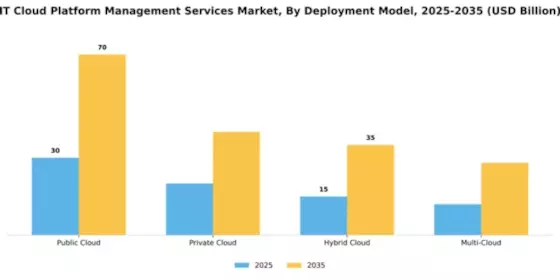
Public Cloud (Dominant) vs. Hybrid Cloud (Emerging)
The Public Cloud is recognized as the dominant deployment model in the IT Cloud Platform Management Services Market, characterized by its extensive user base and reliable service offerings. It provides companies with a scalable and cost-effective solution, enabling rapid deployment of IT resources. On the other hand, the Hybrid Cloud represents an emerging trend within this market, prioritizing a flexible approach that combines the advantages of both Public and Private Clouds. Businesses are increasingly drawn to Hybrid Cloud solutions as they require a balance of performance, security, and management capabilities. This adaptability fosters innovation and enables organizations to respond swiftly to changing market conditions, making it a compelling choice for many.
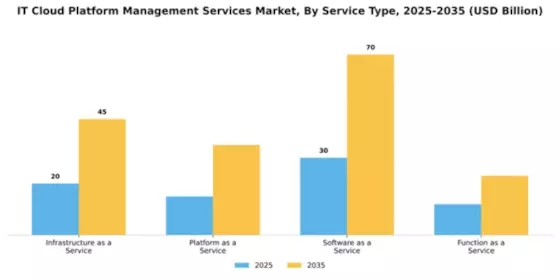
In the IT Cloud Platform Management Services Market, Infrastructure as a Service (IaaS) holds the largest market share among service types, driven by enterprises seeking scalable and flexible solutions for their IT infrastructures. This segment enables businesses to offload hardware management and focus on core operations. On the other hand, Software as a Service (SaaS) is rapidly gaining traction, showcasing significant growth as organizations increasingly adopt cloud-native applications for improved productivity and collaboration. The SaaS model's convenience and cost-effectiveness appeal strongly to businesses of all sizes. As organizations continue to migrate to the cloud, the IT Cloud Platform Management Services Market sees IaaS maintaining dominance. However, the growth of SaaS is accelerated by factors such as mobile workforce trends and the rapid development of digital transformation initiatives. Furthermore, Function as a Service (FaaS) is emerging as a transformative model, appealing to developers due to its serverless architecture, while Platform as a Service (PaaS) is increasingly favored for its robust development and deployment capabilities, contributing to the overarching trend of optimizing application delivery and management.
Infrastructure as a Service (Dominant) vs. Platform as a Service (Emerging)
Infrastructure as a Service (IaaS) is characterized by its ability to provide virtualized computing resources over the internet, making it an attractive option for organizations looking to scale infrastructure efficiently. This segment allows businesses to leverage powerful computing capabilities without investing in physical hardware. In contrast, Platform as a Service (PaaS) is gaining momentum as an emerging choice for developers, offering a robust framework for building, testing, and deploying applications. PaaS provides essential tools that simplify the development process, enabling organizations to accelerate their application delivery while focusing on innovation. Together, these services represent significant aspects of the IT Cloud Platform Management Services Market, with IaaS leading in market presence and PaaS offering innovative pathways for application development.
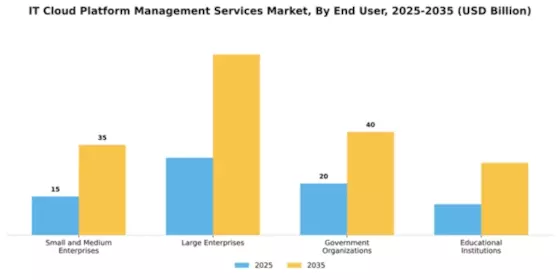
The IT Cloud Platform Management Services market is showing a balanced distribution among its primary end user segments. Small and Medium Enterprises (SMEs) are leading the pack, representing the largest segment due to their growing reliance on cloud solutions to enhance operational efficiency and reduce overhead costs. Following closely are Large Enterprises, which, while not as dominant in numbers, are rapidly increasing their investment in these services to foster innovation and streamline processes. In terms of growth trends, Large Enterprises are emerging as the fastest-growing segment, driven by the need for advanced cloud management functionalities and compliance with regulatory requirements. Meanwhile, SMEs continue to drive substantial demand by seeking scalable and cost-effective cloud solutions that align with their growth ambitions. This dual growth reflects a robust market landscape where both sectors are adapting to technological advancements and evolving business needs.
Small and Medium Enterprises: Dominant vs. Large Enterprises: Emerging
Small and Medium Enterprises (SMEs) are currently the dominant force in the IT Cloud Platform Management Services market. Their agility and adaptability enable them to leverage cloud solutions to drive efficiency and innovation, allowing them to compete with larger firms. SMEs are often more open to adopting new technologies, making them significant contributors to the cloud services ecosystem. Conversely, Large Enterprises, classified as an emerging segment, are rapidly expanding their cloud management capabilities to enhance operational resilience and data governance. These organizations are investing heavily in sophisticated cloud platforms that allow for better resource management and analytics. Together, these segments showcase the diverse needs and strategies that define the current landscape of cloud platform management.
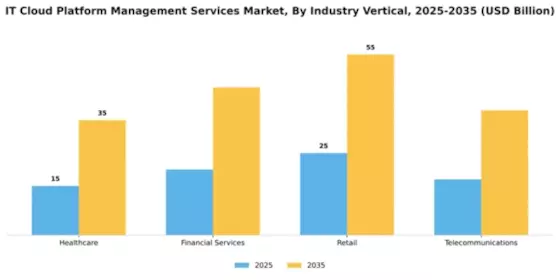
The IT Cloud Platform Management Services Market is segmented across various industry verticals including Healthcare, Financial Services, Retail, and Telecommunications. Among these, the Healthcare segment holds the largest market share, driven by the increasing need for secure data management and compliance with regulations. Telecommunications, on the other hand, is rapidly gaining traction and is recognized as the fastest-growing segment due to the rising demand for digital transformation and network scalability.
Healthcare: Dominant vs. Telecommunications: Emerging
The Healthcare sector within the IT Cloud Platform Management Services Market is characterized by stringent regulatory requirements that compel providers to adopt robust cloud management solutions. This segment's dominance is fueled by the demand for improved patient data management, telemedicine, and enhanced operational efficiency. In contrast, the Telecommunications sector is emerging rapidly as it adapts to the increasing complexity of managing cloud-based communication services. The drive towards 5G implementation and the need for efficient resource allocation facilitate its growth, with service providers opting for cloud management to streamline operations and improve service delivery.
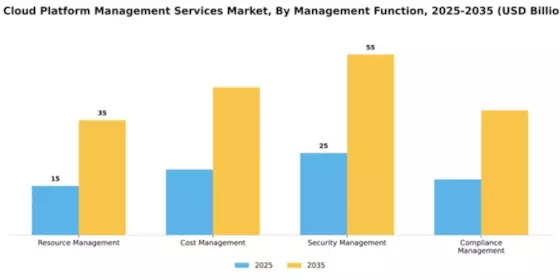
In the IT Cloud Platform Management Services Market, the management functions segment comprises various critical areas, with Resource Management currently holding the largest market share. Resource Management is essential for optimizing the usage of cloud resources, ensuring that organizations can effectively allocate their IT assets. Security Management follows as the fastest-growing function in this segment, driven by the increasing importance of cybersecurity measures in the cloud environment as organizations prioritize the protection of sensitive information.
Resource Management: Largest vs. Security Management: Fastest-Growing
Resource Management plays a pivotal role in the IT Cloud Platform Management Services Market, enabling organizations to streamline their cloud resource allocation and usage effectively. With the rise in cloud adoption, businesses increasingly rely on resource management tools to optimize performance, reduce waste, and ensure operational efficiency. On the other hand, Security Management is gaining traction as the fastest-growing segment, reflecting the escalating need for robust security protocols in cloud deployments. As organizations face cyber threats, the focus on security has intensified, leading to innovations and investments in advanced security solutions that address the dynamic nature of cloud vulnerabilities. Both functions are critical for organizations navigating the complexities of cloud management.
Get more detailed insights about IT Cloud Platform Management Services Market Request Free Sample
North America continues to lead the IT Cloud Platform Management Services market, holding a significant share of 42.0% in 2024. The region's growth is driven by rapid digital transformation, increased cloud adoption, and a robust regulatory framework that encourages innovation. Companies are increasingly leveraging cloud solutions to enhance operational efficiency and scalability, supported by favorable government policies promoting technology investments. The competitive landscape is characterized by major players such as Amazon Web Services, Microsoft, and Google Cloud, which dominate the market. The presence of these tech giants fosters a vibrant ecosystem, encouraging startups and smaller firms to innovate. The U.S. remains the primary market, with Canada also showing strong growth, driven by investments in cloud infrastructure and services.
Europe's IT Cloud Platform Management Services market is poised for growth, with a market size of €20.0 billion. The region is experiencing a surge in demand for cloud services, driven by the need for digital transformation across various sectors. Regulatory initiatives, such as the EU's Digital Services Act, are catalyzing this growth by ensuring data protection and promoting cloud adoption among businesses, thereby enhancing market stability and trust. Leading countries in this region include Germany, the UK, and France, where significant investments in cloud infrastructure are being made. Major players like SAP and IBM are well-established, while new entrants are emerging, creating a competitive landscape. The European market is characterized by a focus on compliance and security, which is crucial for businesses looking to leverage cloud technologies effectively.
The Asia-Pacific region is witnessing rapid growth in the IT Cloud Platform Management Services market, with a market size of $12.0 billion. This growth is fueled by increasing internet penetration, a burgeoning startup ecosystem, and rising demand for scalable IT solutions. Governments in countries like China and India are actively promoting cloud adoption through favorable policies and investments in digital infrastructure, which are essential for economic growth and innovation. Key players in this region include Alibaba Cloud and local providers, which are expanding their offerings to meet diverse customer needs. Countries such as Australia and Japan are also significant contributors, with strong investments in cloud technologies. The competitive landscape is evolving, with both established firms and new entrants vying for market share, driven by the need for digital transformation across various industries.
The Middle East and Africa (MEA) region is gradually emerging in the IT Cloud Platform Management Services market, with a market size of $3.0 billion. The growth is primarily driven by increasing digitalization efforts and the need for efficient IT solutions across various sectors. Governments are investing in cloud infrastructure to support economic diversification and enhance service delivery, which is crucial for attracting foreign investments and fostering innovation. Countries like the UAE and South Africa are leading the charge in cloud adoption, with significant investments from both local and international players. The competitive landscape is characterized by a mix of global giants and regional providers, all striving to capture the growing demand for cloud services. As businesses increasingly recognize the benefits of cloud technologies, the MEA region is set to become a key player in the global market.
The IT Cloud Platform Management Services Market is characterized by intense competition and rapid evolution, driven by the increasing demand for scalable and flexible cloud solutions. Major players such as Amazon Web Services (US), Microsoft (US), and Google Cloud (US) dominate the landscape, each employing distinct strategies to enhance their market presence. Amazon Web Services (US) focuses on continuous innovation, frequently expanding its service offerings to cater to diverse customer needs. Microsoft (US), on the other hand, emphasizes strategic partnerships and integrations, particularly with its Azure platform, to bolster its competitive edge. Google Cloud (US) appears to prioritize AI and machine learning capabilities, positioning itself as a leader in advanced analytics and data management solutions. Collectively, these strategies contribute to a dynamic competitive environment, where agility and technological advancement are paramount.In terms of business tactics, companies are increasingly localizing their services to better meet regional demands, optimizing supply chains to enhance efficiency. The market structure is moderately fragmented, with a few dominant players exerting considerable influence while numerous smaller firms vie for niche segments. This competitive structure fosters innovation, as companies strive to differentiate themselves through unique offerings and customer-centric solutions.In November Amazon Web Services (US) announced the launch of its new Quantum Computing service, aimed at providing businesses with unprecedented computational power. This strategic move is significant as it positions AWS at the forefront of emerging technologies, potentially attracting a new clientele interested in harnessing quantum capabilities for complex problem-solving. The introduction of this service may also catalyze further advancements in cloud computing, as competitors are likely to respond with their own innovations.In October Microsoft (US) expanded its partnership with SAP (DE) to integrate their cloud solutions more seamlessly. This collaboration is crucial as it enhances the interoperability of enterprise applications, allowing businesses to leverage both platforms more effectively. By strengthening this alliance, Microsoft not only solidifies its position in the enterprise market but also enhances its value proposition to customers seeking comprehensive cloud solutions.In September Google Cloud (US) unveiled a new initiative focused on sustainability, pledging to achieve carbon neutrality across its data centers by 2026. This commitment reflects a growing trend among cloud providers to prioritize environmental responsibility, which is increasingly influencing customer choices. By positioning itself as a leader in sustainable cloud practices, Google Cloud may attract environmentally conscious businesses, thereby expanding its market share.As of December the competitive landscape is increasingly shaped by trends such as digitalization, sustainability, and AI integration. Strategic alliances are becoming more prevalent, as companies recognize the value of collaboration in enhancing their service offerings. Looking ahead, competitive differentiation is likely to evolve, with a shift from price-based competition to a focus on innovation, technology, and supply chain reliability. This transition underscores the importance of agility and responsiveness in a rapidly changing market.


The IT Cloud Platform Management Services Market is projected to grow at a 7.64% CAGR from 2025 to 2035, driven by increasing cloud adoption, digital transformation, and demand for scalable solutions.
New opportunities lie in:
By 2035, the market is expected to be robust, reflecting substantial growth and innovation.
| MARKET SIZE 2024 | 77.0(USD Billion) |
| MARKET SIZE 2025 | 82.88(USD Billion) |
| MARKET SIZE 2035 | 173.0(USD Billion) |
| COMPOUND ANNUAL GROWTH RATE (CAGR) | 7.64% (2025 - 2035) |
| REPORT COVERAGE | Revenue Forecast, Competitive Landscape, Growth Factors, and Trends |
| BASE YEAR | 2024 |
| Market Forecast Period | 2025 - 2035 |
| Historical Data | 2019 - 2024 |
| Market Forecast Units | USD Billion |
| Key Companies Profiled | Amazon Web Services (US), Microsoft (US), Google Cloud (US), IBM (US), Oracle (US), Alibaba Cloud (CN), Salesforce (US), VMware (US), SAP (DE) |
| Segments Covered | Deployment Model, Service Type, End User, Industry Vertical, Management Function |
| Key Market Opportunities | Integration of artificial intelligence enhances efficiency in the IT Cloud Platform Management Services Market. |
| Key Market Dynamics | Rising demand for automation and scalability drives competition in the IT Cloud Platform Management Services market. |
| Countries Covered | North America, Europe, APAC, South America, MEA |
The market valuation reached 77.0 USD Billion in 2024.
The market is expected to grow to 173.0 USD Billion by 2035.
The market is anticipated to experience a CAGR of 7.64% from 2025 to 2035.
Key players include Amazon Web Services, Microsoft, Google Cloud, IBM, Oracle, Alibaba Cloud, Salesforce, VMware, and SAP.
The market segments by deployment model include Public Cloud, Private Cloud, Hybrid Cloud, and Multi-Cloud, with valuations ranging from 12.0 to 70.0 USD Billion.
Service types include Infrastructure as a Service, Platform as a Service, Software as a Service, and Function as a Service, with valuations from 12.0 to 70.0 USD Billion.
End users include Small and Medium Enterprises, Large Enterprises, Government Organizations, and Educational Institutions, with valuations between 12.0 and 70.0 USD Billion.
The market is driven by sectors such as Healthcare, Financial Services, Retail, and Telecommunications, with valuations from 15.0 to 55.0 USD Billion.
Management functions encompass Resource Management, Cost Management, Security Management, and Compliance Management, with valuations ranging from 15.0 to 55.0 USD Billion.
Growth varies across segments, with Public Cloud and Software as a Service showing the highest valuations, indicating robust demand.


Kindly complete the form below to receive a free sample of this Report

“This is really good guys. Excellent work on a tight deadline. I will continue to use you going forward and recommend you to others. Nice job”


“Thanks. It’s been a pleasure working with you, please use me as reference with any other Intel employees.”


“Thanks for sending the report it gives us a good global view of the Betaïne market.”


“Thank you, this will be very helpful for OQS.”


“We found the report very insightful! we found your research firm very helpful. I'm sending this email to secure our future business.”


“I am very pleased with how market segments have been defined in a relevant way for my purposes (such as "Portable Freezers & refrigerators" and "last-mile"). In general the report is well structured. Thanks very much for your efforts.”


“I have been reading the first document or the study, ,the Global HVAC and FP market report 2021 till 2026. Must say, good info! I have not gone in depth at all parts, but got a good indication of the data inside!”


“We got the report in time, we really thank you for your support in this process. I also thank to all of your team as they did a great job.”


“The Automotive 48V ECU Components Procurement Intelligence Study” was a complex project, but the Market Research Future (MRFR) team handled it with quality, agility, and customer-centricity. They delivered all requested data on time and within the agreed scope. The team, including Shubhendra Anand and Rahul Gotadki, was always readily available to clarify questions and swiftly implement necessary adjustments, driving the project to a successful conclusion within a very demanding timeframe.
I would also like to specifically commend Akshay Agarwal for his responsiveness and support at every stage—from our initial inquiry on May 6th through to final delivery on June 18th. His dedication made the entire process seamless.”



