×
Request Free Sample ×

Kindly complete the form below to receive a free sample of this Report

* Please use a valid business email

Leading companies partner with us for data-driven Insights

clients tt-cursor
Hero Background

Japan Handheld Surgical Devices Market

ID: MRFR/MED/51285-HCR
200 Pages
Rahul Gotadki
October 2025

Japan Handheld Surgical Devices Market Research Report: By Product Type (Graspers, Retractors, Mechanical Cutters, Suction Tips, Irrigation And Injection Needs, Scopes And Probes, Sutures, Forceps, Tweezers, Others), By Application (Orthopaedic Surgery, Ophthalmology, Cardiology, Wound Care, Urology And Gynecology Surgery, Plastic Surgery, Thoracic Surgery, Neurosurgery, Others) andBy End User (Hospitals & Clinics, Ambulatory Surgical Centers, Others)- Forecast to 2035

Share:
Download PDF ×

We do not share your information with anyone. However, we may send you emails based on your report interest from time to time. You may contact us at any time to opt-out.

Japan Handheld Surgical Devices Market Infographic
Purchase Options

Japan Handheld Surgical Devices Market Summary

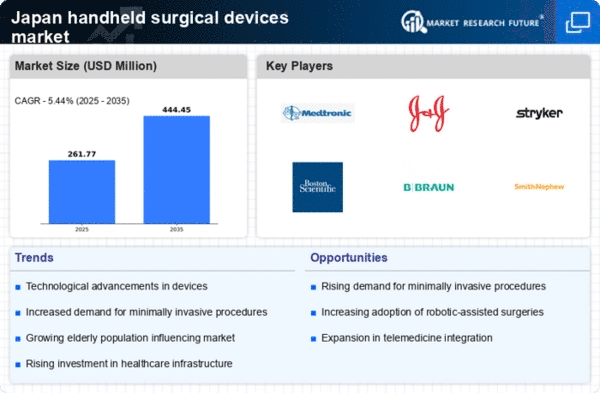
As per MRFR analysis, the Japan handheld surgical devices market size was estimated at 248.27 USD Million in 2024. The Japan handheld surgical-devices market is projected to grow from 261.77 USD Million in 2025 to 444.45 USD Million by 2035, exhibiting a compound annual growth rate (CAGR) of 5.44% during the forecast period 2025 - 2035.

Key Market Trends & Highlights

The Japan handheld surgical devices market is experiencing robust growth driven by technological advancements and increasing demand for precision surgery.

  • Technological advancements are enhancing the capabilities of handheld surgical devices, leading to improved surgical outcomes.
  • Minimally invasive procedures are gaining traction, as they offer reduced recovery times and lower risk of complications.
  • The market is characterized by strong regulatory support and innovation, facilitating the introduction of new devices.
  • Key drivers include the rising demand for precision surgery and the aging population, which necessitates advanced surgical solutions.

Market Size & Forecast

2024 Market Size 248.27 (USD Million)
2035 Market Size 444.45 (USD Million)
CAGR (2025 - 2035) 5.44%

Major Players

Medtronic (US), Johnson & Johnson (US), Stryker (US), Boston Scientific (US), B. Braun Melsungen AG (DE), Smith & Nephew (GB), Zimmer Biomet (US), Conmed Corporation (US)

Japan Handheld Surgical Devices Market Trends

The handheld surgical devices market in Japan is currently experiencing notable growth, driven by advancements in technology and an increasing demand for minimally invasive surgical procedures. The integration of innovative features such as enhanced ergonomics, improved precision, and user-friendly interfaces appears to be attracting healthcare professionals. Furthermore, the aging population in Japan is likely contributing to a higher incidence of chronic diseases, thereby increasing the need for effective surgical interventions. As a result, manufacturers are focusing on developing devices that not only meet the evolving needs of surgeons but also enhance patient outcomes. In addition, regulatory support from the Japanese government seems to be fostering a conducive environment for the handheld surgical-devices market. Initiatives aimed at promoting research and development, along with streamlined approval processes for new technologies, indicate a commitment to advancing healthcare solutions. This supportive framework may encourage innovation and investment in the sector, potentially leading to the introduction of cutting-edge devices. Overall, the handheld surgical-devices market in Japan appears poised for continued expansion, driven by technological advancements and demographic trends that necessitate improved surgical options.

Technological Advancements

The handheld surgical-devices market is witnessing rapid technological advancements, with manufacturers increasingly incorporating smart technologies and automation. These innovations enhance precision and efficiency during surgical procedures, thereby improving patient outcomes.

Minimally Invasive Procedures

There is a growing trend towards minimally invasive surgical techniques within the handheld surgical-devices market. This shift is driven by the benefits of reduced recovery times and lower risk of complications, appealing to both patients and healthcare providers.

Regulatory Support and Innovation

The Japanese government is actively supporting innovation in the handheld surgical-devices market through favorable regulations and funding for research. This environment encourages the development of new technologies, fostering growth and enhancing the quality of surgical care.

Japan Handheld Surgical Devices Market Drivers

Government Initiatives and Funding

Government initiatives aimed at improving healthcare infrastructure and funding for surgical innovations are playing a crucial role in the handheld surgical-devices market in Japan. The Japanese government has been actively promoting advancements in medical technology through various funding programs and incentives for research and development. This support is likely to encourage manufacturers to invest in the development of new handheld surgical devices that meet the evolving needs of healthcare providers. Additionally, the government's focus on enhancing surgical capabilities within hospitals is expected to lead to increased procurement of advanced surgical instruments. As a result, the handheld surgical-devices market is poised for growth, driven by favorable government policies and financial backing.

Aging Population and Surgical Needs

Japan's demographic landscape is characterized by a rapidly aging population, which is significantly influencing the handheld surgical-devices market. As the elderly population increases, there is a corresponding rise in the prevalence of chronic diseases that often require surgical intervention. This demographic shift is expected to drive the demand for handheld surgical devices, as healthcare providers seek to address the unique surgical needs of older patients. Reports indicate that by 2030, nearly 30% of Japan's population will be over 65 years old, creating a substantial market opportunity for surgical device manufacturers. The need for specialized handheld devices that cater to the complexities of geriatric surgery is likely to enhance the growth trajectory of the handheld surgical-devices market in Japan.

Rising Demand for Precision Surgery

The handheld surgical devices market in Japan is experiencing a notable increase in demand for precision surgical procedures. This trend is driven by the growing awareness among healthcare professionals regarding the benefits of accuracy in surgical interventions. As a result, hospitals and surgical centers are increasingly investing in advanced handheld devices that enhance surgical precision. According to recent data, the market for precision surgical instruments is projected to grow at a CAGR of approximately 8% over the next five years. This growth is indicative of a broader shift towards more refined surgical techniques, which is likely to bolster the handheld surgical-devices market. Furthermore, the emphasis on patient safety and improved surgical outcomes is propelling the adoption of these devices, thereby contributing to the overall expansion of the market.

Focus on Minimally Invasive Techniques

The shift towards minimally invasive surgical techniques is significantly impacting the handheld surgical-devices market in Japan. These techniques are associated with reduced recovery times, lower risk of complications, and minimal scarring, making them increasingly preferred by both surgeons and patients. As healthcare providers aim to enhance patient experiences and outcomes, the demand for handheld devices that facilitate minimally invasive procedures is on the rise. Data suggests that the market for minimally invasive surgical instruments is expected to grow by approximately 9% over the next few years. This trend is likely to drive innovation in the handheld surgical-devices market, as manufacturers develop new tools that align with the principles of minimally invasive surgery.

Technological Integration in Healthcare

The integration of advanced technologies in healthcare is a pivotal driver for the handheld surgical-devices market in Japan. Innovations such as robotics, artificial intelligence, and augmented reality are increasingly being incorporated into surgical practices, enhancing the functionality and efficiency of handheld devices. This technological evolution not only improves surgical outcomes but also streamlines workflows in operating rooms. For instance, the use of AI in surgical planning and execution is expected to reduce operation times and improve precision. As hospitals and surgical centers adopt these technologies, the demand for sophisticated handheld surgical devices is likely to rise. The market is projected to witness a growth rate of around 7% annually, reflecting the increasing reliance on technology in surgical procedures.


Market Segment Insights

Handheld Surgical Devices Market Product Type Insights

The Japan Handheld Surgical Devices Market is evolving significantly, with various product types contributing to its expansion. Among these, graspers play a crucial role due to their utility in holding and manipulating tissues during surgical procedures, enhancing precision and control for surgeons. Retractors are equally vital, designed to hold back tissues and organs, thereby improving visibility during operations. 

Mechanical cutters have gained recognition for their efficiency in precise tissue dissection, reflecting advancements in surgical techniques that aim for minimally invasive approaches. Suction tips are essential in maintaining a clear surgical field by removing fluids and debris, which is particularly important in intricate surgeries where visibility is critical.

Irrigation and injection needs are pivotal in ensuring effective fluid management and medication delivery during procedures. In Japan, where healthcare standards are stringent, these devices must meet high-quality regulations, making innovation and reliability key factors for manufacturers. 

Scopes and probes offer diagnostic and therapeutic capabilities, significantly contributing to the accuracy of surgical interventions. Sutures are fundamental in wound closure, with advancements leading to the usage of biocompatible materials that enhance healing and reduce complications. Forceps and tweezers are ubiquitous in surgical environments, providing versatility in handling various tissues and instruments with precision.

The demand for these handheld surgical devices is driven by Japan's aging population, increasing surgical procedures, and advancements in medical technology. The growth in preference for minimally invasive surgeries correlates with a rising demand for highly specialized and efficient surgical devices. 

Handheld Surgical Devices Market Application Insights

The Japan Handheld Surgical Devices Market demonstrates significant diversity in its applications, targeting various sectors including Orthopaedic Surgery, Ophthalmology, Cardiology, Wound Care, Urology and Gynecology Surgery, Plastic Surgery, Thoracic Surgery, and Neurosurgery. With a growing aging population and increasing prevalence of chronic diseases in Japan, demand for effective handheld surgical tools is expanding across these fields. Orthopaedic Surgery remains a vital area due to the rise in musculoskeletal disorders, while Ophthalmology is rapidly evolving with technological advancements enhancing surgical precision.Cardiology's necessity is underscored by the increasing incidence of heart diseases. 

Wound Care represents a crucial application, focusing on improving patient recovery times and outcomes. Moreover, Urology and Gynecology Surgery is dominantly growing as part of women’s health initiatives, emphasizing advanced solutions for minimally invasive procedures. Plastic Surgery continues to thrive as societal acceptance of cosmetic procedures rises. Thoracic Surgery and Neurosurgery are significant due to emerging technologies addressing complex surgical challenges.Overall, the segmentation in the Japan Handheld Surgical Devices Market reflects both established and innovative pathways to enhance surgical outcomes, driven by technological advances and demographic shifts.

Handheld Surgical Devices Market End User Insights

The Japan Handheld Surgical Devices Market showcases a robust landscape with distinct dynamics driven by its user segmentation. Hospitals and clinics play a pivotal role, given their substantial patient volumes and the demand for advanced surgical technologies, thus ensuring a steady requirement for handheld surgical devices. The increasing trend of outpatient surgeries has significantly uplifted the dominance of ambulatory surgical centers, as these facilities prioritize efficiency and lower operational costs while providing quality care. 

The Others category encapsulates a variety of medical institutions such as specialty clinics and research facilities, contributing to the diversification of the Japan Handheld Surgical Devices Market.As Japan continues to invest in medical innovations and improve healthcare infrastructure, these end users are likely to leverage handheld surgical devices to enhance precision, reduce recovery times, and improve overall surgical outcomes. 

The continuous advancements in technology and increasing geriatric population are projected to further drive the demand across all end users, fostering a competitive environment in the market. Additionally, regulatory support and initiatives aimed at enhancing surgical capabilities and patient safety bolster the growth potential within these segments.

Get more detailed insights about Japan Handheld Surgical Devices Market

Key Players and Competitive Insights

The handheld surgical-devices market in Japan is characterized by a dynamic competitive landscape, driven by technological advancements and increasing demand for minimally invasive procedures. Key players such as Medtronic (US), Johnson & Johnson (US), and Stryker (US) are at the forefront, each adopting distinct strategies to enhance their market presence. Medtronic (US) focuses on innovation through continuous product development, while Johnson & Johnson (US) emphasizes strategic partnerships to expand its product portfolio. Stryker (US) is actively pursuing mergers and acquisitions to bolster its capabilities, indicating a trend towards consolidation in the market. Collectively, these strategies contribute to a competitive environment that is both innovative and rapidly evolving.

In terms of business tactics, companies are increasingly localizing manufacturing to reduce costs and improve supply chain efficiency. This approach not only enhances responsiveness to market demands but also aligns with the growing emphasis on sustainability. The market structure appears moderately fragmented, with several key players exerting influence, yet the presence of smaller firms introduces a level of competition that fosters innovation and diversity in product offerings.

In October 2025, Medtronic (US) announced the launch of a new handheld surgical device designed for orthopedic procedures, which integrates advanced imaging technology. This strategic move is significant as it not only enhances surgical precision but also positions Medtronic (US) as a leader in the orthopedic segment, potentially increasing its market share in Japan. The integration of imaging technology into surgical devices reflects a broader trend towards enhanced functionality and improved patient outcomes.

In September 2025, Johnson & Johnson (US) entered into a partnership with a local Japanese firm to co-develop next-generation surgical instruments. This collaboration is indicative of Johnson & Johnson's (US) strategy to leverage local expertise and accelerate product development cycles. By aligning with a domestic partner, the company may enhance its understanding of regional market needs, thereby increasing its competitive edge in Japan.

In August 2025, Stryker (US) completed the acquisition of a Japanese startup specializing in robotic-assisted surgical devices. This acquisition is pivotal as it not only expands Stryker's (US) technological capabilities but also enhances its product offerings in the rapidly growing robotic surgery market. The move underscores a strategic shift towards integrating robotics into handheld surgical devices, which could redefine surgical practices in Japan.

As of November 2025, current trends in the handheld surgical-devices market are heavily influenced by digitalization, sustainability, and the integration of artificial intelligence (AI). Strategic alliances are becoming increasingly important, as companies seek to combine resources and expertise to drive innovation. The competitive landscape is shifting from traditional price-based competition to a focus on technological advancement and supply chain reliability. This evolution suggests that future differentiation will hinge on the ability to innovate and adapt to changing market dynamics, positioning companies that prioritize these aspects for sustained success.

Key Companies in the Japan Handheld Surgical Devices Market market include

Industry Developments

The Japan Handheld Surgical Devices Market has experienced several noteworthy developments recently, particularly with key players like Olympus Corporation, Stryker Corporation, and Boston Scientific focusing on enhancing product innovation and affordability. In September 2023, Terumo Corporation announced the launch of a new handheld device designed to improve surgical precision, aligning with the Japanese government’s initiative to bolster healthcare efficiency. In the previous years, growth in this market is reflected by Medtronic’s expansion strategies, which resulted in a 15% increase in market valuation in early 2023. 

Notably, in August 2023, Smith and Nephew collaborated with Nipro Corporation on a joint venture aimed at developing advanced surgical tools, enhancing operational synergies. On the mergers and acquisitions front, Integra Lifesciences completed an acquisition of a surgical device technology firm in July 2023, focusing on expanding its product portfolio in Japan. 

The demand for innovative, efficient handheld surgical devices continues to rise, driven by Japan's growing healthcare spending and technological advancements aiming at improved patient outcomes. The strategic movements within the sector indicate a robust trajectory for market growth and enhanced healthcare services in Japan.

Future Outlook

Japan Handheld Surgical Devices Market Future Outlook

The Handheld Surgical Devices Market is projected to grow at a 5.44% CAGR from 2024 to 2035, driven by technological advancements and increasing surgical procedures.

New opportunities lie in:

  • Development of AI-integrated surgical tools for enhanced precision
  • Expansion of tele-surgery capabilities to remote locations
  • Introduction of customizable handheld devices for specialized surgeries

By 2035, the market is expected to achieve substantial growth and innovation.

Market Segmentation

Japan Handheld Surgical Devices Market Type Outlook

  • Graspers
  • Retractors
  • Mechanical Cutters
  • Suction Tips and Tubes
  • Irrigation and Injection Needs
  • Scopes and Probes
  • Sutures
  • Forceps
  • Tweezers
  • Others

Japan Handheld Surgical Devices Market End User Outlook

  • Hospitals & Clinics
  • Ambulatory Surgical Centers
  • Others

Japan Handheld Surgical Devices Market Application Outlook

  • Orthopedic Surgery
  • Ophthalmology
  • Cardiology
  • Wound Care
  • Urology and Gynecology Surgery
  • Plastic Surgery
  • Thoracic Surgery
  • Neurosurgery
  • Others

Report Scope

MARKET SIZE 2024 248.27(USD Million)
MARKET SIZE 2025 261.77(USD Million)
MARKET SIZE 2035 444.45(USD Million)
COMPOUND ANNUAL GROWTH RATE (CAGR) 5.44% (2024 - 2035)
REPORT COVERAGE Revenue Forecast, Competitive Landscape, Growth Factors, and Trends
BASE YEAR 2024
Market Forecast Period 2025 - 2035
Historical Data 2019 - 2024
Market Forecast Units USD Million
Key Companies Profiled Medtronic (US), Johnson & Johnson (US), Stryker (US), Boston Scientific (US), B. Braun Melsungen AG (DE), Smith & Nephew (GB), Zimmer Biomet (US), Conmed Corporation (US)
Segments Covered Type, Application, End User
Key Market Opportunities Integration of advanced imaging technologies enhances precision in the handheld surgical-devices market.
Key Market Dynamics Technological advancements drive innovation in handheld surgical devices, enhancing precision and efficiency in surgical procedures.
Countries Covered Japan

Leave a Comment

FAQs

What is the projected market size of the Japan Handheld Surgical Devices Market in 2024?

The Japan Handheld Surgical Devices Market is expected to be valued at 413.75 million USD in 2024.

What is the expected market size for the Japan Handheld Surgical Devices Market in 2035?

By 2035, the Japan Handheld Surgical Devices Market is anticipated to reach a value of 910.0 million USD.

What is the expected compound annual growth rate (CAGR) for the Japan Handheld Surgical Devices Market from 2025 to 2035?

The Japan Handheld Surgical Devices Market is projected to grow at a CAGR of 7.428% from 2025 to 2035.

Who are the key players in the Japan Handheld Surgical Devices Market?

Major players in the Japan Handheld Surgical Devices Market include Olympus Corporation, Stryker Corporation, and Boston Scientific among others.

What is the market size for Graspers within the Japan Handheld Surgical Devices Market in 2024?

The Graspers segment is projected to be valued at 80.0 million USD in 2024.

What is the market value for Retractors in the Japan Handheld Surgical Devices Market in 2035?

The Retractors segment is expected to reach a market value of 200.0 million USD by 2035.

Which product segment is expected to have the highest market growth in the Japan Handheld Surgical Devices Market?

The Irrigation and Injection Needs segment is anticipated to grow significantly, reaching 250.0 million USD by 2035.

What challenges are currently faced by the Japan Handheld Surgical Devices Market?

The market faces challenges such as regulatory hurdles and the need for technological advancements.

What opportunities exist within the Japan Handheld Surgical Devices Market?

Opportunities include innovations in surgical technology and increasing demand for minimally invasive procedures.

How does the growth rate of the Japan Handheld Surgical Devices Market compare with global trends?

The Japan Handheld Surgical Devices Market is expected to maintain a robust growth rate aligned with global advancements in surgical practices.

Download Free Sample

Kindly complete the form below to receive a free sample of this Report

Compare Licence

×
Features License Type
Single User Multiuser License Enterprise User
Price $4,950 $5,950 $7,250
Maximum User Access Limit 1 User Upto 10 Users Unrestricted Access Throughout the Organization
Free Customization
Direct Access to Analyst
Deliverable Format
Platform Access
Discount on Next Purchase 10% 15% 15%
Printable Versions