×
Request Free Sample ×

Kindly complete the form below to receive a free sample of this Report

* Please use a valid business email

Leading companies partner with us for data-driven Insights

clients tt-cursor
Hero Background

Japan Industrial Services Market

ID: MRFR/ICT/58685-HCR
200 Pages
Aarti Dhapte
October 2025

Japan Industrial Services Market Research Report By Type (Installation & Commissioning, Engineering & Consulting), By Application (Human Machine Interface, Distributed Control System, Valves & Actuators) and By End User (Automotive, Metal & Mining, Food & Beverages, Paper, Oil & Gas)-Forecast to 2035

Share:
Download PDF ×

We do not share your information with anyone. However, we may send you emails based on your report interest from time to time. You may contact us at any time to opt-out.

Japan Industrial Services Market Infographic
Purchase Options

Japan Industrial Services Market Summary

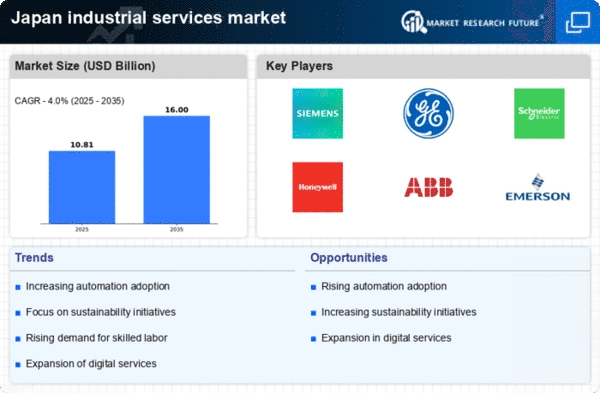
As per MRFR analysis, the Japan industrial services market size was estimated at 10.39 USD Billion in 2024. The Japan industrial services market is projected to grow from 10.81 USD Billion in 2025 to 16.0 USD Billion by 2035, exhibiting a compound annual growth rate (CAGR) of 4.0% during the forecast period 2025 - 2035.

Key Market Trends & Highlights

The Japan industrial services market is experiencing a transformative shift driven by technological advancements and sustainability initiatives.

  • Technological integration is reshaping service delivery across various sectors, enhancing efficiency and productivity.
  • The sustainability focus is becoming increasingly prominent, with companies prioritizing eco-friendly practices and compliance.
  • Collaborative service models are emerging, fostering partnerships that enhance service offerings and customer satisfaction.
  • Rising demand for automation and increased focus on safety standards are key drivers propelling market growth.

Market Size & Forecast

2024 Market Size 10.39 (USD Billion)
2035 Market Size 16.0 (USD Billion)
CAGR (2025 - 2035) 4.0%

Major Players

Siemens (DE), General Electric (US), Schneider Electric (FR), Honeywell (US), ABB (CH), Emerson Electric (US), Rockwell Automation (US), Konecranes (FI), Mitsubishi Electric (JP)

Japan Industrial Services Market Trends

The industrial services market in Japan is currently experiencing a dynamic transformation, driven by advancements in technology and evolving customer demands. Companies are increasingly adopting automation and digital solutions to enhance operational efficiency and reduce costs. This shift is not merely a trend but appears to be a fundamental change in how services are delivered across various sectors. The integration of artificial intelligence and data analytics into service offerings is becoming commonplace, allowing businesses to provide tailored solutions that meet specific client needs. Furthermore, sustainability initiatives are gaining traction, as organizations seek to minimize their environmental impact while maintaining profitability. In addition, the industrial services market is witnessing a growing emphasis on collaboration between service providers and clients. This collaborative approach fosters innovation and enables the development of customized solutions that address unique challenges faced by different industries. As the market evolves, it seems likely that the focus will continue to shift towards creating value through partnerships and integrated service models. Overall, the landscape of the industrial services market in Japan is poised for significant growth, driven by technological advancements and a commitment to sustainability.

Technological Integration

The industrial services market is increasingly incorporating advanced technologies such as automation and artificial intelligence. This integration enhances operational efficiency and allows for more precise service delivery, ultimately leading to improved customer satisfaction.

Sustainability Focus

There is a notable shift towards sustainable practices within the industrial services market. Companies are prioritizing eco-friendly solutions and reducing their carbon footprint, which aligns with broader environmental goals and regulatory requirements.

Collaborative Service Models

The trend towards collaboration between service providers and clients is becoming more pronounced. This approach encourages innovation and the development of tailored solutions, addressing specific industry challenges and enhancing overall service effectiveness.

Japan Industrial Services Market Drivers

Aging Workforce Challenges

Japan's industrial services market is significantly influenced by the challenges posed by an aging workforce. As the population ages, many skilled workers are retiring, leading to a shortage of labor in critical sectors. This demographic shift necessitates the adoption of advanced technologies and services to maintain productivity levels. The government has recognized this issue and is promoting initiatives to attract younger workers into the industrial sector. Consequently, service providers are increasingly focusing on training and upskilling programs to bridge the skills gap. This trend is expected to drive growth in the industrial services market as companies seek external expertise to manage their workforce challenges.

Rising Demand for Automation

The industrial services market in Japan is experiencing a notable increase in demand for automation solutions. This trend is driven by the need for enhanced efficiency and productivity across various sectors, including manufacturing and logistics. As companies seek to reduce operational costs and improve output quality, the adoption of automated systems is becoming more prevalent. According to recent data, the automation market in Japan is projected to grow at a CAGR of approximately 8% over the next five years. This growth is likely to stimulate the industrial services market, as service providers adapt to offer specialized support for automation technologies, including installation, maintenance, and training.

Digital Transformation Initiatives

The push for digital transformation is reshaping the industrial services market in Japan. Companies are increasingly adopting digital tools and platforms to enhance operational efficiency and customer engagement. This shift is driven by the need to remain competitive in a rapidly evolving market landscape. As organizations implement IoT, big data analytics, and cloud computing, the demand for specialized services to support these technologies is rising. The industrial services market is expected to see a surge in demand for consulting, integration, and ongoing support services. Industry reports suggest that the digital services market could grow by 10% annually, indicating a robust opportunity for service providers to align their offerings with digital transformation trends.

Increased Focus on Safety Standards

Safety regulations in Japan are becoming increasingly stringent, impacting the industrial services market. Companies are required to comply with enhanced safety standards to protect workers and minimize risks. This regulatory environment is prompting businesses to invest in safety training, equipment, and services. The industrial services market is likely to benefit from this trend, as service providers offer specialized safety audits, compliance consulting, and training programs. Recent statistics indicate that the safety services sector is expected to grow by 6% annually, reflecting the heightened emphasis on workplace safety. This growth presents opportunities for service providers to expand their offerings and cater to the evolving needs of industries.

Sustainability and Environmental Compliance

Sustainability is becoming a critical driver for the industrial services market in Japan. Companies are increasingly required to adhere to environmental regulations and adopt sustainable practices. This shift is not only a response to regulatory pressures but also a reflection of changing consumer preferences towards eco-friendly products and services. As a result, the demand for services that assist in achieving sustainability goals is on the rise. Service providers are likely to offer solutions such as waste management, energy efficiency consulting, and carbon footprint assessments. The market for environmental services is projected to grow by 7% annually, highlighting the potential for industrial services providers to capitalize on this trend.


Market Segment Insights

By Service Type: Maintenance Services (Largest) vs. Repair Services (Fastest-Growing)

In the Japan industrial services market, the service type segment is witnessing diverse contributions from various categories. Maintenance Services lead the market, commanding a significant share due to the growing emphasis on equipment longevity and reliability. Repair Services, while smaller in share, show considerable potential for growth as industries increasingly recognize the importance of minimizing downtime and optimizing operational efficiency. As we analyze the growth trends, Maintenance Services continue to thrive, driven by the need for regular upkeep and regulatory compliance among industrial players. Conversely, Repair Services are emerging rapidly, spurred by technological advancements and increased automation in manufacturing processes. This dynamic is indicative of a market that is not only mature but also responsive to evolving industrial needs and innovations.

Maintenance Services (Dominant) vs. Operational Services (Emerging)

Maintenance Services have established themselves as the dominant force in the Japan industrial services market, characterized by their comprehensive scope that includes scheduled upkeep, inspections, and compliance checks. This service type is crucial for industries aiming to extend the lifespan of their equipment and ensure consistent productivity. In contrast, Operational Services are gaining traction as an emerging segment, focusing on improving operational efficiency and streamlining processes. This includes support for logistics, workforce management, and production optimization. As companies seek competitive advantages, the shift towards Operational Services reflects a strategic push towards innovation and enhanced operational frameworks.

By End Use Industry: Manufacturing (Largest) vs. Energy (Fastest-Growing)

The Japan industrial services market exhibits a varied distribution of market share among its key end-use industries. Manufacturing holds a significant position, representing the largest share, driven by a robust industrial base and the increasing demand for advanced manufacturing techniques. Oil and Gas and Construction also contribute substantially, with each sector adapting to evolving technological trends. Mining remains a crucial segment, benefiting from Japan's imports of raw materials, while Energy is gaining traction due to the country's shift towards renewable sources. Looking ahead, the growth trends in these segments are influenced by several factors. The Manufacturing sector is expected to continue thriving, bolstered by automation and innovations. Meanwhile, the Energy segment is recognized as the fastest-growing, propelled by government initiatives promoting renewable energy and reducing carbon emissions. The Oil and Gas sector is poised for gradual growth as energy demand stabilizes, while Construction and Mining adapt to changing regulatory landscapes and technological advancements.

Manufacturing: Dominant vs. Energy: Emerging

Manufacturing in the Japan industrial services market is characterized by its substantial contribution to the economy, leveraging advanced technology and high skilled labor. The sector focuses on automation, efficiency, and innovation to maintain its dominant position. In contrast, the Energy segment is emerging rapidly, propelled by the government's push for sustainable practices and renewable energy solutions. As Japan aims for carbon neutrality, investments in clean energy technology are surging. This emerging focus in the Energy sector is attracting new players and transforming traditional dynamics, positioning it as a critical component of the industrial landscape.

By Service Delivery Model: On-site Services (Largest) vs. Remote Services (Fastest-Growing)

In the Japan industrial services market, On-site Services dominate the service delivery model segment, capturing a significant share of the market due to their personalized and hands-on approach. These services provide immediate support and maintenance, fostering strong customer relationships and trust. Conversely, Remote Services are emerging rapidly, driven by advancements in technology and the increasing demand for flexible and cost-effective service options. This segment is gaining traction as companies seek to optimize operations and minimize downtime through innovative remote monitoring and management solutions. Growth trends within this segment reveal a clear shift towards digitization and automation, making Remote Services the fastest-growing option. The need for operational efficiency and the rising emphasis on data analytics further bolster this trend. As industries look to streamline processes and adapt to market changes, the flexibility of Remote Services meets these demands. Moreover, Managed Services also play a critical role, providing comprehensive solutions that bundle both On-site and Remote Services, enhancing overall service delivery and support mechanisms in the industrial space.

On-site Services (Dominant) vs. Remote Services (Emerging)

On-site Services, characterized by direct interaction and tailored support, continue to maintain a dominant position in the market due to their effectiveness in addressing specific client needs on location. The ability to respond quickly to emergencies and provide immediate technical assistance solidifies their importance. In contrast, Remote Services are an emerging player, leveraging the latest technologies to deliver efficient and cost-effective solutions from a distance. With the growing preference for flexible service alternatives and remote monitoring capabilities, this segment is becoming increasingly attractive. The combination of these two service delivery models enhances the overall value proposition offered to clients in the Japan industrial services market, addressing diverse requirements and fostering innovation.

By Technology Used: Automation (Largest) vs. Artificial Intelligence (Fastest-Growing)

In the Japan industrial services market, Automation holds the largest share, reflecting its crucial role in enhancing operational efficiency and productivity across various sectors. This is closely followed by the growing adoption of Artificial Intelligence, which is rapidly gaining attention for its potential to optimize processes and facilitate data-driven decision-making. The Internet of Things (IoT) and Cloud Computing also contribute significantly, but their market shares are comparatively smaller as organizations gradually integrate these technologies into their operations. The growth trends in this segment showcase a strong inclination towards Automation as industries seek to streamline workflows and reduce operational costs. The rapid advancements in Artificial Intelligence are driving its adoption, particularly in predictive maintenance and intelligent automation. The IoT is emerging as a key enabler of real-time data collection and analysis, while Cloud Computing is providing scalable and flexible solutions, allowing businesses to adapt quickly to market demands and enhance their competitive edge.

Technology: Automation (Dominant) vs. IoT (Emerging)

Automation is poised as the dominant technology in the Japan industrial services market, characterized by its extensive implementation across various sectors for improving manufacturing processes, minimizing waste, and optimizing resource allocation. Its ability to reduce labor-intensive tasks and enhance productivity makes it an essential component of industrial strategies. Conversely, IoT represents an emerging technology with significant potential, enabling seamless connectivity and data exchange between devices. It is gaining traction as companies pursue smarter solutions and become more data-centric. As industries increasingly realize the value of data analytics driven by IoT, its market presence is expected to grow considerably, positioning it as a vital technology for future industrial advancements.

Get more detailed insights about Japan Industrial Services Market

Key Players and Competitive Insights

The industrial services market in Japan is characterized by a dynamic competitive landscape, driven by technological advancements and a growing emphasis on sustainability. Major players such as Siemens (DE), General Electric (US), and Mitsubishi Electric (JP) are actively shaping the market through strategic initiatives focused on innovation and digital transformation. Siemens (DE) has positioned itself as a leader in automation and digitalization, leveraging its expertise to enhance operational efficiency across various sectors. Meanwhile, General Electric (US) continues to invest in renewable energy solutions, aligning its operations with global sustainability goals. Mitsubishi Electric (JP) emphasizes smart manufacturing and energy-efficient technologies, reflecting a commitment to both innovation and environmental responsibility. Collectively, these strategies contribute to a competitive environment that prioritizes technological advancement and sustainable practices.

Key business tactics within the market include localizing manufacturing and optimizing supply chains to enhance responsiveness to customer needs. The competitive structure appears moderately fragmented, with several key players exerting influence while also facing competition from emerging firms. This fragmentation allows for diverse offerings and innovation, as established companies strive to maintain their market positions through strategic partnerships and technological investments.

In October 2025, Siemens (DE) announced a partnership with a leading Japanese robotics firm to develop advanced automation solutions tailored for the manufacturing sector. This collaboration is expected to enhance Siemens' capabilities in providing cutting-edge automation technologies, thereby strengthening its market position. The strategic importance of this partnership lies in its potential to accelerate the adoption of Industry 4.0 practices among Japanese manufacturers, positioning Siemens as a key player in the digital transformation of the industry.

In September 2025, General Electric (US) unveiled a new initiative aimed at expanding its renewable energy portfolio in Japan, focusing on offshore wind projects. This strategic move underscores GE's commitment to sustainability and its intent to capitalize on Japan's growing demand for clean energy solutions. The initiative is likely to enhance GE's competitive edge in the renewable sector, aligning with global trends towards decarbonization and energy transition.

In August 2025, Mitsubishi Electric (JP) launched a new suite of energy management solutions designed to optimize energy consumption in industrial facilities. This launch reflects Mitsubishi's strategic focus on smart technologies and energy efficiency, catering to the increasing demand for sustainable industrial practices. The introduction of these solutions is expected to bolster Mitsubishi's market presence and reinforce its reputation as a leader in energy-efficient technologies.

As of November 2025, current competitive trends in the industrial services market are heavily influenced by digitalization, sustainability, and the integration of artificial intelligence (AI). Strategic alliances among key players are shaping the landscape, fostering innovation and enhancing service offerings. Looking ahead, competitive differentiation is likely to evolve, with a shift from price-based competition to a focus on technological innovation, reliability in supply chains, and sustainable practices. Companies that successfully navigate these trends will likely secure a competitive advantage in the increasingly complex market.

Key Companies in the Japan Industrial Services Market market include

Industry Developments

The Japan Industrial Services Market has witnessed several notable developments recently. As of October 2023, companies like Sony and Fujitsu are increasingly focusing on digital transformation initiatives to enhance operational efficiency, resulting in substantial investments in Artificial Intelligence and Internet of Things technologies. Additionally, Daikin Industries has expanded its product offerings to include smart HVAC solutions, addressing rising energy efficiency demands.

In terms of mergers and acquisitions, Mitsubishi Heavy Industries announced its acquisition of a stake in an innovative robotics company in September 2023 to bolster its automation capabilities, while NEC Corporation completed the purchase of a cybersecurity firm earlier this year in July to enhance its cybersecurity solutions portfolio.

Growth in the market valuation of companies such as Kawasaki Heavy Industries and Mitsubishi Electric has been significant, fueled by the rising demand for advanced industrial automation solutions. Furthermore, the Japanese government has been encouraging investments in sustainable manufacturing processes, aligning with global trends in environmental responsibility. Over the last two to three years, the market has experienced transformative shifts, with a keen emphasis on digitalization and sustainability shaping the industry's future landscape.

Future Outlook

Japan Industrial Services Market Future Outlook

The industrial services market in Japan is projected to grow at a 4.0% CAGR from 2024 to 2035, driven by technological advancements and increasing demand for efficiency.

New opportunities lie in:

  • Development of predictive maintenance solutions leveraging IoT technology.
  • Expansion of energy management services for industrial facilities.
  • Implementation of automated logistics systems to enhance supply chain efficiency.

By 2035, the industrial services market is expected to achieve robust growth and increased competitiveness.

Market Segmentation

Japan Industrial Services Market Service Type Outlook

  • Maintenance Services
  • Repair Services
  • Operational Services
  • Installation Services

Japan Industrial Services Market Technology Used Outlook

  • Automation
  • Artificial Intelligence
  • IoT
  • Cloud Computing

Japan Industrial Services Market End Use Industry Outlook

  • Manufacturing
  • Oil and Gas
  • Construction
  • Mining
  • Energy

Japan Industrial Services Market Service Delivery Model Outlook

  • On-site Services
  • Remote Services
  • Managed Services

Report Scope

MARKET SIZE 2024 10.39(USD Billion)
MARKET SIZE 2025 10.81(USD Billion)
MARKET SIZE 2035 16.0(USD Billion)
COMPOUND ANNUAL GROWTH RATE (CAGR) 4.0% (2024 - 2035)
REPORT COVERAGE Revenue Forecast, Competitive Landscape, Growth Factors, and Trends
BASE YEAR 2024
Market Forecast Period 2025 - 2035
Historical Data 2019 - 2024
Market Forecast Units USD Billion
Key Companies Profiled Siemens (DE), General Electric (US), Schneider Electric (FR), Honeywell (US), ABB (CH), Emerson Electric (US), Rockwell Automation (US), Konecranes (FI), Mitsubishi Electric (JP)
Segments Covered Service Type, End Use Industry, Service Delivery Model, Technology Used
Key Market Opportunities Integration of advanced automation technologies enhances efficiency in the industrial services market.
Key Market Dynamics Technological advancements drive efficiency in industrial services, reshaping competitive dynamics and operational strategies in Japan.
Countries Covered Japan

Leave a Comment

FAQs

What is the projected market size of the Japan Industrial Services Market in 2024?

The Japan Industrial Services Market is expected to be valued at 1.5 billion USD in 2024.

What will the market size be in 2035?

By 2035, the market size is projected to reach 2.63 billion USD.

What is the expected CAGR for the Japan Industrial Services Market from 2025 to 2035?

The expected CAGR for the Japan Industrial Services Market from 2025 to 2035 is 5.225%.

What are the values of the Installation & Commissioning segment in 2024 and 2035?

The Installation & Commissioning segment is valued at 0.65 billion USD in 2024 and 1.15 billion USD in 2035.

What is the market value for the Engineering & Consulting segment in 2024 and 2035?

The Engineering & Consulting segment is expected to be valued at 0.85 billion USD in 2024 and 1.48 billion USD in 2035.

Who are the major players in the Japan Industrial Services Market?

Major players in the market include Sony, Toshiba, Fujitsu, Daikin Industries, and Mitsubishi Heavy Industries.

What opportunities exist in the Japan Industrial Services Market?

Emerging trends and technologies offer significant opportunities for growth in various sectors of the market.

What is the impact of current global scenarios on the Japan Industrial Services Market?

Current global scenarios influence demand and operational costs within the Japan Industrial Services Market.

What key growth drivers are influencing the Japan Industrial Services Market?

Technological advancements and increasing automation are key growth drivers for the Japan Industrial Services Market.

What challenges does the Japan Industrial Services Market currently face?

The market faces challenges related to competition and the need for continuous innovation to meet customer demands.

Download Free Sample

Kindly complete the form below to receive a free sample of this Report

Compare Licence

×
Features License Type
Single User Multiuser License Enterprise User
Price $4,950 $5,950 $7,250
Maximum User Access Limit 1 User Upto 10 Users Unrestricted Access Throughout the Organization
Free Customization
Direct Access to Analyst
Deliverable Format
Platform Access
Discount on Next Purchase 10% 15% 15%
Printable Versions