×
Request Free Sample ×

Kindly complete the form below to receive a free sample of this Report

* Please use a valid business email

Leading companies partner with us for data-driven Insights

clients tt-cursor
Hero Background

Japan STD Testing Devices Market

ID: MRFR/MED/49817-HCR
200 Pages
Rahul Gotadki
October 2025

Japan STD Testing Devices Market Research Report By Type of Test (Serological Tests, Molecular Tests, Rapid Tests, Nucleic Acid Amplification Tests), By End User (Hospitals, Diagnostic Laboratories, Home Care Settings, Public Health Organizations), By Product Type (Test Kits, Equipment, Consumables) and By Application (Chlamydia Testing, Gonorrhea Testing, Syphilis Testing, HIV Testing, Hepatitis Testing) - Forecast to 2035

Share:
Download PDF ×

We do not share your information with anyone. However, we may send you emails based on your report interest from time to time. You may contact us at any time to opt-out.

Japan STD Testing Devices Market Infographic
Purchase Options

Japan STD Testing Devices Market Summary

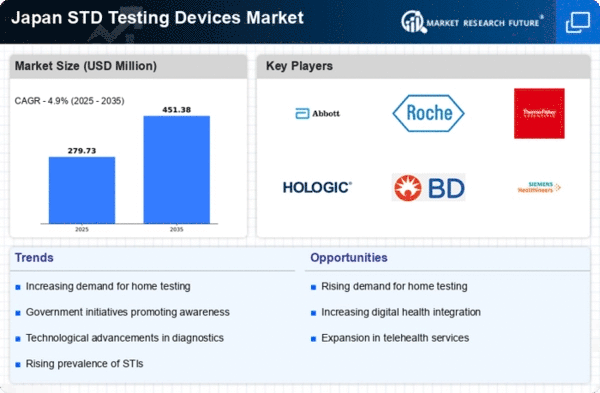
As per MRFR analysis, the Japan STD Testing Devices Market Size was estimated at 266.66 USD Million in 2024. The Japan std testing-devices market is projected to grow from 279.73 USD Million in 2025 to 451.38 USD Million by 2035, exhibiting a compound annual growth rate (CAGR) of 4.9% during the forecast period 2025 - 2035.

Key Market Trends & Highlights

The Japan STD Testing Devices Market is experiencing a transformative shift towards innovative and accessible testing solutions.

  • The market is witnessing a rise in at-home testing solutions, catering to the growing demand for convenience and privacy.
  • Integration of digital health technologies is enhancing the efficiency and accuracy of STD testing devices.
  • Quality and safety standards are becoming increasingly prioritized, ensuring reliable testing outcomes for consumers.
  • Key market drivers include increasing awareness of STDs and government initiatives aimed at promoting preventive healthcare.

Market Size & Forecast

2024 Market Size 266.66 (USD Million)
2035 Market Size 451.38 (USD Million)
CAGR (2025 - 2035) 4.9%

Major Players

Abbott Laboratories (US), Roche Diagnostics (CH), Thermo Fisher Scientific (US), Hologic Inc (US), BD (Becton, Dickinson and Company) (US), Siemens Healthineers (DE), Cepheid (US), Bio-Rad Laboratories (US)

Japan STD Testing Devices Market Trends

The std testing-devices market is currently experiencing notable shifts, driven by advancements in technology and increasing awareness of sexually transmitted infections (STIs). In Japan, the demand for rapid and accurate testing solutions is on the rise, as individuals seek more convenient and private options for health management. This trend is further supported by government initiatives aimed at promoting sexual health education and reducing the stigma associated with STIs. As a result, manufacturers are focusing on developing innovative devices that cater to the needs of consumers, including at-home testing kits and point-of-care testing solutions. Moreover, the regulatory landscape in Japan is evolving, with authorities emphasizing the importance of quality and safety in medical devices. This has led to stricter guidelines for the approval and distribution of std testing-devices, ensuring that only reliable products reach the market. The integration of digital health technologies, such as mobile applications that facilitate test result tracking and health consultations, is also gaining traction. These developments suggest a promising future for the std testing-devices market, as stakeholders adapt to changing consumer preferences and regulatory requirements.

Rise of At-Home Testing Solutions

There is a growing trend towards at-home testing solutions within the std testing-devices market. Consumers are increasingly favoring the convenience and privacy offered by these products, which allow for self-testing without the need for clinical visits. This shift is likely to enhance accessibility and encourage more individuals to engage in regular testing.

Integration of Digital Health Technologies

The incorporation of digital health technologies is becoming more prevalent in the std testing-devices market. Mobile applications that assist users in tracking their health status and managing test results are gaining popularity. This trend indicates a move towards a more connected and informed approach to sexual health.

Focus on Quality and Safety Standards

The emphasis on quality and safety standards is intensifying within the std testing-devices market. Regulatory bodies in Japan are implementing stricter guidelines for device approval, ensuring that only high-quality products are available to consumers. This focus on safety is likely to build trust and confidence in testing solutions.

Japan STD Testing Devices Market Drivers

Rising Incidence of STDs

The rising incidence of STDs in Japan is a significant driver for the std testing-devices market. Recent statistics indicate a troubling increase in reported cases of STDs, with a rise of approximately 25% over the past five years. This alarming trend has prompted health authorities to advocate for more widespread testing and preventive measures. As the incidence of STDs continues to grow, the demand for testing devices is likely to escalate, as individuals seek to understand their health status and take proactive measures. Additionally, healthcare providers are increasingly recommending regular testing as part of routine health check-ups, further contributing to market growth. The urgent need to address this public health concern is expected to bolster the std testing-devices market in the coming years.

Increasing Awareness of STDs

The growing awareness of sexually transmitted diseases (STDs) in Japan is a crucial driver for the std testing-devices market. Educational campaigns and public health initiatives have significantly contributed to this awareness, leading to a higher demand for testing devices. According to recent data, approximately 30% of the population is now more informed about STDs, which has resulted in increased testing rates. This heightened awareness is likely to encourage individuals to seek regular testing, thereby expanding the market. Furthermore, the stigma surrounding STDs is gradually diminishing, which may lead to more people utilizing testing devices. As awareness continues to rise, the std testing-devices market is expected to experience substantial growth, driven by a more health-conscious population that prioritizes sexual health and safety.

Government Initiatives and Funding

Government initiatives aimed at combating STDs in Japan play a pivotal role in shaping the std testing-devices market. The Japanese government has allocated significant funding towards public health programs that promote STD testing and prevention. For instance, recent budgets indicate an increase of 15% in funding for sexual health initiatives, which includes the distribution of testing devices in clinics and community health centers. These initiatives not only enhance accessibility but also encourage regular testing among the population. Additionally, partnerships between the government and private sector entities are likely to foster innovation in testing technologies, further propelling the market. As these initiatives continue to evolve, they are expected to create a more robust infrastructure for STD testing, ultimately benefiting the std testing-devices market.

Shift Towards Preventive Healthcare

The shift towards preventive healthcare in Japan is emerging as a vital driver for the std testing-devices market. As healthcare paradigms evolve, there is a growing emphasis on prevention rather than treatment. This trend is reflected in the increasing number of health screenings and preventive measures being adopted by the population. Recent surveys indicate that nearly 40% of individuals are now prioritizing preventive health measures, including regular STD testing. This proactive approach is likely to enhance the demand for testing devices, as individuals seek to monitor their sexual health more closely. Moreover, healthcare providers are aligning their services to support this shift, offering more comprehensive testing options. As preventive healthcare continues to gain traction, the std testing-devices market is expected to flourish, driven by a population that values early detection and intervention.

Technological Advancements in Testing Devices

Technological advancements are significantly influencing the std testing-devices market in Japan. Innovations such as rapid testing kits and point-of-care testing devices are becoming increasingly prevalent, allowing for quicker and more accurate results. Recent reports suggest that the market for rapid testing devices has grown by approximately 20% in the last year, reflecting a shift towards more efficient testing solutions. These advancements not only improve the user experience but also enhance the reliability of test results, which is crucial for effective disease management. Furthermore, the integration of mobile health applications with testing devices is likely to facilitate better tracking and reporting of STD cases. As technology continues to evolve, it is expected to drive further growth in the std testing-devices market, catering to the needs of a tech-savvy population.


Market Segment Insights

By Type: Molecular Tests (Largest) vs. Rapid Tests (Fastest-Growing)

The Japan std testing-devices market showcases a diverse range of testing methods, with serological tests, molecular tests, rapid tests, and nucleic acid amplification tests forming the key segments. Among these, molecular tests hold the largest share, driven by their accuracy and reliability in detecting various pathogens. Rapid tests are gaining traction as they offer quick results, catering to the urgent needs of patients and healthcare providers. Growth trends indicate a shift towards rapid tests due to advancements in technology and the increasing demand for point-of-care testing. This segment is propelled by the need for faster diagnostics in infectious diseases, especially in emergencies. Molecular tests continue to thrive due to ongoing innovations, and their applications in both clinical and laboratory settings ensure sustained growth in the Japan std testing-devices market.

Molecular Tests (Dominant) vs. Rapid Tests (Emerging)

Molecular tests are established as the dominant segment in the Japan std testing-devices market, primarily due to their precision in detecting specific genetic material from pathogens. They are widely used in various healthcare settings, including hospitals and laboratories, providing essential insights for effective disease management. In contrast, rapid tests are emerging as a significant player, appealing to a broad demographic seeking immediate results. Designed for ease of use and quick deployment, these tests are gaining popularity in both clinical and home settings. The increasing demand for urgent diagnostic solutions is pushing rapid tests to the forefront, potentially reshaping the testing landscape and expanding their market presence in the future.

By End User: Hospitals (Largest) vs. Home Care Settings (Fastest-Growing)

In the Japan std testing-devices market, hospitals represent the largest segment, primarily due to their extensive infrastructure and widespread adoption of advanced testing technologies. Diagnostic laboratories also hold a significant share, leveraging their specialized capabilities to meet diverse testing needs. On the other hand, home care settings, although smaller, are gaining traction due to the increasing demand for at-home testing solutions alongside public health organizations, which play a vital role in disease prevention and health monitoring. The growth trends in this segment are influenced by various factors, including technological advancements and the rising focus on patient-centered care. Increasing chronic diseases and the shift towards personalized medicine are driving hospitals and diagnostic laboratories to expand their services. Meanwhile, home care settings are emerging rapidly as consumers seek convenient testing solutions. Public health organizations continue to promote awareness and accessibility, further catalyzing growth.

Hospitals (Dominant) vs. Home Care Settings (Emerging)

Hospitals dominate the Japan std testing-devices market, characterized by their large scale, comprehensive testing capabilities, and strong funding from public and private sectors. They invest heavily in the latest diagnostic technologies, ensuring they remain at the forefront of testing innovation. Conversely, home care settings are emerging as a significant player, propelled by consumer preferences for convenience and accessibility. These settings increasingly facilitate testing for chronic diseases and routine health checks, leveraging telehealth platforms to reach a wider audience. The collaboration between healthcare providers and technology firms is enhancing the attractiveness of home care solutions, providing a conducive environment for their continued growth.

By Product Type: Test Kits (Largest) vs. Equipment (Fastest-Growing)

In the Japan std testing-devices market, the product type segment is primarily dominated by Test Kits, which hold the largest market share due to their convenience, accuracy, and widespread usage in both clinical and home settings. Equipment follows, with significant contributions to the overall market, while Consumables have a smaller, yet essential, role in supporting the other segments. The distribution of market share reflects the reliance on quick and reliable testing solutions that Test Kits offer, positioning them at the forefront of consumer preferences. The growth trends within the product type segment indicate a notable increase in the adoption of Equipment, which is becoming the fastest-growing area. Factors such as technological advancements, increased health awareness, and regulatory support are driving this growth. Moreover, the surge in demand for rapid testing methods, which are often facilitated by advanced Equipment, is reshaping the landscape, making the need for innovative solutions more crucial than ever.

Test Kits (Dominant) vs. Consumables (Emerging)

Test Kits are recognized as the dominant force in the Japan std testing-devices market due to their ease of use and fast results, making them a preferred choice among healthcare professionals and consumers alike. They are characterized by their variety, catering to different testing needs from infectious diseases to home health diagnostics. On the other hand, Consumables, while considered an emerging segment, play a vital role in the market. These include various materials required for testing, such as reagents and sample collection tools, which complement the effectiveness of Test Kits and other equipment. The growth of the Consumables segment is driven by an escalating demand for comprehensive testing solutions, reflecting the market's move toward more integrated and user-friendly diagnostic options.

By Application: HIV Testing (Largest) vs. Chlamydia Testing (Fastest-Growing)

The Japan std testing-devices market exhibits a diverse application landscape with HIV Testing holding the largest market share among the various testing types. Following closely are Gonorrhea Testing and Syphilis Testing, while Chlamydia Testing is emerging as a critical player due to rising awareness and increased screening initiatives. Growth trends in this segment are largely driven by ongoing public health campaigns and advancements in testing technologies. The increasing prevalence of sexually transmitted infections (STIs) is motivating healthcare providers to enhance their testing capabilities, particularly for HIV and Chlamydia. Furthermore, the expansion of telehealth services adds to the accessibility and convenience of testing, spurring demand across various applications in the market.

HIV Testing (Dominant) vs. Chlamydia Testing (Emerging)

HIV Testing serves as the dominant application within the Japan std testing-devices market, largely attributed to its critical role in managing public health. Effective prevention strategies and treatment options have led to increased testing, further solidifying its market position. On the other hand, Chlamydia Testing is considered an emerging segment, gaining traction due to heightened awareness among the population and initiatives aimed at reducing the incidence of STIs. Despite being smaller in share compared to HIV, the rapid growth rate of Chlamydia Testing reflects the changing landscape of sexual health and the growing importance of early detection in preventing long-term health complications.

Get more detailed insights about Japan STD Testing Devices Market

Key Players and Competitive Insights

The std testing-devices market in Japan is characterized by a competitive landscape that is both dynamic and multifaceted. Key growth drivers include increasing awareness of sexually transmitted diseases (STDs), advancements in diagnostic technologies, and a growing emphasis on preventive healthcare. Major players such as Abbott Laboratories (US), Roche Diagnostics (CH), and Hologic Inc (US) are strategically positioned to leverage these trends. Abbott Laboratories (US) focuses on innovation in point-of-care testing, while Roche Diagnostics (CH) emphasizes its extensive portfolio of molecular diagnostics. Hologic Inc (US) is known for its commitment to women's health, particularly in STD testing, which shapes their operational focus and market strategies. Collectively, these strategies contribute to a competitive environment that is increasingly centered on technological advancement and customer-centric solutions.

Key business tactics employed by these companies include localizing manufacturing and optimizing supply chains to enhance efficiency and responsiveness to market demands. The market structure appears moderately fragmented, with several key players holding substantial market shares. This fragmentation allows for a diverse range of products and services, fostering competition that drives innovation and quality improvements across the sector.

In October 2025, Roche Diagnostics (CH) announced the launch of a new rapid testing device aimed at improving the accessibility of STD testing in rural areas of Japan. This strategic move is significant as it aligns with the company's goal of expanding its reach and addressing healthcare disparities, thereby enhancing its market presence. The introduction of this device is likely to bolster Roche's competitive edge by catering to an underserved demographic, potentially increasing testing rates and early diagnosis of STDs.

In September 2025, Hologic Inc (US) entered into a partnership with a leading telehealth provider to integrate its STD testing solutions into virtual healthcare platforms. This collaboration is indicative of a broader trend towards digital health solutions, allowing for more convenient access to testing and results. By leveraging telehealth, Hologic aims to enhance patient engagement and streamline the testing process, which could lead to increased adoption of their products in a rapidly evolving healthcare landscape.

In August 2025, Abbott Laboratories (US) expanded its distribution network in Japan by collaborating with local healthcare providers to facilitate the deployment of its latest STD testing devices. This strategic action underscores Abbott's commitment to enhancing accessibility and ensuring that its innovative solutions reach a wider audience. By strengthening its distribution channels, Abbott is likely to improve its market penetration and reinforce its position as a leader in the STD testing segment.

As of November 2025, current competitive trends in the std testing-devices market include a pronounced shift towards digitalization, sustainability, and the integration of artificial intelligence (AI) in diagnostic processes. Strategic alliances are increasingly shaping the landscape, enabling companies to pool resources and expertise to drive innovation. The competitive differentiation is expected to evolve from traditional price-based competition to a focus on technological advancements, reliability of supply chains, and the ability to deliver innovative solutions that meet the changing needs of healthcare providers and patients alike.

Key Companies in the Japan STD Testing Devices Market market include

Industry Developments

In recent developments, the Japan STD Testing Devices Market has witnessed significant advancements, particularly in the wake of increasing awareness around sexually transmitted diseases and the importance of early detection. In October 2023, Fujirebio Inc announced an upgrade to their immunodiagnostic testing capabilities, enhancing the reliability and speed of STD diagnostics in clinical settings.

Moreover, in September 2023, Abbott Laboratories launched a new point-of-care testing system, aimed at increasing accessibility to rapid STD tests in urban clinics across Japan. In terms of mergers and acquisitions, in August 2023, Thermo Fisher Scientific Inc acquired a local biotech firm specializing in molecular diagnostics to bolster their portfolio in the Japanese market. This acquisition is tailored towards enhancing their research and development efforts within STD testing.

Over the past few years, there has been notable growth in the Japan STD testing devices market, with a reported valuation increase due to high demand for innovative testing solutions and government initiatives promoting health screenings. Major players such as Roche Diagnostics and Hologic Inc continue to invest in localized manufacturing to meet increasing market demands. These continuous efforts reflect a strong commitment to improving healthcare outcomes in Japan.


Future Outlook

Japan STD Testing Devices Market Future Outlook

The STD Testing Devices Market in Japan is projected to grow at a 4.9% CAGR from 2024 to 2035, driven by technological advancements and increasing health awareness.

New opportunities lie in:

  • Development of mobile testing units for remote areas
  • Integration of AI for enhanced diagnostic accuracy
  • Expansion of subscription-based testing services for regular monitoring

By 2035, the market is expected to achieve substantial growth and innovation.

Market Segmentation

Japan STD Testing Devices Market Type Outlook

  • Serological Tests
  • Molecular Tests
  • Rapid Tests
  • Nucleic Acid Amplification Tests

Japan STD Testing Devices Market End User Outlook

  • Hospitals
  • Diagnostic Laboratories
  • Home Care Settings
  • Public Health Organizations

Japan STD Testing Devices Market Application Outlook

  • Chlamydia Testing
  • Gonorrhea Testing
  • Syphilis Testing
  • HIV Testing
  • Hepatitis Testing

Japan STD Testing Devices Market Product Type Outlook

  • Test Kits
  • Equipment
  • Consumables

Report Scope

MARKET SIZE 2024266.66(USD Million)
MARKET SIZE 2025279.73(USD Million)
MARKET SIZE 2035451.38(USD Million)
COMPOUND ANNUAL GROWTH RATE (CAGR)4.9% (2024 - 2035)
REPORT COVERAGERevenue Forecast, Competitive Landscape, Growth Factors, and Trends
BASE YEAR2024
Market Forecast Period2025 - 2035
Historical Data2019 - 2024
Market Forecast UnitsUSD Million
Key Companies ProfiledAbbott Laboratories (US), Roche Diagnostics (CH), Thermo Fisher Scientific (US), Hologic Inc (US), BD (Becton, Dickinson and Company) (US), Siemens Healthineers (DE), Cepheid (US), Bio-Rad Laboratories (US)
Segments CoveredType, End User, Product Type, Application
Key Market OpportunitiesIntegration of advanced digital technologies enhances accessibility and efficiency in the std testing-devices market.
Key Market DynamicsRising demand for innovative STD testing devices driven by regulatory changes and consumer awareness in Japan.
Countries CoveredJapan

Leave a Comment

FAQs

What is the expected market size for the Japan STD Testing Devices Market in 2024?

The expected market size for the Japan STD Testing Devices Market in 2024 is valued at 349.5 million USD.

What is the projected market size for the Japan STD Testing Devices Market by 2035?

By 2035, the projected market size for the Japan STD Testing Devices Market is expected to reach 699.0 million USD.

What is the expected CAGR for the Japan STD Testing Devices Market from 2025 to 2035?

The expected CAGR for the Japan STD Testing Devices Market from 2025 to 2035 is 6.504%.

What are the key players in the Japan STD Testing Devices Market?

Key players in the Japan STD Testing Devices Market include Becton Dickinson and Company, bioMérieux SA, and Abbott Laboratories among others.

Which type of test is valued the highest in the Japan STD Testing Devices Market in 2024?

In 2024, Molecular Tests are valued the highest in the Japan STD Testing Devices Market at 104.5 million USD.

What is the value of Serological Tests in the Japan STD Testing Devices Market for 2024?

The value of Serological Tests in the Japan STD Testing Devices Market for 2024 is 87.5 million USD.

How much is the market for Rapid Tests expected to grow by 2035?

The market for Rapid Tests is expected to grow to 185.0 million USD by 2035.

What challenges does the Japan STD Testing Devices Market face?

The Japan STD Testing Devices Market faces challenges such as regulatory obstacles and competition among established players.

What opportunities are emerging in the Japan STD Testing Devices Market?

Emerging opportunities in the Japan STD Testing Devices Market include advancements in molecular testing technologies.

What is the expected value of Nucleic Acid Amplification Tests by 2035?

The expected value of Nucleic Acid Amplification Tests by 2035 is 130.0 million USD.

Download Free Sample

Kindly complete the form below to receive a free sample of this Report

Compare Licence

×
Features License Type
Single User Multiuser License Enterprise User
Price $4,950 $5,950 $7,250
Maximum User Access Limit 1 User Upto 10 Users Unrestricted Access Throughout the Organization
Free Customization
Direct Access to Analyst
Deliverable Format
Platform Access
Discount on Next Purchase 10% 15% 15%
Printable Versions