Download Free Sample
Kindly complete the form below to receive a free sample of this Report
Jet Hand Dryer Market Size, Share, Industry Trend & Analysis Research Report: By Product Type (Warm Air Hand Dryer, Hot Air Hand Dryer, Hybrid Hand Dryer), By Technology (Infrared Sensor, Push Button, Automatic, Touchless), By Power Consumption (Less than 1000W, 1000W to 1500W, 1500W and above), By Mounting Type (Wall-mounted, Deck-mounted, Pedestal-mounted), By Usage (Commercial, Residential, Industrial) andBy Regional (North America, Europe, South America, Asia Pacific, Middle East and Africa)- Forecast to 2035
As per Market Research Future analysis, the Jet Hand Dryer Market Size was estimated at 1.655 USD Billion in 2024. The Jet Hand Dryer industry is projected to grow from 1.746 USD Billion in 2025 to 2.977 USD Billion by 2035, exhibiting a compound annual growth rate (CAGR) of 5.48% during the forecast period 2025 - 2035
The Jet Hand Dryer Market is experiencing a shift towards sustainability and technological innovation.
| 2024 Market Size | 1.655 (USD Billion) |
| 2035 Market Size | 2.977 (USD Billion) |
| CAGR (2025 - 2035) | 5.48% |
The Jet Hand Dryer Market is currently experiencing a notable evolution, driven by increasing awareness regarding hygiene and sustainability. As public spaces prioritize cleanliness, the demand for efficient hand drying solutions has surged. Jet hand dryers, known for their rapid drying capabilities and reduced environmental impact compared to paper towels, are becoming a preferred choice in various establishments, including restaurants, airports, and healthcare facilities. This shift reflects a broader trend towards eco-friendly practices, as businesses seek to minimize waste and enhance user experience. Furthermore, advancements in technology are contributing to the market's growth, with innovations aimed at improving energy efficiency and reducing noise levels. In addition to technological enhancements, the Jet Hand Dryer Market is witnessing a diversification of product offerings. Manufacturers are increasingly focusing on design and functionality, catering to diverse consumer preferences. This includes the introduction of models that integrate touchless operation, which not only enhances hygiene but also aligns with modern consumer expectations. As the market continues to evolve, it appears poised for further expansion, driven by a combination of health consciousness, environmental considerations, and technological advancements. The future landscape of the Jet Hand Dryer Market suggests a dynamic interplay between innovation and consumer demand, shaping the way hand drying solutions are perceived and utilized across various sectors.
The Jet Hand Dryer Market is increasingly aligning with sustainability initiatives. As organizations aim to reduce their carbon footprint, the preference for energy-efficient models is growing. This trend reflects a broader societal shift towards environmentally responsible practices.
Innovations in the Jet Hand Dryer Market are enhancing user experience and operational efficiency. Features such as touchless operation and improved drying technology are becoming standard, appealing to health-conscious consumers and businesses alike.
The market is witnessing a shift towards aesthetically pleasing designs. Manufacturers are recognizing the importance of integrating style with functionality, leading to products that not only perform well but also complement modern restroom environments.
Cost efficiency is a significant driver in the Jet hand dryer Market. Businesses are increasingly recognizing the long-term savings associated with jet hand dryers compared to traditional paper towel dispensers. While the initial investment in jet hand dryers may be higher, the reduction in ongoing costs for paper towels, waste disposal, and maintenance can lead to substantial savings over time. Reports indicate that facilities can save thousands of dollars annually by switching to jet hand dryers. This financial incentive is compelling for many organizations, particularly in sectors with high foot traffic. As cost considerations become more critical, the jet hand dryer Market is likely to see continued growth as businesses seek to optimize their operational expenses.
Regulatory compliance is becoming increasingly relevant in the Jet Hand Dryer Market. Governments and health organizations are implementing stricter hygiene regulations, particularly in public spaces and commercial establishments. These regulations often encourage or mandate the use of hand drying solutions that promote hygiene and reduce waste. Jet hand dryers, with their ability to provide a hygienic and efficient drying method, are well-positioned to meet these regulatory demands. As compliance becomes a priority for businesses, the demand for jet hand dryers is expected to rise. This trend not only supports public health initiatives but also drives innovation within the Jet Hand Dryer Market, as manufacturers strive to meet evolving standards and consumer expectations.
Technological advancements play a crucial role in shaping the Jet Hand Dryer Market. The introduction of high-speed dryers with advanced sensor technology enhances user experience and efficiency. These innovations not only reduce drying time but also improve hygiene by minimizing contact. Recent studies indicate that modern jet hand dryers can dry hands in as little as 10 to 15 seconds, which is significantly faster than traditional methods. Furthermore, the integration of HEPA filters in some models ensures that the air used for drying is clean and free from contaminants. As technology continues to evolve, the Jet Hand Dryer Market is expected to witness further enhancements, attracting more consumers and businesses seeking efficient and hygienic solutions.
The Jet Hand Dryer Market is increasingly influenced by sustainability initiatives. Organizations are prioritizing eco-friendly solutions to reduce their carbon footprint. Jet hand dryers, which consume less energy and reduce paper waste, align with these goals. According to recent data, the adoption of jet hand dryers can lead to a reduction in paper towel usage by up to 90%, significantly lowering waste. This shift towards sustainable practices is not merely a trend; it is becoming a standard expectation among consumers and businesses alike. As environmental concerns grow, the demand for energy-efficient and sustainable products in the Jet Hand Dryer Market is likely to increase, driving innovation and investment in this sector.
The Jet Hand Dryer Market is experiencing a surge in demand due to heightened awareness of health and hygiene. In various sectors, including healthcare and food service, the emphasis on maintaining cleanliness is paramount. Jet hand dryers, which offer touchless operation and reduce the risk of cross-contamination, are becoming preferred choices. Data suggests that facilities equipped with jet hand dryers report lower instances of bacterial contamination compared to those using paper towels. This growing focus on hygiene is likely to propel the market forward, as businesses seek to provide safer environments for their customers and employees. The Jet Hand Dryer Market is thus positioned to benefit from this trend, as more establishments prioritize health-conscious solutions.
The Jet Hand Dryer Market exhibits a diverse range of product types, with warm air hand dryers holding the largest market share. This segment is widely preferred in various settings, particularly in commercial establishments, due to its energy efficiency and reduced operational costs. In contrast, hot air hand dryers are rapidly gaining traction, driven by advancements in technology that enhance drying efficiency and user experience. Additionally, consumers are increasingly prioritizing hygiene and eco-friendliness, contributing to the rising preference for hot air models.
The growth trends in the Jet Hand Dryer Market reveal a significant shift toward hybrid hand dryer options, which combine the best features of both warm and hot air dryers. These hybrid models are appealing to consumers looking for versatility and performance. As environmental awareness grows, the demand for sustainable solutions in hand drying is prompting manufacturers to innovate continuously, positioning hybrid hand dryers as a strong contender in the market. This segment is likely to witness robust growth as more facilities adopt these advanced gadgets that offer superior functionality and low energy consumption.
Warm Air Hand Dryer (Dominant) vs. Hybrid Hand Dryer (Emerging)
Warm air hand dryers dominate the Jet Hand Dryer Market due to their wide acceptance and established technology. Known for providing a gentle and effective drying experience, they are particularly popular in spaces where user comfort is paramount. These dryers are often perceived as more hygienic as they minimize paper towel waste. On the other hand, hybrid hand dryers, characterized by their dual functionality that combines warm and hot air, are emerging rapidly. They cater to a specific market segment seeking greater efficiency and speed, utilizing advanced technology that allows for energy-saving features without compromising drying times. This combination positions hybrid hand dryers as an attractive alternative as they merge user convenience with eco-friendly practices.
In the Jet Hand Dryer Market, the Automatic category commands the highest share, appealing to consumers seeking convenience and efficiency. The Push Buttons and Infrared Sensors segments also hold significant market positions, but their shares are comparatively lower. While Automatic dryers dominate, Touchless technology is rapidly catching up, driven by increased hygiene awareness and the need for contactless solutions in public restrooms.
As the demand for hygiene-focused solutions increases, Touchless technology is emerging as the fastest-growing segment within the market. Consumers and businesses alike are prioritizing touch-free options that reduce cross-contamination risks. The integration of advanced sensors and smart technologies are expected to propel further growth in this sub-segment, aligning with the broader trends in health and safety across various sectors.
Technology: Automatic (Dominant) vs. Touchless (Emerging)
The Automatic segment is characterized by its user-friendly interface and reliance on advanced sensors to optimize the drying experience. This technology appeals largely to the market due to its efficiency and ease of use, catering to high-traffic areas such as airports and shopping malls. In contrast, the Touchless segment is gaining traction as a modern solution, focusing on enhancing user experience while minimizing hygiene risks. It incorporates features such as motion sensors to operate without physical contact, aligning perfectly with contemporary demands for cleanliness. The emergence of Touchless technology signals a shift in consumer preferences, making it a key trend to watch in the Jet Hand Dryer Market.
The Jet Hand Dryer Market showcases a varied distribution of power consumption segments, with 'Less than 1000W' claiming the largest share, appealing for its energy efficiency and reduced operational costs. This segment is favored particularly in smaller establishments and eco-conscious businesses, positioning itself as a cost-effective solution for hand drying needs. The '1000W to 1500W' range holds a significant position as well, balancing power and efficiency, while '1500W and above' emerges as an innovation-driven segment, catering to environments necessitating rapid hand drying with advanced technologies.
Growth in the Jet Hand Dryer Market is significantly influenced by evolving consumer preferences towards sustainability and energy efficiency. The 'Less than 1000W' segment benefits from rising energy costs and environmental concerns, prompting businesses to adopt more efficient solutions. Conversely, the '1500W and above' segment is gaining momentum due to increasing demands for high-speed drying capabilities, particularly in high-traffic areas such as airports and shopping malls. This dual push illustrates a dynamic market responding to both efficiency and performance requirements.
Power Consumption: Less than 1000W (Dominant) vs. 1500W and above (Emerging)
The 'Less than 1000W' segment is established as the dominant force in the Jet Hand Dryer Market, characterized by its energy efficiency and lower operational costs. This segment attracts a wide range of customers, from small businesses to environmentally-conscious retailers, emphasizing the need for sustainable practices without sacrificing performance. In contrast, the '1500W and above' segment is emerging rapidly, driven by technological advancements aimed at enhancing drying speed and overall user experience. While this segment caters to high-traffic environments, its adoption is also influenced by evolving consumer expectations for fast and efficient hygiene solutions, thus presenting a unique opportunity for manufacturers to innovate in design and functionality.
In the Jet Hand Dryer Market, the mounting type segment showcases a notable distribution among wall-mounted, deck-mounted, and pedestal-mounted dryers. Wall-mounted units continue to dominate the market, benefiting from their space-saving design and ease of installation. Conversely, while deck-mounted dryers have their niche, pedestal-mounted units are quickly gaining traction due to their flexibility and accessibility in various settings. The overall consumer preference leans towards wall-mounted solutions primarily for their efficiency and cost-effectiveness.
Wall-mounted (Dominant) vs. Pedestal-mounted (Emerging)
Wall-mounted jet hand dryers have established themselves as the dominant choice in the market due to their compact and discreet nature, making them suitable for a wide range of public settings, from washrooms to airports. These units are preferred for their ease of use and installation, often requiring minimal maintenance. In contrast, pedestal-mounted jet hand dryers are emerging as a versatile alternative, appealing to environments where mobility or additional features are necessary. Their growing popularity can be attributed to innovative designs and increased awareness of hygiene, as they allow for easy sanitation and heightened customer satisfaction in high-traffic areas.
In the Jet Hand Dryer Market, the usage segment is primarily divided into commercial, residential, and industrial sectors. The commercial segment dominates the market due to a strong demand for efficient and hygienic hand drying solutions in businesses like restaurants, hotels, and public facilities. As more organizations recognize the benefits of jet hand dryers over traditional paper towels, this segment continues to command a significant share of the market, appealing to various end-users looking for sustainability and long-term cost savings.
On the other hand, the industrial segment is emerging as the fastest-growing area within this market. The increasing focus on maintaining hygiene and reducing waste in manufacturing and large-scale processing facilities is driving the demand for jet hand dryers. Additionally, the industrial sector is rapidly installing these devices to meet enhanced health standards, making it a vital contributor to the segment's growth trajectory in the coming years.
Commercial (Dominant) vs. Industrial (Emerging)
Within the Jet Hand Dryer Market, the commercial segment stands out as the dominant player, characterized by widespread adoption in public restrooms and high-traffic areas. This segment is favored for its ability to improve hygiene and reduce environmental impact compared to traditional drying methods. Businesses are increasingly investing in high-performance jet hand dryers that are both energy-efficient and cost-effective, thus reflecting a transition towards more sustainable practices. In contrast, the industrial segment is emerging rapidly as companies prioritize sanitation in environments like manufacturing plants and warehouses. This segment is characterized by robust designs capable of handling high usage rates, compliance with stringent health regulations, and an emphasis on durability and maintenance ease. The growth in this segment is supported by a shift towards integrated hygiene solutions in industrial settings.
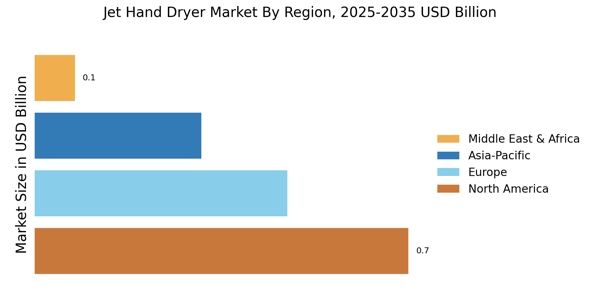
North America is the largest market for jet hand dryers, holding approximately 45% of the global share. The growth is driven by increasing awareness of hygiene, sustainability initiatives, and technological advancements in hand drying solutions. Regulatory support for energy-efficient appliances further fuels demand, with many states implementing stricter energy efficiency standards. The market is expected to continue expanding as businesses prioritize eco-friendly solutions. The United States is the dominant player in this region, with key companies like Dyson, Excel Dryer, and American Dryer leading the competitive landscape. The presence of advanced manufacturing capabilities and a strong distribution network enhances market penetration. Canada also contributes significantly, focusing on energy-efficient products. The competitive environment is characterized by innovation, with companies investing in R&D to enhance product features and performance.
Europe is witnessing a robust growth trajectory in the jet hand dryer market, accounting for approximately 30% of the global share. The region's focus on sustainability and hygiene, driven by stringent regulations and consumer preferences, is a key growth driver. The European Union's directives on energy efficiency and waste reduction are catalyzing the adoption of eco-friendly hand drying solutions, making it a significant market for manufacturers. Leading countries in this region include Germany, the UK, and France, where companies like Saniflow and Mitsubishi Electric are prominent. The competitive landscape is marked by innovation and a strong emphasis on product quality and energy efficiency. The presence of established players and a growing number of startups contribute to a dynamic market environment, fostering competition and technological advancements.
Asia-Pacific is emerging as a significant player in the jet hand dryer market, holding around 20% of the global share. The rapid urbanization, increasing disposable incomes, and rising awareness of hygiene are driving demand in this region. Countries like China and Japan are leading the market, supported by government initiatives promoting sanitation and hygiene in public spaces. The region's growth is also fueled by the increasing number of commercial establishments and public facilities. China is the largest market in Asia-Pacific, with a growing number of local manufacturers entering the market. Japan follows closely, with established brands like Toto and Mitsubishi Electric leading the way. The competitive landscape is evolving, with both international and local players vying for market share. The focus on innovation and energy efficiency is becoming increasingly important as consumers demand high-performance products that align with sustainability goals.
The Middle East and Africa region is gradually emerging in the jet hand dryer market, currently holding about 5% of the global share. The growth is primarily driven by increasing investments in infrastructure, particularly in the hospitality and healthcare sectors, where hygiene standards are paramount. Governments are also implementing regulations to improve sanitation in public facilities, which is expected to boost demand for efficient hand drying solutions. Leading countries in this region include the UAE and South Africa, where the market is characterized by a mix of international brands and local manufacturers. The competitive landscape is still developing, with opportunities for growth as awareness of hygiene and sustainability increases. Key players are beginning to establish a presence, focusing on innovative products that cater to the unique needs of the region's diverse markets.
Major players in the Jet Hand Dryer Market industry are continuously investing in research and development to enhance their product offerings and gain a competitive edge. Leading Jet Hand Dryer Market players are focusing on developing products that are more energy-efficient, quieter, and faster than traditional hand dryers. They are also exploring new technologies, such as high-speed air jets and antimicrobial surfaces, to improve the user experience. The Jet Hand Dryer Market is highly competitive, with several established and emerging players vying for market share.
To succeed in this market, companies must differentiate their products based on factors such as performance, durability, and price.Dyson is a leading player in the Jet Hand Dryer Market. The company offers a range of hand dryers that are known for their high-speed air jets and energy efficiency. Dyson's hand dryers are also relatively quiet, making them suitable for use in public restrooms and other noise-sensitive environments.
In addition to its core hand dryer business, Dyson also offers a variety of other products, including vacuum cleaners, air purifiers, and hair dryers.Another major player in the Jet Hand Dryer Market is Excel Dryer. The company offers a range of hand dryers that are known for their durability and reliability. Excel Dryer's hand dryers are also relatively affordable, making them a good option for businesses on a budget. In addition to its core hand dryer business, Excel Dryer also offers a variety of other products, including soap dispensers and paper towel dispensers.



The Jet Hand Dryer Market is projected to reach USD 2.4 billion by 2032, exhibiting a CAGR of 5.48% during the forecast period. Rising hygiene concerns, increasing adoption in public spaces, and growing awareness of energy efficiency are driving market growth. Key industry participants include Dyson, Mitsubishi Electric, and World Dryer. Recent developments include the launch of Dyson's Airblade 9kJ, which offers faster drying times and reduced energy consumption. Additionally, the market is witnessing a shift towards touchless models to minimize the spread of germs.
The Jet Hand Dryer Market is projected to grow at a 5.48% CAGR from 2025 to 2035, driven by sustainability trends, technological advancements, and increasing hygiene awareness.
New opportunities lie in:
By 2035, the market is expected to solidify its position as a leader in hygiene solutions.
| MARKET SIZE 2024 | 1.655(USD Billion) |
| MARKET SIZE 2025 | 1.746(USD Billion) |
| MARKET SIZE 2035 | 2.977(USD Billion) |
| COMPOUND ANNUAL GROWTH RATE (CAGR) | 5.48% (2025 - 2035) |
| REPORT COVERAGE | Revenue Forecast, Competitive Landscape, Growth Factors, and Trends |
| BASE YEAR | 2024 |
| Market Forecast Period | 2025 - 2035 |
| Historical Data | 2019 - 2024 |
| Market Forecast Units | USD Billion |
| Key Companies Profiled | Dyson (GB), Mitsubishi Electric (JP), Excel Dryer (US), World Dryer (US), Saniflow (ES), Toto (JP), American Dryer (US), Kohler (US) |
| Segments Covered | Product Type, Technology, Power Consumption, Mounting Type, Usage, Regional |
| Key Market Opportunities | Integration of energy-efficient technologies and touchless features in the Jet Hand Dryer Market. |
| Key Market Dynamics | Rising demand for touchless technology drives innovation and competition in the jet hand dryer market. |
| Countries Covered | North America, Europe, APAC, South America, MEA |
The Jet Hand Dryer Market is projected to reach a valuation of 2.977 USD Billion by 2035.



Kindly complete the form below to receive a free sample of this Report

“This is really good guys. Excellent work on a tight deadline. I will continue to use you going forward and recommend you to others. Nice job”


“Thanks. It’s been a pleasure working with you, please use me as reference with any other Intel employees.”


“Thanks for sending the report it gives us a good global view of the Betaïne market.”


“Thank you, this will be very helpful for OQS.”


“We found the report very insightful! we found your research firm very helpful. I'm sending this email to secure our future business.”


“I am very pleased with how market segments have been defined in a relevant way for my purposes (such as "Portable Freezers & refrigerators" and "last-mile"). In general the report is well structured. Thanks very much for your efforts.”


“I have been reading the first document or the study, ,the Global HVAC and FP market report 2021 till 2026. Must say, good info! I have not gone in depth at all parts, but got a good indication of the data inside!”


“We got the report in time, we really thank you for your support in this process. I also thank to all of your team as they did a great job.”


“The Automotive 48V ECU Components Procurement Intelligence Study” was a complex project, but the Market Research Future (MRFR) team handled it with quality, agility, and customer-centricity. They delivered all requested data on time and within the agreed scope. The team, including Shubhendra Anand and Rahul Gotadki, was always readily available to clarify questions and swiftly implement necessary adjustments, driving the project to a successful conclusion within a very demanding timeframe.
I would also like to specifically commend Akshay Agarwal for his responsiveness and support at every stage—from our initial inquiry on May 6th through to final delivery on June 18th. His dedication made the entire process seamless.”



