Laser Processing Equipment Market
Laser Processing Equipment Market Summary
As per Market Research Future analysis, the Laser Processing Equipment Market was estimated at 23.3 USD Billion in 2024. The Laser Processing Equipment industry is projected to grow from 25.62 USD Billion in 2025 to 66.03 USD Billion by 2035, exhibiting a compound annual growth rate (CAGR) of 9.93% during the forecast period 2025 - 2035
Key Market Trends & Highlights
The Laser Processing Equipment Market is poised for substantial growth driven by technological advancements and increasing demand across various sectors.
- North America remains the largest market for laser processing equipment, reflecting robust industrial activity.
- The Asia-Pacific region is emerging as the fastest-growing market, fueled by rapid industrialization and technological adoption.
- The cutting segment continues to dominate the market, while the welding segment is experiencing the fastest growth due to its versatility.
- Technological advancements in laser technology and rising demand from the automotive sector are key drivers propelling market expansion.
Market Size & Forecast
| 2024 Market Size | 23.3 (USD Billion) |
| 2035 Market Size | 66.03 (USD Billion) |
| CAGR (2025 - 2035) | 9.93% |
Major Players
Laser Processing Equipment Market Trends
The Laser Processing Equipment Market is currently experiencing a dynamic evolution, driven by advancements in technology and increasing demand across various industries. This market encompasses a wide range of applications, including cutting equipment, welding, engraving, and marking, which are essential in sectors such as automotive, aerospace, electronics, and medical devices. The integration of automation and smart technologies into laser processing systems appears to enhance efficiency and precision, thereby attracting a broader customer base. Furthermore, the growing emphasis on sustainable manufacturing practices suggests a shift towards laser solutions that minimize waste and energy consumption, aligning with global environmental goals. In addition, the competitive landscape of the Laser Processing Equipment Market is characterized by continuous innovation and strategic partnerships among key players. Companies are likely investing in research and development to introduce advanced laser technologies that offer improved performance and versatility. As industries seek to optimize production processes and reduce operational costs, the demand for high-quality laser processing equipment is expected to rise. Overall, the Laser Processing Equipment Market seems poised for substantial growth, driven by technological advancements and evolving industry needs.
Increased Automation in Manufacturing
The trend towards automation in manufacturing processes is becoming increasingly prevalent within the Laser Processing Equipment Market. Companies are integrating automated systems to enhance productivity and reduce human error, which may lead to more consistent and reliable outcomes. This shift not only streamlines operations but also allows for greater scalability in production.
Focus on Energy Efficiency
There is a growing emphasis on energy efficiency within the Laser Processing Equipment Market. Manufacturers are developing equipment that consumes less power while maintaining high performance levels. This trend aligns with global sustainability initiatives, as businesses seek to reduce their carbon footprint and operational costs.
Expansion into Emerging Markets
The Laser Processing Equipment Market is witnessing an expansion into emerging markets, where industrialization is rapidly increasing. As these regions invest in modern manufacturing technologies, the demand for laser processing solutions is likely to grow. This trend presents opportunities for companies to establish a presence in new geographical areas and cater to diverse industry needs.
Laser Processing Equipment Market Drivers
Expansion of Industrial Applications
The Laser Processing Equipment Market is witnessing an expansion in its applications across various industrial sectors. Industries such as aerospace, medical, and construction are increasingly utilizing laser technologies for their unique capabilities. For instance, in the aerospace sector, lasers are used for precision cutting of lightweight materials, which is essential for aircraft manufacturing. The medical industry employs laser processing for applications such as surgical instruments and implants. This diversification of applications is likely to drive market growth, as more sectors recognize the benefits of laser processing. The increasing versatility of laser technologies suggests a promising outlook for the market.
Rising Demand from Automotive Sector
The automotive sector plays a pivotal role in driving the Laser Processing Equipment Market. With the increasing complexity of vehicle designs and the need for lightweight materials, manufacturers are turning to laser processing for precision cutting and welding. The market for laser processing equipment in the automotive industry is projected to grow at a compound annual growth rate of around 15% over the next few years. This growth is fueled by the need for enhanced safety features and fuel efficiency, which require advanced manufacturing techniques. As automotive manufacturers continue to innovate, the demand for laser processing equipment is expected to expand significantly.
Growing Adoption in Electronics Manufacturing
The electronics manufacturing sector is increasingly adopting laser processing technologies, which is a key driver for the Laser Processing Equipment Market. The need for miniaturization and precision in electronic components has led to a rise in the use of laser systems for tasks such as drilling, cutting tools, and marking. Recent statistics indicate that the electronics segment accounts for nearly 30% of the total laser processing equipment market. As consumer electronics continue to evolve, the demand for high-precision laser processing equipment is likely to increase, thereby supporting market growth. This trend suggests a robust future for laser technologies in the electronics sector.
Technological Advancements in Laser Technology
The Laser Processing Equipment Market is experiencing a surge in technological advancements, which enhances the efficiency and precision of laser systems. Innovations such as fiber lasers and ultrafast lasers are becoming increasingly prevalent, allowing for improved cutting, welding, and engraving capabilities. These advancements not only increase productivity but also reduce operational costs for manufacturers. According to recent data, the adoption of fiber lasers has grown by approximately 20% annually, indicating a strong trend towards more efficient laser solutions. As industries seek to optimize their processes, the demand for advanced laser processing equipment is likely to rise, further propelling the market forward.
Emphasis on Sustainable Manufacturing Practices
Sustainability is becoming a crucial focus within the Laser Processing Equipment Market. Manufacturers are increasingly seeking eco-friendly solutions that minimize waste and energy consumption. Laser processing technologies are inherently more efficient than traditional methods, often resulting in less material waste and lower energy usage. This shift towards sustainable practices is not only beneficial for the environment but also aligns with regulatory pressures and consumer preferences for greener products. As industries strive to meet sustainability goals, the demand for laser processing equipment that supports these initiatives is expected to rise, indicating a positive trend for the market.
Market Segment Insights
By Application: Cutting (Largest) vs. Welding (Fastest-Growing)
The application segment of the Laser Processing Equipment Market is characterized by diverse functionalities, with cutting leading the way as the largest application segment. This dominance is attributed to the growing adoption of laser cutting in industries such as automotive and aerospace, where precision and efficiency are paramount. Following closely is welding, which is experiencing significant growth due to the increasing use of laser technology for high-speed, high-quality welds in various manufacturing sectors. Growth trends in the laser processing equipment application segment showcase a robust trajectory, particularly in welding and drilling applications. The demand for automation and the need for enhanced production capabilities are primary drivers. Businesses are increasingly investing in laser cutting machines technology to reduce operational costs and improve output quality, fostering a competitive landscape. The adoption of these technologies is poised to accelerate, especially as industries seek to upgrade their equipment for enhanced performance and sustainability.
Welding (Dominant) vs. Engraving (Emerging)
In the application segment of the Laser Processing Equipment Market, welding stands out as the dominant force, known for its ability to deliver high-speed, precise, and reliable welds essential for a wide range of manufacturing processes. Its utilization spans various industries, including automotive, aerospace, and construction, where it significantly improves production efficiency. On the other hand, engraving represents an emerging value within the market, gaining popularity for its capacity to create detailed designs and markings on diverse materials. As customization continues to trend across sectors, the need for advanced engraving solutions is growing, making it vital for companies looking to differentiate their products. The shift toward personalized goods is positioning engraving as a key player in the evolving landscape of laser applications.
By Power Output: 1-3 kW (Largest) vs. 3-5 kW (Fastest-Growing)
In the Laser Processing Equipment Market, the power output segment is divided into categories based on kilowatt ratings. The segment ranging from 1-3 kW holds the largest market share, primarily due to its widespread application across various industries, including manufacturing and automotive. This power range is highly favored for processes such as cutting, welding, and engraving, offering a balanced performance that caters to diverse operational needs. Conversely, the 3-5 kW segment is emerging as the fastest-growing category. This growth can be attributed to advancements in technology that enhance efficiency and capabilities of equipment within this range. The ability to handle thicker materials and increase processing speeds is driving its adoption in sectors requiring precision and high throughput, leading to an expanding role in the market.
1-3 kW (Dominant) vs. 5 kW and above (Emerging)
The 1-3 kW segment is characterized by its versatility and popularity across various applications including engraving, marking, and thin-cutting. Its dominance in the market stems from its cost-effectiveness and reliability, making it the go-to choice for small to medium-sized enterprises. Meanwhile, the 5 kW and above category is emerging rapidly due to the increasing demand for high-performance equipment capable of processing thicker and more complex materials. These systems often incorporate advanced technologies that enhance cutting speed and precision, positioning them as essential tools for industries seeking to improve productivity and reduce operational costs.
By Laser Type: Fiber Laser (Largest) vs. CO2 Laser (Fastest-Growing)
In the Laser Processing Equipment Market, Fiber Lasers have established themselves as the largest segment, dominating due to their efficiency and versatility in various applications. They account for a significant portion of the market share, appealing to industries ranging from automotive to aerospace. CO2 Lasers, on the other hand, while historically popular, are experiencing a resurgence in demand as their applications in materials processing expand, leading them to be recognized as the fastest-growing segment in recent years. Growth trends for these laser types are primarily driven by the increasing automation and precision required in modern manufacturing processes. Fiber Lasers continue to benefit from technological advancements, making them ideal for cutting, welding, and marking various materials. CO2 Lasers are also capitalizing on new developments in cutting techniques and efficiency, enhancing their value in sectors like woodworking and textiles. This dual growth trajectory underscores the dynamic nature of the Laser Processing Equipment Market, as innovations fuel competition among these segments.
Fiber Laser (Dominant) vs. Ultraviolet Laser (Emerging)
Fiber Lasers are widely regarded as the dominant technology in laser processing, known for their ability to deliver high-quality cuts and engravings at rapid speeds. Their solid-state design contributes to robust performance, low maintenance, and reduced operational costs, making them a preferred choice in industries such as metal fabrication and 3D printing. In contrast, Ultraviolet Lasers are emerging as a crucial alternative, particularly in applications requiring minimal thermal impact, such as in the electronics sector. Their precision in micro-processing and ability to handle delicate materials position them as a specialized solution, gaining traction in niche markets where traditional lasers may falter.
By Industry: Automotive (Largest) vs. Aerospace (Fastest-Growing)
The Laser Processing Equipment Market exhibits a diverse distribution across several key industries. In this landscape, the automotive sector emerges as the largest market segment, driven by the growing need for precision manufacturing and automation. This sector’s demand for laser technology is propelled by its ability to enhance production efficiency and quality control, ensuring that manufacturers can meet strict regulatory standards and consumer expectations effectively. In contrast, the aerospace industry is recognized as the fastest-growing segment within this market. The increasing emphasis on lightweight materials and advanced manufacturing processes in aerospace applications has led to a surge in laser processing capabilities. This growth is attributed to factors such as the rising demand for aerospace components, innovations in laser technology, and the push for sustainable manufacturing practices that reduce waste and energy consumption.
Automotive: Dominant vs. Aerospace: Emerging
The automotive segment of the Laser Processing Equipment Market is recognized for its dominance, leveraging laser technology for a range of applications, including cutting, welding, and marking. This sector benefits greatly from the need for precision in manufacturing, allowing companies to achieve tighter tolerances and higher production rates. Companies in automotive manufacturing are increasingly adopting lasers for various parts production, ranging from body components to intricate assemblies. On the other hand, the aerospace sector represents an emerging force within the market, driven by innovations that facilitate the use of advanced materials and complex geometries. The unique requirements of aerospace applications, such as weight reduction and enhanced structural integrity, position laser processing as an ideal solution, thus attracting significant investments and technological advancements.
Regional Insights
North America : Innovation and Market Leadership
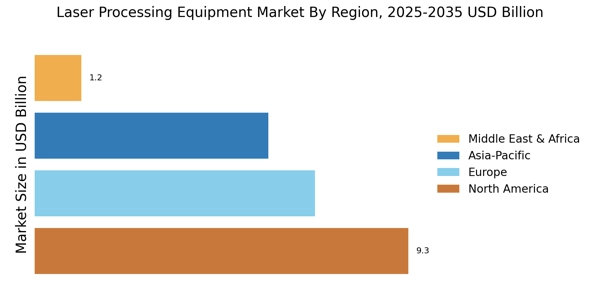
North America is the largest market for laser processing equipment, holding approximately 40% of the global market share. The region benefits from strong demand in aerospace, automotive, and electronics sectors, driven by technological advancements and increased automation. Regulatory support for manufacturing innovation further catalyzes growth, with initiatives aimed at enhancing productivity and sustainability. The United States is the dominant player, with significant contributions from Canada and Mexico. Key companies like Trumpf, Cincinnati Incorporated, and Coherent are at the forefront, driving competition and innovation. The presence of advanced manufacturing facilities and research institutions fosters a robust ecosystem for laser technology development, ensuring North America remains a leader in this field.
Europe : Regulatory Support and Growth
Europe is the second-largest market for laser processing equipment, accounting for around 30% of the global market share. The region's growth is propelled by stringent regulations promoting energy efficiency and sustainability in manufacturing processes. Countries like Germany and France are leading the charge, with government initiatives aimed at fostering innovation and competitiveness in the laser technology sector. Germany stands out as a key player, hosting major companies such as Trumpf and Bystronic. The competitive landscape is characterized by a mix of established firms and emerging startups, all vying for market share. The European market is also witnessing increased collaboration between industry and academia, enhancing research and development efforts in laser technologies.
Asia-Pacific : Emerging Market Potential
Asia-Pacific is witnessing rapid growth in the laser processing equipment market, holding approximately 25% of the global market share. The region's expansion is driven by increasing industrialization, particularly in countries like China and Japan, where demand for precision manufacturing is surging. Government initiatives aimed at boosting high-tech manufacturing capabilities further support this growth trajectory. China is the largest market in the region, with significant contributions from Japan and South Korea. The competitive landscape is marked by the presence of key players like Han's Laser and Mitsubishi Electric, which are investing heavily in R&D to enhance their product offerings. The region is also seeing a rise in local manufacturers, intensifying competition and driving innovation in laser technologies.
Middle East and Africa : Resource-Rich Opportunities
The Middle East and Africa region is gradually emerging in the laser processing equipment market, currently holding about 5% of the global market share. The growth is primarily driven by increasing investments in manufacturing and infrastructure development, particularly in countries like the UAE and South Africa. Regulatory frameworks are evolving to support advanced manufacturing technologies, which is expected to further stimulate market growth. The UAE is leading the market, with a focus on diversifying its economy away from oil dependency. South Africa is also making strides in adopting laser technologies across various sectors. The competitive landscape is characterized by a mix of international players and local firms, creating opportunities for collaboration and innovation in laser processing solutions.
Key Players and Competitive Insights
In August Trumpf (Germany) announced the launch of its new laser cutting system, which incorporates AI-driven features to enhance precision and reduce waste. This strategic move not only reinforces Trumpf's commitment to sustainability but also positions the company as a leader in the integration of artificial intelligence within laser processing technologies. The introduction of such advanced systems is likely to attract a broader customer base seeking efficiency and environmental responsibility.
In September Coherent (United States) completed the acquisition of a leading software firm specializing in laser automation. This acquisition is significant as it allows Coherent to enhance its product portfolio with advanced automation capabilities, thereby addressing the growing demand for smart manufacturing solutions. The integration of software with hardware is expected to provide customers with comprehensive solutions that streamline operations and improve productivity.
In July Han's Laser (China) expanded its operations into Southeast Asia by establishing a new manufacturing facility in Vietnam. This strategic expansion is indicative of Han's Laser's intent to tap into emerging markets and reduce production costs. By localizing its manufacturing, the company aims to enhance its competitive edge in the region, which is witnessing a surge in demand for laser processing equipment.
As of October the competitive trends in the Laser Processing Equipment Market are increasingly defined by digitalization, sustainability, and the integration of artificial intelligence. Strategic alliances among key players are shaping the landscape, fostering innovation and collaborative advancements. The shift from price-based competition to a focus on technological innovation and supply chain reliability is becoming evident, suggesting that companies that prioritize these aspects will likely achieve a sustainable competitive advantage in the evolving market.
Key Companies in the Laser Processing Equipment Market include
Industry Developments
- Q2 2024: TRUMPF launches new TruLaser 5000 series with enhanced automation features TRUMPF introduced its latest TruLaser 5000 series laser cutting machines, featuring advanced automation and digital connectivity for increased productivity in industrial sheet metal processing. The launch aims to address growing demand for high-speed, precise laser processing equipment in manufacturing.
- Q2 2024: IPG Photonics Announces Opening of New Manufacturing Facility in Germany IPG Photonics opened a new state-of-the-art manufacturing facility in Germany to expand its production capacity for high-power fiber laser systems, supporting increased demand from automotive and electronics sectors.
- Q2 2024: Coherent Corp. appoints new CEO to drive growth in laser processing equipment segment Coherent Corp. announced the appointment of a new Chief Executive Officer, citing a strategic focus on expanding its laser processing equipment business and accelerating innovation in industrial laser solutions.
- Q3 2024: Han’s Laser Technology Industry Group and Siemens announce strategic partnership for smart manufacturing Han’s Laser and Siemens entered a strategic partnership to integrate Siemens’ digitalization technologies with Han’s Laser’s processing equipment, aiming to deliver smart manufacturing solutions for global customers.
- Q3 2024: Lumentum Holdings Inc. completes acquisition of NeoPhotonics Corporation Lumentum Holdings finalized its acquisition of NeoPhotonics, strengthening its position in the laser processing equipment market and expanding its portfolio of photonic solutions for industrial and communications applications.
- Q3 2024: AMADA Co., Ltd. launches new fiber laser welding system for automotive applications AMADA introduced a new fiber laser welding system designed specifically for automotive manufacturing, offering improved speed and precision for high-volume production lines.
- Q4 2024: nLIGHT, Inc. awarded multi-year contract to supply laser processing equipment to aerospace manufacturer nLIGHT secured a multi-year contract to provide advanced laser processing equipment to a leading aerospace manufacturer, supporting the production of next-generation aircraft components.
- Q4 2024: Trumpf and Bosch announce joint venture to develop laser-based manufacturing solutions Trumpf and Bosch formed a joint venture focused on developing and commercializing laser-based manufacturing solutions, targeting applications in automotive, electronics, and medical device industries.
- Q1 2025: IPG Photonics acquires Laserline GmbH to expand high-power laser portfolio IPG Photonics completed the acquisition of Laserline GmbH, a specialist in high-power diode lasers, to broaden its offerings in the industrial laser processing equipment market.
- Q1 2025: Coherent Corp. unveils new ultrafast laser processing platform for semiconductor manufacturing Coherent Corp. launched a new ultrafast laser processing platform designed for advanced semiconductor manufacturing, enabling higher throughput and precision in chip fabrication.
- Q2 2025: Han’s Laser secures major contract to supply laser cutting systems to European automotive OEM Han’s Laser signed a significant contract to deliver multiple laser cutting systems to a leading European automotive original equipment manufacturer (OEM), supporting the OEM’s transition to electric vehicle production.
- Q2 2025: AMADA Co., Ltd. announces $100 million investment in new laser processing R&D center in Japan AMADA Co., Ltd. announced a $100 million investment to establish a new research and development center in Japan focused on next-generation laser processing technologies.
Future Outlook
Laser Processing Equipment Market Future Outlook
The Laser Processing Equipment Market is projected to grow at a 9.93% CAGR from 2025 to 2035, driven by advancements in automation, increased demand for precision manufacturing, and expanding applications across industries.
The future outlook for the Laser Processing Equipment Market is exceptionally strong, driven by the rapid expansion of EV battery production and semiconductor manufacturing. Growth is fueled by the adoption of ultrafast lasers and AI-integrated systems for high-precision micro-machining.
New opportunities lie in:
- Development of AI-integrated laser systems for enhanced precision and efficiency.
- Expansion into emerging markets with tailored laser solutions for local industries.
- Partnerships with automation firms to create integrated manufacturing solutions.
By 2035, the Laser Processing Equipment Market is expected to solidify its position as a leader in advanced manufacturing technologies.
Market Segmentation
Laser Processing Equipment Market Industry Outlook
- Automotive
- Aerospace
- Electronics
- Medical
- Energy
Laser Processing Equipment Market Laser Type Outlook
- Fiber Laser
- CO2 Laser
- Ultraviolet Laser
- Green Laser
Laser Processing Equipment Market Application Outlook
- Cutting
- Welding
- Drilling
- Engraving
- Marking
Laser Processing Equipment Market Power Output Outlook
- Below 1 kW
- 1-3 kW
- 3-5 kW
- 5 kW and above
Report Scope
| MARKET SIZE 2024 | 23.3(USD Billion) |
| MARKET SIZE 2025 | 25.62(USD Billion) |
| MARKET SIZE 2035 | 66.03(USD Billion) |
| COMPOUND ANNUAL GROWTH RATE (CAGR) | 9.93% (2025 - 2035) |
| REPORT COVERAGE | Revenue Forecast, Competitive Landscape, Growth Factors, and Trends |
| BASE YEAR | 2024 |
| Market Forecast Period | 2025 - 2035 |
| Historical Data | 2019 - 2024 |
| Market Forecast Units | USD Billion |
| Key Companies Profiled | Trumpf (DE), Cincinnati Incorporated (US), Coherent (US), Han's Laser (CN), Amada (JP), Mitsubishi Electric (JP), Bystronic (CH), LVD (BE), Epilog Laser (US) |
| Segments Covered | Application, Power Output, Laser Type, Industry, Regional |
| Key Market Opportunities | Integration of advanced automation technologies enhances efficiency in the Laser Processing Equipment Market. |
| Key Market Dynamics | Technological advancements drive innovation in laser processing equipment, enhancing efficiency and expanding application areas across industries. |
| Countries Covered | North America, Europe, APAC, South America, MEA |
FAQs
What is the projected market valuation of the Laser Processing Equipment Market by 2035?
The projected market valuation of the Laser Processing Equipment Market is expected to reach 66.03 USD Billion by 2035.
What was the market valuation of the Laser Processing Equipment Market in 2024?
The overall market valuation of the Laser Processing Equipment Market was 23.3 USD Billion in 2024.
What is the expected CAGR for the Laser Processing Equipment Market during the forecast period 2025 - 2035?
The expected CAGR for the Laser Processing Equipment Market during the forecast period 2025 - 2035 is 9.93%.
Which application segment is projected to have the highest valuation by 2035?
The marking application segment is projected to reach 23.0 USD Billion by 2035.
How does the valuation of the cutting segment change from 2024 to 2035?
The cutting segment valuation is expected to increase from 5.0 USD Billion in 2024 to 14.0 USD Billion by 2035.
What are the leading companies in the Laser Processing Equipment Market?
Key players in the Laser Processing Equipment Market include Trumpf, Cincinnati Incorporated, Coherent, and Han's Laser.
Which laser type is anticipated to dominate the market by 2035?
What is the expected growth in the electronics industry segment of the Laser Processing Equipment Market?
How does the power output segment of below 1 kW compare to higher power outputs by 2035?
What trends are influencing the growth of the Laser Processing Equipment Market?
Research Approach
Secondary Research
The secondary research process involved comprehensive analysis of technical standards databases, peer-reviewed engineering journals, industry publications, and authoritative manufacturing organizations. Key sources included the International Organization for Standardization (ISO), International Electrotechnical Commission (IEC), Laser Institute of America (LIA), SPIE - International Society for Optics and Photonics, American Society of Mechanical Engineers (ASME), Society of Manufacturing Engineers (SME), National Institute of Standards and Technology (NIST), Occupational Safety and Health Administration (OSHA) Laser Safety Guidelines, European Committee for Electrotechnical Standardization (CENELEC), Japan Industrial Standards (JIS), China National Institute of Standardization (CNIS), US Department of Energy (DOE) Manufacturing Demonstration Facility, European Photonics Industry Consortium (EPIC), Optoelectronics Industry Development Association (OIDA), and national manufacturing statistics from key markets. These sources were used to collect equipment shipment data, safety compliance standards, technological adoption trends, industrial automation statistics, and competitive landscape analysis for fiber lasers, CO₂ lasers, ultraviolet lasers, and green laser technologies across cutting, welding, drilling, engraving, and marking applications.
Primary Research
Qualitative and quantitative insights were obtained by interviewing supply-side and demand-side stakeholders during the primary research process. The supply-side sources consisted of CEOs, VPs of Business Development, chief technology officers, and sales directors from laser processing equipment manufacturers, system integrators, and component suppliers. Manufacturing engineers, production managers, procurement heads, and plant administrators from automotive OEMs, aerospace manufacturers, electronics fabrication facilities, medical device companies, and energy sector operators comprised demand-side sources. Market segmentation was verified, product development roadmaps were confirmed, and insights regarding technology adoption patterns, capital expenditure cycles, and after-service revenue dynamics were obtained through primary research.
Primary Respondent Breakdown:
By Designation: C-level Primaries (32%), Director Level (31%), Others (37%)
By Region: North America (32%), Europe (30%), Asia-Pacific (34%), Rest of World (4%)
Market Size Estimation
Global market valuation was derived through revenue mapping and equipment installation base analysis. The methodology included:
Identification of 50+ key manufacturers across North America, Europe, Asia-Pacific, and Latin America
Product mapping across fiber laser, CO₂ laser, ultraviolet laser, and green laser categories
Analysis of reported and modeled annual revenues specific to laser processing equipment portfolios
Coverage of manufacturers representing 75-80% of global market share in 2024
Extrapolation using bottom-up (equipment units × ASP by country and application) and top-down (manufacturer revenue validation) approaches to derive segment-specific valuations for automotive, aerospace, electronics, medical, and energy industry verticals
Kindly complete the form below to receive a free sample of this Report
Customer Stories
“This is really good guys. Excellent work on a tight deadline. I will continue to use you going forward and recommend you to others. Nice job”
“Thanks. It’s been a pleasure working with you, please use me as reference with any other Intel employees.”
“Thanks for sending the report it gives us a good global view of the Betaïne market.”
“Thank you, this will be very helpful for OQS.”
“We found the report very insightful! we found your research firm very helpful. I'm sending this email to secure our future business.”
“I am very pleased with how market segments have been defined in a relevant way for my purposes (such as "Portable Freezers & refrigerators" and "last-mile"). In general the report is well structured. Thanks very much for your efforts.”
“I have been reading the first document or the study, ,the Global HVAC and FP market report 2021 till 2026. Must say, good info! I have not gone in depth at all parts, but got a good indication of the data inside!”
“We got the report in time, we really thank you for your support in this process. I also thank to all of your team as they did a great job.”