Learning Management System (LMS) Market (2026 - 2035)

Learning Management System (LMS) Market Size, Share and Research Report: By Application (Corporate, Academics), By Deployment (Cloud and On-Premise), By Service (Administration, Performance Management, Content Management, Communication & Collaboration), And By Region (North America, Europe, Asia-Pacific, And Rest Of The World) –Market Forecast Till 2035
ID: MRFR/ICT/1326-HCR
110 Pages
Ankit Gupta
Last Updated: August 04, 2026
Learning Management System (LMS) Market
Market Size
Forecast Period2026-2035
CAGR (2026-2035)13.68%
2025 Market SizeUSD 28.74 Billion
2035 Market SizeUSD 98.52 Billion
Key Players
Cornerstone OnDemand
SAP Litmos
Docebo
Instructure
Blackboard
D2L
Opportunities
  • AI-Powered Skills Passports and Credential Interoperability
  • Immersive Learning through VR/AR Integration
  • SME-Focused Turnkey Subscription Models

Learning Management System (LMS) Market Summary

The Learning Management System Market stood at USD 28.74 billion in 2025 and is projected to reach USD 32.46 billion in 2026 before climbing to USD 98.52 billion by 2035, registering a CAGR of 13.68% during 2026–2035. Two structural forces anchor this trajectory: corporate mandates tying employee training software completion rates to regulatory compliance, and a wave of national digital-education policies — including India's National Education Policy and the EU's Digital Education Action Plan — that channel public funding into LMS e-learning platforms for K-12 and higher education.

Legacy installed bases of on-premise SCORM servers and standalone instructor-led modules are giving way to cloud-native ecosystems that unify educational content delivery, skills assessment, and talent analytics on a single pane. Enterprise buyers spent an estimated USD 4.2 billion on LMS migration projects in 2024 alone, driven by the need for open-API architectures that connect virtual classroom tools with HRIS and CRM suites [3]. Generative-AI copilots embedded within these platforms now auto-generate quizzes, adaptive learning paths, and real-time coaching feedback, compressing course-development cycles from weeks to hours.

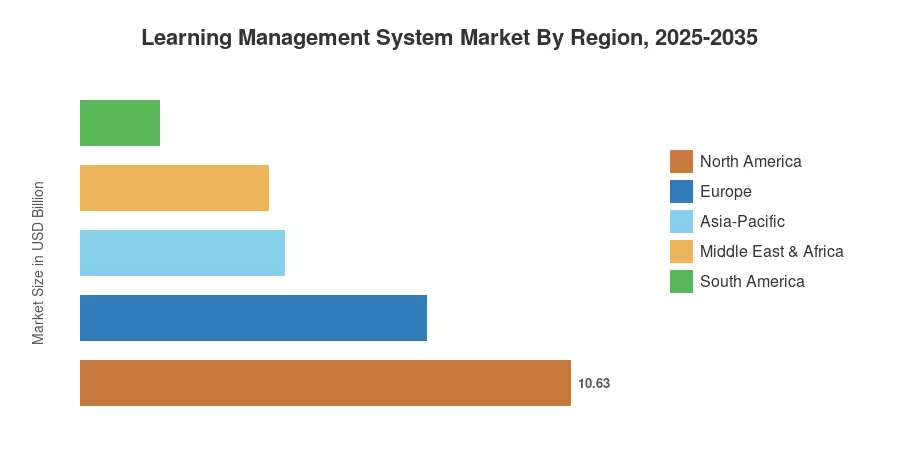
North America commands roughly 37% of the Learning Management System Market, supported by mature SaaS adoption and heavy corporate L&D budgets across financial services and healthcare Asia-Pacific is the fastest-growing region at a 15.42% CAGR, propelled by government digitization programs in India, China, and ASEAN nations. Europe holds the second-largest share at approximately 26%, where GDPR-compliant online course management requirements shape vendor selection. As hybrid work models and skills-based hiring continue to accelerate, demand for integrated LMS ecosystems will remain on an upward arc through 2035.


Key Report Takeaways

• By Component

  • Packaged solutions captured 75.82% of the Learning Management System Market revenue in 2025, reflecting enterprise preference for turnkey LMS e-learning platforms with pre-built content libraries
  • Services are forecast to grow at a 16.21% CAGR through 2035 as organizations outsource customization, managed administration, and employee training software integration

• By Deployment Mode

  • Cloud deployments held 93.47% share in 2025, underscoring the shift to subscription-based online course management architectures
  • On-premise installations are limited to single-digit growth, confined to defense and government verticals with strict data-sovereignty mandates

• By Region

  • North America generated USD 10.63 billion in 2025 Learning Management System Market revenue, led by US corporate L&D spending
  • Asia-Pacific is expanding at a 15.42% CAGR, fueled by India's and China's mass-digitization of educational content delivery
  • The healthcare and pharmaceuticals vertical represents the fastest-growing end-user segment at a 14.89% CAGR, driven by continuing-education compliance cycles


Market Size and Forecast (2021–2035)

MRFR's market-sizing model blends bottom-up revenue analysis of 45+ LMS vendors with top-down demand signals from corporate training budgets, institutional IT procurement data, and government education-technology allocations. Historical figures (2021–2024) are validated against audited annual reports; forecast values (2026–2035) apply the calibrated 13.68% CAGR with adjustments for macroeconomic cycles and technology adoption curves[4].
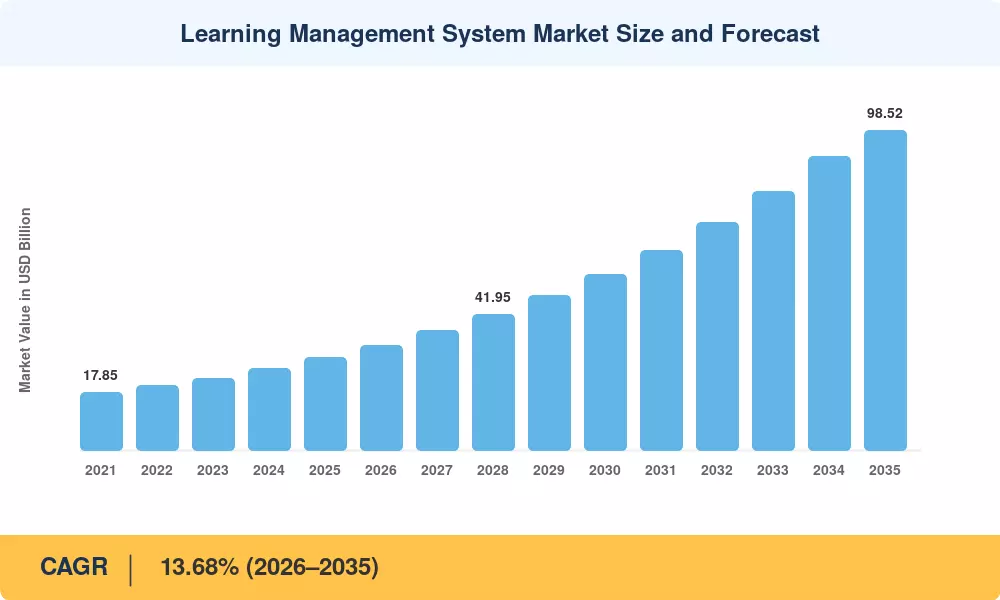
Learning Management System Market Size and Forecast
Our Impact
Enabled $4.3B Revenue Impact for Fortune 500 and Leading Multinationals
Partnering with 2000+ Global Organizations Each Year
30K+ Citations by Top-Tier Firms in the Industry

Driver Impact Analysis

Driver ~% Impact on CAGR Geographic Relevance Impact Timeline
Hybrid work & remote workforce mandates ~18% Global Short-term (≤2 yr)
Generative-AI content authoring & adaptive feedback ~22% North America, Europe Medium-term (2–4 yr)
Government digital-education policies ~15% Asia-Pacific, South America Medium-term (2–4 yr)
Skills-based hiring & credential verification ~12% North America, Europe Long-term (≥4 yr)
Cloud infrastructure cost reduction ~14% Global Short-term (≤2 yr)
Healthcare & pharma compliance training cycles ~10% North America, Europe Medium-term (2–4 yr)
Outcome-linked pricing & ROI accountability ~9% Global Long-term (≥4 yr)


Hybrid Work and Remote Workforce Mandates

The institutionalization of hybrid work has transformed employee training software from a discretionary spend into a board-level priority. This structural shift compresses procurement cycles and raises switching costs, locking buyers into multi-year SaaS contracts that sustain recurring revenue for vendors.

Generative-AI Content Authoring and Adaptive Feedback

Large-language-model integration is reshaping how organizations build and deliver educational content delivery modules. Platforms embedding generative-AI copilots — capable of auto-generating assessments, translating courseware into 40+ languages, and providing real-time learner coaching — are capturing disproportionate new-logo wins. Docebo reported a 32% increase in enterprise pipeline attributed to its AI-powered "Shape" feature in Q3 2024 [3]. The productivity gain for instructional designers averages 60%, according to Brandon Hall Group research, accelerating content refresh cycles from quarterly to continuous [5].

Government Digital-Education Policies

India's National Education Policy 2020 allocated INR 99,300 crore (≈USD 12 billion) across five years for digital infrastructure, with LMS procurement for 1.5 million schools as a key pillar [6]. China's "Smart Education of China" platform, launched in 2022, onboarded 68 million users by mid-2024, funneling demand toward scalable virtual classroom tools [7]. These public-sector programs are pulling SME LMS vendors into the Asia-Pacific arena, creating a multiplier effect on regional growth rates.

Healthcare and Pharmaceutical Compliance Training

Continuing medical education (CME) requirements and FDA 21 CFR Part 11 compliance mandates are accelerating LMS adoption across healthcare and life sciences. The US alone spends an estimated USD 3.6 billion annually on clinical-staff online course management, and CMS's 2024 Conditions of Participation update expanded mandatory training modules by 18% [8]. This regulatory tailwind positions healthcare as the fastest-growing vertical within the Learning Management System Market through 2035.


Restraints Impact Analysis

Restraint ~% Drag on CAGR Geographic Relevance Impact Timeline
Data privacy & cross-border compliance complexity ~−8% Europe, Asia-Pacific Medium-term (2–4 yr)
Integration fatigue with legacy HR/ERP stacks ~−6% North America, Europe Short-term (≤2 yr)
Low digital literacy in emerging economies ~−5% Africa, South Asia Long-term (≥4 yr)
Content piracy & IP protection gaps ~−4% Global Medium-term (2–4 yr)
Vendor lock-in & LTI interoperability friction ~−3% Global Short-term (≤2 yr)


Data Privacy and Cross-Border Compliance Complexity

GDPR, China's PIPL, and India's DPDP Act create a patchwork of data-residency obligations that raise deployment costs for multinational LMS buyers. A recent study estimated that compliance overhead adds 12–18% to the total cost of ownership for organizations operating employee training software across three or more regulatory jurisdictions. Vendors without region-specific data centers face buyer resistance, particularly in financial services and government verticals.

Integration Fatigue with Legacy HR/ERP Stacks

Despite open-API rhetoric, 41% of mid-market organizations report that connecting LMS e-learning platforms to existing SAP SuccessFactors or Workday instances takes 6–9 months and costs USD 150,000–400,000 in implementation services. This friction lengthens sales cycles and depresses net-new logo velocity, particularly among companies with fragmented IT estates.

Low Digital Literacy in Emerging Economies

Sub-Saharan Africa and parts of South Asia face broadband-penetration rates below 35%, limiting the reach of cloud-based virtual classroom tools [14]. Without offline-capable and low-bandwidth delivery modes, LMS vendors struggle to monetize these high-population, low-ARPU markets, constraining the addressable market expansion that headline growth figures imply.


Learning Management System (LMS) Market Opportunities

AI-Powered Skills Passports and Credential Interoperability

Blockchain-verified micro-credentials and AI-curated skills passports are a USD 2.8 billion sub-segment by 2030 [10]. LMS suppliers who build verifiable-credential issuing directly into their online course management workflows will grab enterprise procurement resources that are currently scattered across stand-alone credentialing platforms


Immersive Learning through VR/AR Integration

Meta’s $1.5 billion investment in enterprise VR training tools and Apple’s Vision Pro ecosystem are offering new avenues for delivering educational information. Native VR-module hosting and spatial-analytics dashboards in LMSs attract 25–40% pricing premiums over text-and-video-only competitors, particularly in manufacturing and healthcare simulation training.


SME-Focused Turnkey Subscription Models

The fastest-growing organization size segment in the Learning Management System Market is small and medium companies, with a CAGR of 15.36% Vendors that bundle pre-built compliance libraries, automated onboarding routines, and sub-$5/month per-seat pricing are unlocking a long tail of first-time buyers across Latin America, Southeast Asia, and Eastern Europe.


Data Monetization through Learning Analytics

Aggregated and anonymised learning-performance data, such as completion rates, time-to-competency and skill-gap heatmaps, is of great use to workforce-planning consultancies and insurance underwriters. LMS providers that create analytics-as-a-service income streams can diversify beyond SaaS subscriptions, adding 8–12 percentage points of gross margin.


Government Procurement in Emerging Markets

Brazil's "Escola Digital" initiative, Indonesia's Merdeka Belajar program, and Nigeria's National Information Technology Development Agency (NITDA) digital-skills drive collectively target 120 million new digital learners by 2030 [6][14]. These programs create bulk-procurement opportunities for employee training software vendors willing to localize content and operate through regional system integrators


Learning Management System (LMS) Market Future Outlook

Generative-AI and Autonomous Learning Orchestration

By 2028, an estimated 60% of enterprise LMS platforms will embed generative-AI agents capable of autonomously designing curricula, generating assessments, and adapting difficulty in real time [3]. This shift transforms the Learning Management System Market from a content-hosting layer into an intelligent educational content delivery engine, raising average contract values by 30–45% for AI-enabled tiers. Vendors that fail to integrate large-language-model capabilities risk displacement within two product cycles.

Platform Economics and Ecosystem Consolidation

The LMS competitive landscape is converging toward platform plays where vendors build marketplace ecosystems — hosting third-party content providers, credentialing bodies, and analytics add-ons. Cornerstone OnDemand's acquisition of SumTotal and Instructure's purchase of Parchment illustrate how M&A is being used to aggregate educational content delivery, credentialing, and analytics into unified platforms [5]. Mid-market vendors without ecosystem strategies will face acquisition pressure or margin erosion through 2030.

Immersive-Learning Supercycle

Global spending on VR/AR-based employee training software is projected to exceed USD 12 billion by 2032, with healthcare simulation, manufacturing safety, and soft-skills coaching as primary use cases. The Learning Management System Market will absorb a significant share of this spend as platforms add native XR-hosting, spatial analytics dashboards and haptic-feedback integration. Early movers like Strivr and Mursion are already embedding their immersive modules within mainstream LMS ecosystems.

ESG-Linked Workforce Development Reporting

Growing ESG disclosure requirements — including the EU's Corporate Sustainability Reporting Directive (CSRD) and the SEC's proposed human-capital metrics — are creating demand for LMS platforms that can track and report workforce-development KPIs [18]. Organizations will need online course management systems that generate auditable training-hours data, diversity-training completion rates, and skills-gap closure metrics, adding a compliance-reporting revenue stream to LMS vendor portfolios through 2035.


Learning Management System (LMS) Market Segmentation

By Component

Segment Key Metric Primary Demand Driver
Solutions 75.82% share (2025) Turnkey platform demand for online course management
Services 16.21% CAGR (2026–2035) Outsourced implementation and managed LMS administration


The Learning Management System Market is led by packaged solutions, which account for more than three-quarters of 2025 revenue. Enterprise buyers favor all-in-one LMS e-learning platforms that bundle content authoring, assessment engines, and reporting dashboards to minimize multi-vendor complexity. The services segment, however, is the faster-growing category as organizations — particularly those with limited in-house IT capacity — outsource platform customization, data migration, and ongoing managed administration to specialized integrators. Employee training software implementation services alone generated an estimated USD 4.1 billion in 2024, with managed-service contracts increasingly tied to outcome-based SLAs covering learner-engagement and completion-rate targets [5].

By Deployment Mode

Segment Key Metric Primary Demand Driver
Cloud 93.47% share (2025) Scalability, lower TCO, API-driven integrations
On-Premise USD 1.92 Billion (2025) Defense, government data-sovereignty requirements


Cloud deployment dominates the Learning Management System Market by a wide margin, propelled by subscription economics that compress upfront capital outlay and enable elastic scaling for seasonal training surges. Virtual classroom tools hosted on AWS, Azure, and GCP benefit from sub-100ms latency globally, making real-time synchronous instruction viable across time zones. On-premise installations persist in defense and intelligence agencies where classified-network requirements prohibit cloud connectivity, but this segment is projected to grow at only 4–5% annually — well below the market average [4].

By Delivery Mode

Segment Key Metric Primary Demand Driver
Distance Learning 51.63% share (2025) Asynchronous micro-module consumption patterns
Instructor-Led Training USD 6.48 Billion (2025) Regulatory-mandated live assessment requirements
Blended Learning 14.68% CAGR (2026–2035) Synchronous coaching layered on async content


Distance learning holds the largest share of the Learning Management System Market by delivery mode, reflecting the entrenchment of asynchronous educational content delivery in corporate and academic settings. Blended learning is the fastest-growing mode, as organizations layer live virtual classroom tools — including real-time instructor-led coaching and breakout-room collaboration — onto self-paced micro-modules to improve knowledge retention and course-completion rates[8].

By Organization Size

Segment Key Metric Primary Demand Driver
Large Enterprises 66.10% share (2025) Multi-country compliance, advanced analytics needs
Small and Medium Enterprises 15.36% CAGR (2026–2035) Turnkey subscriptions, per-seat pricing compression


Large enterprises dominate the Learning Management System Market by organization size, driven by complex, multi-jurisdictional compliance-training requirements and demand for advanced workforce analytics dashboards. SMEs represent the faster-growing segment as SaaS vendors introduce freemium and micro-subscription tiers that lower the entry barrier for online course management to under USD 5 per seat per month, enabling first-time LMS adoption among organizations with 50–500 employees [7].

By End-User Vertical

Segment Key Metric Primary Demand Driver
Educational Institutions 43.12% share (2025) K-12 and higher-ed digital-classroom mandates
Healthcare & Pharmaceuticals 14.89% CAGR (2026–2035) CME compliance, FDA training regulations
BFSI USD 4.26 Billion (2025) Anti-money-laundering and cybersecurity certification
Manufacturing 13.42% CAGR (2026–2035) Safety training, Industrie 4.0 reskilling


Educational institutions lead the Learning Management System Market by end-user vertical, supported by government mandates that channel public funds into LMS e-learning platforms for millions of students and educators globally. Healthcare and pharmaceuticals represent the fastest-growing vertical, where continuing-medical-education requirements and FDA 21 CFR Part 11 compliance create recurring demand for employee training software with audit-trail capabilities and certificate-management features [8][18].


Regional Market Share Analysis

Region Key Metric Primary Investment Themes
North America 37.0% share (2025) Corporate L&D, healthcare compliance, AI-feature adoption
Europe 26.1% share (2025) GDPR-compliant platforms, multilingual online course management
Asia-Pacific 15.42% CAGR (2026–2035) Government edtech mandates, SME digital adoption
South America USD 1.72 Billion (2025) Public-sector education digitization, Portuguese/Spanish localization
Middle East & Africa 14.18% CAGR (2026–2035) National workforce-skilling programs, mobile-first delivery
Total USD 28.74 Billion (2025)

The Learning Management System Market exhibits significant regional variation in maturity, growth velocity, and buyer priorities. North America leads on absolute spend, while Asia-Pacific outpaces all regions on growth, driven by government-led digitization of educational content delivery and rapidly expanding corporate sectors.


North America

Country Key Metric Key Driver
United States 78.4% of regional share Corporate training budgets, Fortune 500 LMS refresh cycles
Canada 12.9% of regional share Bilingual (EN/FR) compliance training mandates
Mexico 13.86% CAGR Nearshoring workforce upskilling programs


The United States alone accounts for more than three-quarters of the North American Learning Management System Market revenue, propelled by a USD 100+ billion annual corporate training spend and aggressive adoption of generative-AI features in employee training software. Canada's bilingual regulatory environment creates demand for dual-language LMS e-learning platforms, while Mexico's manufacturing nearshoring boom is fueling first-time LMS procurement among maquiladora operators and automotive OEMs[7].

Europe

Country Key Metric Key Driver
Germany USD 1.84 Billion (2025) Industrie 4.0 workforce reskilling
United Kingdom 12.74% CAGR Post-Brexit skills-certification reforms
France 14.2% of regional share CPF (Compte Personnel de Formation) subsidies
Italy 9.8% of regional share SME digitization grants under PNRR
Spain 11.52% CAGR Public-university LMS modernization
Nordic Countries 8.1% of regional share High broadband penetration, lifelong-learning culture
Russia USD 0.38 Billion (2025) Domestic platform substitution post-sanctions
Rest of Europe 13.15% CAGR Eastern European edtech startup ecosystem


Europe's Learning Management System Market is shaped by regulatory frameworks that mandate certified training across financial services, pharmaceuticals, and energy. France's CPF system — allocating EUR 500 per employee annually for virtual classroom tools — remains the continent's most direct demand driver, while Germany's Industrie 4.0 initiative channels federal funds into manufacturing-workforce reskilling via online course management platforms [6].

Asia-Pacific

Country Key Metric Key Driver
China 31.6% of regional share Smart Education of China platform, K-12 digitization
India 16.48% CAGR NEP 2020 digital infrastructure rollout
Japan USD 1.12 Billion (2025) Corporate reskilling for aging workforce
South Korea 13.95% CAGR EdTech export strategy, K-MOOC expansion
ASEAN 15.74% CAGR Government digital-literacy programs
Rest of Asia-Pacific 12.6% of regional share Australia/NZ university LMS refresh cycles


Asia-Pacific is the fastest-growing region in the Learning Management System Market, with India and ASEAN driving adoption at the intersection of large youth populations and government-funded educational content delivery programs. China's centralized "Smart Education" platform, serving 68 million registered users, is creating a domestic ecosystem that favors homegrown LMS vendors over Western incumbents, while Japan's corporate sector invests in employee training software to address a projected 6.4-million-worker skills deficit by 2030 [7][14].

South America

Country Key Metric Key Driver
Brazil 58.3% of regional share Escola Digital initiative, public-university LMS
Argentina 12.78% CAGR EdTech startup ecosystem, Spanish-language platforms
Rest of South America USD 0.42 Billion (2025) Andean Community cross-border training agreements


Brazil dominates the South American Learning Management System Market, with federal and state governments deploying LMS e-learning platforms across 140,000 public schools under the Escola Digital program. Argentina's Buenos Aires–based edtech cluster — home to Globant's training division and several homegrown LMS startups — is building a Spanish-language virtual classroom tools ecosystem with export potential across the Hispanic Americas [6].

Middle East & Africa

Country Key Metric Key Driver
Saudi Arabia 34.7% of regional share Vision 2030 workforce-skilling mandates
UAE 15.26% CAGR Smart-government digital training programs
South Africa USD 0.31 Billion (2025) B-BBEE compliance training requirements
Egypt 14.52% CAGR National e-learning center expansion
Rest of MEA 27.4% of regional share Mobile-first LMS for low-connectivity regions


Saudi Arabia's Vision 2030 workforce-development pillar is the single largest demand driver in the Middle East & Africa Learning Management System Market, channeling SAR 20 billion into digital-skills programs that require online course management platforms for 2.5 million trainees annually. The UAE's Smart Government Strategy has mandated LMS deployment across all federal entities, creating a captive procurement pipeline for employee training software vendors with Arabic-language capabilities [14].


Learning Management System Market By Region, 2025-2035

Competitive Benchmarking

The Learning Management System Market exhibits medium concentration, with the top five vendors collectively controlling an estimated 32–38% of global revenue. The competitive field is fragmented beyond the leaders, with 200+ niche and regional players serving vertical-specific or geography-specific segments. Generative-AI capabilities are emerging as the primary differentiator in the current product cycle, and vendors without credible AI roadmaps face accelerating churn among enterprise accounts[5].

Company Est. Revenue Share Range Key Offerings for Learning Management System Market Strategic Positioning
Cornerstone OnDemand ~7–10% Cornerstone Learning, Content Anytime, Skills Graph Talent-suite integration, AI-driven skills ontology
SAP Litmos ~5–8% SAP Litmos LMS, Content Marketplace ERP-native integration, mid-market focus
Docebo ~4–7% Docebo Learn, Shape AI, Content Marketplace AI-first positioning, partner ecosystem
Instructure (Canvas) ~5–8% Canvas LMS, Canvas Credentials, Parchment Higher-ed dominance, credential interoperability
Blackboard (Anthology) ~4–6% Blackboard Learn Ultra, Ally, Student Services Academic vertical lock-in, accessibility compliance
D2L (Brightspace) ~3–5% Brightspace LMS, Creator+, Performance+ K-12 and higher-ed specialization
Absorb Software ~2–4% Absorb LMS, Absorb Infuse, Absorb Create Mid-market corporate, embedded-learning APIs
TalentLMS (Epignosis) ~2–4% TalentLMS, eFront SME-focused freemium model
Moodle ~3–5% Moodle LMS, Moodle Workplace, MoodleCloud Open-source community, cost-sensitive verticals
iSpring Solutions ~1–3% iSpring Learn, iSpring Suite Rapid authoring, PowerPoint-to-eLearning conversion


Recent News & Developments

  • Cornerstone OnDemand (September 2024): Launched "Cornerstone Galaxy," a unified AI-powered talent-experience platform integrating LMS, skills intelligence, and workforce planning in a single cloud architecture. The release targets enterprises seeking consolidated employee training software ecosystems.


  • Instructure (January 2025): Completed the acquisition of Parchment for USD 835 million, integrating digital-credential issuance into the Canvas online course management ecosystem and positioning the combined entity as a credentialing-first LMS provider.
  • European Commission (March 2024): Published the Digital Education Action Plan 2024–2027, earmarking EUR 2.1 billion for cross-border LMS e-learning platforms, interoperable digital credentials, and multilingual educational content delivery infrastructure [6].


  • India's Ministry of Education (August 2024): Expanded the SWAYAM MOOC platform to 5,200 courses and announced INR 1,500 crore in additional funding for state-level LMS deployments under the National Education Policy, projected to onboard 25 million new learners by 2027 [6].


Learning Management System (LMS) Market Report Scope

Parameter Details
Market Scope Global Learning Management System Market — Solutions, Services, Cloud, On-Premise, Distance Learning, Instructor-Led, Blended, Large Enterprises, SMEs, Education, Healthcare, BFSI, Manufacturing
Study Period 2021–2035
CAGR 13.68% (2026–2035)
Market Size — 2025 (Base Year) USD 28.74 Billion
Market Size — 2035 (Forecast End) USD 98.52 Billion
Fastest Growing Segments Services (by component), SMEs (by org size), Healthcare & Pharma (by vertical), Asia-Pacific (by region)
Companies Profiled 10 (Cornerstone, SAP Litmos, Docebo, Instructure, Blackboard, D2L, Absorb, TalentLMS, Moodle, iSpring)
Valuation Currency USD Billion


FAQs

How do outcome-linked pricing models change LMS procurement decisions?
Outcome-linked contracts tie vendor fees to measurable KPIs such as course-completion rates and time-to-competency, shifting risk from the buyer to the provider. This pricing model favors vendors with robust analytics stacks and compresses evaluation cycles to 60–90 days [5].
What interoperability standards should buyers prioritize when selecting an LMS platform?
LTI Advantage, xAPI, and SCORM 2004 4th Edition remain the critical trio for ensuring content portability across LMS e-learning platforms. Buyers should verify native support for all three before shortlisting vendors [16].
How does the Learning Management System Market address accessibility compliance for disabled learners?
Leading platforms embed WCAG 2.1 AA compliance, screen-reader compatibility, and auto-captioning powered by AI. Anthology's Ally tool, for instance, auto-generates alternative formats for uploaded content [17].
What total cost of ownership differences exist between cloud and on-premise LMS deployments in the Learning Management System Market?
Cloud deployments typically cost 35–50% less over a five-year horizon when factoring in infrastructure, patching, and scaling. On-premise retains an edge only where classified-network mandates prohibit external hosting [4].
How are LMS vendors in the Learning Management System Market differentiating through mobile-first design?
Top platforms offer offline-capable mobile apps, push-notification-driven micro-learning nudges, and responsive design certified for low-bandwidth environments. Mobile completion rates now exceed desktop in APAC markets [7].
What role do learning-analytics dashboards play in enterprise LMS selection within the Learning Management System Market?
Analytics dashboards that surface skill-gap heatmaps, predictive attrition scores, and ROI attribution are becoming table-stakes for enterprise procurement. Vendors without embedded BI face exclusion from RFPs above 5,000 seats [11].
How should organizations evaluate AI-generated content quality in employee training software?
Buyers should demand human-in-the-loop review workflows, bias-detection audits, and factual-accuracy scoring before relying on AI-authored courseware. Pilot programs of 90 days with controlled cohorts are the industry best practice [3].    
Author
Author
Author Profile
Ankit Gupta LinkedIn
Team Lead - Research
Ankit Gupta is a seasoned market intelligence and strategic research professional with over six plus years of experience in the ICT and Semiconductor industries. With academic roots in Telecom, Marketing, and Electronics, he blends technical insight with business strategy. Ankit has led 200+ projects, including work for Fortune 500 clients like Microsoft and Rio Tinto, covering market sizing, tech forecasting, and go-to-market strategies. Known for bridging engineering and enterprise decision-making, his insights support growth, innovation, and investment planning across diverse technology markets.

Research Approach

Research Methodology on Learning Management System Market

Introduction

The profound research initiative by Market Research Future (MRFR) unveils the various latent dynamics of the global Global Learning Management Systems (LMS) Market. The in-depth analysis of the various parameters regard to growth, opportunities, challenges, restraints, and trends associated with the global learning management system market, covers the current and the augmented prospects of the market.

This report captures the emerging opportunities, essential strategies, and ongoing investments by key exhibitors competing in the learning management systems market. It also offers a comprehensive assessment of the global LMS market that has been deployed accustomed to aid market players in devising effective development strategies with assured success.

Research Objectives

The primary objective of this research report is to assess the current status and estimated growth of the global market for LMS. The report offers a comprehensive, market-oriented analysis of the opportunities and challenges associated with the global LMS market over the review period of 2023-2030.

The scope of the research work extends from analyzing regional and global market outlooks to regional outlooks for the assessed period of 2023-2030. Further, the report analyzes the market-based statist interlude and pricing details, CAGR of the market, and Y-o-Y growth of the entire industry over the review period. Also, the report elaborates on the market based on the product overview, and key company accounts.

Data Collection

MRFR research methodology includes a combination of primary and secondary research. Market Research Future analysts conduct in-depth primary interviews with key market participants and opinion leaders to secure qualitative and quantitative information.

The primary research captures each aspect of the industry value chain, product developments, and trends, to identify the stakeholders, and opinions regarding various aspects of product deployments. Further, it helps to gain an insight into the competition landscape, dynamics, and product companies involved in the market.

MRFR uses a top-down and bottom-up approach to forecast data by individually and collectively identifying the size of several segments and portions of the target market. It helps researchers to swiftly understand the market viewpoints, perceptions, and opinions about strategic industry players and trends that impact various segments of the target market.

Market Estimation

MRFR conducts both primary and secondary research to estimate the target market size and its growth rate. To estimate the size of the market data reporting, base year analysis and forecast opt. The base year is chosen based on the availability of reliable data and past trends in the selected market.

To identify the growth rate, our highly experienced experts used their bottom-up and top-down approaches. The top-down approach is used to figure out the overall market size and shares, based on the revenue generated by the revenues of the major players.

Data Triangulation

Data triangulation is a significant step taken while working on market estimation and market size. It is done to reconcile the validation assumptions and perform a detailed market share analysis of the various components in the target market.

Target Audience


  • Learning Management Systems Manufacturers
  • Education Institutes
  • Learning Management System Solution Providers
  • Education Software Vendors
  • Education Technology Providers
  • Governments
  • Education-Specific Organizations
  • Research Institutes
  • Investment Banks
  • Equity Firms


Stakeholders

The stakeholders include Learning Management Systems Manufacturers, Education Institutes, Learning Management System Solution Providers, Education Software Vendors, Education Technology Providers, Governments, Education-Specific Organizations, Research Institutes, Investment Banks and Equity Firms

Scope of the Report

The report revises the global Learning Management Systems market from 2023-2030. The report also highlights the dynamic conditions that are expected to influence the current and future agenda of the overall market.

Market Segmentation

For a better understanding and an organized evaluation of the market, the global learning management system (LMS) market is segmented based on component, deployment, end user and region.

The component-based segmentation of the market classifies the market into solutions and services. The solutions segment is further bifurcated into enterprise LMS, collaboration, and communication systems, performance & analytics, and others. The services segment is segmented into consulting, design & integration and support & maintenance.

Based on deployment, the market is bifurcated into cloud and on-premise.

The end user-based segmentation further classifies the market into K-12, higher education, corporate, health care and others.

Regional Analysis

The global learning management system (LMS) market is assessed for the key regions such as Asia Pacific, North America, Europe, and the Rest of the World (RoW). North American region is expected to hold a significant share of the global learning management system (LMS) market.

High adoption of ICT in the region, growing demand for technical education and large availability of technical resources will propel the growth of the market in this region.

North America is followed by Europe. The combination of high technical resources availability and penetration of ICT will enable the Europe LMS market to generate a lucrative CAGR during the forecast period.

Asia-Pacific is expected to be the fastest-growing region in the global learning management system (LMS) market. The growing demand for technical education in the Asia Pacific region will enable the market to generate opportunities during the forecast period 2023 to 2030.

Competitive Landscape

The report also covers a detailed competitive landscape including company profiles of key players operating in the global market. The key players include Microsoft Corporation, Saba Software, Oracle Corporation, Blackboard Inc. (INNOVATIVE EDUCATIONAL SOLUTIONS, COURSERA, XuetangX (MOOC.CN), Adobe Systems, IBM Corporation, and GP Strategies Corp.

Conclusion

The report presents a statistical analysis of the market, a regional analysis, market outlook. It includes comprehensive coverage of the market drivers and restraints, current market trends, market growth ratio, and potential upcoming opportunities in the global market, which would further shape the growth of the market in the forecast period.

Download Free Sample

Kindly complete the form below to receive a free sample of this Report

Download PDF ×

We do not share your information with anyone. However, we may send you emails based on your report interest from time to time. You may contact us at any time to opt-out.
















