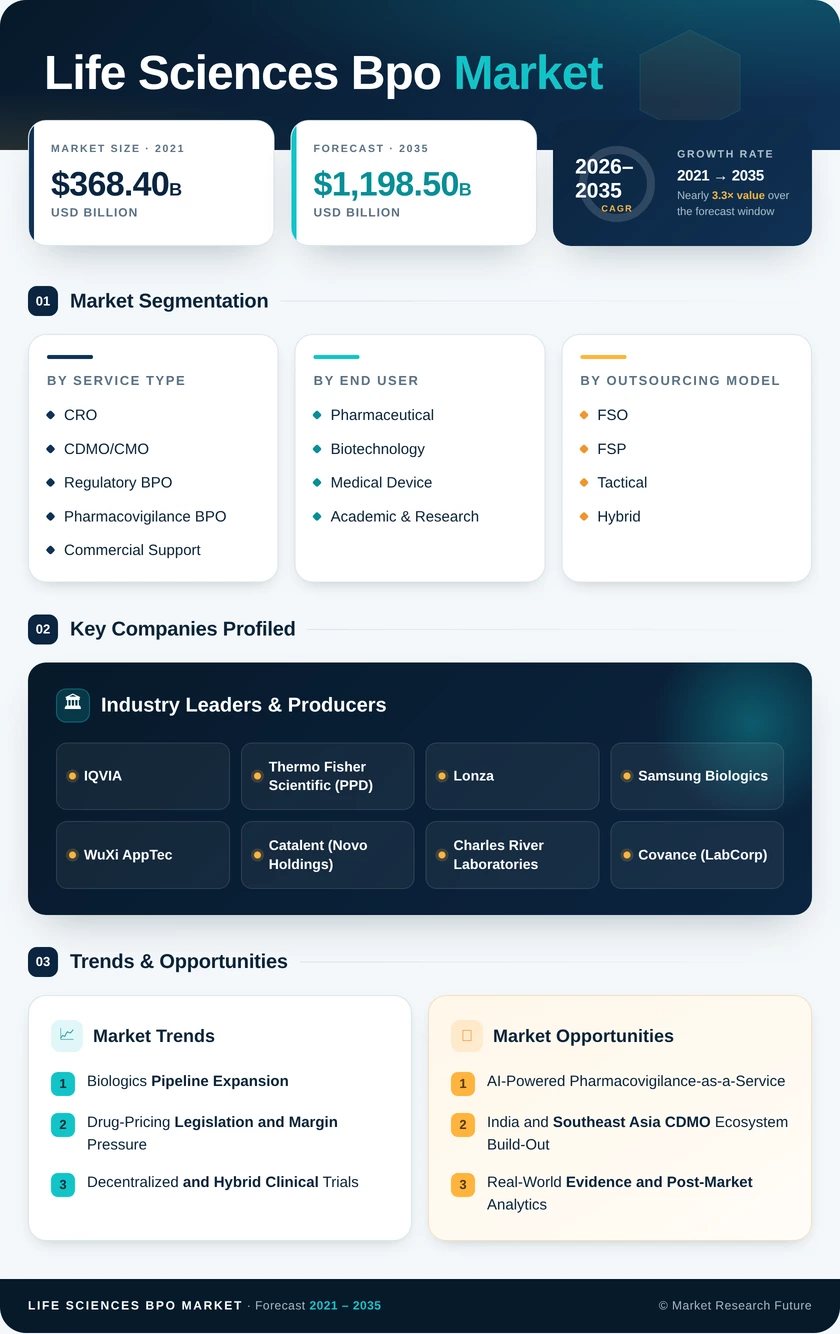
Life Sciences BPO Market

ID: MRFR/LS/8689-HCR
138 Pages
Rahul Gotadki
Last Updated: June 22, 2026
Life Sciences BPO Market Research Report Information By Service Type (Pharmaceutical Outsourcing, [Contract Research Organizations (CROs), {Drug Discovery, Pre-clinical Studies, Clinical Trial Studies, Regulatory Services, Pharmacovigilance}, Contract Manufacturing Organizations (CMOs) {API (Active Pharmaceutical Ingredient), Finished Dose Form, Packaging}, Medical Devices Outsourcing {Contract Manufacturing, Contract Research}, Contract Sales & Marketing Outsourcing {Sales Force Support, Market Access Services, Brand/CRM Support}, Other Service Categories), By End User(Pharmaceutical companies, Biotechnology companies, Medical device companies) - Growth & Industry Forecast 2026 To 2035
Download PDF ×

We do not share your information with anyone. However, we may send you emails based on your report interest from time to time. You may contact us at any time to opt-out.

  1. 1 Market Overview |
    1. 1.1 Study Assumptions & Market Definition |
    2. 1.2 Scope of the Study |
    3. 1.3 Research Methodology
  2. 2 Market Summary & Key Takeaways
  3. 3 Market Dynamics |
    1. 3.1 Market Drivers Analysis | |
      1. 3.1.1 Biologics Pipeline Expansion | |
      2. 3.1.2 Drug-Pricing Legislation & Margin Pressure | |
      3. 3.1.3 Decentralized & Hybrid Clinical Trials | |
      4. 3.1.4 AI/ML Automation of Regulatory & Safety Functions | |
      5. 3.1.5 China-Plus-One CDMO Diversification | |
      6. 3.1.6 Real-World Evidence & Post-Market Surveillance Mandates | |
      7. 3.1.7 Specialty Pharma M&A Driving Outsource-First Models |
    2. 3.2 Market Restraints Analysis | |
      1. 3.2.1 Data-Privacy & Cross-Border Transfer Restrictions | |
      2. 3.2.2 Supply-Chain Concentration Risk in Asia | |
      3. 3.2.3 Talent Shortages in Specialized CRO/CDMO Roles | |
      4. 3.2.4 IP Leakage and Trade-Secret Concerns | |
      5. 3.2.5 Regulatory Fragmentation Across Emerging Markets |
    3. 3.3 Market Opportunity Analysis | |
      1. 3.3.1 AI-Powered Pharmacovigilance-as-a-Service | |
      2. 3.3.2 India and Southeast Asia CDMO Ecosystem Build-Out | |
      3. 3.3.3 Real-World Evidence and Post-Market Analytics | |
      4. 3.3.4 Functional Service Provider (FSP) Model Expansion | |
      5. 3.3.5 Data Monetization Through Federated Analytics Platforms |
    4. 3.4 Industry Value Chain Analysis |
    5. 3.5 Porter's Five Forces Analysis
  4. 4 Global Life Sciences BPO Market Size & Forecast (2021–2035) |
    1. 4.1 Historical Market Size (2021–2025) |
    2. 4.2 Current & Forecast Market Size (2026–2035) |
    3. 4.3 Market Size by Revenue (USD Billion) |
    4. 4.4 Year-over-Year Growth Analysis
  5. 5 Segmentation Analysis |
    1. 5.1 By Service Type | |
      1. 5.1.1 CRO | |
      2. 5.1.2 CDMO/CMO | |
      3. 5.1.3 Regulatory BPO | |
      4. 5.1.4 Pharmacovigilance BPO | |
      5. 5.1.5 Commercial Support | |
      6. 5.1.6 Supply-Chain BPO |
    2. 5.2 By End User | |
      1. 5.2.1 Pharmaceutical | |
      2. 5.2.2 Biotechnology | |
      3. 5.2.3 Medical Device | |
      4. 5.2.4 Academic & Research |
    3. 5.3 By Outsourcing Model | |
      1. 5.3.1 Full-Service Outsourcing (FSO) | |
      2. 5.3.2 Functional Service Provider (FSP) | |
      3. 5.3.3 Tactical Outsourcing | |
      4. 5.3.4 Hybrid Model
  6. 6 Regional Analysis |
    1. 6.1 North America | |
      1. 6.1.1 United States | |
      2. 6.1.2 Canada | |
      3. 6.1.3 Mexico |
    2. 6.2 Europe | |
      1. 6.2.1 Germany | |
      2. 6.2.2 United Kingdom | |
      3. 6.2.3 France | |
      4. 6.2.4 Italy | |
      5. 6.2.5 Spain | |
      6. 6.2.6 Nordic Countries | |
      7. 6.2.7 Russia | |
      8. 6.2.8 Rest of Europe |
    3. 6.3 Asia-Pacific | |
      1. 6.3.1 China | |
      2. 6.3.2 India | |
      3. 6.3.3 Japan | |
      4. 6.3.4 South Korea | |
      5. 6.3.5 ASEAN | |
      6. 6.3.6 Rest of Asia-Pacific |
    4. 6.4 South America | |
      1. 6.4.1 Brazil | |
      2. 6.4.2 Argentina | |
      3. 6.4.3 Rest of South America |
    5. 6.5 Middle East & Africa | |
      1. 6.5.1 Saudi Arabia | |
      2. 6.5.2 UAE | |
      3. 6.5.3 South Africa | |
      4. 6.5.4 Egypt | |
      5. 6.5.5 Rest of MEA
  7. 7 Competitive Landscape |
    1. 7.1 Market Share Analysis (2025) |
    2. 7.2 Competitive Benchmarking Matrix |
    3. 7.3 Company Profiles | |
      1. 7.3.1 IQVIA | |
      2. 7.3.2 Thermo Fisher Scientific (PPD) | |
      3. 7.3.3 Lonza | |
      4. 7.3.4 Samsung Biologics | |
      5. 7.3.5 WuXi AppTec | |
      6. 7.3.6 Catalent (Novo Holdings) | |
      7. 7.3.7 Charles River Laboratories | |
      8. 7.3.8 Covance (LabCorp) | |
      9. 7.3.9 Parexel | |
      10. 7.3.10 Cognizant Life Sciences
  8. 8 Future Outlook & Strategic Recommendations (2026–2035) |
    1. 8.1 AI-Native Outsourcing Operations |
    2. 8.2 Platform-Based Outsourcing Ecosystems |
    3. 8.3 Sustainability and ESG Reporting in Outsourced Operations |
    4. 8.4 Cell and Gene Therapy Outsourcing Inflection
  9. 9 Recent Developments & News
  10. 10 Frequently Asked Questions (FAQs)
  11. 11 Report Scope & Methodology |
    1. 11.1 Study Period & Base Year |
    2. 11.2 Data Sources & Citations |
    3. 11.3 Abbreviations
  12. 12 LIST OF TABLES |
  13. TABLE 1 Global Life Sciences BPO Market Size & Forecast, by Revenue (USD Billion), 2021–2035 |
  14. TABLE 2 Global Life Sciences BPO Market – Year-over-Year Growth Analysis, 2021–2035 |
  15. TABLE 3 Global Life Sciences BPO Market – Driver Impact Analysis |
  16. TABLE 4 Global Life Sciences BPO Market – Restraint Impact Analysis |
  17. TABLE 5 Global Life Sciences BPO Market Size, by Service Type, 2021–2035 (USD Billion) |
  18. TABLE 6 Global Life Sciences BPO Market Size, by End User, 2021–2035 (USD Billion) |
  19. TABLE 7 Global Life Sciences BPO Market Size, by Outsourcing Model, 2021–2035 (USD Billion) |
  20. TABLE 8 Global Life Sciences BPO Market Size, by Region, 2021–2035 (USD Billion) |
  21. TABLE 9 North America Life Sciences BPO Market Size, by Country, 2021–2035 (USD Billion) |
  22. TABLE 10 Europe Life Sciences BPO Market Size, by Country, 2021–2035 (USD Billion) |
  23. TABLE 11 Asia-Pacific Life Sciences BPO Market Size, by Country, 2021–2035 (USD Billion) |
  24. TABLE 12 South America Life Sciences BPO Market Size, by Country, 2021–2035 (USD Billion) |
  25. TABLE 13 Middle East & Africa Life Sciences BPO Market Size, by Country, 2021–2035 (USD Billion) |
  26. TABLE 14 Competitive Benchmarking Matrix – Global Life Sciences BPO Market, 2025 |
  27. TABLE 15 Company Profiles – Key Players, Global Life Sciences BPO Market |
  28. TABLE 16 Recent Developments & Strategic Announcements, 2024–2025 |
  29. TABLE 17 Report Scope & Methodology Summary |
  30. TABLE 18 Detailed Sources and Citations
  31. 13 LIST OF FIGURES |
  32. FIGURE 1 Life Sciences BPO Market Dynamics – Drivers, Restraints, and Opportunities |
  33. FIGURE 2 Life Sciences BPO Market – Industry Value Chain Analysis |
  34. FIGURE 3 Life Sciences BPO Market – Porter's Five Forces Analysis |
  35. FIGURE 4 Global Life Sciences BPO Market Size Trend (USD Billion), 2021–2035 |
  36. FIGURE 5 Global Life Sciences BPO Market Share, by Service Type (%), 2025 |
  37. FIGURE 6 Global Life Sciences BPO Market Share, by End User (%), 2025 |
  38. FIGURE 7 Global Life Sciences BPO Market Share, by Outsourcing Model (%), 2025 |
  39. FIGURE 8 Global Life Sciences BPO Market Share, by Region (%), 2025 |
  40. FIGURE 9 North America Life Sciences BPO Market Size Trend (USD Billion), 2021–2035 |
  41. FIGURE 10 Europe Life Sciences BPO Market Size Trend (USD Billion), 2021–2035 |
  42. FIGURE 11 Asia-Pacific Life Sciences BPO Market Size Trend (USD Billion), 2021–2035 |
  43. FIGURE 12 South America Life Sciences BPO Market Size Trend (USD Billion), 2021–2035 |
  44. FIGURE 13 Middle East & Africa Life Sciences BPO Market Size Trend (USD Billion), 2021–2035 |
  45. FIGURE 14 Competitive Landscape – Market Share of Top 10 Players (%), 2025

Segmentation Quick Reference

DimensionSub-SegmentsDominant SegmentFastest Growing Segment
Service TypeCRO, CDMO/CMO, Regulatory BPO, Pharmacovigilance BPO, Commercial Support, Supply-Chain BPOCROCDMO/CMO
End UserPharmaceutical, Biotechnology, Medical Device, Academic & ResearchPharmaceuticalBiotechnology
Outsourcing ModelFSO, FSP, Tactical, HybridFSOFSP
RegionNorth America, Europe, Asia-Pacific, South America, Middle East & AfricaNorth AmericaAsia-Pacific


Market Segmentation Overview

By Service Type

Sub-SegmentKey Trend
CRODecentralized trial adoption expanding addressable scope
CDMO/CMOBiologics and cell-gene therapy driving capacity investments
Regulatory BPOAI automation transforming submission assembly workflows
Pharmacovigilance BPOMachine-learning case triage replacing manual processing
Commercial SupportMarket-access analytics and pricing strategy outsourcing rising
Supply-Chain BPOCold-chain complexity for biologics fueling demand


CRO services remain the largest service category, processing thousands of clinical trials annually across all therapeutic areas. CDMO/CMO services are scaling at the fastest rate as biologics and advanced therapies require specialized manufacturing that most sponsors cannot build in-house.

By End User

Sub-SegmentKey Trend
PharmaceuticalMargin pressure accelerating outsource-first operating models
BiotechnologyVenture-funded startups outsourcing from day one
Medical DeviceEU MDR compliance driving regulatory BPO demand
Academic & ResearchGrant-funded translational programs requiring CRO partnerships


Pharmaceutical companies account for the majority of outsourcing spend due to their large, diversified pipelines and enterprise-wide cost-optimization mandates. Biotechnology firms represent the fastest-growing user segment as capital-efficient startups externalize virtually all operational functions.

By Outsourcing Model

Sub-SegmentKey Trend
Full-Service Outsourcing (FSO)Single-vendor accountability for end-to-end program delivery
Functional Service Provider (FSP)Sponsors embedding outsourced teams under internal governance
Tactical OutsourcingShort-term resource augmentation for peak workloads
Hybrid ModelBlended FSO-FSP structures for complex multi-regional trials


Full-service outsourcing dominates by revenue share, offering streamlined project management across clinical development milestones. The FSP model is the fastest-growing structure, appealing to large pharmaceutical companies that want direct control over outsourced teams and workflows.

By Region

Sub-SegmentKey Trend
North AmericaRegulatory complexity and pharma HQ density sustain leadership
EuropeEMA harmonization and post-Brexit UK agility shape dynamics
Asia-PacificIndia PLI scheme and South Korea biologics CDMO fuel growth
South AmericaBrazil's ANVISA modernization expands clinical trial access
Middle East & AfricaVision 2030 healthcare investment opens new outsourcing corridors


North America leads global spending, driven by the concentration of large pharmaceutical headquarters and the FDA's extensive regulatory requirements. Asia-Pacific is the fastest-growing region, with India, South Korea, and Southeast Asian nations rapidly building CDMO and CRO capacity to serve both domestic and global sponsors.