×
Request Free Sample ×

Kindly complete the form below to receive a free sample of this Report

* Please use a valid business email

Leading companies partner with us for data-driven Insights

clients tt-cursor
Hero Background

Liquor Chocolate Market

ID: MRFR/FnB/40472-HCR
128 Pages
Snehal Singh
October 2025

Liquor Chocolate Market Research Report By Type (Dark Chocolate, Milk Chocolate, White Chocolate, Ruby Chocolate), By Flavor Profile (Mint, Coffee, Fruits, Spices), By Packaging Type (Bars, Truffles, Bonbons, Gift Boxes), By Distribution Channel (Online Retail, Supermarkets, Specialty Stores, Convenience Stores) and By Regional (North America, Europe, South America, Asia Pacific, Middle East and Africa) - Forecast to 2035

Share:
Download PDF ×

We do not share your information with anyone. However, we may send you emails based on your report interest from time to time. You may contact us at any time to opt-out.

Liquor Chocolate Market Infographic
Purchase Options

Liquor Chocolate Market Summary

As per MRFR analysis, the Liquor Chocolate Market Size was estimated at 3.64 USD Billion in 2024. The Liquor Chocolate industry is projected to grow from 3.837 USD Billion in 2025 to 6.492 USD Billion by 2035, exhibiting a compound annual growth rate (CAGR) of 5.4 during the forecast period 2025 - 2035.

Key Market Trends & Highlights

The Liquor Chocolate Market is experiencing a dynamic shift towards premiumization and innovative flavors.

  • The North American market remains the largest, driven by a strong demand for premium liquor chocolates.
  • In the Asia-Pacific region, the market is rapidly expanding, fueled by a growing interest in unique flavor profiles.
  • Dark chocolate continues to dominate the segment, while ruby chocolate is emerging as the fastest-growing option.
  • Rising consumer preferences for premium products and innovative flavor combinations are key drivers of market growth.

Market Size & Forecast

2024 Market Size 3.64 (USD Billion)
2035 Market Size 6.492 (USD Billion)
CAGR (2025 - 2035) 5.4%

Major Players

Godiva (BE), Lindt & Sprüngli (CH), Ferrero (IT), Chocoladefabriken Lindt & Sprüngli AG (CH), Cacao Barry (FR), Ghirardelli Chocolate Company (US), Baileys (IE), Kahlua (MX), Chocovision (US)

Liquor Chocolate Market Trends

The Liquor Chocolate Market is currently experiencing a notable evolution, characterized by a growing consumer preference for premium and artisanal products. This shift appears to be driven by an increasing demand for unique flavor profiles and high-quality ingredients. As consumers become more discerning, they seem to gravitate towards brands that emphasize craftsmanship and authenticity. Additionally, the market is witnessing a rise in innovative product offerings, with manufacturers experimenting with diverse liquors and chocolate combinations, thereby enhancing the overall sensory experience. This trend suggests a potential for expansion as consumers seek out novel indulgences that cater to their evolving tastes. Moreover, the Liquor Chocolate Market is also influenced by changing social dynamics, where gifting and sharing experiences are becoming more prevalent. This cultural shift indicates that liquor chocolates are increasingly viewed as suitable gifts for various occasions, further broadening their appeal. The intersection of luxury and accessibility in this market may lead to a more inclusive consumer base, as brands strive to cater to both high-end and everyday consumers. Overall, the Liquor Chocolate Market appears poised for continued growth, driven by innovation, quality, and evolving consumer preferences.

Premiumization of Products

The Liquor Chocolate Market is witnessing a trend towards premiumization, where consumers are increasingly opting for high-quality, artisanal products. This shift indicates a preference for unique flavors and superior ingredients, suggesting that brands focusing on craftsmanship may gain a competitive edge.

Innovative Flavor Combinations

Manufacturers in the Liquor Chocolate Market are exploring innovative flavor combinations, blending various liquors with chocolate to create distinctive offerings. This trend reflects a desire for novel taste experiences, potentially attracting adventurous consumers seeking new indulgences.

Gifting Culture

The Liquor Chocolate Market is benefiting from a growing gifting culture, where these products are increasingly seen as suitable gifts for various occasions. This trend suggests that brands may expand their marketing strategies to emphasize the celebratory aspects of liquor chocolates.

Liquor Chocolate Market Drivers

Innovative Flavor Profiles

Innovation in flavor combinations is a key driver in the Liquor Chocolate Market, as manufacturers experiment with diverse ingredients to create unique offerings. The integration of exotic flavors, such as chili, sea salt, and various spices, has become increasingly popular, appealing to adventurous consumers. Market data indicates that products featuring innovative flavor profiles have outperformed traditional offerings, with sales growth rates exceeding 10% in certain regions. This trend not only attracts new customers but also encourages repeat purchases from those seeking novel taste experiences. As brands continue to push the boundaries of flavor, the Liquor Chocolate Market is likely to witness an influx of creative products that cater to evolving consumer preferences, thereby enhancing overall market growth.

Health-Conscious Consumer Trends

The Liquor Chocolate Market is witnessing a shift towards health-conscious products, as consumers become more aware of their dietary choices. This trend is characterized by an increasing demand for products that incorporate natural ingredients, lower sugar content, and functional benefits. Market Research Future indicates that products labeled as organic or containing superfoods are gaining traction, with sales growth in this segment reaching approximately 12% annually. As consumers seek indulgent treats that align with their health goals, brands that innovate to meet these demands are likely to thrive. This focus on health and wellness not only attracts a broader audience but also encourages existing consumers to explore new offerings within the Liquor Chocolate Market, thereby driving overall market expansion.

Gifting Trends and Seasonal Demand

The Liquor Chocolate Market benefits significantly from gifting trends, particularly during festive seasons and special occasions. Consumers often seek unique and luxurious gifts, and liquor chocolates serve as an appealing option that combines indulgence with sophistication. Data suggests that sales in the gifting segment have surged, with a notable increase of around 15% during holiday seasons. This trend is further fueled by the rise of experiential gifting, where consumers prefer gifts that offer memorable experiences. As brands capitalize on this trend by creating attractive packaging and limited-edition flavors, the Liquor Chocolate Market is poised for continued growth. The ability to position products as ideal gifts enhances their appeal and drives sales, particularly in markets where gifting culture is deeply ingrained.

Rising Demand for Premium Products

The Liquor Chocolate Market is experiencing a notable shift towards premiumization, as consumers increasingly seek high-quality, artisanal products. This trend is driven by a growing appreciation for craftsmanship and unique flavor profiles. According to recent data, the premium segment of the liquor chocolate market has seen a compound annual growth rate of approximately 8% over the past few years. Consumers are willing to pay a premium for products that offer distinctive taste experiences and superior ingredients. This inclination towards luxury items is not merely a passing trend; it reflects a broader cultural movement towards indulgence and self-care. As a result, brands that position themselves within the premium segment are likely to capture a larger share of the market, appealing to discerning consumers who prioritize quality over quantity.

E-commerce Growth and Digital Marketing

The Liquor Chocolate Market is experiencing a transformation due to the rise of e-commerce and digital marketing strategies. As consumers increasingly turn to online shopping for convenience, brands are adapting their sales channels to meet this demand. Recent statistics indicate that online sales of liquor chocolates have grown by over 20% in the past year, reflecting a shift in consumer purchasing behavior. Digital marketing campaigns, including social media promotions and influencer partnerships, are effectively reaching target audiences and driving brand awareness. This trend not only enhances accessibility for consumers but also allows brands to engage with their customers in innovative ways. As e-commerce continues to expand, the Liquor Chocolate Market is likely to see sustained growth, driven by the ability to reach a wider audience and adapt to changing consumer preferences.
Market Segment Insights

By Type: Dark Chocolate (Largest) vs. Ruby Chocolate (Fastest-Growing)

In the Liquor Chocolate Market, Dark Chocolate emerges as the largest segment, commanding a significant share due to its rich flavor profile and health benefits. This has led to a consistent preference from consumers who seek a more intense taste and lower sugar content. Following closely are Milk Chocolate and White Chocolate segments, which offer a sweeter and creamier taste, appealing to different palettes and age groups, thus diversifying consumer choices.

Dark Chocolate (Dominant) vs. Ruby Chocolate (Emerging)

Dark Chocolate stands out in the Liquor Chocolate Market as the dominant segment, favored for its combination of rich flavor and perceived health benefits, such as antioxidants. It attracts a wide range of consumers, from gourmet enthusiasts to health-conscious buyers. In contrast, Ruby Chocolate is gaining traction as an emerging player, known for its unique berry-like taste and visually striking pink color. This innovative variety appeals to younger consumers looking for novelty and experience. The growing interest in premium and unique chocolate products enhances Ruby Chocolate's market presence, making it a significant segment to watch in the coming years.

By Flavor Profile: Mint (Largest) vs. Coffee (Fastest-Growing)

In the Liquor Chocolate Market, the flavor profile segment showcases a diverse distribution among Mint, Coffee, Fruits, and Spices. Mint has emerged as the largest segment, appealing to consumers with its refreshing and invigorating characteristics. Coffee follows closely, carving its niche among chocolate lovers who enjoy the rich, robust flavors. Fruits and Spices, while significant, currently hold a smaller market share but contribute to the overall diversity of the flavor offerings in the market. As consumer preferences evolve, the competition among these flavor profiles intensifies.

Mint (Dominant) vs. Coffee (Emerging)

Mint stands out as the dominant flavor profile in the Liquor Chocolate Market, known for its refreshing taste that pairs well with chocolate, enhancing its appeal among consumers seeking unique and flavorful experiences. Mint-infused liquors provide a broad market presence, often enjoyed in cocktails or as standalone treats. Conversely, Coffee represents an emerging trend, capturing the attention of gourmet chocolate enthusiasts eager for rich, bold flavors. Coffee-flavored liquors are gaining traction, driven by the growing popularity of coffee culture and the desire for innovative flavor combinations. Together, Mint and Coffee illustrate the dynamic nature of consumer preferences within this exciting segment.

By Packaging Type: Bars (Largest) vs. Truffles (Fastest-Growing)

In the Liquor Chocolate Market, packaging type significantly influences consumer preferences and overall sales. Among the segment values, Bars emerge as the dominant player, capturing a substantial portion of market share thanks to their convenience and widespread appeal. Following closely are Truffles, which, while not as large in market share, are gaining traction and popularity for their luxurious feel and gifting potential, contributing to their rapidly growing presence in the market.

Bars (Dominant) vs. Truffles (Emerging)

Bars represent a well-established segment within the Liquor Chocolate Market, favored for their accessibility and variety. They cater to a broad range of consumers looking for a quick and indulgent experience. The easy-to-store format makes them a preferred choice for retailers and consumers alike. In contrast, Truffles are the emerging star, renowned for their premium quality and artisanal appeal. They are often a choice for special occasions and gifting, leading to an increased demand as consumer preferences shift towards more refined and unique experiences. This creates an exciting dynamic between both segments.

By Distribution Channel: Online Retail (Largest) vs. Supermarkets (Fastest-Growing)

In the Liquor Chocolate Market, Online Retail is currently the largest distribution channel, capturing a significant share of consumer purchases. This segment has thrived as shoppers increasingly turn to e-commerce platforms for their liquor chocolate needs. On the other hand, Supermarkets are witnessing rapid growth due to their widespread availability and the strategic placement of liquor chocolates in high-traffic areas, catering to impulse buyers and those who prefer in-store experiences.

Supermarkets (Dominant) vs. Convenience Stores (Emerging)

Supermarkets hold a dominant position in the Liquor Chocolate Market, benefiting from extensive product assortments and promotional activities that attract a wide range of customers. They often offer liquor chocolates in strategic locations, making it easy for shoppers to purchase them alongside their regular grocery items. In contrast, Convenience Stores are emerging players in this segment as they cater to on-the-go consumers seeking quick and easy access to liquor chocolates. While they may not offer the same variety as supermarkets, their 24/7 availability and strategic locations provide opportunities for growth, particularly among younger demographics looking for instant gratification.

Get more detailed insights about Liquor Chocolate Market

Regional Insights

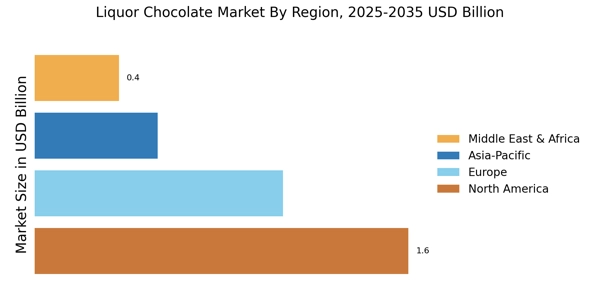
The Liquor Chocolate Market has shown significant growth across various regions, with North America and Europe leading in market valuation. In 2024, North America is valued at 0.95 USD Billion, while Europe holds a substantial valuation of 1.029 USD Billion. Both regions are expected to experience considerable growth, reaching 1.606 USD Billion and 1.759 USD Billion, respectively, by 2035, showcasing their dominant positions.

The APAC region, valued at 0.633 USD Billion in 2024, is also anticipated to see growth, driven by increasing consumer interest in premium liquor chocolates, elevating its valuation to 1.147 USD Billion by 2035.South America and MEA have been at 0.396 USD Billion and 0.633 USD Billion, respectively, in 2024; however, their growth rates highlight emerging market opportunities with valuations expected to reach 0.688 USD Billion and 1.3 USD Billion in 2035. The majority of holding in the European market is attributed to established chocolate manufacturers and innovative product offerings.

In contrast, North America remains significant due to the high demand for unique and luxurious chocolate experiences among consumers. Overall, these dynamics showcase the competitive landscape of the Liquor Chocolate Market and underscore the importance of each region in driving market growth.

Liquor Chocolate Market Regional Image

Key Players and Competitive Insights

The Liquor Chocolate Market has experienced significant growth due to a rising trend among consumers for premium confections that combine alcohol with indulgent flavors. This niche market is characterized by a blend of artisanal craftsmanship and innovative flavor combinations that cater to sophisticated palates. As competition intensifies, companies are focusing on differentiating their products and enhancing brand loyalty through unique offerings. Market players are employing various strategies such as collaborations, product innovations, and promotion of their products in social and experiential settings to capture consumer attention.

The increasing popularity of liquor-infused chocolates as gifts and celebratory treats is driving demand, thereby creating a vibrant competitive landscape.

AnheuserBusch has established a strong presence in the Liquor Chocolate Market through its commitment to quality and innovation. The company's strategic maneuvers in product development emphasize the incorporation of premium ingredients that resonate with discerning consumers. AnheuserBusch leverages its extensive distribution network and brand reputation to enhance market penetration, allowing it to reach a broad audience effectively. The company's strengths lie in its robust marketing strategies and ability to adapt to changing consumer preferences, particularly in the liquor and confectionery space.

By focusing on unique flavors and limited-edition collaborations, AnheuserBusch elevates the consumer experience and solidifies its position within the competitive arena of liquor chocolates.

Molson Coors Beverage Company is another formidable competitor in the Liquor Chocolate Market, recognized for its innovative approaches and diverse product range. The company capitalizes on its extensive experience in the beverage industry to infuse alcohol into chocolate, creating products that appeal to both beer enthusiasts and chocolate lovers. Molson Coors Beverage Company is known for its ability to create brand awareness through captivating campaigns and strategic partnerships that enhance customer engagement. The strengths of Molson Coors Beverage Company lie in its deep-rooted expertise in brewing and its commitment to sustainability, which resonates with a growing segment of eco-conscious consumers.

The combination of high-quality ingredients and a strong brand identity positions Molson Coors as a significant player in a market that thrives on creativity and indulgence.

Key Companies in the Liquor Chocolate Market market include

Industry Developments

The Liquor Chocolate Market has seen significant recent developments, particularly with major players like Anheuser-Busch, Pernod Ricard, and Diageo innovating to capture consumer interest. Molson Coors Beverage Company and Constellation Brands have also been enhancing their portfolios with new flavored liquor chocolates aimed at the increasing demand for premium and artisanal products. Current affairs indicate a positive market sentiment as brands like Ferrero, Mars Incorporated, and Kraft Heinz are expanding their offerings in the luxury sector of chocolate combined with spirits.

In terms of mergers and acquisitions, notable events involve Toblerone, as it has attracted interest from larger conglomerates aiming to diversify into the liquor chocolate niche.

 Recent evaluations show that companies such as Brown-Forman and Heineken are experiencing growth in market valuation, attributing this to the rising popularity of liquor-infused chocolates among consumers inclined towards indulgent treats. Nestlé is also strategically investing in new product development to enhance its presence in this sector, reflecting the sustained growth trend in the Liquor Chocolate Market.

Future Outlook

Liquor Chocolate Market Future Outlook

The Liquor Chocolate Market is projected to grow at a 5.4% CAGR from 2024 to 2035, driven by increasing consumer demand for premium products and innovative flavors.

New opportunities lie in:

  • Expansion into e-commerce platforms for direct-to-consumer sales.
  • Development of limited-edition seasonal flavors to attract niche markets.
  • Partnerships with luxury brands for co-branded product lines.

By 2035, the Liquor Chocolate Market is expected to achieve substantial growth and diversification.

Market Segmentation

Liquor Chocolate Market Type Outlook

  • Dark Chocolate
  • Milk Chocolate
  • White Chocolate
  • Ruby Chocolate

Liquor Chocolate Market Flavor Profile Outlook

  • Mint
  • Coffee
  • Fruits
  • Spices

Liquor Chocolate Market Packaging Type Outlook

  • Bars
  • Truffles
  • Bonbons
  • Gift Boxes

Liquor Chocolate Market Distribution Channel Outlook

  • Online Retail
  • Supermarkets
  • Specialty Stores
  • Convenience Stores

Report Scope

MARKET SIZE 20243.64(USD Billion)
MARKET SIZE 20253.837(USD Billion)
MARKET SIZE 20356.492(USD Billion)
COMPOUND ANNUAL GROWTH RATE (CAGR)5.4% (2024 - 2035)
REPORT COVERAGERevenue Forecast, Competitive Landscape, Growth Factors, and Trends
BASE YEAR2024
Market Forecast Period2025 - 2035
Historical Data2019 - 2024
Market Forecast UnitsUSD Billion
Key Companies ProfiledMarket analysis in progress
Segments CoveredMarket segmentation analysis in progress
Key Market OpportunitiesGrowing consumer interest in premium, artisanal Liquor Chocolate products presents significant market opportunities.
Key Market DynamicsRising consumer preference for premium liquor chocolates drives innovation and competition among manufacturers.
Countries CoveredNorth America, Europe, APAC, South America, MEA

Leave a Comment

FAQs

What is the projected market valuation of the Liquor Chocolate Market by 2035?

The Liquor Chocolate Market is projected to reach a valuation of 6.492 USD Billion by 2035.

What was the market valuation of the Liquor Chocolate Market in 2024?

In 2024, the Liquor Chocolate Market had a valuation of 3.64 USD Billion.

What is the expected CAGR for the Liquor Chocolate Market during the forecast period 2025 - 2035?

The expected CAGR for the Liquor Chocolate Market during the forecast period 2025 - 2035 is 5.4%.

Which companies are considered key players in the Liquor Chocolate Market?

Key players in the Liquor Chocolate Market include Godiva, Lindt & Sprüngli, Ferrero, and Baileys, among others.

What segment of the Liquor Chocolate Market had the highest valuation in 2024?

In 2024, the Milk Chocolate segment had the highest valuation at 1.5 USD Billion.

How does the projected growth of the Dark Chocolate segment compare to other segments?

The Dark Chocolate segment is projected to grow from 1.1 USD Billion in 2024 to 2.0 USD Billion by 2035.

What flavor profile segment is expected to show significant growth by 2035?

The Fruits flavor profile segment is expected to grow from 1.09 USD Billion in 2024 to 1.85 USD Billion by 2035.

Which distribution channel is anticipated to dominate the Liquor Chocolate Market?

Supermarkets are anticipated to dominate the Liquor Chocolate Market, growing from 1.45 USD Billion in 2024 to 2.5 USD Billion by 2035.

What packaging type is projected to see the most growth in the Liquor Chocolate Market?

Truffles are projected to see the most growth, increasing from 1.2 USD Billion in 2024 to 2.0 USD Billion by 2035.

How does the growth of online retail compare to other distribution channels?

Online retail is expected to grow from 0.73 USD Billion in 2024 to 1.25 USD Billion by 2035, indicating a steady increase.

Download Free Sample

Kindly complete the form below to receive a free sample of this Report

Compare Licence

×
Features License Type
Single User Multiuser License Enterprise User
Price $4,950 $5,950 $7,250
Maximum User Access Limit 1 User Upto 10 Users Unrestricted Access Throughout the Organization
Free Customization
Direct Access to Analyst
Deliverable Format
Platform Access
Discount on Next Purchase 10% 15% 15%
Printable Versions