×
Request Free Sample ×

Kindly complete the form below to receive a free sample of this Report

* Please use a valid business email

Leading companies partner with us for data-driven Insights

clients tt-cursor
Hero Background

Lithium Ion Energy Accumulator Market

ID: MRFR/EnP/40985-HCR
200 Pages
Shubham Munde
October 2025

Lithium-ion Energy Accumulator Market Research Report By Application (Consumer Electronics, Electric Vehicles, Energy Storage Systems, Industrial Equipment), By Type (Cylindrical, Prismatic, Polymer), By End Use (Residential, Commercial, Utilities), By Chemistry (Lithium Nickel Manganese Cobalt Oxide, Lithium Iron Phosphate, Lithium Cobalt Oxide) and By Regional (North America, Europe, South America, Asia Pacific, Middle East and Africa) - Forecast to 2035

Share:
Download PDF ×

We do not share your information with anyone. However, we may send you emails based on your report interest from time to time. You may contact us at any time to opt-out.

Lithium Ion Energy Accumulator Market Infographic
Purchase Options

Lithium Ion Energy Accumulator Market Summary

As per MRFR analysis, the Lithium-ion Energy Accumulator Market Size was estimated at 42.1 USD Billion in 2024. The Lithium-ion Energy Accumulator industry is projected to grow from 45.55 USD Billion in 2025 to 100.08 USD Billion by 2035, exhibiting a compound annual growth rate (CAGR) of 8.19 during the forecast period 2025 - 2035.

Key Market Trends & Highlights

The Lithium-ion Energy Accumulator Market is poised for substantial growth driven by technological advancements and increasing demand across various sectors.

  • Technological advancements are enhancing the efficiency and lifespan of lithium-ion batteries, thereby attracting more investments.
  • North America remains the largest market for lithium-ion energy accumulators, primarily due to its robust electric vehicle sector.
  • The Asia-Pacific region is experiencing rapid growth, fueled by rising adoption of consumer electronics and smart technologies.
  • Key market drivers include the expansion of the renewable energy sector and government initiatives promoting electric vehicle adoption.

Market Size & Forecast

2024 Market Size 42.1 (USD Billion)
2035 Market Size 100.08 (USD Billion)
CAGR (2025 - 2035) 8.19%

Major Players

CATL (CN), LG Energy Solution (KR), Panasonic (JP), Samsung SDI (KR), BYD (CN), A123 Systems (US), Toshiba (JP), SK Innovation (KR), Hitachi Chemical (JP), Saft (FR)

Lithium Ion Energy Accumulator Market Trends

The Lithium-ion Energy Accumulator Market is currently experiencing a dynamic evolution, driven by the increasing demand for energy storage solutions across various sectors. This market appears to be influenced by the growing emphasis on renewable energy sources, as industries and consumers alike seek efficient ways to store energy generated from solar, wind, and other sustainable methods. Furthermore, advancements in technology are likely enhancing the performance and longevity of lithium-ion batteries, making them more appealing for applications ranging from electric vehicles to portable electronics. As environmental concerns continue to rise, the shift towards cleaner energy alternatives seems to be propelling the market forward, indicating a robust future for lithium-ion energy accumulators. In addition to technological advancements, the Lithium-ion Energy Accumulator Market is also witnessing a shift in consumer preferences. There appears to be a growing inclination towards electric vehicles, which are increasingly seen as a viable alternative to traditional combustion engines. This trend is likely fostering a surge in demand for high-capacity batteries that can support longer ranges and faster charging times. Moreover, the integration of smart technologies into energy storage systems may further enhance user experience and efficiency. Overall, the market seems poised for substantial growth, driven by innovation and changing consumer behaviors, suggesting a promising trajectory in the coming years.

Technological Advancements

Recent innovations in battery technology are enhancing the efficiency and lifespan of lithium-ion accumulators. These improvements may lead to increased adoption across various sectors, including automotive and renewable energy.

Rising Demand for Electric Vehicles

The growing popularity of electric vehicles is significantly impacting the Lithium-ion Energy Accumulator Market. As consumers seek sustainable transportation options, the need for high-performance batteries is likely to rise.

Integration of Smart Technologies

The incorporation of smart technologies into energy storage solutions appears to be transforming user experiences. Enhanced monitoring and management capabilities may lead to greater efficiency and convenience in energy usage.

Lithium Ion Energy Accumulator Market Drivers

Growing Renewable Energy Sector

The increasing emphasis on renewable energy sources is a pivotal driver for the Lithium-ion Energy Accumulator Market. As nations strive to reduce carbon emissions, the integration of solar and wind energy systems has surged. Lithium-ion batteries are essential for storing energy generated from these intermittent sources, ensuring a stable power supply. In 2025, the renewable energy sector is projected to account for a substantial portion of the energy mix, with lithium-ion batteries facilitating this transition. The ability of these accumulators to provide efficient energy storage solutions positions them as a cornerstone in the renewable energy landscape, thereby propelling the Lithium-ion Energy Accumulator Market forward.

Expansion of Consumer Electronics

The proliferation of consumer electronics is a significant catalyst for the Lithium-ion Energy Accumulator Market. With the continuous advancement in technology, devices such as smartphones, laptops, and tablets are increasingly reliant on lithium-ion batteries for their power needs. In 2025, the consumer electronics sector is expected to witness a growth rate of approximately 6% annually, further driving the demand for efficient energy storage solutions. The lightweight and high energy density characteristics of lithium-ion batteries make them the preferred choice for manufacturers. This trend not only enhances the performance of consumer devices but also contributes to the overall growth of the Lithium-ion Energy Accumulator Market.

Advancements in Battery Technology

Technological innovations in battery design and manufacturing processes are driving the Lithium-ion Energy Accumulator Market. Recent advancements have led to improvements in battery life, charging speed, and safety features, making lithium-ion batteries more appealing for various applications. In 2025, the introduction of solid-state batteries is expected to revolutionize the market, offering higher energy densities and reduced risks of overheating. These advancements not only enhance the performance of lithium-ion accumulators but also expand their applicability across sectors such as automotive and renewable energy. Consequently, the Lithium-ion Energy Accumulator Market is poised for substantial growth as these technologies mature.

Rising Adoption of Electric Vehicles

The surge in electric vehicle (EV) adoption is a primary driver for the Lithium-ion Energy Accumulator Market. As consumers increasingly opt for environmentally friendly transportation options, the demand for efficient and reliable energy storage solutions has escalated. In 2025, the electric vehicle market is projected to grow significantly, with lithium-ion batteries being the preferred choice due to their high energy density and longevity. This trend is further supported by advancements in charging infrastructure and government incentives aimed at reducing carbon footprints. The growing acceptance of EVs is likely to bolster the Lithium-ion Energy Accumulator Market, creating new opportunities for manufacturers and suppliers.

Government Initiatives and Regulations

Government policies and regulations aimed at promoting clean energy technologies are instrumental in shaping the Lithium-ion Energy Accumulator Market. Many countries have implemented incentives for electric vehicle adoption and renewable energy projects, which often include the use of lithium-ion batteries. In 2025, it is anticipated that these initiatives will lead to a marked increase in the deployment of energy storage systems. The regulatory framework encourages innovation and investment in battery technology, thereby enhancing the competitiveness of the Lithium-ion Energy Accumulator Market. As governments continue to prioritize sustainability, the demand for lithium-ion accumulators is likely to escalate.
Market Segment Insights

By Application: Electric Vehicles (Largest) vs. Consumer Electronics (Fastest-Growing)

The Lithium-ion Energy Accumulator Market exhibits a diverse application landscape, with Electric Vehicles (EVs) commanding the largest share, driven by increasing adoption and advancements in electric mobility. Consumer Electronics follows closely, reflecting the high demand for mobile devices and the integration of lithium-ion batteries in various personal gadgets, contributing to substantial market presence. Growth trends within this segment indicate a surge in Electric Vehicle adoption, propelled by government policies supporting sustainable transportation and improvements in battery technologies. On the other hand, Consumer Electronics is characterized by rapid innovation and a growing consumer base, leading to an increasing need for efficient energy solutions. Both segments are influenced significantly by technological advancements and shifting consumer preferences towards eco-friendly products.

Electric Vehicles (Dominant) vs. Consumer Electronics (Emerging)

Electric Vehicles represent the dominant segment within the Lithium-ion Energy Accumulator Market, characterized by significant investment in technology and infrastructure development. The growing preference for sustainable transport and government initiatives are key drivers of this dominance. These vehicles are equipped with advanced battery systems that emphasize efficiency and energy density, meeting the rising consumer expectations for longer ranges and quicker charging capabilities. On the other hand, the Consumer Electronics sector is emerging rapidly, fueled by a continuous demand for portable electronic devices and improvement in battery life. This segment is highly competitive and innovative, with manufacturers focusing on creating smaller, lighter, and more efficient batteries to cater to the increasing consumption of smart gadgets. The versatility of lithium-ion technologies allows for widespread application, reinforcing its presence in both dominant and emerging markets.

By Type: Cylindrical (Largest) vs. Prismatic (Fastest-Growing)

The Lithium-ion Energy Accumulator Market is witnessing significant competition among three primary types: Cylindrical, Prismatic, and Polymer cells. Among these, Cylindrical cells dominate the market due to their established manufacturing processes and widespread application in the automotive and electronics sectors. Prismatic cells, however, have gained traction, especially in electric vehicles (EVs) and portable electronics, thanks to their space-efficient designs and improved energy densities. The Polymer segment, while currently smaller, is beginning to show potential for growth as new applications in flexible electronics emerge. The growth trends in this segment are shaped by innovations in battery technology and increasing demand for lightweight, high-capacity energy solutions. Cylindrical batteries continue to thrive due to their robustness and reliability, making them a favorite in high-demand environments. Meanwhile, Prismatic cells are experiencing the most rapid growth driven by the expansion of the EV market, which favors their compact design. Polymer batteries are expected to emerge gradually in niche markets where weight and design flexibility are prioritized, highlighting the dynamic nature of this segment.

Cylindrical (Dominant) vs. Prismatic (Emerging)

Cylindrical batteries have established themselves as the dominant type in the Lithium-ion Energy Accumulator market thanks to their superior thermal performance and stability during charging cycles. They are commonly used in applications requiring high energy density, such as electric vehicles and consumer electronics. The standardized shape and design also allow for ease of manufacturing and integration into various devices. On the other hand, Prismatic batteries are emerging with a focus on maximizing space efficiency in product design. Their flat and rectangular form factor enables higher energy densities and flexible design options, making them ideal for modern consumer electronics and electric cars. As industries continue to prioritize space-saving solutions and energy efficiency, Prismatic batteries are positioned to capture significant market share in the coming years.

By End Use: Residential (Largest) vs. Commercial (Fastest-Growing)

The Lithium-ion Energy Accumulator Market is increasingly segmented across various end uses, showcasing a diverse landscape of applications. The Residential sector holds the largest share within the market, driven by the rising demand for renewable energy sources and self-consumption of generated electricity. Meanwhile, the Commercial sector is emerging rapidly, leveraging advancements in battery technology and the need for energy storage solutions in businesses. Utilities, while critical, currently occupy a smaller proportion of the overall market share, highlighting the dynamic growth potential within the other segments.

End Use: Residential (Dominant) vs. Commercial (Emerging)

In the Lithium-ion Energy Accumulator Market, the Residential segment is characterized by its high adoption of solar energy systems, with users increasingly investing in battery storage to optimize their energy consumption. This dominance is attributed to homeowners seeking to reduce electricity costs and reliance on grid power, driving demand for efficient storage solutions. In contrast, the Commercial segment is classified as emerging, propelled by the need for businesses to implement sustainable energy practices and reduce operational costs. As companies look for reliable and efficient energy management strategies, the demand for Lithium-ion energy accumulators in commercial applications is rapidly increasing, driven by the urgency to transition to greener technologies.

By Chemistry: Lithium Iron Phosphate (Largest) vs. Lithium Nickel (Fastest-Growing)

In the Lithium-ion Energy Accumulator Market, the chemistry segment showcases a diverse distribution among its components. Lithium Iron Phosphate (LiFePO4) leads the market due to its safety and thermal stability features, forming a significant part of energy storage applications. Meanwhile, Lithium Nickel (LiNi) is quickly gaining traction, driven by its energy density advantages and suitability for electric vehicle applications, capturing the attention of manufacturers and consumers alike. Growth trends for this segment are underpinned by rising demand for electric vehicles and renewable energy storage solutions. Lithium Iron Phosphate continues to be favored for its longevity and minimal environmental impact, while Lithium Nickel is emerging as a preferred choice for high-performance batteries in mobile technologies. The anticipated growth in sustainable energy solutions is further propelling the adoption of these chemistries, signaling a shift towards more efficient and eco-friendly options in the market.

Lithium Iron Phosphate (Dominant) vs. Lithium Nickel (Emerging)

Lithium Iron Phosphate (LiFePO4) stands out as the dominant chemistry in the Lithium-ion Energy Accumulator Market, known for its exceptional safety profile and thermal stability. This stability makes it highly suitable for applications requiring long-term energy storage and performance. With a robust cycle life and cost-effectiveness, LiFePO4 batteries are ideal for various sectors, including stationary storage and electric vehicles. Meanwhile, Lithium Nickel (LiNi) is emerging rapidly due to its high energy density and efficiency, particularly in automotive and portable electronics. Manufacturers are increasingly investing in this segment as it offers the potential for greater performance in lightweight batteries. As demand for advanced energy solutions grows, the competition between these two chemistries will define the future landscape of battery technologies.

Get more detailed insights about Lithium Ion Energy Accumulator Market

Regional Insights

North America : Innovation and Demand Surge

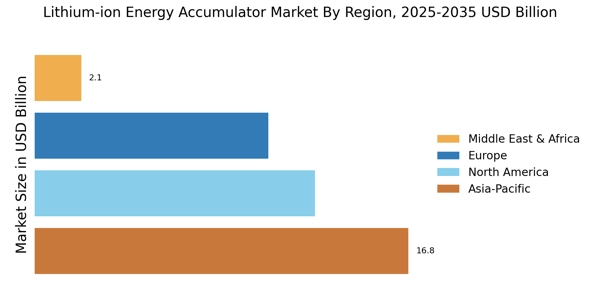
North America is witnessing a robust growth in the Lithium-ion Energy Accumulator market, driven by increasing demand for electric vehicles (EVs) and renewable energy storage solutions. The region holds approximately 30% of the global market share, making it the largest market. Regulatory support, such as tax incentives for EV purchases and investments in clean energy infrastructure, further catalyzes this growth. The United States and Canada are the leading countries in this region, with significant contributions from key players like A123 Systems and Tesla. The competitive landscape is characterized by innovation and strategic partnerships among manufacturers. Companies are focusing on enhancing battery efficiency and sustainability, positioning themselves to meet the rising demand for energy storage solutions in various sectors.

Europe : Sustainability and Innovation Focus

Europe is rapidly advancing in the Lithium-ion Energy Accumulator market, driven by stringent environmental regulations and a strong push towards sustainable energy solutions. The region accounts for approximately 25% of the global market share, making it the second-largest market. Initiatives like the European Green Deal and investments in battery recycling technologies are key regulatory catalysts that support this growth. Leading countries such as Germany, France, and the Netherlands are at the forefront of this transition, with major players like Saft and LG Energy Solution establishing manufacturing facilities. The competitive landscape is marked by collaborations between automotive and technology firms to innovate battery technologies, ensuring Europe remains a leader in the energy transition.

Asia-Pacific : Manufacturing Powerhouse

Asia-Pacific is a manufacturing powerhouse in the Lithium-ion Energy Accumulator market, driven by high demand from the electric vehicle sector and consumer electronics. The region holds around 40% of the global market share, making it the largest contributor. Government initiatives promoting electric mobility and renewable energy adoption are significant growth drivers, alongside investments in local manufacturing capabilities. China, South Korea, and Japan are the leading countries in this region, with key players like CATL, Samsung SDI, and Panasonic dominating the market. The competitive landscape is characterized by rapid technological advancements and aggressive pricing strategies, as companies strive to enhance battery performance and reduce costs, ensuring their leadership in the global market.

Middle East and Africa : Emerging Market Potential

The Middle East and Africa are emerging as potential markets for Lithium-ion Energy Accumulators, driven by increasing investments in renewable energy projects and infrastructure development. The region currently holds about 5% of the global market share, with significant growth expected in the coming years. Government initiatives aimed at diversifying energy sources and enhancing energy security are key regulatory catalysts for market expansion. Countries like South Africa and the UAE are leading the charge, with investments in solar energy and electric vehicle infrastructure. The competitive landscape is still developing, with opportunities for both local and international players to establish a foothold. As the region continues to invest in energy storage solutions, it presents a promising market for growth and innovation.

Lithium Ion Energy Accumulator Market Regional Image

Key Players and Competitive Insights

The Lithium-ion Energy Accumulator Market has become an increasingly critical sector as the demand for energy storage solutions surges due to the proliferation of electric vehicles, renewable energy sources, and portable electronic devices.

Competitive insights into this market reveal a landscape characterized by rapid technological advancements, innovative product offerings, and strategic partnerships aimed at enhancing performance, safety, and efficiency.

Players in this market are focused on research and development to reduce costs and improve energy density, cycle life, and charging speed, thereby positioning themselves favorably against their competitors.

The drive toward sustainability and reduced carbon footprints also shapes market dynamics, with companies striving to offer eco-friendly Lithium-ion solutions to appeal to environmentally-conscious consumers and regulations.

One of the company's key strengths lies in its commitment to electric vehicle development, evidenced by significant investments in producing high-capacity Lithium-ion batteries that support both range and performance.

The collaboration with various technology partners and suppliers enhances General Motors' ability to innovate and optimize battery systems. Moreover, the strong brand recognition and customer loyalty that General Motors enjoys in the automotive sector enable it to effectively market its Lithium-ion energy solutions, reinforcing its competitive position in this rapidly evolving industry.

Panasonic holds a prominent spot in the  Lithium-ion Energy Accumulator Market, primarily recognized for its advanced battery technology and substantial contributions to energy storage solutions. One of Panasonic's key strengths is its extensive research and development efforts, which have driven breakthroughs in Lithium-ion battery efficiency and safety.

The partnership with leading automotive manufacturers positions Panasonic as a critical supplier of high-performance batteries, further solidifying its standing in the market. Its commitment to sustainable practices also enhances its appeal among consumers and businesses looking for greener alternatives.

Furthermore, Panasonic's manufacturing capabilities and experience in scaling production enable it to meet diverse customer demands effectively, making it a formidable competitor in the Lithium-ion energy accumulator landscape.

Key Companies in the Lithium Ion Energy Accumulator Market market include

Future Outlook

Lithium Ion Energy Accumulator Market Future Outlook

The Lithium-ion Energy Accumulator Market is projected to grow at an 8.19% CAGR from 2024 to 2035, driven by increasing demand for electric vehicles, renewable energy storage, and technological advancements.

New opportunities lie in:

  • Development of advanced battery recycling technologies
  • Expansion into emerging markets with tailored energy solutions
  • Integration of AI for predictive maintenance in battery systems

By 2035, the market is expected to solidify its position as a leader in energy storage solutions.

Market Segmentation

Lithium Ion Energy Accumulator Market Type Outlook

  • Cylindrical
  • Prismatic
  • Polymer

Lithium Ion Energy Accumulator Market End Use Outlook

  • Residential
  • Commercial
  • Utilities

Lithium Ion Energy Accumulator Market Chemistry Outlook

  • Lithium Nickel
  • Manganese Cobalt Oxide
  • Lithium Iron Phosphate
  • Lithium Cobalt Oxide

Lithium Ion Energy Accumulator Market Application Outlook

  • Consumer Electronics
  • Electric Vehicles
  • Energy Storage Systems
  • Industrial Equipment

Report Scope

MARKET SIZE 2024 42.1(USD Billion)
MARKET SIZE 2025 45.55(USD Billion)
MARKET SIZE 2035 100.08(USD Billion)
COMPOUND ANNUAL GROWTH RATE (CAGR) 8.19% (2024 - 2035)
REPORT COVERAGE Revenue Forecast, Competitive Landscape, Growth Factors, and Trends
BASE YEAR 2024
Market Forecast Period 2025 - 2035
Historical Data 2019 - 2024
Market Forecast Units USD Billion
Key Companies Profiled Market analysis in progress
Segments Covered Market segmentation analysis in progress
Key Market Opportunities Advancements in recycling technologies enhance sustainability in the Lithium-ion Energy Accumulator Market.
Key Market Dynamics Rising demand for electric vehicles drives innovation and competition in the Lithium-ion Energy Accumulator market.
Countries Covered North America, Europe, APAC, South America, MEA

Leave a Comment

FAQs

What is the projected market valuation of the Lithium-ion Energy Accumulator Market by 2035?

The projected market valuation for the Lithium-ion Energy Accumulator Market by 2035 is 100.08 USD Billion.

What was the market valuation of the Lithium-ion Energy Accumulator Market in 2024?

The overall market valuation of the Lithium-ion Energy Accumulator Market in 2024 was 42.1 USD Billion.

What is the expected CAGR for the Lithium-ion Energy Accumulator Market from 2025 to 2035?

The expected CAGR for the Lithium-ion Energy Accumulator Market during the forecast period 2025 - 2035 is 8.19%.

Which application segment is projected to have the highest valuation in 2035?

The Electric Vehicles application segment is projected to reach a valuation of 40.0 USD Billion by 2035.

What are the key players in the Lithium-ion Energy Accumulator Market?

Key players in the Lithium-ion Energy Accumulator Market include CATL, LG Energy Solution, Panasonic, Samsung SDI, and BYD.

How does the valuation of the Energy Storage Systems segment change from 2024 to 2035?

The Energy Storage Systems segment is expected to grow from 10.0 USD Billion in 2024 to 25.0 USD Billion by 2035.

What is the projected valuation for the Utilities end-use segment by 2035?

The Utilities end-use segment is projected to reach a valuation of 45.08 USD Billion by 2035.

Which type of lithium-ion battery is expected to have the highest valuation in 2035?

The Polymer type of lithium-ion battery is expected to reach a valuation of 35.08 USD Billion by 2035.

What is the expected growth for the Lithium Iron Phosphate chemistry segment from 2024 to 2035?

The Lithium Iron Phosphate chemistry segment is expected to grow from 15.0 USD Billion in 2024 to 35.0 USD Billion by 2035.

How does the valuation of the Commercial end-use segment change from 2024 to 2035?

The Commercial end-use segment is projected to increase from 12.0 USD Billion in 2024 to 30.0 USD Billion by 2035.

Download Free Sample

Kindly complete the form below to receive a free sample of this Report

Compare Licence

×
Features License Type
Single User Multiuser License Enterprise User
Price $4,950 $5,950 $7,250
Maximum User Access Limit 1 User Upto 10 Users Unrestricted Access Throughout the Organization
Free Customization
Direct Access to Analyst
Deliverable Format
Platform Access
Discount on Next Purchase 10% 15% 15%
Printable Versions