Lithium Metal Polymer (LMP) Battery Market
Lithium Metal Polymer (LMP) Battery Market Summary
As per Market Research Future analysis, the In the Lithium Metal Polymer (LMP) Battery Market, the form factor segment showcases a diverse range of profiles. was estimated at 9.141 USD Billion in 2024. The Lithium Metal Polymer Lmp Battery industry is projected to grow from 11.35 USD Billion in 2025 to 98.47 USD Billion by 2035, exhibiting a compound annual growth rate (CAGR) of 24.12% during the forecast period 2025 - 2035
Key Market Trends & Highlights
The Lithium Metal Polymer (LMP) Battery Market is poised for substantial growth driven by technological advancements and increasing demand across various sectors.
- Technological advancements in battery design are enhancing performance and efficiency, particularly in the automotive sector.
- The sustainability focus is driving innovations in battery materials and recycling processes, appealing to environmentally conscious consumers.
- Integration of smart technologies is becoming prevalent, particularly in portable electronics, enhancing user experience and functionality.
- Rising demand for electric vehicles and government initiatives are key drivers propelling the market forward, especially in North America and the rapidly growing Asia-Pacific region.
Market Size & Forecast
| 2024 Market Size | 9.141 (USD Billion) |
| 2035 Market Size | 98.47 (USD Billion) |
| CAGR (2025 - 2035) | 24.12% |
Major Players
Samsung SDI (KR), LG Energy Solution (KR), Panasonic (JP), A123 Systems (US), Sion Power (US), Oxis Energy (GB), Amprius Technologies (US), BASF (DE), Fujitsu (JP)
Lithium Metal Polymer (LMP) Battery Market Trends
The Lithium Metal Polymer Lmp Battery Market is currently experiencing a notable evolution, driven by advancements in battery technology and increasing demand for energy storage solutions. This market appears to be influenced by the growing emphasis on renewable energy sources and electric vehicles, which necessitate efficient and high-performance batteries. Manufacturers are focusing on enhancing the energy density and safety features of LMP batteries, which may lead to broader adoption across various sectors. Furthermore, the integration of smart technologies into battery management systems is likely to optimize performance and longevity, thereby attracting more consumers and industries alike. In addition, the Lithium Metal Polymer Lmp Battery Market seems to be benefiting from a shift towards sustainable practices. As environmental concerns gain prominence, stakeholders are exploring eco-friendly materials and production methods. This trend indicates a potential for innovation in recycling processes and the development of biodegradable components. Overall, the market landscape is evolving, with a strong inclination towards sustainability and technological advancement, which could redefine energy storage solutions in the near future.
Technological Advancements
The Lithium Metal Polymer Lmp Battery Market is witnessing rapid technological advancements that enhance battery performance. Innovations in materials and design are likely to improve energy density and safety, making these batteries more appealing for various applications.
Sustainability Focus
There is a growing emphasis on sustainability within the Lithium Metal Polymer Lmp Battery Market. Stakeholders are increasingly prioritizing eco-friendly materials and production methods, which may lead to the development of more sustainable battery solutions.
Integration of Smart Technologies
The integration of smart technologies into battery management systems is becoming a prominent trend in the Lithium Metal Polymer Lmp Battery Market. This development could optimize battery performance and longevity, thereby enhancing user experience and efficiency.
Lithium Metal Polymer (LMP) Battery Market Drivers
Growing Consumer Electronics Market
The burgeoning consumer electronics market is another significant driver for the Lithium Metal Polymer Lmp Battery Market. As devices such as smartphones, tablets, and wearables become increasingly sophisticated, the demand for high-performance batteries continues to rise. In 2025, the consumer electronics sector is projected to generate substantial revenue, with estimates suggesting that battery demand could exceed 500 GWh. This trend indicates that manufacturers are likely to focus on developing Lithium Metal Polymer Lmp batteries, which offer advantages such as lightweight design and enhanced safety features. As consumer preferences shift towards more efficient and longer-lasting devices, the Lithium Metal Polymer Lmp Battery Market is poised for growth, driven by the need for innovative battery solutions.
Rising Demand for Electric Vehicles
The increasing demand for electric vehicles (EVs) is a primary driver for the Lithium Metal Polymer Lmp Battery Market. As consumers and manufacturers alike prioritize sustainable transportation solutions, the need for efficient and high-capacity batteries has surged. In 2025, the EV market is projected to grow significantly, with estimates suggesting that battery demand could reach 1,500 GWh by 2030. This growth is likely to propel the Lithium Metal Polymer Lmp Battery Market, as these batteries offer advantages such as higher energy density and improved safety compared to traditional lithium-ion batteries. Consequently, manufacturers are investing heavily in research and development to enhance battery performance, which may further stimulate market growth.
Government Initiatives and Regulations
Government initiatives and regulations aimed at promoting clean energy solutions are significantly influencing the Lithium Metal Polymer Lmp Battery Market. Many countries are implementing policies that encourage the adoption of electric vehicles and renewable energy sources, which in turn increases the demand for advanced battery technologies. For example, incentives for EV purchases and investments in charging infrastructure are expected to boost battery sales. By 2025, it is anticipated that regulatory frameworks will become more stringent, further pushing manufacturers to innovate and comply with environmental standards. This regulatory environment is likely to create a favorable landscape for the Lithium Metal Polymer Lmp Battery Market, as companies strive to meet the growing demand for sustainable energy solutions.
Technological Innovations in Battery Design
Technological innovations play a crucial role in shaping the Lithium Metal Polymer Lmp Battery Market. Recent advancements in battery chemistry and design have led to the development of batteries that are lighter, more efficient, and capable of faster charging. For instance, the introduction of solid-state technology is expected to enhance the safety and longevity of batteries, making them more appealing to consumers. As of 2025, the market is witnessing a shift towards these advanced battery technologies, with projections indicating that the market for solid-state batteries could reach USD 10 billion by 2030. This trend suggests that ongoing innovations will likely drive the adoption of Lithium Metal Polymer Lmp batteries in various applications, including consumer electronics and renewable energy storage.
Expansion of Renewable Energy Storage Solutions
The expansion of renewable energy storage solutions is a pivotal driver for the Lithium Metal Polymer Lmp Battery Market. As the world increasingly shifts towards renewable energy sources, the need for efficient energy storage systems becomes paramount. Lithium Metal Polymer Lmp batteries are well-suited for this application due to their high energy density and long cycle life. In 2025, the market for energy storage systems is expected to grow significantly, with projections indicating a potential market size of USD 20 billion by 2030. This growth is likely to be fueled by the integration of renewable energy sources such as solar and wind, which require reliable storage solutions. Consequently, the Lithium Metal Polymer Lmp Battery Market stands to benefit from this trend, as demand for advanced battery technologies continues to rise.
Market Segment Insights
By Power Application: Portable Electronics (Largest) vs. Automotive (Fastest-Growing)
The The Lithium Metal Polymer (LMP) Battery Market is experiencing diverse applications across various power segments. is experiencing diverse applications across various power segments, with Portable Electronics taking the lead in market share. This segment includes a wide range of devices, encompassing smartphones, laptops, and other consumer electronics. Following this, the Automotive sector is gaining significant traction as electric vehicles become more prevalent, contributing to an expanding market share.
Portable Electronics (Dominant) vs. Automotive (Emerging)
The Portable Electronics segment is characterized by its established market presence, delivering high energy density and lightweight solutions essential for modern devices. This segment caters to a rapidly growing consumer demand for efficient and compact power sources. In contrast, the Automotive segment, marked as emerging, is propelled by the global shift towards electric vehicles and sustainable transport solutions. The rising adoption of lithium metal polymer batteries in cars highlights their potential for efficient energy management and longer life cycles, establishing a robust competition against traditional battery technologies.
By Capacity: Medium Capacity (Largest) vs. High Capacity (Fastest-Growing)
The The Lithium Metal Polymer LMP Battery Market has seen a distinct distribution among capacity segments. has seen a distinct distribution among capacity segments. The medium capacity segment, which ranges from 2000 to 5000mAh, holds the largest share in the market due to its widespread application in consumer electronics. Meanwhile, the low capacity segment, at 2000mAh, caters to niche markets, while the high capacity segment, exceeding 5000mAh, is gaining traction in electric vehicles and renewable energy, indicating a shift towards higher energy demands.
Medium Capacity (Dominant) vs. High Capacity (Emerging)
The medium capacity segment is characterized by its versatility and cost-effectiveness, making it the preferred choice for various applications, particularly in portable electronics. This segment supports a well-established supply chain and benefits from economies of scale, enhancing its market dominance. Conversely, the high capacity segment, which is emerging rapidly, focuses on powering electric vehicles and large-scale energy storage systems. Its growth is driven by advancements in technology and increasing demand for sustainable and efficient energy solutions, positioning it as a key player in the future of energy storage.
By Discharge Rate: Medium Discharge Rate (1C-5C) vs. High Discharge Rate (>5C)
The The Lithium Metal Polymer LMP Battery Market showcases diverse segments based on discharge rates. showcases diverse segments based on discharge rates, with a notable distribution among Low, Medium, and High Discharge Rate categories. The Medium Discharge Rate segment accounts for a significant share, appealing to a broad range of applications including consumer electronics and electric vehicles. Meanwhile, the High Discharge Rate segment captures the attention of industries requiring rapid energy delivery, positioning itself as a crucial player in the market. In contrast, the Low Discharge Rate segment, while stable, exhibits less growth potential compared to its counterparts.
Medium Discharge Rate (Dominant) vs. High Discharge Rate (Emerging)
The Medium Discharge Rate segment (1C-5C) holds a dominant position in the Lithium Metal Polymer Lmp Battery Market, primarily due to its versatile application across various industries, including consumer electronics and electric vehicles. This segment offers a balance between energy efficiency and power delivery, making it a preferred choice for manufacturers. Conversely, the High Discharge Rate segment (>5C), although emerging, is gaining traction in applications requiring substantial power bursts, such as in power tools and motorsports. Its rapid energy release capabilities make it attractive to specific sectors, but it is currently overshadowed by the broader appeal and established market presence of the Medium Discharge Rate batteries.
By Voltage Range: Low Voltage (Largest) vs. High Voltage (Fastest-Growing)
In the In the Lithium Metal Polymer LMP Battery Market, the voltage range segments illustrate diverse distribution values., the voltage range segments illustrate diverse distribution values. Low Voltage batteries (3.7V) hold the largest share, appealing to applications in consumer electronics and small devices where efficiency is crucial. In contrast, High Voltage batteries (>7.4V) are rapidly gaining traction, primarily driven by the increasing demand in electric vehicles and energy storage solutions, marking a clear shift towards higher capacity applications.
Low Voltage (Dominant) vs. High Voltage (Emerging)
Low Voltage Lithium Metal Polymer batteries are dominant in the market due to their established presence in portable consumer applications like smartphones and tablets, where power density and compact design are essential. These batteries offer reliability and efficiency, catering to everyday electronics. On the other hand, High Voltage batteries are emerging as a significant segment, positioned for rapid growth due to advancements in electric vehicle technology and renewable energy storage systems. Their capacity for handling increased energy loads makes them preferable for industrial applications, thus indicating a promising future as sectors shift towards higher utilization rates.
By Form Factor: Cylindrical (Largest) vs. Prismatic (Fastest-Growing)
In the Lithium Metal Polymer (LMP) Battery Market, the form factor segment showcases a diverse range of profiles, with cylindrical batteries holding the largest market share. This form factor is preferred for its robustness and compatibility with various applications, serving sectors like consumer electronics and electric vehicles effectively. On the other hand, prismatic batteries are gaining traction, appealing to manufacturers for their space-saving design and higher energy density, which allows for increased performance in compact devices.
Cylindrical (Dominant) vs. Pouch (Emerging)
Cylindrical batteries dominate the LMP battery market due to their structural integrity and efficiency. These batteries are designed for high energy and power output while facilitating thermal management. In contrast, pouch batteries represent an emerging segment, capturing attention for their lightweight and flexible design, which enables them to fit into various configurations. The increasing demand for portable solutions in consumer electronics, coupled with advancements in manufacturing processes, is propelling pouch batteries into a competitive position within the market.
Regional Insights
North America : Innovation and Demand Surge
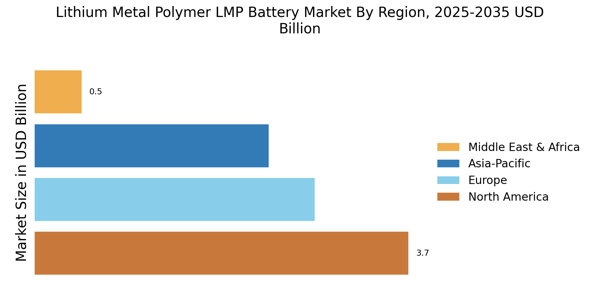
North America is witnessing significant growth in the Lithium Metal Polymer (LMP) battery market, driven by increasing demand for electric vehicles (EVs) and renewable energy storage solutions. The region holds approximately 40% of the global market share, making it the largest market for LMP batteries. Regulatory support, such as tax incentives for EV purchases and investments in clean energy, further catalyzes this growth. The United States is the leading country in this region, with major players like A123 Systems and Sion Power driving innovation. The competitive landscape is characterized by a focus on research and development, with companies investing heavily in advanced battery technologies. The presence of established manufacturers like Panasonic and emerging firms enhances the market's dynamism, positioning North America as a hub for LMP battery advancements.
Europe : Sustainability and Innovation Focus
Europe is rapidly evolving as a key player in the Lithium Metal Polymer (LMP) battery market, driven by stringent environmental regulations and a strong push for sustainable energy solutions. The region accounts for approximately 30% of the global market share, making it the second-largest market. Initiatives like the European Green Deal and investments in battery recycling technologies are pivotal in shaping the market landscape. Germany and France are at the forefront of this growth, with companies like BASF and Samsung SDI leading the charge in innovation. The competitive environment is marked by collaborations between automotive manufacturers and battery producers, aiming to enhance energy density and reduce costs. The presence of robust research institutions further supports the development of next-generation LMP batteries, ensuring Europe's competitive edge in the global market.
Asia-Pacific : Manufacturing Powerhouse
Asia-Pacific is a manufacturing powerhouse for Lithium Metal Polymer (LMP) batteries, driven by the increasing demand for consumer electronics and electric vehicles. The region holds around 25% of the global market share, with countries like China and Japan leading in production capabilities. Government initiatives promoting electric mobility and renewable energy adoption are significant growth drivers in this market. China is the largest market in the region, with major players like LG Energy Solution and Panasonic heavily investing in LMP technology. The competitive landscape is characterized by rapid technological advancements and a focus on cost reduction. Collaborations between local manufacturers and international firms are common, enhancing the region's position as a global leader in battery technology and production.
Middle East and Africa : Emerging Market Potential
The Middle East and Africa are emerging markets for Lithium Metal Polymer (LMP) batteries, driven by increasing investments in renewable energy and electric mobility. The region currently holds about 5% of the global market share, with significant growth potential as governments focus on diversifying their energy sources and reducing carbon emissions. Initiatives to promote electric vehicles are also gaining traction, supported by regulatory frameworks aimed at sustainability. Countries like South Africa and the UAE are leading the charge in adopting LMP technology, with local firms exploring partnerships with international battery manufacturers. The competitive landscape is still developing, but the presence of key players and government support is expected to drive innovation and market growth in the coming years. The region's unique energy landscape presents opportunities for tailored LMP solutions.
Key Players and Competitive Insights
Key Companies in the Lithium Metal Polymer (LMP) Battery Market include
Industry Developments
The Lithium Metal Polymer (LMP) Battery market is projected to witness substantial growth over the forecast period, driven by increasing demand for electric vehicles and consumer electronics. In 2023, the market was valued at USD 5.93 billion and is expected to reach USD 41.5 billion by 2032, exhibiting a CAGR of 24.12%. Key factors contributing to this growth include government initiatives promoting electric vehicle adoption, technological advancements in battery performance, and rising consumer preference for sustainable energy solutions.
Recent news developments in the market include strategic partnerships between major players, such as Samsung SDI and Hyundai Motor Group, to develop and produce LMP batteries for electric vehicles. Additionally, research and development efforts are focused on enhancing battery efficiency, safety, and lifespan, which is expected to further drive market growth in the coming years.
Future Outlook
Lithium Metal Polymer (LMP) Battery Market Future Outlook
The Lithium Metal Polymer LMP Battery Market is projected to grow at a 24.12% CAGR from 2025 to 2035, driven by advancements in energy density, safety, and sustainability.
New opportunities lie in:
- Development of high-capacity LMP batteries for electric vehicles
- Integration of LMP technology in renewable energy storage solutions
- Establishment of recycling programs for LMP battery materials
By 2035, the market is expected to achieve substantial growth, positioning itself as a leader in energy storage solutions.
Market Segmentation
Lithium Metal Polymer Battery Market Capacity Outlook
- Low Capacity (2000mAh)
- Medium Capacity (2000-5000mAh)
- High Capacity (>5000mAh)
Lithium Metal Polymer Battery Market Form Factor Outlook
- Cylindrical
- Prismatic
- Pouch
- Button
Lithium Metal Polymer Battery Market Voltage Range Outlook
- Low Voltage (3.7V)
- Medium Voltage (3.7-7.4V)
- High Voltage (>7.4V)
Lithium Metal Polymer Battery Market Discharge Rate Outlook
- Low Discharge Rate (1C)
- Medium Discharge Rate (1C-5C)
- High Discharge Rate (>5C)
Lithium Metal Polymer Battery Market Power Application Outlook
- Portable Electronics
- Automotive
- Industrial
- Medical
- Energy Storage
Report Scope
| MARKET SIZE 2024 | 9.141(USD Billion) |
| MARKET SIZE 2025 | 11.35(USD Billion) |
| MARKET SIZE 2035 | 98.47(USD Billion) |
| COMPOUND ANNUAL GROWTH RATE (CAGR) | 24.12% (2025 - 2035) |
| REPORT COVERAGE | Revenue Forecast, Competitive Landscape, Growth Factors, and Trends |
| BASE YEAR | 2024 |
| Market Forecast Period | 2025 - 2035 |
| Historical Data | 2019 - 2024 |
| Market Forecast Units | USD Billion |
| Key Companies Profiled | Samsung SDI (KR), LG Energy Solution (KR), Panasonic (JP), A123 Systems (US), Sion Power (US), Oxis Energy (GB), Amprius Technologies (US), BASF (DE), Fujitsu (JP) |
| Segments Covered | Power Application, Capacity, Discharge Rate, Voltage Range, Form Factor, Regional |
| Key Market Opportunities | Advancements in energy density and safety features drive growth in the Lithium Metal Polymer Lmp Battery Market. |
| Key Market Dynamics | Technological advancements and regulatory shifts drive the adoption of Lithium Metal Polymer batteries in various applications. |
| Countries Covered | North America, Europe, APAC, South America, MEA |
FAQs
What is the projected market valuation of the Lithium Metal Polymer LMP Battery Market by 2035?
The market is projected to reach a valuation of 98.47 USD Billion by 2035.
What was the overall market valuation of the Lithium Metal Polymer LMP Battery Market in 2024?
In 2024, the overall market valuation was 9.141 USD Billion.
What is the expected CAGR for the Lithium Metal Polymer LMP Battery Market during the forecast period 2025 - 2035?
The expected CAGR for the market during the forecast period is 24.12%.
Which companies are considered key players in the Lithium Metal Polymer LMP Battery Market?
Key players include Samsung SDI, LG Energy Solution, Panasonic, A123 Systems, and Sion Power.
What segment had the highest projected valuation in the Power Application category for 2035?
The Energy Storage segment is projected to reach 38.47 USD Billion by 2035.
How does the market for High Capacity Lithium Metal Polymer batteries compare to other capacity segments?
The High Capacity (>5000mAh) segment is projected to reach 48.47 USD Billion by 2035, indicating strong growth.
What is the projected valuation for the Automotive segment of the Lithium Metal Polymer LMP Battery Market by 2035?
The Automotive segment is expected to reach a valuation of 30.0 USD Billion by 2035.
What is the anticipated market performance for the Medium Discharge Rate segment by 2035?
The Medium Discharge Rate (1C-5C) segment is projected to reach 35.0 USD Billion by 2035.
Which form factor is expected to show significant growth in the Lithium Metal Polymer LMP Battery Market?
The Prismatic form factor is projected to reach 30.0 USD Billion by 2035, indicating notable growth.
What is the expected valuation for the Low Voltage segment by 2035?
The Low Voltage (3.7V) segment is projected to reach 25.0 USD Billion by 2035.
Kindly complete the form below to receive a free sample of this Report
Customer Stories
“This is really good guys. Excellent work on a tight deadline. I will continue to use you going forward and recommend you to others. Nice job”
“Thanks. It’s been a pleasure working with you, please use me as reference with any other Intel employees.”
“Thanks for sending the report it gives us a good global view of the Betaïne market.”
“Thank you, this will be very helpful for OQS.”
“We found the report very insightful! we found your research firm very helpful. I'm sending this email to secure our future business.”
“I am very pleased with how market segments have been defined in a relevant way for my purposes (such as "Portable Freezers & refrigerators" and "last-mile"). In general the report is well structured. Thanks very much for your efforts.”
“I have been reading the first document or the study, ,the Global HVAC and FP market report 2021 till 2026. Must say, good info! I have not gone in depth at all parts, but got a good indication of the data inside!”
“We got the report in time, we really thank you for your support in this process. I also thank to all of your team as they did a great job.”